by COWBERRY

10 minute read
Green tea: names, nutrition, benefits and how to brew it

Green tea is the minimally processed leaf of the tea plant Camellia sinensis, brewed into a pale cup. This hub gathers what the references actually print: the names, the pack-panel nutrition, the honest benefits and side effects, the brew ratios, and every page in the green tea cluster.
What green tea is: the plant, the name and the colour
All true teas come from one plant, Camellia sinensis. In the 2020 Cochrane review of green tea and cancer, the teas of this plant are described as grouping into green, black and oolong. After picking, green tea leaves are minimally processed, which keeps their natural green colour and their delicate, clean character, whereas black tea leaves oxidise fully and darken; the difference between the two is made in the processing, not in the field.
On names, the table below carries the three that can be verified: green tea (English), chai (Hindi) and cha (Bengali); of these, chai and cha simply mean tea. The official food tables print no Hindi, Kannada, Tamil, Marathi or other regional names for green tea, so none are guessed here; the full breakdown, with the botanical name and the often-confused teas, is on the page about green tea in Hindi. How the fresh leaf becomes the green tea in your pack, step by step from the garden onward, is walked through on how green tea is made.
| Language | Name (romanised) |
|---|---|
| English | Green tea |
| Hindi | Chai |
| Marathi | — |
| Gujarati | — |
| Punjabi | — |
| Bengali | Cha |
| Odia | — |
| Assamese | — |
| Kannada | — |
| Telugu | — |
| Tamil | — |
| Malayalam | — |
| Urdu | — |
| Sanskrit | — |
| Botanical name | — |
Source: no source found. — means no name recorded in the source.
English ‘Green tea’: Green tea - Wikipedia. Hindi ‘Chai’: Chai - Wikipedia. Bengali ‘Cha’: Chai - Wikipedia.
Green tea nutrition: the printed numbers and the blanks
Neither the 2017 Indian Food Composition Tables nor USDA FoodData Central has an entry for dry green tea leaf, so this hub shows the leaf's figures in words rather than a table. The numbers that do exist are the ones COWBERRY's pack panel must carry, per 100 g of dry leaf: 362.8 kcal of energy, 69.46 g of carbohydrates, 21.24 g of protein, 17.89 g of fibre, 63.445 mg of sodium, 1744.223 mg of potassium, 468.627 mg of calcium, 18.811 mg of iron and 7.08 mg of vitamin C, with no fat figure printed.
The brewed cup is a different story, and the only per-cup figure the guidelines print is caffeine: 30 to 65 mg in a 150 ml cup, with a tolerable daily limit of 300 mg and moderation asked for. For a plain cup, no official table or guideline prints a calorie figure; the energy that can actually be counted is what you stir in: sugar by the teaspoon (5 g) adds roughly 19 kcal, honey by the teaspoon (7 g) about 21 kcal. The full arithmetic, including why there is no glycemic index number, is on the green tea calories per 100g page. On the glycemic index itself, Sydney's GI database carries no green tea entry at all, and a GI value belongs to carbohydrate foods tested for their blood-glucose response; the sweetener you stir in is what carries the cup's carbohydrate, so green tea has no GI to be high or low.
Green tea benefits and side effects, honestly stated
What the leaf provably carries, per the ICMR-NIN dietary guidelines, is caffeine alongside theobromine, theophylline, and flavonoids and other polyphenols, which may reduce the risk of coronary heart disease and stomach cancer; the same guidelines say these come through best without milk and in moderation. What large studies add is an association, not a promise: a 2024 meta-analysis of 38 prospective cohort data sets put all-cause mortality at a pooled estimate of 0.90 and cardiovascular mortality at 0.86 when the heaviest tea drinkers were compared with the lightest, with the greatest all-cause reduction around two cups a day.
What the trials do not show gets the same space here. The Cochrane review on weight found a small, statistically non-significant loss, which the green tea for weight loss page walks through figure by figure, and the Cochrane review on cancer calls the evidence limited and inconsistent, with most of its studies done among Asian populations, heavy tea drinkers in particular. The side-effect cautions sit mostly with extracts and timing, not the cup. Liver concerns were seen only with concentrated preparations rich in catechins, swallowed as large bolus doses, never with brewed tea, and the safety review behind that finding derived its safe intakes for preparations, not cups: 338 mg of EGCG a day as a solid bolus dose and 704 mg a day in beverage form. The extract trials in the Cochrane review reported their own list, stomach upsets, elevated liver enzymes, with insomnia, higher blood pressure and skin reactions turning up in fewer cases, again recorded for extract intake rather than for drinking tea. For the cup itself, the cautions are two: iron and caffeine. In a 2017 trial of twelve healthy women, tea with a meal cut fractional iron absorption from 5.7% to 3.6%, and tea kept until an hour after the meal brought it back to 5.7%, cutting the tea's effect by about half; on caffeine, at 30 to 65 mg a cup, the guidelines ask for moderation within 300 mg a day, and the NHS advises no more than 200 mg in pregnancy, at about 75 mg per cup. Both halves of the picture are on green tea benefits, in English, and on green tea ke fayde, in Hindi. The concentrated-preparation warnings belong to green tea extract.
Brewing green tea: the exact ratios and the daily amount
The pack's brewing note is the whole recipe: steep one teaspoon of leaves in water around 80 to 85 °C for 2 to 3 minutes, and keep boiling water away from the leaf, as it may make the cup bitter. The guidelines print a caffeine limit rather than a cup count, 300 mg a day, which, at 30 to 65 mg per 150 ml cup, arrives at roughly 4.6 cups on the high end of that range and 10 cups on the low end, so two or three cups a day sits comfortably inside it.
Two habits matter more than the count. Keep the cup at least one hour away from meals, because the tannin in tea interferes with iron absorption; and drink it plain, because the guidelines say tea's benefits come through best without milk. The pack names boiling water as what may make the cup bitter, so the water temperature and steeping time above are worth keeping to. Strain the leaf out when the time is up; the pack prints no rule for stretching the same leaves further. The step-by-step method, with water temperature and steeping time, is on how to make green tea, and the daily timings, common mistakes and how much to drink sit on how to use green tea.
Green tea next to coffee, tea bags, matcha and black tea
Against coffee, the difference is caffeine: a 150 ml cup of brewed tea prints 30 to 65 mg, while brewed coffee prints 80 to 120 mg and instant coffee 50 to 65 mg in the same volume, which is why a tea cup is the lighter lift. The full cup-for-cup comparison is on green tea vs black coffee.
Against tea bags, the difference is the leaf. Loose green tea keeps the leaf whole, while a bagged tea is usually cut small, and matcha is green tea milled to a powder and whisked into the cup instead of steeped, so it is green tea in another form, not a different plant. Black tea and oolong are the same Camellia sinensis leaf processed differently, while tulsi, chamomile and peppermint are infusions of entirely different plants, carrying no tea leaf at all. These distinctions are laid out on green tea leaves vs tea bags.
Eating, cooking and storing green tea leaves
The leaf can go beyond the cup. Eaten whole, it is a dense food: the pack panel prints 21.24 g of protein and 17.89 g of fibre per 100 g of dry leaf, along with its minerals, which is why powdered leaves kneaded into dough or stirred through porridge carry real nutrition; what that means in practice is on whether you can eat green tea leaves.
In the kitchen, the cluster's recipe page has the same leaf in roti, porridge, oatmeal and iced tea, all of which are on green tea recipes. And because the dry leaf fades with time, storage matters: a sealed container kept cool and dry, away from direct sunlight and strong smells, keeps the leaf fresh; the full storage routine is on how to store green tea.
Buying green tea: the COWBERRY pack and its certificates
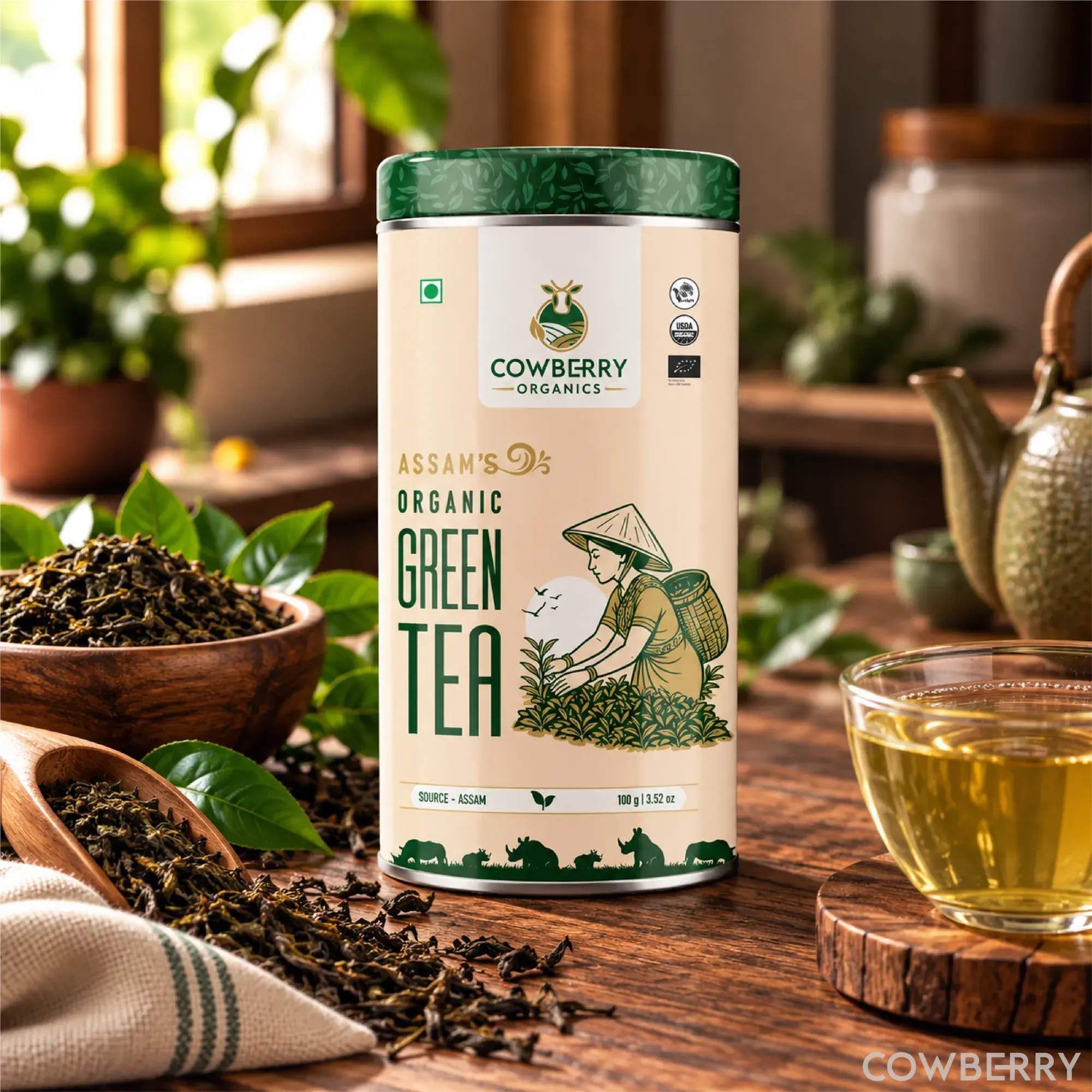
COWBERRY's Organic Green Tea is whole young leaves from Assam's organic gardens, minimally processed, with no artificial flavours or additives, which is the profile this hub's brew and recipe pages assume. When a green tea organic claim is printed on a pack, the certificate line is what backs it: this pack reads India Organic, USDA & EU certified, and the green tea leaves organic assurance comes from those certificates rather than from the label alone. The cup the pack describes is light and soothing, with gentle caffeine and pure flavour from the leaf itself, and the panel lists no artificial flavours, colours or preservatives, so what you buy is leaf and nothing else.
The leaf behind those certificates is the one described across this hub, from its names and nutrition to its brew. Start with the page that matches your question; the cluster pages are linked through the sections above.
FAQs
What is green tea?
Green tea is tea from Camellia sinensis leaves that are minimally processed after picking, which is what keeps the leaf green. The 2020 Cochrane review of green tea and cancer describes the teas of this plant as grouping into green, black and oolong, so green tea is one member of that family, known for its delicate, clean cup.
What is green tea leaves?
The green tea plant's leaf, dried and sold whole and loose; in tea bags the leaf is usually cut small. Per 100 g of dry leaf, COWBERRY's pack panel prints 21.24 g of protein and 17.89 g of fibre, with its minerals listed on the same panel. In the cup, only a small share of the leaf's contents is released; the leaf itself stays behind in the strainer.
Why is green tea called green tea?
The name comes from the leaf's colour, which the minimal processing preserves. Unlike black tea, which is oxidised until dark, green tea leaves are handled minimally after picking, so the green stays in the leaf and in the name; no colouring or flavouring is added to make it so.
Why green tea is green in colour?
The colour comes from the minimal processing. The fresh leaf is dried with minimal handling, which preserves its natural green colour; black tea, by contrast, is oxidised fully, which turns it dark. Nothing is added to make the leaf green, and the pale cup it brews is the same colour, diluted in water.
Does green tea have caffeine?
Yes, naturally. Per the ICMR-NIN dietary guidelines, the brewed 150 ml cup holds 30 to 65 mg of caffeine, set against 80 to 120 mg for brewed coffee, with moderation asked for inside a tolerable limit of 300 mg of caffeine a day. That is a gentle dose, not a coffee-sized one.
Is green tea good for health?
What is sourced is modest: caffeine, theobromine, theophylline and polyphenols in the cup, per the ICMR-NIN guidelines, plus lower mortality associated with tea drinking in large observational studies. The trial evidence on weight loss and cancer is small or limited, so the honest answer stops there.
References
- Indian Food Composition Tables (IFCT) 2017, ICMR-National Institute of Nutrition
- USDA FoodData Central
- Dietary Guidelines for Indians, ICMR-National Institute of Nutrition
- Kim Y, Je Y. Tea consumption and risk of all-cause, cardiovascular disease, and cancer mortality: a meta-analysis of thirty-eight prospective cohort data sets. Epidemiol Health, 2024
- Jurgens TM, Whelan AM, Killian L et al. Green tea for weight loss and weight maintenance in overweight or obese adults. Cochrane Database Syst Rev, 2012
- Filippini T, Malavolti M, Borrelli F et al. Green tea (Camellia sinensis) for the prevention of cancer. Cochrane Database Syst Rev, 2020
- Hu J, Webster D, Cao J et al. The safety of green tea and green tea extract consumption in adults - Results of a systematic review. Regul Toxicol Pharmacol, 2018
- Ahmad Fuzi SF, Koller D, Bruggraber S et al. A 1-h time interval between a meal containing iron and consumption of tea attenuates the inhibitory effects on iron absorption. Am J Clin Nutr, 2017
- NHS: foods to avoid in pregnancy (caffeine section)
Shop this article
Keep reading
Coffee vs tea: caffeine, benefits and which is better
Coffee calories per 100g: powder, beans and filter coffee

Coffee in pregnancy: how much caffeine is safe