by COWBERRY

8 minute read
Green tea recipes: roti, porridge, oatmeal and iced tea

Green tea recipes work when the leaf is used as a light seasoning, not a main ingredient: one teaspoon of leaf seasons a batch of rotis or a bowl of porridge, and the leaf is kept out of boiling liquid. The dishes that suit an Indian kitchen are roti and chapati, porridge and oatmeal, and iced green tea, each with a measured method below.
Green tea recipes, Indian style: the base rules
Use green tea in the kitchen the way ajwain or jeera goes into a dough: a seasoning measured in teaspoons, never a flour. Powdered leaves knead into atta, while steeped whole leaves give the pale green liquid for porridge, oatmeal and iced tea. Three rules keep the flavour pleasant. First, keep the leaf out of boiling liquid, since boiling water may make the tea taste bitter. Second, measure small: one teaspoon of powder is a batch, not a cup. Third, cook only with leaves that smell fresh; how to keep them that way is on how to store green tea. A kitchen scale is not needed; the teaspoon does the measuring. The leaf itself, its names and its benefits sit on the green tea hub.
Green tea roti and chapati
Green tea roti. Powder the leaves first, then knead one cup (120 g) of whole wheat flour with one teaspoon of powdered leaves, a pinch of salt and warm water. Rest the dough for ten minutes, then roll it thin, dusting the ball with a little dry flour so the pale dough does not stick, and roast it on a hot tawa, turning it twice, until brown specks appear on both sides. The rotis usually carry a pale green tint and a mild flavour. Serve them hot with dal, sabzi or a bowl of curd.
Green tea chapati. The chapati version keeps the same teaspoon-to-cup ratio and adds a teaspoon of oil to the dough, which makes the bread softer and easier to roll; cook it the same way, with or without a light brush of ghee at the end. Do not go above a teaspoon of leaves per cup of flour: the tea is there to season the bread, and a heavy hand may make it bitter.
Green tea porridge and oatmeal
Both porridge and oatmeal start from steeped tea rather than powder. Heat a cup of milk, or half milk and half water, without letting it boil, add one teaspoon of leaves, take the pan off the heat and let the leaves sit for 2 to 3 minutes, then strain and press them against the strainer. Cook half a cup of oats in this pale green milk over a low flame until soft and creamy, then sweeten with a little jaggery or honey if you like.
Green tea rice porridge uses the same steeped milk with half a cup of cooked, mashed rice simmered in it until thick; it is a gentle breakfast that uses up leftover rice. Oats and rice both take the tea quietly, so the bowl should taste milky first, with the tea showing as a light green tint. Keep the leaves out of the cooking pot and strain them before the grain goes in. If it is the milky classic you want instead, that is a different drink, the chai patti recipe.
Green tea iced tea
Iced green tea is the easiest recipe on this page. Steep one teaspoon of leaves in a cup of hot water at 80 to 85 °C for 2 to 3 minutes, strain, and let the tea cool before it goes over ice; pouring it over ice while it is hot waters it down fast. For a jug, steep four teaspoons of leaves in four cups of water at the same temperature and chill the strained tea. Serve each glass with a wedge of lemon or a few mint leaves, and sweeten the glass rather than the jug, since tastes differ from person to person. Make the jug the day before, and the fridge does the chilling; keep it covered, and drink it within a day or two.
A cold steep works too: cover the leaves with cooled boiled water in a jug and leave it in the fridge until the water turns pale green, then strain. It takes longer than the hot method but should be less likely to turn bitter, because the water was never hot.
How to powder the leaves, and two things to remember
Powdering. Dry leaves grind in seconds: pulse two to three teaspoons in a dry mixer jar, shaking the jar between pulses, until the leaves are a fine powder, then press the powder through a fine sieve and re-grind what stays behind. A teaspoon of powder seasons a whole batch, so a little goes a long way; keep the rest sealed and use it soon.
Caffeine. Green tea contains caffeine, and the NHS estimates 75 mg of caffeine in a cup of tea, black or green; in pregnancy its advice is no more than 200 mg of caffeine a day in total, counting tea, coffee and chocolate together. Iron. In a 2017 trial in twelve healthy women, tea drunk with a meal containing iron reduced the iron absorbed from that meal, and waiting about an hour after the meal before drinking the tea cut the effect by about half. So wait about an hour after an iron-rich meal before a cup of green tea. The hot cup itself, with its water temperature and ratio, is on how to make green tea, and how much to drink in a day sits on how to use green tea.
Buying and keeping the leaf
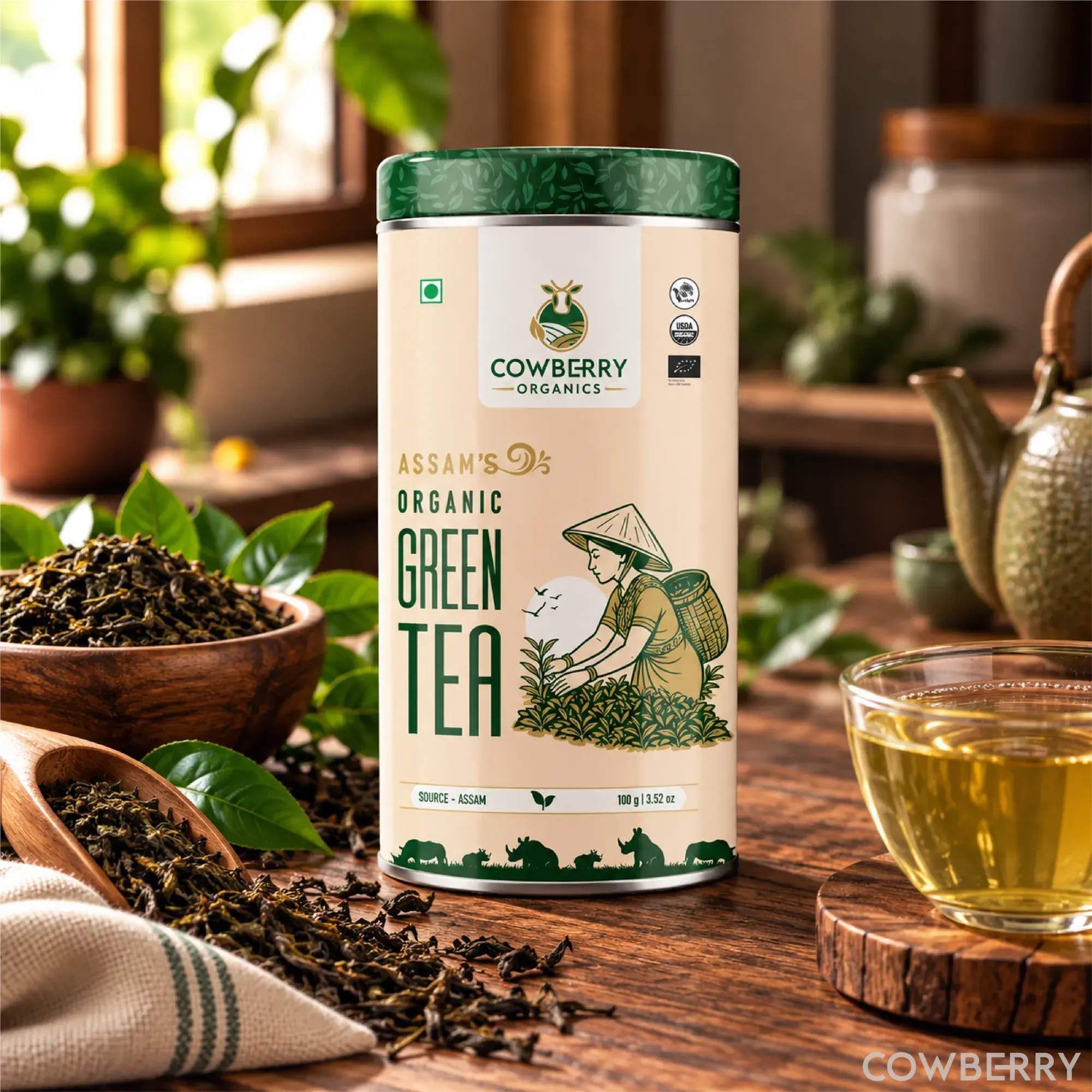
Every recipe on this page starts from loose leaf rather than tea bags, because the methods measure the leaf by the teaspoon and want the whole leaf: COWBERRY's green tea, for instance, is made from whole young leaves. Buy a small pack you will finish within a few months, and keep it sealed, cool, dark and dry, away from direct sunlight, moisture and strong odours, which is the rule the storage page sets out. How plucking, heating and drying turn the leaf green is the story on how green tea is made, and the leaf-versus-bag choice is compared on green tea leaves vs tea bags.
Organic Green Tea from COWBERRY is whole young leaves from organic gardens in Assam, minimally processed and free of artificial flavours and additives, packed in 100 g and 500 g sizes; it is India Organic, USDA & EU certified. If you would rather eat the leaf whole than powder it, green tea leaves are safe to eat, and that page shows how.
FAQs
How to make green tea leaves into powder?
Dry whole leaves are all you need. Pulse two to three teaspoons in a small spice grinder or a dry mixer jar, a few seconds at a time, shaking the jar between pulses, then press the powder through a fine sieve and re-grind what stays behind. One teaspoon of powder is enough for a whole batch, so grind small amounts at a time. Keep the powder sealed, away from light and moisture, and use it soon.
Does green tea have caffeine?
Yes. Green tea carries caffeine naturally, and the NHS estimates 75 mg of caffeine in a cup of tea, black or green, against 100 mg in a cup of instant coffee. In pregnancy the NHS advises no more than 200 mg of caffeine a day in total. A roti or porridge made with the leaf may carry some caffeine too.
Does green tea leaves expire?
Green tea leaves do not go bad the way milk does, but they do fade: the cup from an old or badly stored pack usually turns flat and dull. Kept sealed, cool, dark and dry, away from direct sunlight, moisture and strong odours, a pack stays bright for many months. Cook only with leaves that still smell fresh; a flat-smelling pack adds nothing to a roti or a bowl of porridge.
Which green tea is best for weight loss?
None has been shown to be. A 2012 Cochrane review pooled trials in overweight and obese adults: the six studies conducted outside Japan showed a mean weight difference of minus 0.04 kg in favour of green tea preparations, which is statistically non-significant; the eight Japanese studies were too different to pool. Choose a leaf for taste, and work on the plate if weight is the goal; for a plan that fits you, talk to your doctor or dietitian.
What is green tea leaves?
Green tea leaves are the young leaves of the tea plant, Camellia sinensis, dried with only light processing so they keep their green colour. In a Cochrane review, tea from this plant falls into three types: green, black and oolong. Black tea is the same plant fully oxidised, which gives a darker cup. In these recipes the leaf appears as a powder or a steeped liquid, never as a piece to chew.
Is green tea good for health?
It can be part of a healthy diet, and the big studies show associations, not promises. A 2024 meta-analysis of 38 prospective cohort data sets found the heaviest tea drinkers had about 10 percent lower risk of death from any cause and 14 percent lower risk of death from cardiovascular disease than the lightest drinkers, with the greatest all-cause reduction at about two cups a day. The review covers tea of all kinds and shows association, not causation.
References
- Kim Y, Je Y. Tea consumption and risk of all-cause, cardiovascular disease, and cancer mortality: a meta-analysis of thirty-eight prospective cohort data sets. Epidemiol Health, 2024
- Ahmad Fuzi SF, Koller D, Bruggraber S et al. A 1-h time interval between a meal containing iron and consumption of tea attenuates the inhibitory effects on iron absorption. Am J Clin Nutr, 2017
- Jurgens TM, Whelan AM, Killian L et al. Green tea for weight loss and weight maintenance in overweight or obese adults. Cochrane Database Syst Rev, 2012
- Filippini T, Malavolti M, Borrelli F et al. Green tea (Camellia sinensis) for the prevention of cancer. Cochrane Database Syst Rev, 2020
- NHS: foods to avoid in pregnancy (caffeine section)
Shop this article
Keep reading
Coffee vs tea: caffeine, benefits and which is better
Coffee calories per 100g: powder, beans and filter coffee
Coffee in pregnancy: how much caffeine is safe