by COWBERRY

8 minute read
What is green tea extract? Safety and how it differs from brewed tea

What is green tea extract? It is the concentrated, catechin-rich form of green tea, taken as a pill rather than drunk from a cup. A 2018 safety review found that liver-related adverse events in the literature attach to large bolus doses of concentrated preparations, not to brewed tea. Here is what that means for anyone weighing the capsules against the cup.
What is green tea extract?
Green tea extract is what you get when the compounds of the leaf, above all the catechins, are concentrated into a small dose: a pill, powder or drink ingredient that concentrates what a cup carries. The evidence for what that concentration does comes from a 2018 systematic review of toxicology studies and 159 human intervention studies. Its toxicology review pointed to the liver as the main organ at risk, with hepatotoxicity the critical effect, and the effect grew with total catechin and EGCG content. On the human side, only a small set of concentrated preparations rich in catechins produced liver-related adverse events, in a dose-dependent way, and only when they were swallowed as one large bolus. From the same data the review calculated a safe intake of 338 mg of EGCG daily for doses taken as a solid bolus, and an observed safe level of 704 mg of EGCG daily for the beverage form. Put simply, extract is a dose question: the same catechins that sit in a cup, concentrated into a single serving.
Green tea extract vs brewed green tea: the dose is the difference
The dividing line in the safety review is not the plant but the dose and the form. Liver-related adverse events appeared with concentrated, catechin-rich preparations taken in large bolus doses, while brewed tea, extracts drunk in beverages and tea eaten within food all went without them. What a cup carries is printed for caffeine, not for EGCG: the dietary guidelines put brewed tea at 30–65 mg of caffeine per 150 ml cup, and none of the references prints an EGCG figure for a brewed cup. The guidelines add that tea contains theobromine and theophylline along with flavonoids and other polyphenols, again without per-cup amounts. The practical reading is that the form changes the amount of catechin the body actually absorbs, and that internal dose is the factor the review calls decisive for the appearance and severity of liver problems. Our green tea hub covers the brewed drink in full, and our page on whether green tea leaves are safe to eat covers the whole leaf as food.
What is green tea extract used for?
In the trial literature, the use is specific: green tea preparations have been studied as aids for weight loss and weight maintenance, and that is the use the evidence here speaks to. A Cochrane review pooled randomised trials that ran for at least 12 weeks among adults who were overweight or obese, and the result was modest. The pooled mean difference outside Japan came to -0.04 kg, and its confidence interval ran from -0.5 kg to 0.4 kg; the review summed the finding up as a weight loss that was small, statistically non-significant, and not likely to be clinically important. So the one use with pooled human data does not deliver much on results. The safety review separates solid bolus doses from beverage forms, so the form matters as much as the plant. Our page on green tea for weight loss walks through every number in that review.
Green tea leaf extract side effects
The side effect the safety review centres on is the liver. Its toxicology work named the liver as the target organ, with hepatotoxicity the critical effect, and the studies in people agreed: the liver-related adverse events clustered around concentrated preparations that are rich in catechins, taken in one large dose, with more catechin and EGCG content tied to more effect. How the dose was given mattered as well; gavage boluses and dosing while fasting were strongly associated with the effect, and the amount of catechin reaching the body was what decided whether problems appeared and how severe they were. Brewed tea, beverage-form extracts and tea eaten with meals did not show that pattern in the same review. The profile, in short, is about how the dose is taken as much as about the plant. For solid bolus doses the review derived a safe intake of 338 mg of EGCG a day for adults. That figure is not a recommended dose; the review studied adults and prints nothing for children or pregnancy.
Green tea leaf extract for weight loss: what the trials showed
The weight-loss trials pooled in the Cochrane review used green tea preparations; the review does not split them by form, so it cannot say how a pill would do on its own. Studies from Japan could not be pooled because they differed too much; one by one they reported mean differences from -0.2 kg to -3.5 kg, across 1030 participants, in favour of the preparations. In the studies outside Japan the pooled picture was flat: body mass index moved by -0.2 kg/m2, waist circumference by -0.2 cm, and the waist-to-hip ratio did not change significantly. The two maintenance studies, with 184 participants between them, showed that green tea did not significantly help in keeping the lost weight off. Among the eight studies with adverse-event records, half reported mild to moderate ones, and the two hospitalisations on record were reported as not linked to the intervention. Twelve to 13 weeks of green tea preparations, in other words, moved the scale by amounts the review itself called clinically unimportant. None of the trials reported on patient satisfaction, morbidity or cost, so the wider picture stays thin.
Should you take green tea extract?
The review's findings point towards the cup over the pill: the forms that caused liver-related adverse events were concentrated preparations taken as large bolus doses, while the beverage and food forms did not. If you still want a supplement, check what its label lists for EGCG and weigh it against the review's figures above, and ask your doctor or pharmacist about timing, since the review's laboratory studies tied dosing while fasting to the liver effect. If you take medicines or have a health condition, talk to your doctor or dietitian before adding a concentrated supplement. Remember too that the 704 mg of EGCG a day observed safe level applies to beverage-form preparations, not to pills on an empty stomach. Our page on how to make green tea covers the plain cup, and green tea benefits covers what the drink itself is known for.
Why the brewed cup is the simpler choice
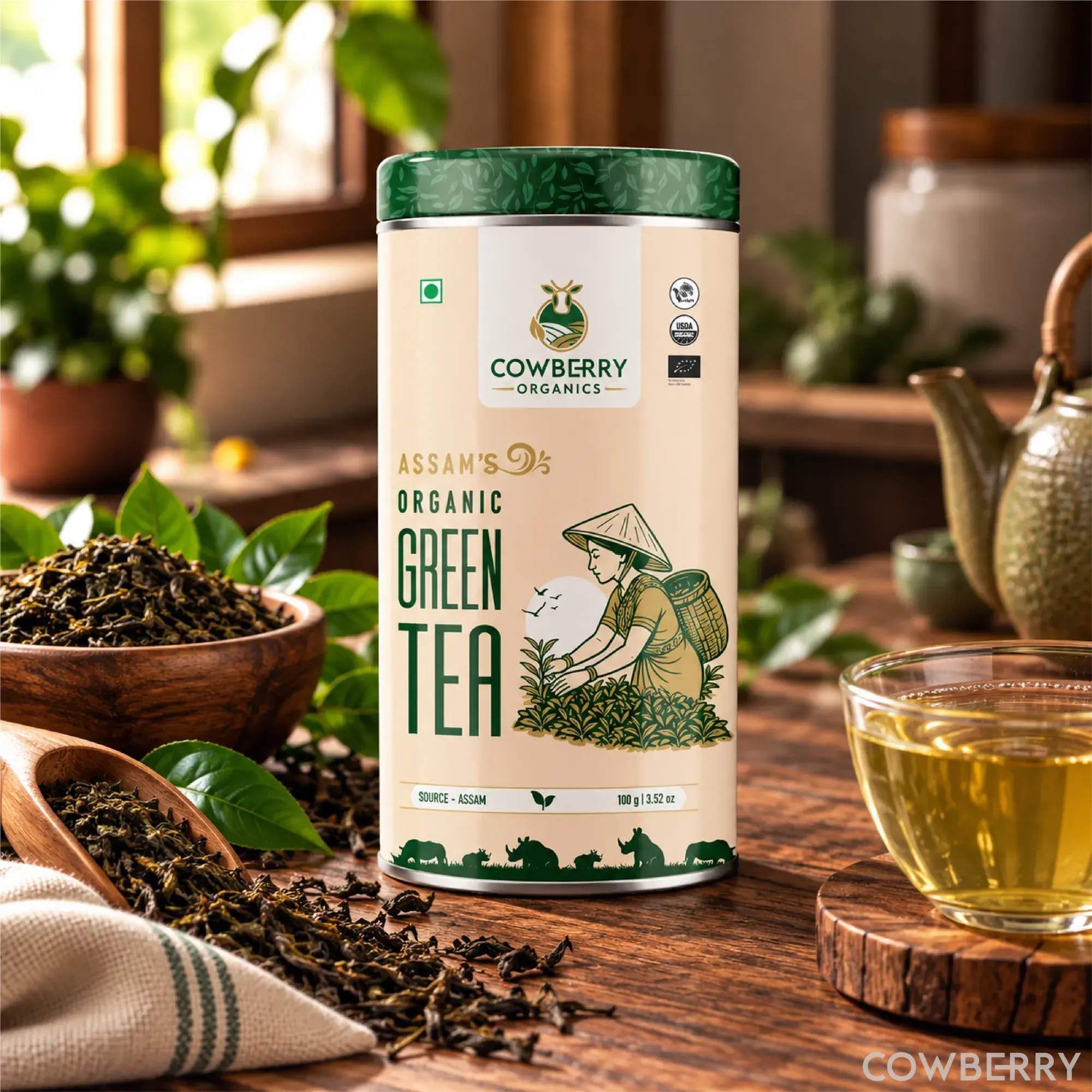
The brewed cup gives you the flavonoids and other polyphenols the guidelines list in tea, with none of the dosing questions the extract raises, and the guidelines add that the benefits come through best when tea is taken without milk and in moderation. For the cup itself, COWBERRY's green tea is organically grown in Assam and minimally processed, with no artificial flavours or additives in the pack, and it is India Organic, USDA & EU certified. Brew the pack's way: one teaspoon of leaves in 80–85°C water, steeped for 2–3 minutes, and the cup is ready. The cup also keeps the caffeine check simple: at 30–65 mg per 150 ml, you can count the cups against the 300 mg a day the guidelines call the tolerable limit. For more ways to drink it, green tea recipes turns the same leaves into roti, porridge, oatmeal and iced tea.
FAQs
Is green tea leaf extract the same as green tea?
No. Green tea extract is the concentrated, catechin-rich form of the plant, taken as a supplement or in beverage form, while green tea is the leaf brewed in water. The 2018 safety review handles them as different exposures: liver-related adverse events appeared with large bolus doses of concentrated preparations, not with brewed tea.
Is green tea leaf extract good for you?
The evidence is mixed by form and dose. The safety review recorded no liver-related adverse events when catechins came from brewed tea, drinks or food, and dose-dependent liver problems only with concentrated preparations taken as large bolus doses. For weight loss, the Cochrane review found a small, statistically non-significant effect, so any benefit has to be weighed against how the dose is taken.
What is green tea extract used for?
In the trial literature, green tea preparations have been studied as aids for weight loss and weight maintenance. The Cochrane review pooled those trials and found a weight loss that was small, statistically non-significant and not likely to be clinically important, so the one well-studied use does not deliver much.
Is green tea extract safe?
At the doses and forms the review studied, the dividing line is clear: 338 mg of EGCG a day is the safe intake it derived for preparations taken as a solid bolus dose, and liver-related adverse events clustered in concentrated preparations taken as large bolus doses. Beverage-form preparations and brewed tea did not show the same pattern. Check any label against those numbers.
How much green tea extract should I take?
The references recommend no dose. For adults the safety review derived 338 mg of EGCG a day as a safe intake for solid bolus preparations, and 704 mg of EGCG a day as an observed safe level for the beverage form. Check any label against those figures before taking anything.
Is green tea extract better than drinking green tea for weight loss?
Not shown. The Cochrane trials that used green tea preparations produced only a small, statistically non-significant loss, and the review does not compare the pill with the cup. The brewed cup carries none of the dosing questions the concentrated forms raise, so the evidence gives no reason to prefer the pill.
References
- Hu J, Webster D, Cao J et al. The safety of green tea and green tea extract consumption in adults - Results of a systematic review. Regul Toxicol Pharmacol, 2018
- Jurgens TM, Whelan AM, Killian L et al. Green tea for weight loss and weight maintenance in overweight or obese adults. Cochrane Database Syst Rev, 2012
- Dietary Guidelines for Indians, ICMR-National Institute of Nutrition
Shop this article
Keep reading
Coffee vs tea: caffeine, benefits and which is better
Coffee calories per 100g: powder, beans and filter coffee
Coffee in pregnancy: how much caffeine is safe