by COWBERRY

9 minute read
Green tea benefits and side effects: what the evidence shows

Green tea benefits are modest, and the evidence is easier to state than the marketing: polyphenols and a caffeine dose in the cup, a small and not significant effect on weight, and limited evidence on cancer. Each point below is tied to its source; names, storage and buying are on the green tea hub.
Green tea benefits: the honest short list
What a brewed cup gives you, per the ICMR-NIN dietary guidelines: caffeine in the range of 30 to 65 mg for a 150 ml cup, theobromine, theophylline, and flavonoids along with other antioxidant polyphenols. What large studies add: drinking tea is linked with lower all-cause and cardiovascular mortality, with the greatest reduction for all-cause mortality at about two cups a day, but that is an association, not a promise.
What the trials do not show matters just as much. A Cochrane review of weight-loss trials found a small, statistically non-significant loss in overweight and obese adults, and a Cochrane review on cancer prevention calls the evidence limited and inconsistent. The honest version of green tea leaves benefits is the list below, nothing more; the page on green tea ke fayde says the same in Hindi.
Green tea leaves benefits: what the leaf and the cup carry
1. Flavonoids and other polyphenols
The ICMR-NIN dietary guidelines describe tea, green and black alike, as carrying flavonoids and other antioxidant polyphenols, with a possible lowering of risk for heart disease of the coronary kind and for stomach cancer. Taken without milk and in moderation, a cup brings these through best, the same guidelines add. Since no per-cup amount is printed anywhere, the point is put as a possibility, not a number.
2. Theobromine and theophylline
Two further compounds appear in the guidelines' list for tea: theobromine and theophylline, which the guidelines describe as relaxing arteries and so promoting blood circulation. As before, no per-cup amount is printed; what the leaf contributes is simply named.
3. Caffeine, 30 to 65 mg a cup
A 150 ml cup of tea carries 30 to 65 mg of caffeine, and the guidelines print 80 to 120 mg for brewed coffee by comparison. Caffeine stimulates the central nervous system. Moderation is the guidelines' ask, keeping the day's caffeine inside the 300 mg tolerable limit.
4. The dry leaf as food
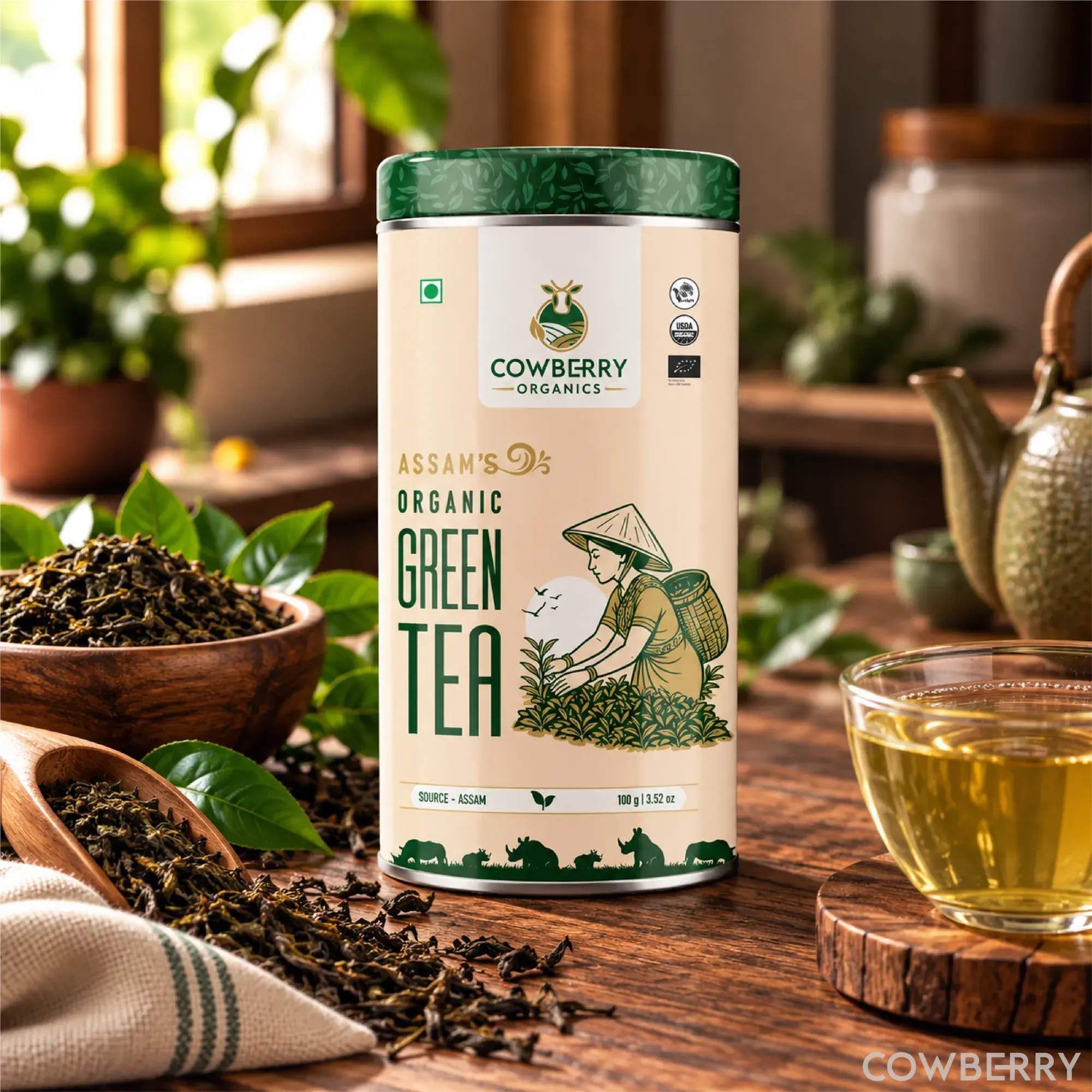
The benefits above describe the brewed cup. The dry leaf itself is another matter: per 100 g, the COWBERRY pack panel prints 21.24 g of protein, 17.89 g of fibre, 468.6 mg of calcium, 18.8 mg of iron and 1744.2 mg of potassium. Those figures matter only if the leaf is eaten rather than steeped and strained, which is what the page on whether green tea leaves are safe to eat covers, with the per-100 g detail on green tea calories per 100g.
What tea drinking is associated with in large studies
Epidemiology and Health published a 2024 meta-analysis that pooled 38 prospective cohorts, covering over 1.9 million participants, and set the heaviest tea drinkers against the lightest. The pooled estimate for all-cause mortality landed at 0.90, roughly a tenth lower among the heaviest drinkers, and 0.86 for cardiovascular mortality, or about 14 percent lower. For cancer mortality the same estimate read 0.90, and its confidence interval crossed 1.0.
The dose-response part of the same analysis then mapped the curve: all-cause mortality improved most around 2.0 cups each day and cancer mortality around 1.5 cups each day, with little extra beyond that. The review's conclusion: moderate drinking, roughly 1.5 to 2.0 cups daily, associates with lower mortality than drinking none at all. The review covers tea of all kinds, not green tea alone, and it measures association in observational cohorts, not a tested effect of drinking tea. Those numbers describe people who drink tea, not a promise that the next cup changes your risk.
Green tea and weight loss: what the Cochrane review found
The best trial evidence on green tea and weight comes from a 2012 Cochrane review of randomised controlled trials that ran at least 12 weeks, all in overweight or obese adults. Pooling the six studies conducted outside Japan, the mean difference in weight loss was -0.04 kg (95% CI -0.5 to 0.4; P = 0.88; 532 participants). The eight Japanese studies were too different to pool; one by one their results ran from -0.2 kg out to -3.5 kg, each favouring the green tea preparations. As the review sums it up, green tea preparations appear to induce a small, statistically non-significant loss, unlikely to matter clinically, and they did not significantly help weight stay off.
That is the whole finding, and it is the reason this page makes no weight-loss claim. Green tea is a fine drink; the review does not show it to be a weight-loss tool. Every figure in that review, and what it means for a diet, is walked through on the green tea for weight loss page.
Green tea and cancer prevention: the evidence is limited
A 2020 Cochrane review brought together 142 completed studies on green tea and cancer: 11 experimental studies, which allocated 1795 participants to green tea extract or placebo, and 131 nonexperimental studies with over 1.1 million participants. The results were inconsistent. Comparing the highest green tea intake with the lowest, overall cancer incidence gave a summary risk ratio of 0.83 (95% CI 0.65 to 1.07), but the interval crosses 1.0, and cancer mortality showed no association, at 0.99 (95% CI 0.91 to 1.07).
The review's conclusion is that the evidence for green tea cutting overall cancer risk, or risk at specific sites, is limited and inconsistent, with most studies carried out in Asian populations who drink a lot of tea. Green tea does not get a cancer claim from this evidence, and this page makes none.
Green tea side effects: what to watch, and who should limit it
The safety review found no liver events from brewed tea; most cautions below belong to extracts, to caffeine and to timing.
- Liver concerns belong to concentrated preparations. A 2018 safety review traced liver-related adverse events to a limited range of concentrated, catechin-rich preparations, in a dose-dependent way, when they were swallowed as large bolus doses, and not when they were consumed as brewed tea, as extracts in beverages, or as part of food. From the same review comes a safe intake of 338 mg of EGCG daily for preparations taken as a solid bolus dose; that figure belongs to supplements, not cups, as the green tea extract page explains.
- Adverse effects in the trials. In the 2020 Cochrane cancer review, trials that gave green tea extract reported gastrointestinal disorders, elevation of liver enzymes, and, more rarely, insomnia, raised blood pressure and skin or subcutaneous reactions. Those effects were reported for extract intake; the review's conclusion also notes side effects associated with high intakes of green tea.
- Iron absorption. Tea's tannin interferes with iron absorption from food. In 2017, a controlled trial gave twelve healthy women an iron-containing porridge meal with tea, and fractional iron absorption fell from 5.7% to 3.6%, whereas with tea an hour after the meal it was 5.7%, about half the inhibitory effect of tea taken with the meal. The guidelines therefore ask for tea at least one hour before or after meals.
- Caffeine. A 150 ml cup holds 30 to 65 mg of caffeine, and the guidelines put the day's tolerable limit at 300 mg, moderation included. For pregnancy the NHS advice caps caffeine at 200 mg a day, with a cup of tea counted at about 75 mg; too much caffeine is linked in that advice to a higher chance of miscarriage and stillbirth.
Anyone taking medicines or living with a health condition should talk to their doctor or dietitian about where tea fits into the day.
How much green tea per day, and how to drink it
What the guidelines cap is caffeine, not cups: 300 mg of caffeine across the day, with moderation advised. Between the printed bounds of 30 and 65 mg per 150 ml cup, the top reaches that limit at roughly 4.6 cups and the bottom at 10 cups, so two or three cups a day from tea alone sit inside it, and the hour kept clear around meals is the part of the day that matters for iron.
Follow the pack for the brew: one teaspoon of leaves into water at 80 to 85 °C, a 2 to 3 minute steep, never boiling, then strain. The step-by-step method is on how to make green tea, and the timings, mistakes and daily quantity on how to use green tea. Drink it plain, since the guidelines say the benefits come through best without milk. For the same leaf cooked into food, roti, porridge, oatmeal and iced tea all appear on the green tea recipes page, and the whole cluster of pages sits on the green tea hub.
FAQs
Is green tea good for health?
The sourced effects are modest: caffeine between 30 and 65 mg per 150 ml cup, theobromine, theophylline, and flavonoids and other polyphenols, per the ICMR-NIN guidelines, whose advice is to take it without milk and in moderation. The weight-loss and cancer evidence is small or limited, so no stronger claim follows.
Does green tea cause side effects?
Liver-related adverse events were reported only for concentrated, catechin-rich preparations swallowed as large bolus doses; brewed tea did not show them. Extract trials also reported stomach upsets and, rarely, insomnia and raised blood pressure. For cups, the real points are caffeine totals and tea's effect on iron absorption.
Why green tea is good for health?
The sourced reasons: it carries caffeine, theobromine, theophylline and polyphenols, and in the 2024 meta-analysis of 38 cohorts, tea drinking (all kinds of tea) tracked with about 10 percent lower all-cause mortality and 14 percent lower cardiovascular mortality among the heaviest drinkers, with the greatest all-cause reduction at about two cups a day. That is an association in observational data, not a tested effect.
What is green tea good for?
A plain hot drink with a mild caffeine lift, and that is the honest answer. The weight review's Cochrane finding was a small, statistically non-significant loss, and the cancer review found limited, inconsistent evidence. What the guidelines list for tea is caffeine and polyphenols in a cup without milk.
Does green tea have caffeine?
Yes. Per the ICMR-NIN dietary guidelines, the 150 ml cup of brewed tea carries 30 to 65 mg of caffeine, next to 80 to 120 mg for brewed coffee, with instant coffee at 50 to 65 mg. Those guidelines set 300 mg of caffeine a day as the tolerable limit, with moderation advised.
References
- Dietary Guidelines for Indians, ICMR-National Institute of Nutrition
- Kim Y, Je Y. Tea consumption and risk of all-cause, cardiovascular disease, and cancer mortality: a meta-analysis of thirty-eight prospective cohort data sets. Epidemiol Health, 2024
- Jurgens TM, Whelan AM, Killian L et al. Green tea for weight loss and weight maintenance in overweight or obese adults. Cochrane Database Syst Rev, 2012
- Filippini T, Malavolti M, Borrelli F et al. Green tea (Camellia sinensis) for the prevention of cancer. Cochrane Database Syst Rev, 2020
- Hu J, Webster D, Cao J et al. The safety of green tea and green tea extract consumption in adults - Results of a systematic review. Regul Toxicol Pharmacol, 2018
- Ahmad Fuzi SF, Koller D, Bruggraber S et al. A 1-h time interval between a meal containing iron and consumption of tea attenuates the inhibitory effects on iron absorption. Am J Clin Nutr, 2017
- NHS: foods to avoid in pregnancy (caffeine section)
Shop this article
Keep reading

Coffee vs tea: caffeine, benefits and which is better
Coffee calories per 100g: powder, beans and filter coffee

Coffee in pregnancy: how much caffeine is safe