by COWBERRY

5 minute read
Green tea leaves vs tea bags: taste, cost and which to choose

Green tea leaves vs tea bags is a question of leaf size and time, not of the tea itself: both brew the same Camellia sinensis leaf, the loose one steeped whole, the bagged one usually cut small. COWBERRY's whole leaf is described as delicate, clean and full; bags need no spoon or strainer. Which form fits which day follows, with the full story on the green tea hub.
Green tea leaves or bags: which is better in three lines
- Loose whole leaves win the taste round. Whole young leaves steeped whole give the delicate, clean, full cup the pack describes.
- Tea bags win the convenience round. A pre-portioned bag needs no spoon, no strainer and no measuring, and the cup is ready in a few minutes.
- Matcha is a different drink in form. Powder whisked into the cup is not a leaf-versus-bag choice, so judge it separately.
Green tea tea bags vs leaves: side by side
| Point | Loose whole leaves | Tea bags | Matcha powder |
|---|---|---|---|
| What it is | Whole young leaves, sold loose | Usually the same leaf cut or broken small, sealed into a bag | Green tea ground to a powder |
| Brewing | One teaspoon at 80 to 85 C, 2 to 3 minutes, then strained | One bag in a cup of hot water, lifted out | Whisked into the water, nothing strained |
| The cup | Delicate, clean, full character | Needs no spoon or strainer | Thick; the powder is drunk whole |
| Fits | Home and slow cups | Office, travel, first cups | Lattes and whisked drinks |
The table's leaf-versus-bag rows keep one fact in front: the same plant fills both, so the choice is about the leaf's size and your minutes, not about two different teas. The brewing numbers come from the note COWBERRY prints for its loose leaf; the how to make green tea page walks through the full method.
Nutrition and safety: what changes between leaves and bags
No composition table is possible on this page, and the reason is worth saying plainly: IFCT 2017 has no entry for the dry green tea leaf, and USDA carries only brewed green tea, so there is no per-100 g figure with which to compare leaf against bag. What the guidelines print applies to the cup, not the packaging: tea holds 30 to 65 mg of caffeine in a 150 ml cup, and the guidelines' hour-away-from-meals rule for iron holds however the leaf was packed.
Safety is the same story. The 2018 review's liver concerns attached to concentrated preparations swallowed as large bolus doses, and it found no such pattern for brewed tea or tea in food; a tea bag brews the same tea as loose leaves, not an extract. So leaf versus bag changes the experience, not any nutrition figure that can be stated.
Taste and brewing, form by form
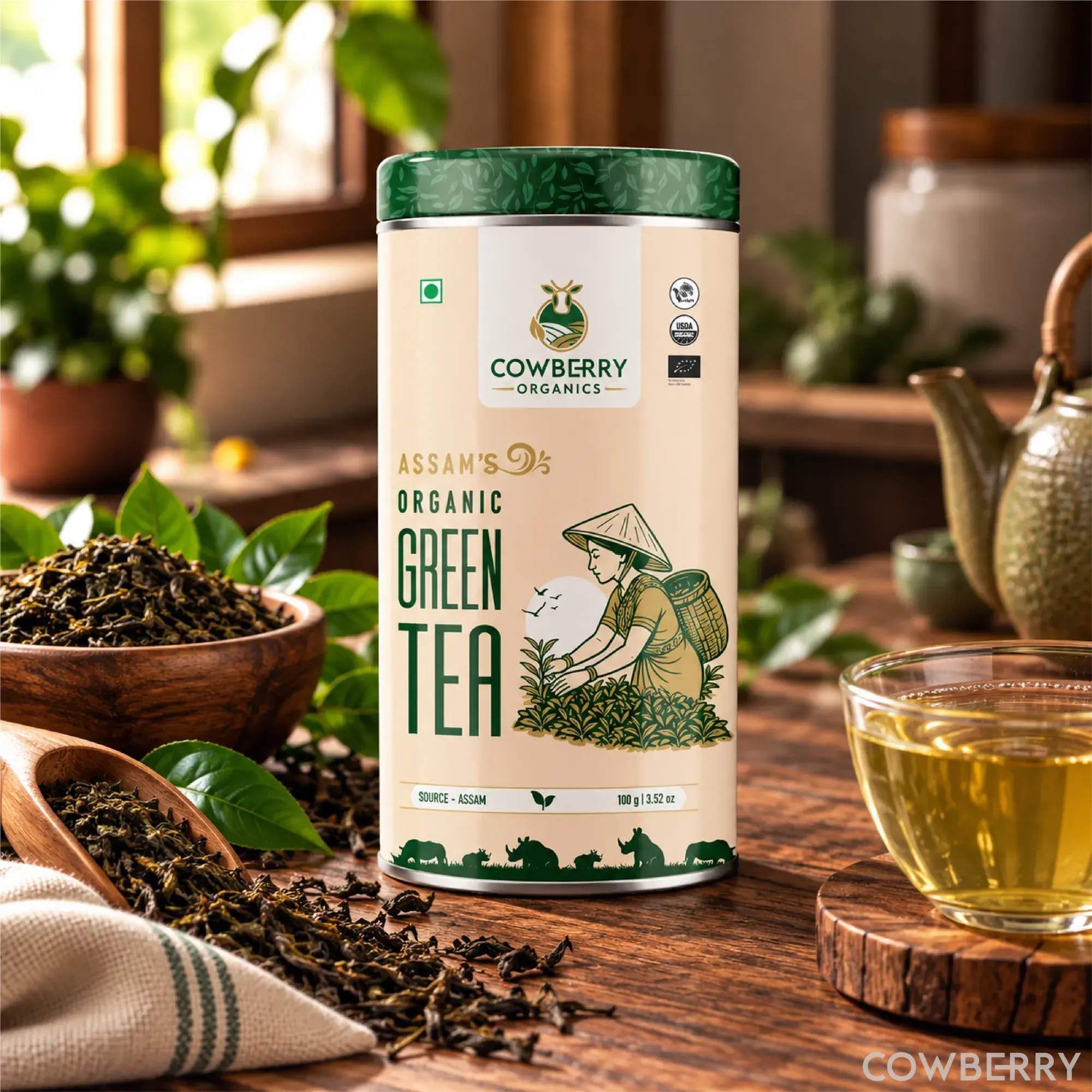
Loose whole leaves give the fullest version of the tea. COWBERRY's pack holds whole young leaves from organic gardens in Assam, minimally processed, with a delicate flavour and a clean, full character, and its brewing note is one teaspoon in water around 80 to 85 C for 2 to 3 minutes, never boiling.
Tea bags usually hold the same plant's leaf cut or broken small. Matcha skips steeping altogether: the ground leaf is whisked into the water and drunk, which makes a thicker cup.
The same hour-from-meals rule and 300 mg tolerable daily caffeine limit cover every form above.
Cost and where each fits
No price is quoted for either form. Both are sold by the pack, so the fair comparison is cost per cup, not the form.
Where each form fits follows the same line: the bag for a train seat, an office drawer or a first cup, because it needs nothing but hot water; the loose leaf for the home pot and the slow evening cup; and matcha for whisked lattes. The caffeine numbers against coffee sit on the green tea vs black coffee page.
Which for whom
- First cups: start with bags; there is nothing to measure and nothing to strain.
- Taste-first drinkers: loose whole leaf, one teaspoon at 80 to 85 C, drunk plain.
- Office and travel: bags again, for the same reason.
- Slow evenings: loose leaf, brewed in the pot.
- Kitchen use: whichever form the recipe calls for, with roti, porridge, oatmeal and iced tea collected on the green tea recipes page and the leaf-in-food question on can you eat green tea leaves.
- Every drinker: keep the cup an hour from meals and the day's caffeine within the 300 mg tolerable limit, identical for leaf, bag and powder.
The leaf's full story, from names to storage, sits on the green tea hub.
FAQs
Which is better green tea leaves or powder?
Whichever matches how you drink. Whole leaves steep a delicate, clean cup; matcha powder is whisked and drunk whole, giving a thicker cup. No guideline or study we could find ranks the two forms, so leaf suits slow cups and powder suits whisked drinks and lattes.
Difference between green tea and matcha?
Matcha is green tea in powder form: the same Camellia sinensis leaf, ground and whisked into the water instead of steeped and strained. Whole green tea leaves are lifted out after 2 to 3 minutes, so the leaf itself stays in the pot, while matcha's powder is drunk entirely.
Is green tea leaves matcha?
No. Green tea leaves are whole dried leaves that you steep and lift out; matcha starts from green tea but is ground into a powder that stays in the cup. They share the plant and the caffeine, but leaf tea is steeped and matcha is whisked.
What is loose leaf tea?
Tea sold as whole dried leaves, spooned or weighed per cup and strained after steeping, instead of sealed into bags. COWBERRY's green tea is loose leaf: whole young leaves from organic gardens in Assam, steeped one teaspoon at a time in water at 80 to 85 C for 2 to 3 minutes.
Can I steep the same leaves twice?
Many drinkers do, and the second cup is usually lighter. No guideline or study we could find sets a rule for second steeps, so let the taste of the second cup decide.
Do tea bags need the same water temperature?
The printed brewing note, 80 to 85 C and never boiling water, is for loose leaves, and no separate figure is printed for bags. What holds for both is the one warning the note prints: boiling water makes green tea bitter.
References
- Dietary Guidelines for Indians, ICMR-National Institute of Nutrition
- Filippini T, Malavolti M, Borrelli F et al. Green tea (Camellia sinensis) for the prevention of cancer. Cochrane Database Syst Rev, 2020
- Hu J, Webster D, Cao J et al. The safety of green tea and green tea extract consumption in adults - Results of a systematic review. Regul Toxicol Pharmacol, 2018
Shop this article
Keep reading
Coffee vs tea: caffeine, benefits and which is better
Coffee calories per 100g: powder, beans and filter coffee
Coffee in pregnancy: how much caffeine is safe