by COWBERRY

7 minute read
Coffee calories per 100g: powder, beans and filter coffee

Coffee calories per 100g are counted on dry coffee powder, the only form of coffee the composition tables carry values for. This page sets out the full per-100g table, scales it to the teaspoon, tablespoon and mug, and shows what milk, sugar and jaggery add to the cup. The coffee hub holds the wider coffee story.
Coffee calories per 100g: the full table
The table below shows the figures per 100 g for dry coffee, white sugar and jaggery, the three things a sweet milky cup is built from. Dry coffee carries 353 kcal, 12.2 g protein, 0.5 g fat and 75.4 g carbohydrate per 100 g, with 4.41 mg iron, 141 mg calcium, 327 mg magnesium and 3540 mg potassium. The coffee figures come from USDA FoodData Central; the Indian composition tables, IFCT 2017, do not list coffee, and the sugar and jaggery sit beside the coffee because they are what changes a cup's arithmetic.
White sugar is 387 kcal per 100 g (USDA tables) and jaggery 354 kcal (IFCT 2017), both almost entirely carbohydrate. A plain brewed cup stays close to water; the energy arrives with the spoonfuls added after brewing.
| Nutrient | Coffee beans / powder (dry) | White sugar | Jaggery (cane) |
|---|---|---|---|
| Energy (kcal) | 353 | 387 | 354 |
| Protein (g) | 12 | 0 | 1.9 |
| Fat (g) | 0.5 | 0 | 0.2 |
| Carbohydrates (g) | 75 | 100 | 85 |
| Dietary fibre (g) | 0 | 0 | — |
| Iron (mg) | 4.4 | 0.1 | 4.6 |
| Calcium (mg) | 141 | 1 | 107 |
| Magnesium (mg) | 327 | 0 | 115 |
| Potassium (mg) | 3540 | 2 | 488 |
| Sodium (mg) | 37 | 1 | 25 |
| Zinc (mg) | 0.3 | 0 | 0.5 |
| Folate (mcg) | 0 | 0 | 14 |
| Vitamin C (mg) | 0 | 0 | — |
| Glycemic index (GI) | — | 70 | — |
Per 100 g raw, edible portion. Composition: USDA FoodData Central (SR Legacy), FDC ID 171893, NDB 14214; USDA FoodData Central (SR Legacy), FDC ID 169655, NDB 19335; IFCT 2017 (ICMR-NIN). GI: University of Sydney GI database. — means not reported. These are average values for the food; the label on a pack gives the values for that product.
Coffee powder calories per 100g: which coffee the numbers describe
The figures above describe dry instant coffee powder, the one coffee record the USDA tables carry. They are not the numbers for a bag of roasted ground beans and not for a brewed cup: the first has no separate record in the tables, and the second is mostly water. In India, coffee powder usually means the finely ground roasted beans that go into the filter; the shared figure set stands in for beans and powder alike, which is why both appear in the table above.
One hundred grams of dry powder is also far more coffee than a home brew uses, so the useful numbers come from scaling down. The how coffee is made page follows the bean from cherry to powder, and the coffee powder vs beans page explains why both share this one set of figures.
Coffee calories per teaspoon, tablespoon and mug
Scaled to the kitchen, the dry powder works out to about 18 kcal in a level teaspoon (5 g) and about 35 kcal in a tablespoon (10 g). Those spoonfuls are what one mug starts from, so even a generous brew begins from a small energy base; the powder's carbohydrate also shrinks, to a little under 4 g per teaspoon of dry powder.
For the brewed mug itself no kcal figure is recorded, because the composition tables carry values only for the dry powder, and a brewed cup is mostly water. For the cup itself, the recorded numbers are caffeine: the Indian guidelines count 80-120 mg in a 150 ml brewed cup of coffee and 50-65 mg in instant. The filter coffee vs instant coffee page lays out how the two cups differ.
Coffee calories with milk and sugar
Most of the energy in a real cup arrives after brewing. One level teaspoon (5 g) of white sugar comes to about 19 kcal, and an equal spoon of jaggery to about 18 kcal, so a pair of spoonfuls from either adds more energy than the coffee brings itself. White sugar also carries a glycemic index of 70 in the tables, while coffee has no glycemic index recorded.
Milk is the other half of the cup, and the tables carry no per-cup figure for it, so the honest way to count a milky cup is measuring what you pour. Coffee for weight loss counts what a finished cup costs, and coffee for diabetes walks through how the cup stays low in carbohydrate until sugar enters it.
Coffee beans nutrition facts 100g
Coffee beans nutrition comes down to the same figures as the powder, because the tables carry one set of values for coffee beans and powder together: 353 kcal, 12.2 g protein and 75.4 g carbohydrate per 100 g of the dry coffee, with the minerals listed in the table above. Whether you buy beans or powder, the starting numbers are identical.
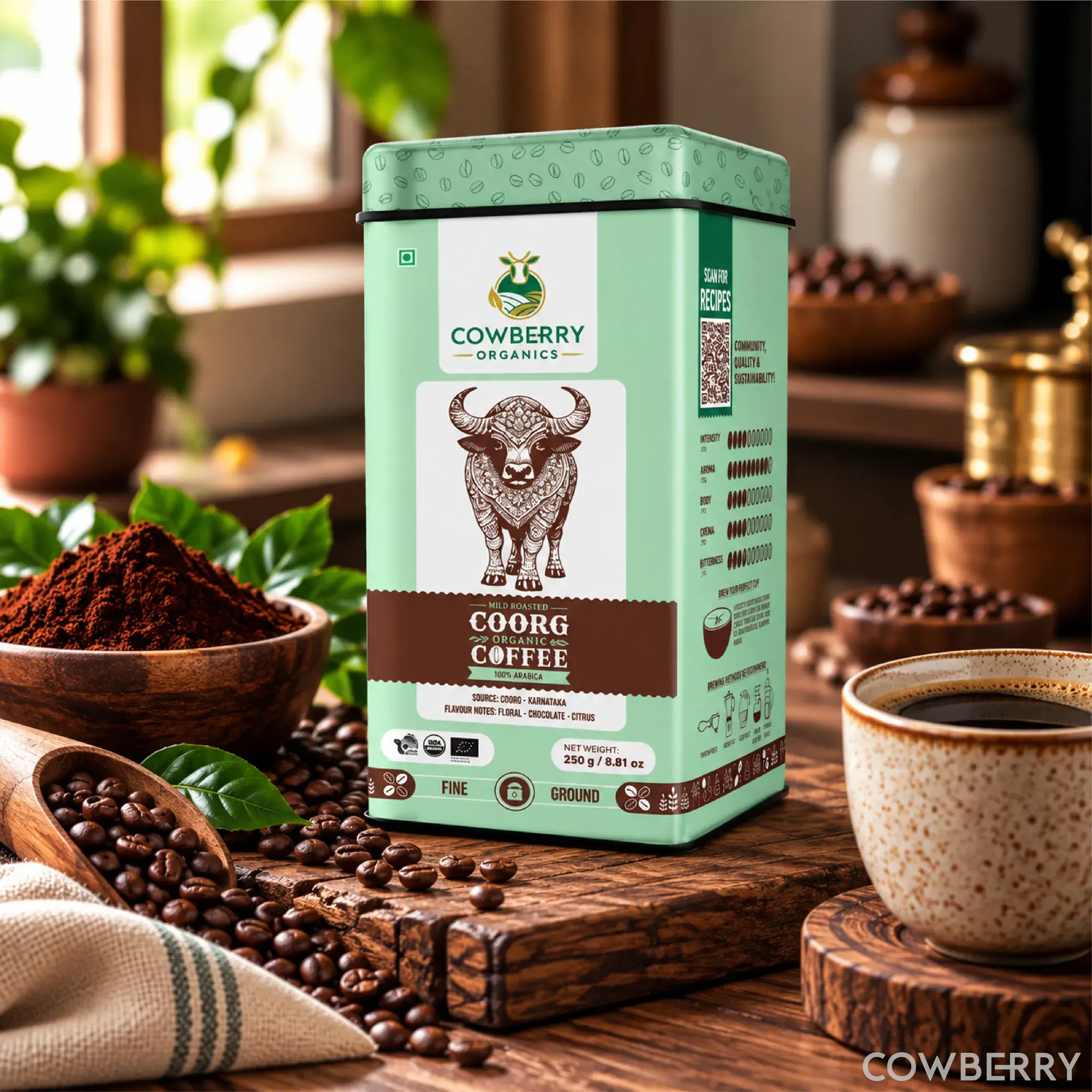
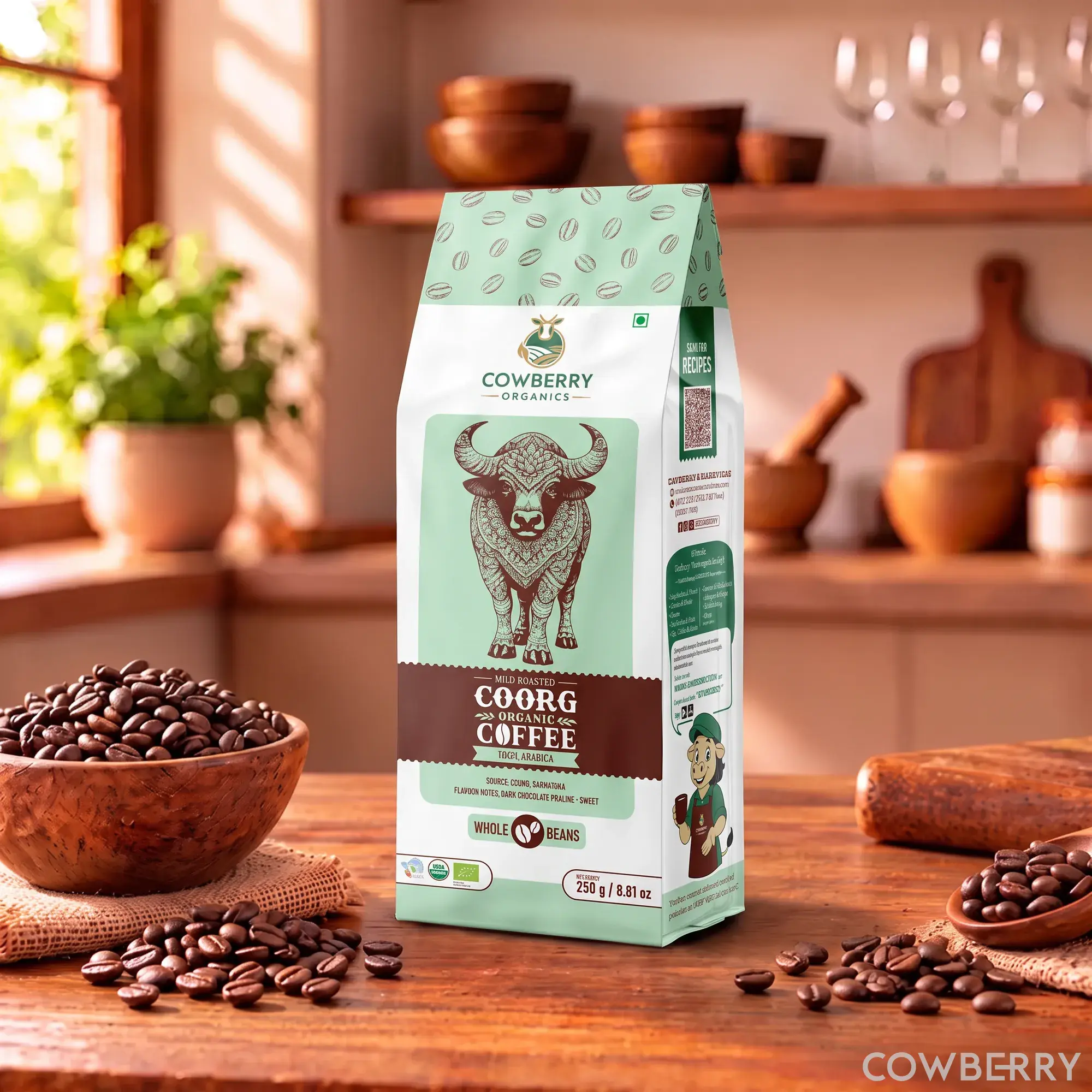
What differs between the two is freshness, not nutrition. COWBERRY's whole Arabica beans from Coorg, Karnataka, are sealed immediately after roasting, and the point of buying beans is to grind only what you need at the moment of brewing. The coffee powder vs beans page lays out that choice in detail.
Filter coffee calories and caffeine per cup
Filter coffee starts from the same ground beans, so its cup begins from the same dry powder, and no recorded kcal figure exists for the finished cup with its milk. On caffeine, the Indian guidelines count 80-120 mg in a 150 ml brewed cup, and the NHS notes that filter coffee can run past the 100 mg it estimates in a mug of instant.
So a filter coffee's energy depends on the milk and sugar poured in, and its caffeine sits towards the higher end of the stated range. The what is filter coffee guide unpacks the drink, and the filter coffee how to make page sets out decoction, milk ratio and the way it is served.
Glycemic index and the micronutrients in coffee
The tables carry no glycemic index for coffee, so no GI value exists to quote for the drink itself. The micronutrients sit in the table above; in words, dry coffee carries 3540 mg potassium, 327 mg magnesium, 141 mg calcium, 4.41 mg iron, 37 mg sodium and 0.35 mg zinc per 100 g, with folate and vitamin C at zero.
Scaled to a 5 g teaspoon, that is about 177 mg of potassium and 7 mg of calcium, and the rest shrink to amounts too small to count on: coffee is not where a diet gets its minerals, and the numbers mainly explain what the dry powder holds before brewing. For the whole coffee story, from names to how the cup is made, the coffee hub is the page to start from.
FAQs
What is the glycemic index of coffee?
Coffee has no glycemic index in the tables, so there is no GI value to quote for the drink itself. White sugar does carry a GI of 70, while coffee itself has none recorded. A plain brewed cup is mostly water.
Does filter coffee have caffeine?
Yes, and more of it than instant coffee. The Indian guidelines count 80-120 mg in a 150 ml brewed cup, and the NHS adds that filter coffee can run past the 100 mg it estimates in a mug of instant. Filter coffee is brewed from ground beans, so the caffeine comes through into the decoction.
What is coffee powder?
Coffee powder is roasted coffee ground to a fine texture, ready to brew in a filter, press or pot. COWBERRY's powder is pure Arabica from Coorg, Karnataka, given a mild small-batch roast and ground straight after roasting, with no chicory or additives. The nutrition figures describe dry instant powder, the form the tables carry values for.
Can coffee cause constipation?
The research recorded on this page covers the dry powder's energy and minerals, not digestion, so it carries no finding on constipation either way; a brewed cup is mostly water. If constipation is a regular concern, the person to ask is your doctor.
How many calories are in black coffee?
No per-cup figure is recorded for black coffee; the tables carry values only for dry coffee powder, at 353 kcal per 100 g. A plain black cup is brewed water, so its own energy is close to nothing, and the 18 kcal of a 5 g teaspoon describes the dry powder, not the cup. The milk and sugar are what carry the calories.
How many calories in coffee with milk?
The tables carry no value for a cup of coffee with milk, and the coffee numbers are for dry powder. Count what you pour instead, a teaspoon of white sugar at about 19 kcal and jaggery at about 18 kcal, and measure the milk, since that is where the rest of the cup's energy sits.
References
Shop this article
Keep reading

Coffee vs tea: caffeine, benefits and which is better

Coffee in pregnancy: how much caffeine is safe

Coffee in Hindi, Kannada, Tamil and other Indian languages