by COWBERRY

7 minute read
How to use green tea: best time to drink and how much

Green tea how to use comes down to three rules: one teaspoon of leaves, water at 80 to 85 C steeped for 2 to 3 minutes, and caffeine kept inside the 300 mg tolerable daily limit. The best time to drink, how much per day and the mistakes that spoil the cup follow; the leaf itself is covered on the green tea hub.
Green tea how to consume: the short answer
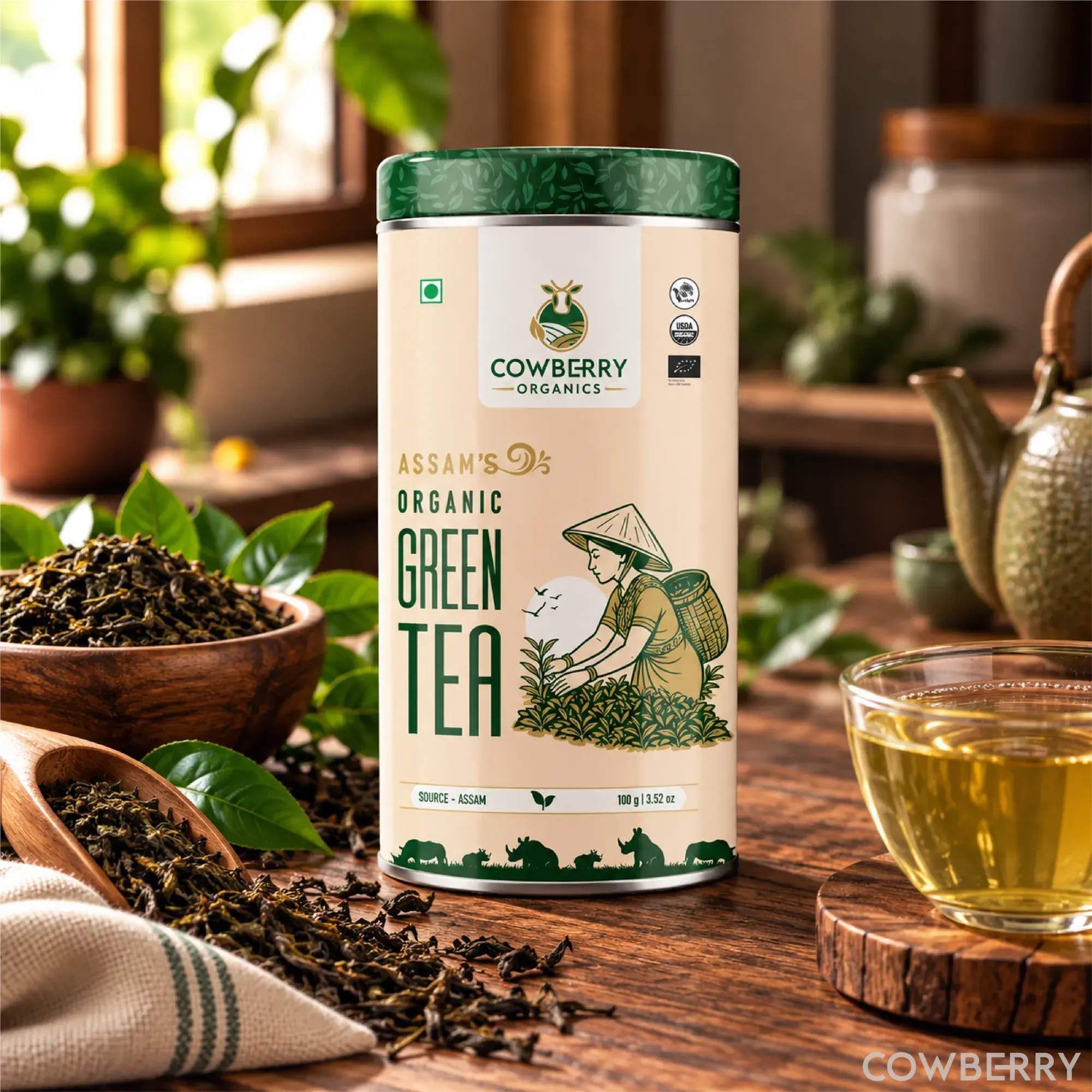
Brew a teaspoon of leaves in water at 80 to 85 C, drink the cup plain, and keep it an hour away from meals. The brewing note COWBERRY prints for its green tea is one teaspoon of leaves in hot water around 80 to 85 C, steeped for 2 to 3 minutes, never boiling water, because boiling makes the cup bitter.
The hour-away-from-meals rule answers the iron question. The ICMR-NIN dietary guidelines note that tannin in tea and coffee interferes with iron absorption, so the cup should sit at least one hour before or after a meal. A 2017 controlled trial in twelve healthy UK women put numbers on it: with water, the women absorbed 5.7 percent of the iron in a porridge meal, 3.6 percent when tea came with the meal, and 5.7 percent again when the tea was drunk an hour after it.
How much in a day: moderation. ICMR-NIN prints a tolerable limit of 300 mg of caffeine a day and 30 to 65 mg in a 150 ml cup of tea, so the same guidelines ask for moderation rather than a cup count. Names, nutrition and benefits are gathered on the green tea hub.
Step by step: how to use green tea day to day
- Measure the leaves. One teaspoon of loose green tea for the cup. The teaspoon is the measure the brewing note prints; the exact leaf-to-water ratio is covered under how to make green tea.
- Heat the water to 80 to 85 C, not to a boil. If there is no way to check the temperature, let boiled water sit a moment before pouring. Boiling water is the one thing the brewing note warns against.
- Steep for 2 to 3 minutes. The 2-to-3-minute window is short on purpose; the leaf gives its cup inside it.
- Lift the leaves and drink the cup plain. The guidelines say the benefits of tea come through best if milk is not added, so skip it and taste the leaf.
- Time the cup around meals. Keep at least an hour on either side, the rule the guidelines print; the 2017 trial tested the hour after a meal containing iron.
- Count the day's caffeine. One 150 ml cup holds 30 to 65 mg and the tolerable limit is 300 mg a day, so keep a rough count on days with several cups.
Best time to take green tea (green tea kab pina chahiye)
Morning. Neither the ICMR-NIN guidelines nor the studies in the references pin green tea to an hour of the day; the rules in the guidelines are about meals and totals, not the clock.
Around meals. This is the one timing the guidelines settle, and it is the answer to how long after eating: at least an hour, before or after, for the iron reason set out above.
On an empty stomach. No study in the references tested a brewed cup on an empty stomach, so there is no rule to give. The 2018 safety review tied liver concerns to concentrated, catechin-rich preparations swallowed as large bolus doses, in its laboratory studies, with fasting among the dosing conditions, and it found no such pattern for brewed tea. The review flagged concentrated preparations, not brewed tea.
At night. The caffeine figure above is the whole answer the guidelines give: caffeine stimulates the central nervous system. The guidelines print no cut-off hour, so if sleep suffers, take the last cup earlier in the day.
Common mistakes when using green tea
- Boiling water. The brewing note is explicit: avoid boiling water, because it makes the tea bitter.
- Steeping past 2 to 3 minutes. The 2-to-3-minute window is short; a long steep takes the cup beyond what the note calls for, and the brewing page has the fixes for a bitter cup.
- Drinking it with meals. Tea at the meal lowered iron absorption in the 2017 trial; the hour gap on either side is the fix.
- Adding milk. The guidelines say tea's benefits come through best without milk.
- Filling the allowance. The 300 mg tolerable daily limit is a ceiling, not a target; moderation is the guidelines' own word.
- An open, badly stored pack. Leaves keep their freshness in an airtight container, in a cool dry place away from sunlight, moisture and strong odours, as the does green tea leaves expire page explains.
How much green tea per day: time and quantity table
The numbers worth keeping on hand:
| What | Number |
|---|---|
| Leaves per cup | One teaspoon (COWBERRY brewing note) |
| Water temperature | Around 80 to 85 C, not boiling |
| Steeping time | 2 to 3 minutes |
| Caffeine in a 150 ml cup of tea | 30 to 65 mg (ICMR-NIN) |
| Tolerable daily caffeine | 300 mg a day (ICMR-NIN) |
| Gap around meals | At least 1 hour before and after (ICMR-NIN); the 2017 trial tested 1 hour after |
At 30 to 65 mg a cup, 300 mg is reached after about 4.6 cups at the top of that range and 10 cups at the bottom, and the guidelines ask for moderation, not a full allowance.
The 2018 safety review adds figures for green tea preparations rather than cups: a safe intake of 338 mg of EGCG a day for preparations taken as a solid bolus dose, and an observed safe level of 704 mg of EGCG a day for preparations in beverage form. Its liver concerns attached to concentrated preparations swallowed as large bolus doses, not to brewed tea, so neither figure converts to a cup count.
Beyond the cup, the same leaves go into roti, porridge, oatmeal and iced tea, with methods on the green tea recipes page. If you are pregnant, ask your doctor about caffeine before following the limit above.
FAQs
Can green tea be taken on empty stomach?
Neither the ICMR-NIN guidelines nor the studies in the references set a rule for an empty-stomach cup. The 2018 safety review's liver concerns came from concentrated, catechin-rich preparations swallowed as large bolus doses, with fasting among the dosing conditions in its laboratory work; brewed tea showed no such pattern. Keep the hour-from-meals rule and decide the rest by how the cup feels.
Can green tea be taken at night?
Yes, with the caffeine in mind. A 150 ml cup of tea holds 30 to 65 mg of caffeine, and caffeine stimulates the central nervous system, which is the whole of what the guidelines say on timing. The guidelines print no cut-off hour, so the practical answer is personal: if a late cup keeps you awake, take the last one earlier in the day.
How to drink green tea leaves?
Steep them, lift them out, and drink the cup plain. One teaspoon of leaves goes into hot water at 80 to 85 C for 2 to 3 minutes, never boiling water, which is the brewing note COWBERRY prints for its green tea. The guidelines add that the tea's benefits come through best without milk, so keep the cup plain.
Does green tea have caffeine?
Yes. The ICMR-NIN dietary guidelines print 30 to 65 mg of caffeine in a 150 ml cup of tea, next to 80 to 120 mg for a cup of brewed coffee and 50 to 65 mg for instant coffee. A cup of tea therefore sits at the lighter end of those printed ranges. The same guidelines set a 300 mg tolerable daily limit and ask for moderation.
Which green tea is best for weight loss?
No type has been shown to win that race. A Cochrane review of green tea preparations in overweight and obese adults found a small weight loss that was not statistically significant, so no form, bag or brand gets a stronger claim from it. What the evidence does and does not say is laid out on the green tea for weight loss page.
How much green tea per day is safe?
The guidelines print a limit, not a cup count. ICMR-NIN's tolerable limit is 300 mg of caffeine a day, which at 30 to 65 mg a cup is reached after about 4.6 to 10 cups, with moderation asked for rather than a full allowance. If you are pregnant, ask your doctor about caffeine before using that limit.
References
- Dietary Guidelines for Indians, ICMR-National Institute of Nutrition
- Ahmad Fuzi SF, Koller D, Bruggraber S et al. A 1-h time interval between a meal containing iron and consumption of tea attenuates the inhibitory effects on iron absorption. Am J Clin Nutr, 2017
- Jurgens TM, Whelan AM, Killian L et al. Green tea for weight loss and weight maintenance in overweight or obese adults. Cochrane Database Syst Rev, 2012
- Hu J, Webster D, Cao J et al. The safety of green tea and green tea extract consumption in adults - Results of a systematic review. Regul Toxicol Pharmacol, 2018
Shop this article
Keep reading
Coffee vs tea: caffeine, benefits and which is better
Coffee calories per 100g: powder, beans and filter coffee
Coffee in pregnancy: how much caffeine is safe