by COWBERRY

4 minute read
Green tea in Hindi, English and other Indian languages

Green tea in Hindi starts from chai, the Hindi word for tea, and green tea in English is the name the pack carries. This page lists the names that can be verified, the botanical name, and what the official tables do and do not print. The leaf itself is on the green tea hub.
Green tea leaves in hindi: the quick answer
Green tea leaves in Hindi are the leaves of green tea, and the Hindi word for tea is chai. The Indian Food Composition Tables of 2017 do not list green tea at all, so no official Hindi or regional name for it exists in them; USDA FoodData Central records only brewed green tea, not the dry leaf. The table below shows the names that can be verified: chai (Hindi) and cha (Bengali) are words for tea in general.
| Language | Name (romanised) |
|---|---|
| English | Green tea |
| Hindi | Chai |
| Marathi | — |
| Gujarati | — |
| Punjabi | — |
| Bengali | Cha |
| Odia | — |
| Assamese | — |
| Kannada | — |
| Telugu | — |
| Tamil | — |
| Malayalam | — |
| Urdu | — |
| Sanskrit | — |
| Botanical name | — |
Source: no source found. — means no name recorded in the source.
English ‘Green tea’: Green tea - Wikipedia. Hindi ‘Chai’: Chai - Wikipedia. Bengali ‘Cha’: Chai - Wikipedia.
Green tea in English and the botanical name
In English the tea is green tea, the name COWBERRY's pack carries. The botanical name of the tea plant is Camellia sinensis: the 2020 Cochrane review of green tea for cancer prevention notes that teas from the plant Camellia sinensis group into green, black and oolong tea.
The green in the name comes from the making, not from a colouring. Green tea leaves are minimally processed after harvest, so the leaf keeps its natural green colour, while black tea leaves are allowed to oxidise fully. A green leaf and a black leaf can therefore come from the same plant, and the processing steps are walked through on the how green tea is made page.
Green tea in kannada, Tamil, Marathi and other languages
Neither the Indian Food Composition Tables of 2017 nor USDA FoodData Central prints a Kannada, Tamil, Marathi, Gujarati, Punjabi, Malayalam, Urdu or other regional name for green tea, so none is given here rather than guessing. What can be said is in the table above: green tea in English, chai in Hindi and cha in Bengali, the last two being words for tea in general. The pack itself reads Organic Green Tea.
Often confused with: black tea, matcha and herbal teas
Black tea. Same plant, different processing: black tea leaves are allowed to oxidise fully, which turns them dark, while green tea leaves are minimally processed so the leaf keeps its green colour.
Oolong. Oolong comes from the same plant. The Cochrane review groups teas from Camellia sinensis into green, black and oolong tea.
Matcha. Matcha is green tea ground into a powder that is whisked into the cup rather than steeped, so it is a form of green tea, not a different plant.
Herbal teas. Tulsi, chamomile or peppermint infusions come from other plants entirely and carry no tea leaf. For the leaf's benefits, caffeine and storage, the green tea hub gathers them.
Where green tea grows
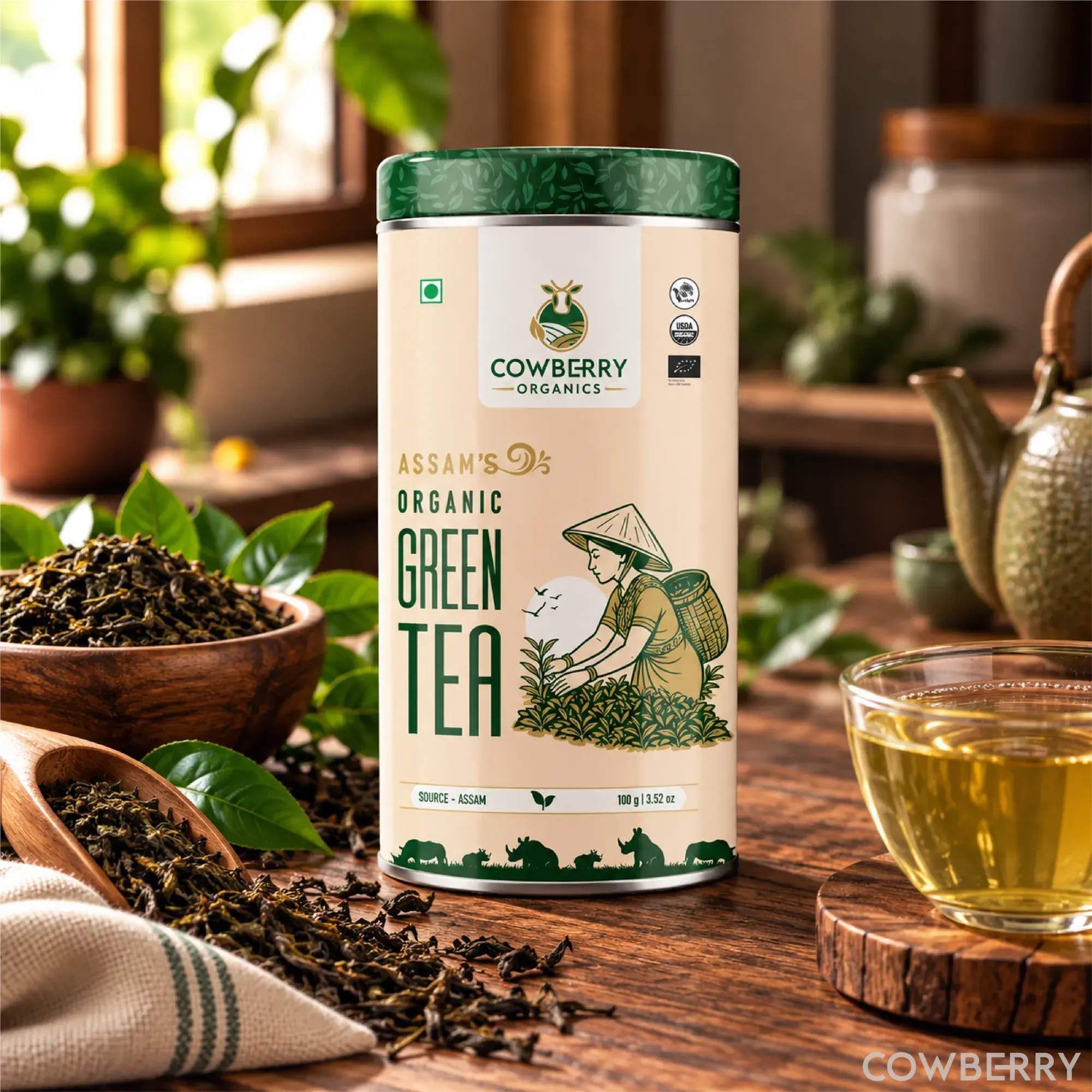
COWBERRY's green tea comes from organic gardens in Assam, hilly country with rich alluvial soil and abundant rainfall. The leaves used are whole young leaves, harvested and minimally processed to keep their natural green colour, with no artificial flavours or additives.
Beyond the cup, the same whole leaves go into the roti, porridge, oatmeal and iced tea methods on the green tea recipes page; the everyday brewing questions sit on the how to use green tea page.
FAQs
What is green tea leaves in hindi?
The leaves of green tea; chai is the Hindi word for tea. The Indian Food Composition Tables of 2017 do not list green tea, so no official Hindi name for the leaf exists in them. COWBERRY's pack carries the English name, Organic Green Tea.
What is green tea?
Green tea is the minimally processed leaf tea of the plant Camellia sinensis; a 2020 Cochrane review notes that teas from the plant group into green, black and oolong. Green leaves are minimally processed, so the leaf keeps its natural green colour and a delicate, clean cup.
What is green tea leaves?
The dried leaves of the green tea plant. COWBERRY's pack holds whole young leaves from organic gardens in Assam, minimally processed, with no artificial flavours, colours or preservatives, so what is in the pack is leaf and nothing else.
Does green tea have caffeine?
Yes. The ICMR-NIN dietary guidelines print 30 to 65 mg of caffeine in a 150 ml cup of tea, which is below the 80 to 120 mg they print for a cup of brewed coffee. The same guidelines ask for moderation so that a day's caffeine stays within the tolerable limit of 300 mg.
Why is green tea called green tea?
Because the leaf stays green. Green tea leaves are minimally processed after harvest, keeping their natural green colour, while black tea leaves are allowed to oxidise until dark. The name describes the leaf in the cup, not an added colour or flavour.
References
- Indian Food Composition Tables (IFCT) 2017, ICMR-National Institute of Nutrition
- Filippini T, Malavolti M, Borrelli F et al. Green tea (Camellia sinensis) for the prevention of cancer. Cochrane Database Syst Rev, 2020
- Dietary Guidelines for Indians, ICMR-National Institute of Nutrition
- USDA FoodData Central
Shop this article
Keep reading
Coffee vs tea: caffeine, benefits and which is better
Coffee calories per 100g: powder, beans and filter coffee

Coffee in pregnancy: how much caffeine is safe