by COWBERRY

8 minute read
Are green tea leaves safe to eat? Benefits and how to eat them

Green tea leaves safe to eat? Most likely, in small food amounts, though no study has tested eating the leaf itself. A 2018 safety review of human studies found liver-related adverse events only with concentrated preparations in large bolus doses, not with brewed tea or tea taken as part of food. Here is what that means, what the leaves carry per 100 g, and how to eat them.
Are green tea leaves safe to eat? What the safety review found
Probably, in food-sized amounts. The safety evidence sits in a 2018 systematic review that covered toxicology studies and 159 human intervention studies on green tea and its preparations. Its toxicology side pointed to the liver as the organ most affected, with the harm linked to how the dose was given, for instance as a gavage bolus or on an empty stomach, and growing with total catechin and EGCG content. The human side matched: liver-related adverse events showed up only with a narrow group of concentrated preparations rich in catechins, swallowed as one large dose, and they did not show up for brewed tea, for extracts in beverages, or for tea consumed as part of food. The review studied green tea preparations rather than eating the whole leaf, so a leaf folded into a dish is only close to that last pattern, not tested by it. Food use and extract use are handled separately below.
What changes when you eat the leaf instead of brewing it
When you brew, you drink an infusion and the spent leaves go in the bin; when you eat, the whole leaf goes in. Dry leaf is what the pack panel measures; a brewed cup carries only what dissolves into the water, while eating takes the leaf's own solids along. The Indian food composition tables (IFCT 2017) list nothing for dry green tea leaves, so the numbers below come from the nutrition panel printed on COWBERRY's pack, per 100 g of dry leaf: 362.8 kcal of energy, 69.46 g of carbohydrates, 21.24 g of protein, 17.89 g of fibre, 468.6 mg of calcium, 18.8 mg of iron, 1744.2 mg of potassium, 63.4 mg of sodium and 7.08 mg of vitamin C. Those are per-100 g figures, and people eat tea leaves by the teaspoon, so a dish gets only a small part of each value. Our page on how green tea is made covers how the leaf is processed, and green tea calories per 100g explains the label on the pack.
Caffeine and tannins: the two things to watch
The leaf carries caffeine and tannins, the two things a brewed cup is known for. The dietary guidelines put a 150 ml cup of brewed tea at 30–65 mg of caffeine and call for moderation so caffeine does not pass 300 mg in a day; since the caffeine in the cup comes out of the leaf, eating the leaf brings caffeine along, so count the habit alongside your cups. Tannins are the second point. In a controlled trial, twelve healthy women ate the same iron-containing porridge meal three times. With tea alongside the meal, fractional iron absorption came to 3.6%; with tea held back until one hour after the meal, absorption stayed at 5.7%, matching the meal with water, and the authors reported the difference as significant (P = 0.046). The tea's inhibitory effect dropped by roughly half, from 37.2% to 18.1%. The trial used brewed tea, not eaten leaf, so for leaves this is a sensible carry-over rather than a tested rule: keep them an hour away from iron-rich meals. The dietary guidelines likewise advise tea and coffee at least one hour before and after meals. The guidelines also note that tea carries theobromine, theophylline, flavonoids and other polyphenols, and they say these benefits come through best when tea is taken without milk and in moderation.
Simple ways to eat green tea leaves
The dishes on our green tea recipes page are the easy routes: roti, porridge, oatmeal and iced tea, with full quantities and steps for each. Grind the dry leaves to a fine powder in a dry grinder and pass it through a fine sieve, so the leaf does not stay chewy. A clean spice grinder does this in seconds, and the sieve keeps the last stem bits out of the dough. Knead a teaspoon of the powder into the dry atta before adding water, so it spreads evenly through roti or paratha, where the leaf speckles the dough. Stir a pinch into porridge or oatmeal while it cooks, or sprinkle the powder over a finished bowl. Green tea is usually a little bitter, so start with less and build the amount by taste.
How much leaf is sensible?
No source prints a daily amount for eaten green tea leaves. The safe-intake figure in the safety review, 338 mg of EGCG a day, belongs to concentrated preparations taken as a solid bolus dose, not to leaves eaten in food, so it does not transfer to teaspoons of leaf. The recipes here use a teaspoon of ground leaf in a dish, which is a small, food-sized amount, but no source sets it as a limit. Count the caffeine from the leaf together with your cups, and keep the day's total within the 300 mg a day the guidelines print as the tolerable limit.
Green tea leaves vs green tea extract: not the same thing
Whole leaves and extract sit on opposite sides of the safety review's dividing line. Extract means the concentrated, catechin-rich preparations that produced dose-dependent liver-related adverse events when swallowed as one large dose; the leaf folded into dough is nearer to the tea-as-part-of-food pattern, where the review found no such events, though it did not test whole leaves. For a solid bolus dose the review's safe intake is 338 mg of EGCG each day, derived from toxicological and human safety data, and its observed safe level for the beverage form sits higher, at 704 mg of EGCG each day. Eating leaves involves neither kind of dose. How much catechin actually reaches the body is, in the review's words, the key determinant of whether liver problems occur and how bad they get. Our page on green tea extract explains the difference in full.
Buying and keeping green tea leaves you plan to eat
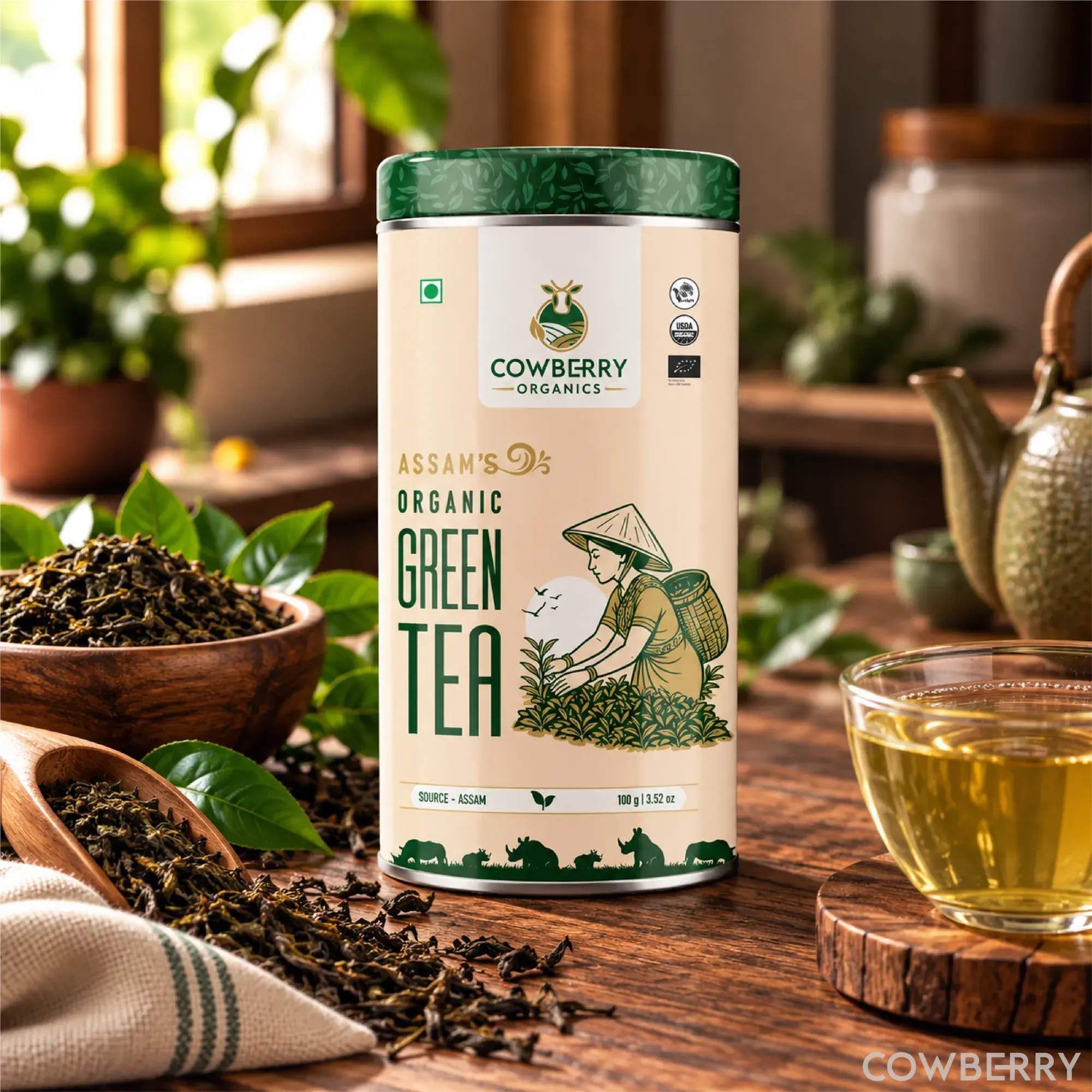
Because the whole leaf goes into the food, choose leaves grown without synthetic chemicals. COWBERRY's green tea, which is India Organic, USDA & EU certified, is organically grown in Assam from whole young leaves, minimally processed, with no artificial flavours or additives. Store the leaves the way you would store tea for brewing: a sealed container, somewhere cool and dry, out of direct sunlight, away from moisture, and well away from anything strong-smelling. Our page on whether green tea leaves expire covers shelf life in detail, and green tea leaves vs tea bags compares loose leaf with what is inside a bag.
The bottom line
Eaten by the teaspoon in dough, porridge or oatmeal, green tea leaves bring the whole leaf into the food, along with the caffeine and polyphenols a brewed cup carries. The cautions are ordinary ones: keep the day's caffeine total in mind, and keep the leaves an hour away from iron-rich meals. Used that way, tea leaves are a garnish food, not a supplement. For everything else about the drink itself, start at the green tea hub, which links the full set of green tea pages.
FAQs
Are green tea leaves edible?
Yes, the leaves are edible. The 2018 safety review found liver-related adverse events only with concentrated, catechin-rich preparations taken as large bolus doses, not with brewed tea or tea consumed as part of food. It did not test eating the whole leaf. Eat the leaves ground into dough or stirred through porridge, in small amounts.
Is eating green tea leaves good for you?
It takes in the whole leaf rather than just a brew of it. Per 100 g of dry leaf the COWBERRY pack prints 362.8 kcal of energy, 21.24 g of protein, 17.89 g of fibre, 468.6 mg of calcium and 18.8 mg of iron, though a teaspoon-sized serving contributes only a small part of each value.
Can green tea leaves be eaten?
Yes. Dry leaves work best because they grind to a fine powder; knead the powder into roti dough, stir it into porridge or oatmeal, or pick the steeped leaves out of the cup afterwards and add them to the same bowl. Start with a small amount, since green tea is usually a little bitter.
Can you eat green tea leaves after making tea?
Yes, the leaves from a brewed cup can be eaten. The safety review found liver-related events only with large bolus doses of concentrated preparations, not with brewed tea; it did not look at eating spent leaves. Fold them into dough or porridge if you want to use them up, in small amounts.
Can pregnant women eat green tea leaves?
Pregnancy advice from the NHS is to keep total caffeine under 200 mg a day, with a cup of green or black tea counted at 75 mg. Eaten leaves carry caffeine from the same leaf, so count them into that 200 mg; the NHS page notes that too much caffeine has been linked to a higher chance of miscarriage and stillbirth. If unsure, talk to your midwife or doctor.
How do you eat green tea leaves?
Grind dry leaves to a fine powder and knead a teaspoon into atta dough for roti or paratha, or stir a pinch into porridge or oatmeal while it cooks. Green tea is usually a little bitter, so start small and build by taste. Full quantities and steps for roti, porridge, oatmeal and iced tea are on the green tea recipes page.
References
- Hu J, Webster D, Cao J et al. The safety of green tea and green tea extract consumption in adults - Results of a systematic review. Regul Toxicol Pharmacol, 2018
- Dietary Guidelines for Indians, ICMR-National Institute of Nutrition
- Ahmad Fuzi SF, Koller D, Bruggraber S et al. A 1-h time interval between a meal containing iron and consumption of tea attenuates the inhibitory effects on iron absorption. Am J Clin Nutr, 2017
- NHS: foods to avoid in pregnancy (caffeine section)
Shop this article
Keep reading
Coffee vs tea: caffeine, benefits and which is better
Coffee calories per 100g: powder, beans and filter coffee
Coffee in pregnancy: how much caffeine is safe