by COWBERRY

6 minute read
Is green tea good for weight loss? What the evidence says

Green tea for weight loss is worth a careful look, because the best trial evidence is modest. A Cochrane review of randomised trials found a small, statistically non-significant weight loss in overweight and obese adults. Here are those numbers, the calories that sugar and honey add to a cup of green tea, and how much to drink.
Short answer: is green tea good for weight loss?
No, not in a way you can count on. A 2012 Cochrane review pooled randomised trials of at least 12 weeks in overweight or obese adults. The studies run outside Japan gave a mean difference in weight loss of -0.04 kg (95% CI -0.5 to 0.4; P = 0.88; 532 participants). The eight studies run in Japan were too different to pool; their results ranged from -0.2 kg to -3.5 kg (1030 participants), all favouring the green tea preparations. The review's own conclusion: a small, statistically non-significant weight loss that is not likely to be clinically important.
What the Cochrane review actually found
Beyond body weight, the review pooled the changes in body mass index and waist circumference from the trials run outside Japan. Body mass index moved by a mean of -0.2 kg/m2 (95% CI -0.5 to 0.1; 222 participants) and waist circumference by a mean of -0.2 cm (95% CI -1.4 to 0.9; 404 participants), while the waist-to-hip ratio showed no significant change (144 participants). Two maintenance studies with 184 participants showed a change in weight of 0.6 to -1.6 kg, which the review read as no significant effect on keeping weight off. Of the eight studies that recorded adverse events, four reported mild to moderate ones; two hospitalisations were reported as not associated with the intervention.
Green tea calories: where they come from
The Indian food composition tables (IFCT 2017) carry no entry for dry green tea leaves, so no per-100 g figure is printed for the leaf itself. What people stir into the cup is the energy you can actually count. One teaspoon of sugar (5 g) brings about 19 kcal, one teaspoon of honey (7 g) about 21 kcal, and two teaspoons of sugar in each of three cups means 30 g of sugar, or about 116 kcal over the day. Our green tea vs black coffee page compares the two drinks cup for cup, and green tea calories per 100g explains what the pack label prints.
How much green tea to drink and when
The dietary guidelines put brewed tea at 30–65 mg of caffeine per 150 ml cup and ask for moderation so the day's caffeine stays within 300 mg, the tolerable limit they print. Four 150 ml cups, at the top of that range, come to about 260 mg of caffeine. Timing matters for iron: in a controlled trial with 12 healthy women, tea drunk together with an iron-containing porridge meal cut fractional iron absorption from 5.7% to 3.6%, while tea drunk one hour after the meal left it at 5.7%. The guidelines therefore say to avoid tea for at least one hour before and after meals.
Green tea benefits for weight loss: the honest list
Strip away the marketing and the honest list is short. For weight loss itself, the pooled human evidence is the Cochrane review quoted above, and its mean difference was small and not statistically significant. What green tea does offer, per the dietary guidelines, is caffeine alongside flavonoids and other polyphenols; the guidelines say the benefits of tea come through best when it is taken without milk and in moderation. Those general points live on our green tea benefits page, and green tea ke fayde covers the same ground in Hindi.
Better and worse ways to drink it for weight loss
The better version is the plain one, because two teaspoons of sugar in every cup means about 39 kcal per cup before you have drunk anything. Brew the way the pack says: one teaspoon of leaves in water at 80–85°C, steeped for 2–3 minutes. The worse versions are the concentrated ones. A 2018 safety review found that a limited set of concentrated, catechin-rich preparations produced dose-dependent liver-related adverse events when taken as large bolus doses, which did not happen with brewed tea. That warning belongs to green tea extract, not to your cup. For ideas beyond the plain drink, green tea recipes has roti, porridge, oatmeal and iced tea.
What to avoid while using green tea for weight loss
A few habits actively work against you. Do not stir sugar or honey into every cup; the energy arithmetic in the calories section above runs away quickly. Do not chase a stronger effect with concentrated green tea preparations, because the safety review traced the liver problems in the literature to large bolus doses of catechin-rich preparations rather than to brewed tea. And do not count cups of green tea as a stand-in for everything else you eat and drink; the Cochrane trials compared green tea preparations with a control, and their net effect was the small, non-significant difference already described.
Talk to your doctor or dietitian
Green tea is a drink, not a weight-loss programme, and this page has kept to what the trials and the guidelines actually say. The Cochrane review is one piece of evidence among many in any personal plan. If you take medicines, live with a health condition, or are planning a diet around weight loss, talk to your doctor or dietitian about how tea fits into it.
FAQs
Does green tea reduce belly fat?
The pooled trials in the Cochrane review did not show green tea shrinking the belly. The studies that measured waist circumference outside Japan recorded a mean difference of -0.2 cm (95% CI -1.4 to 0.9), and the interval runs from 1.4 cm smaller to 0.9 cm larger, so the result was not statistically significant.
Does green tea reduce weight?
Only barely, in the trials. Outside Japan the pooled mean difference was -0.04 kg over 12 to 13 weeks, with a 95% confidence interval from -0.5 kg to 0.4 kg, which the review called a small, statistically non-significant loss that is not likely to be clinically important.
Which green tea is best for weight loss?
The Cochrane review did not rank types of green tea, so the evidence gives no variety an edge for weight loss. The 2018 safety review traced liver concerns to concentrated, catechin-rich preparations taken as large bolus doses, not to brewed tea, and the sugar or honey you add is the energy in the cup that can be counted.
Does green tea have caffeine?
Yes. The dietary guidelines put brewed tea at 30–65 mg of caffeine per 150 ml cup, and they ask for moderation so the day's caffeine stays within 300 mg, the tolerable limit they print. Four cups at the top of that range come to about 260 mg.
Is green tea leaves good for weight loss?
The trial evidence is for green tea preparations, and even those gave only a small, non-significant loss. Eating the leaves means taking the whole leaf instead of a brew, and the weight-loss evidence does not get any stronger that way. See our page on whether green tea leaves are safe to eat.
How much green tea per day for weight loss?
The trials ran for 12 to 13 weeks with varying preparations, and the review prints no per-day amount linked to a bigger loss. The dietary guidelines ask for moderation within 300 mg of caffeine a day, and for tea to be kept at least one hour away from meals because tannin interferes with iron absorption.
References
- Dietary Guidelines for Indians, ICMR-National Institute of Nutrition
- Jurgens TM, Whelan AM, Killian L et al. Green tea for weight loss and weight maintenance in overweight or obese adults. Cochrane Database Syst Rev, 2012
- Ahmad Fuzi SF, Koller D, Bruggraber S et al. A 1-h time interval between a meal containing iron and consumption of tea attenuates the inhibitory effects on iron absorption. Am J Clin Nutr, 2017
- Hu J, Webster D, Cao J et al. The safety of green tea and green tea extract consumption in adults - Results of a systematic review. Regul Toxicol Pharmacol, 2018
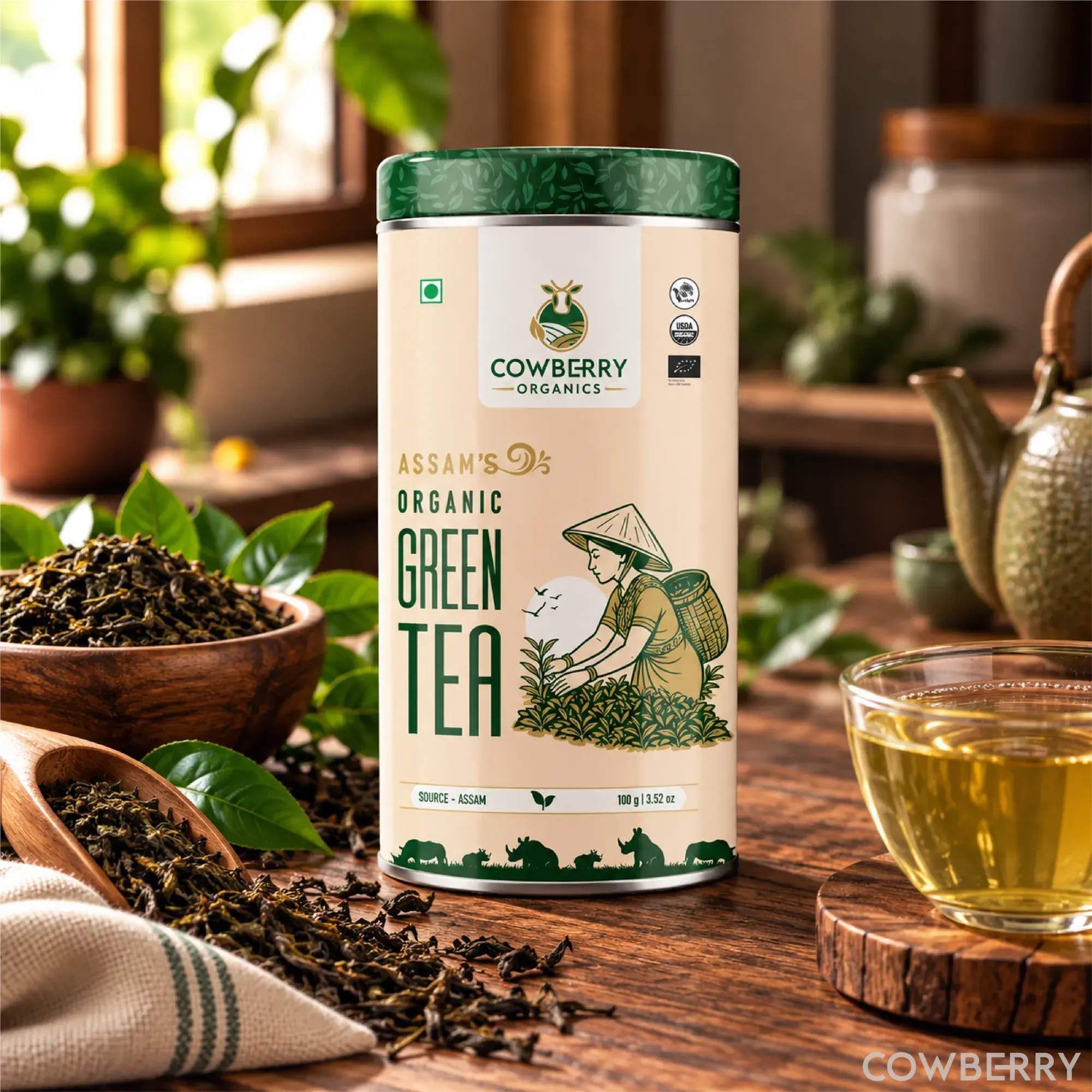
Shop this article
Keep reading
Coffee vs tea: caffeine, benefits and which is better
Coffee calories per 100g: powder, beans and filter coffee
Coffee in pregnancy: how much caffeine is safe