by COWBERRY

8 minute read
Which loose leaf tea is best? Types of tea and how to choose

Which loose leaf tea is best? The one that matches the cup you drink: strong Assam CTC for milk chai, whole-leaf orthodox for a plain black cup, and light green tea when you want no milk at all. No type wins in the abstract; taste, strength and process differ, and the match with your habit decides. Each type, and how to choose between them, follows.
Which loose leaf tea is best? Match the type to your cup
The honest answer to which loose leaf tea is best is that there is no single best: the best tea is the one made for how you drink it. The packs themselves spell out the split. CTC tea is processed into small granules and brews stronger and bolder — its pack says the full-bodied taste is for those who enjoy a stronger tea flavour. Orthodox tea is rolled whole leaf with a smoother, more layered flavour and a delicate aroma, made for drinking plain. Green tea is minimally processed, light and delicate. So a milk-chai household is best served by CTC, a black-tea drinker by orthodox, and a light-cup drinker by green tea. The two comparisons with the most detail — CTC tea vs orthodox tea and orthodox tea vs green tea — take each pairing further.
The main types of chai patti: CTC, orthodox, green tea and dust
CTC tea
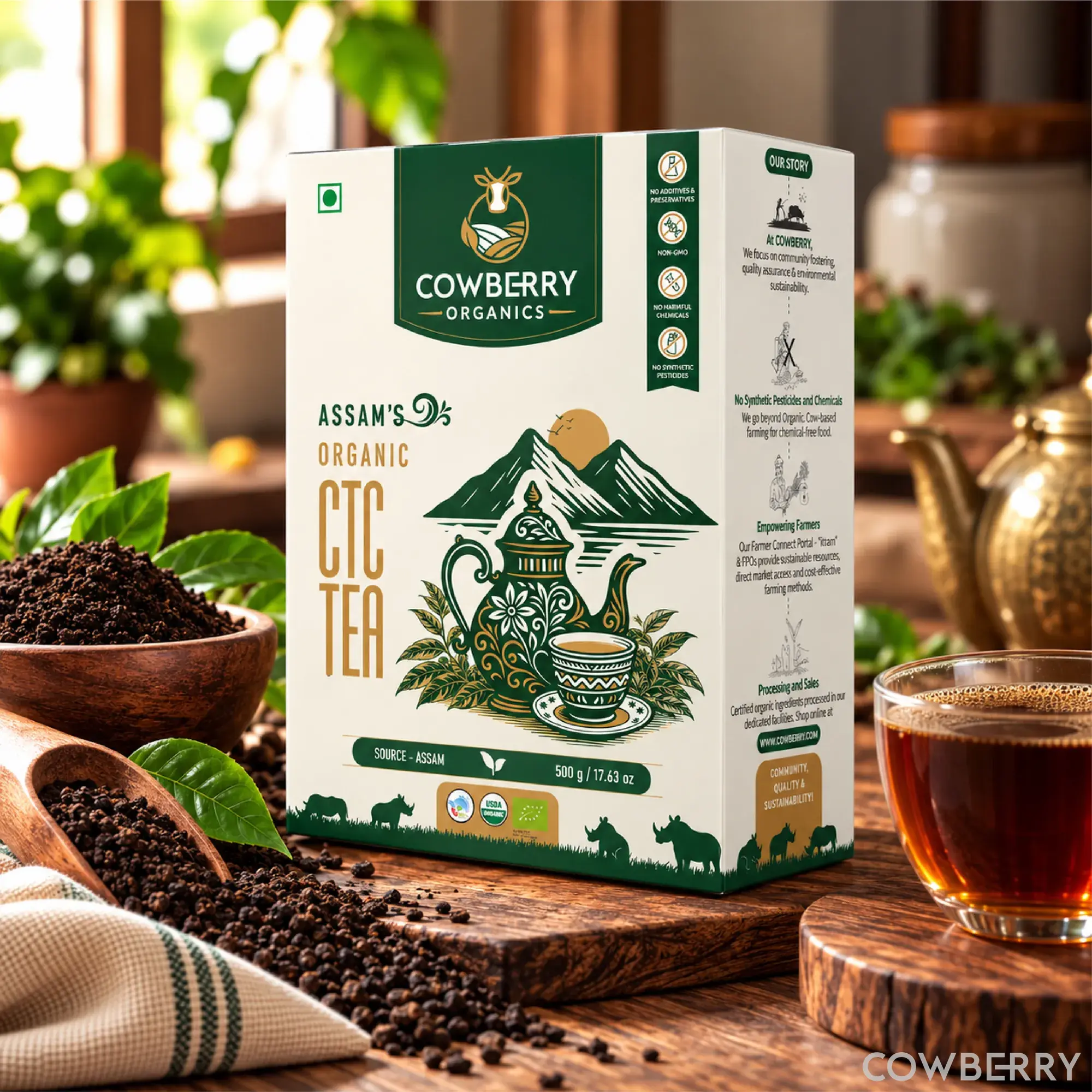
Crush, tear and curl: the leaves are cut, torn and curled into small, uniform pellets, which brew strong, bold and dark. COWBERRY's CTC comes from Assam's tea gardens, and the pack promises a strong, full-bodied cup.
Orthodox tea
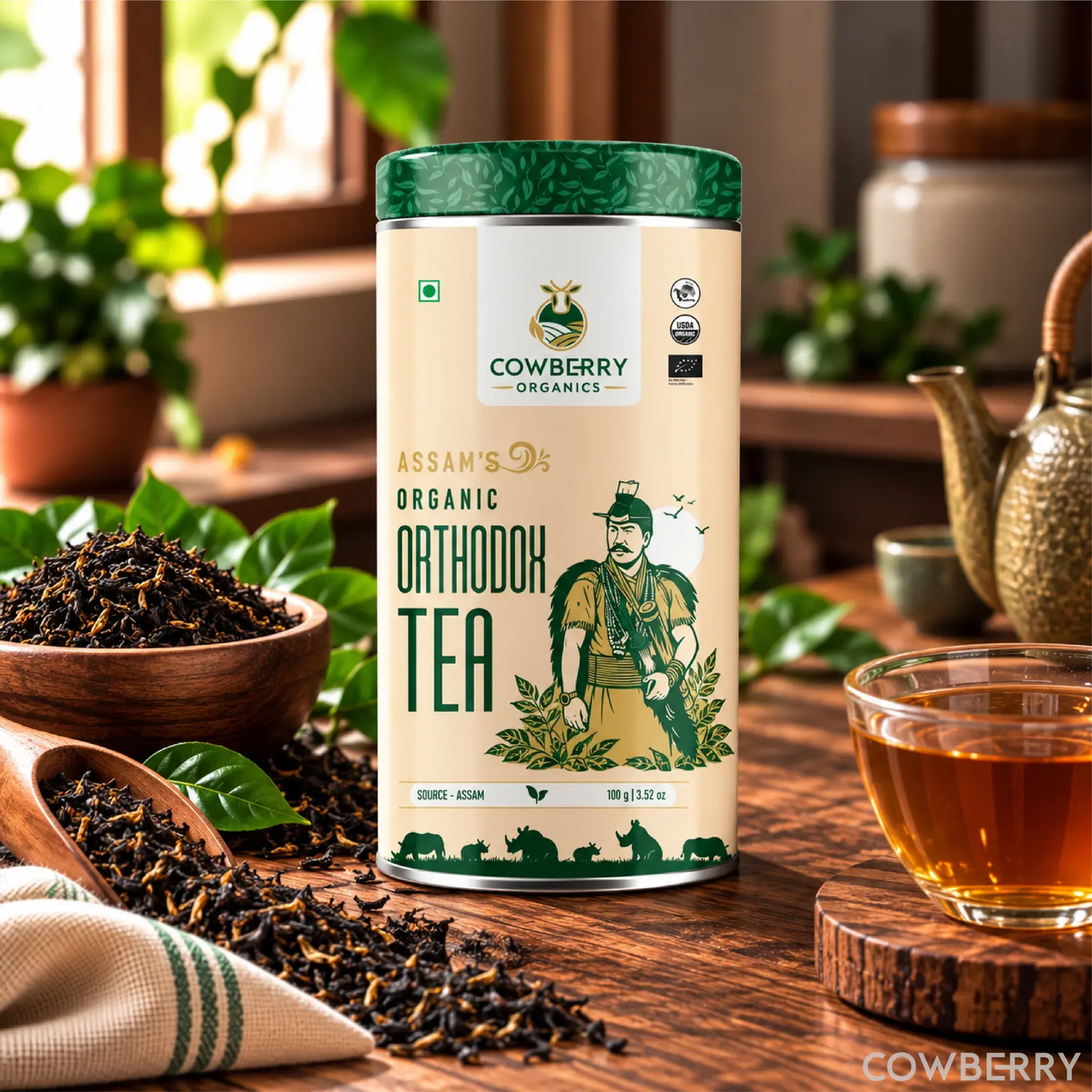
Whole leaves are rolled the traditional way instead of being crushed. COWBERRY's orthodox tea is handpicked in Assam and processed by that orthodox method; the pack describes a smoother, more layered flavour and a delicate aroma.
Green tea
Green tea is minimally processed, so the leaf keeps its green colour and fresh taste. COWBERRY's green tea is organically grown in Assam and minimally processed.
Dust tea and tea bags
Dust tea and tea bags round out the shelf, and each gets its own comparison — CTC tea vs dust tea and loose leaf tea vs tea bags — while this guide stays with the three types the packs describe. The whole tea shelf, from names to benefits, is on the chai patti hub.
Loose leaf tea: whole leaves against CTC granules
Loose leaf tea is tea sold as whole leaves — COWBERRY's orthodox tea is described as a whole-leaf tea — and it is brewed loose in a pot or with a strainer, not packed into bags. CTC stands at the other end: the same leaf, cut into small pellets by machine. The form changes the brew. The orthodox pack says its flavours and aromas unfold gradually into a smooth cup, while the CTC pack talks of brewing efficiency and a full-bodied cup for those who enjoy a stronger tea flavour. That is why a whole-leaf cup and a CTC cup are brewed differently, as the next two sections show. The process in full is on what is CTC tea, and the orthodox side on what is orthodox tea.
How the processing decides the type
One leaf, three processes, three teas. Black tea is oxidised fully, which deepens the colour and the strength; green tea skips that stage, so the leaf stays green and the cup stays light. Within black tea the split is mechanical: CTC machines crush, tear and curl the leaf into pellets, while orthodox processing rolls whole leaves the traditional way. That is why CTC and orthodox are both black teas and yet brew so differently. The journey from plucked leaf to granules is traced step by step on how chai patti is made.
How to brew each type of tea
The printed instructions differ by type. Orthodox tea: one teaspoon in water at 90 to 95°C, steeped for 3 to 5 minutes, then strained; the full method with water temperature and timing is on how to make orthodox tea. Green tea: one teaspoon in water at 80 to 85°C for 2 to 3 minutes, and the pack warns against boiling water, which can make the cup bitter. CTC prints no water temperature or steeping time, because CTC is usually boiled into chai rather than steeped; the classic brew is our chai recipe and the spiced one is masala chai, with more ideas in loose leaf tea recipes.
How to choose chai patti for chai
For the milk-chai habit, choose CTC: the crush-tear-curl pellets brew the strong, full-bodied cup the pack puts first. COWBERRY's CTC comes from Assam — the region its description calls the heartland of Indian tea — and it is sold in the larger packs of the three, 500 g and 1 kg, sized for a house that brews chai every day. For a plain black cup, pick orthodox in its 100 g pack; for a light, no-milk cup, pick green tea, which comes in 100 g and 500 g packs. Which chai patti is best in India comes down to the same match: the leaf that suits how you drink it. No pack or table prints a ranking of grades to lean on, so choose by leaf form and strength. The Indian food composition tables (IFCT 2017) carry no entry for dry tea leaves, so no per-100 g numbers appear here; the choice between types is about taste, strength and leaf form.
What the research says across tea types
Across all types, a 2024 meta-analysis of thirty-eight cohort data sets associated regular tea drinking with lower death risk from all causes, with the greatest reduction around two cups a day and nothing further beyond it. Ten randomised trials pooled in 2015 measured black tea's effect on blood fats: LDL cholesterol down by about 4.64 mg/dL, total and HDL cholesterol unchanged. One is an association and one a measured effect; both are averages across tea drinkers, not promises, and neither ranks one tea type above another — which leaves the choice where it belongs: with your cup and your habit.
Buying: what to look for on the pack
If organic matters to you, look for a certification mark on the pack; a word like natural alone certifies nothing, and the FSSAI's advertising and claims regulations govern how such words may be used. COWBERRY's CTC tea and orthodox tea are India Organic, USDA & EU certified, and its green tea comes from organically grown Assam gardens.
Which type of tea has the most caffeine?
The packs themselves point at the answer. The CTC pack lists caffeine among the tea's features; the green pack puts the caffeine as moderate and lighter than coffee; the orthodox pack prints strength and flavour, and no caffeine claim at all. None of the packs prints a per-cup figure, and the per-cup numbers belong to the dedicated page — does CTC tea have caffeine carries them, along with how tea compares with coffee, cola and chocolate. One thing the green pack notes: lighter than coffee does not mean caffeine-free, so a green cup still carries its share.
Storing chai patti: dry, airtight and away from smells
The packs print one storage rule for the teas: store the tea airtight and dry, out of direct sunlight, away from moisture and strong smells. Strong smells matter: the packs say keep the tea away from strong odours to preserve its freshness and aroma, so the spice shelf is the wrong neighbour. Buy only what you will brew in a reasonable stretch, since an opened pack fades in aroma and freshness. How long chai patti keeps and the signs of a pack past its best are on how long chai patti keeps.
FAQs
Which loose leaf tea is best?
The best loose leaf tea is the one matched to your cup: CTC for strong milk chai, orthodox for a plain black cup, green tea for a light no-milk brew. The packs themselves split it that way — CTC as the strong, full-bodied leaf and orthodox as the smooth, layered whole leaf — so choose by how you drink, not by a ranking.
Which chai patti is best in taste?
Taste is the strongest reason the types differ. CTC brews strong, bold and full-bodied, made to stand up to milk; orthodox rolls whole leaves into a smoother, more layered cup with a delicate aroma. For milk chai, choose the strong CTC cup; drunk plain, orthodox is the smoother choice.
Is CTC tea low quality?
No. CTC is a different process, not a lower grade: the leaves are crushed, torn and curled into pellets that brew strong and bold, which is exactly what milk chai needs. Orthodox is the same leaf handled differently, for a different cup. One is not above the other; they are made for different brews.
What is CTC tea?
CTC tea is black tea made by the crush-tear-curl process, which cuts tea leaves into small, uniform pellets. It brews strong, bold and dark, which makes it the standard chai leaf. COWBERRY's CTC comes from Assam; the full process is on what is CTC tea.
What is orthodox tea?
Orthodox tea is black tea made the traditional way: whole leaves are rolled rather than crushed, so the cup is smoother and more layered, with a delicate aroma. It is the loose leaf for a plain cup. COWBERRY's orthodox tea is handpicked in Assam and processed by that method.
What is loose leaf tea?
Loose leaf tea is tea sold as whole leaves, brewed loose in a pot or infuser rather than packed into bags. COWBERRY's orthodox tea is a whole-leaf tea — the form in which its flavours unfold gradually — and its green tea is minimally processed leaf. CTC, by contrast, is the same leaf crushed into pellets.
Which CTC tea is best for chai?
For chai, an Assam CTC brewed strong is the match: the pellets give a bold, full-bodied cup that stands up to milk. COWBERRY's CTC comes from Assam's tea gardens in 500 g and 1 kg packs, sized for a daily chai habit. Pick by freshness and how you brew; the packs and tables print no grade ranking.
References
- Kim Y, Je Y. Tea consumption and risk of all-cause, cardiovascular disease, and cancer mortality: a meta-analysis of thirty-eight prospective cohort data sets. Epidemiol Health, 2024
- Zhao Y, Asimi S, Wu K et al. Black tea consumption and serum cholesterol concentration: Systematic review and meta-analysis of randomized controlled trials. Clin Nutr, 2015
- FSSAI Food Safety and Standards (Advertising and Claims) Regulations 2018, compendium (PDF)
Shop this article
Keep reading
Coffee vs tea: caffeine, benefits and which is better
Coffee calories per 100g: powder, beans and filter coffee

Coffee in pregnancy: how much caffeine is safe