by COWBERRY

8 minute read
What is orthodox tea? Meaning, process and how it differs

What is orthodox tea? It is black tea finished the traditional way: whole leaves, hand-picked and rolled with care so the leaf stays in one piece, giving a smooth, layered cup that many drink plain. This page explains the orthodox tea meaning, the whole-leaf process and how orthodox differs from CTC.
What does orthodox tea mean?
Orthodox means the traditional way of finishing a tea leaf. Where CTC machines cut the leaf into pellets, the orthodox method keeps the leaf whole: it is picked, then carefully rolled, and the rolling is what preserves the leaf's natural flavour, aroma and character. That is the orthodox tea meaning in English, and it is why the tea is sold as whole leaf black tea. In shops it also turns up under names like whole leaf tea, loose leaf black tea or estate tea, but the leaf inside is the same rolled whole leaf.
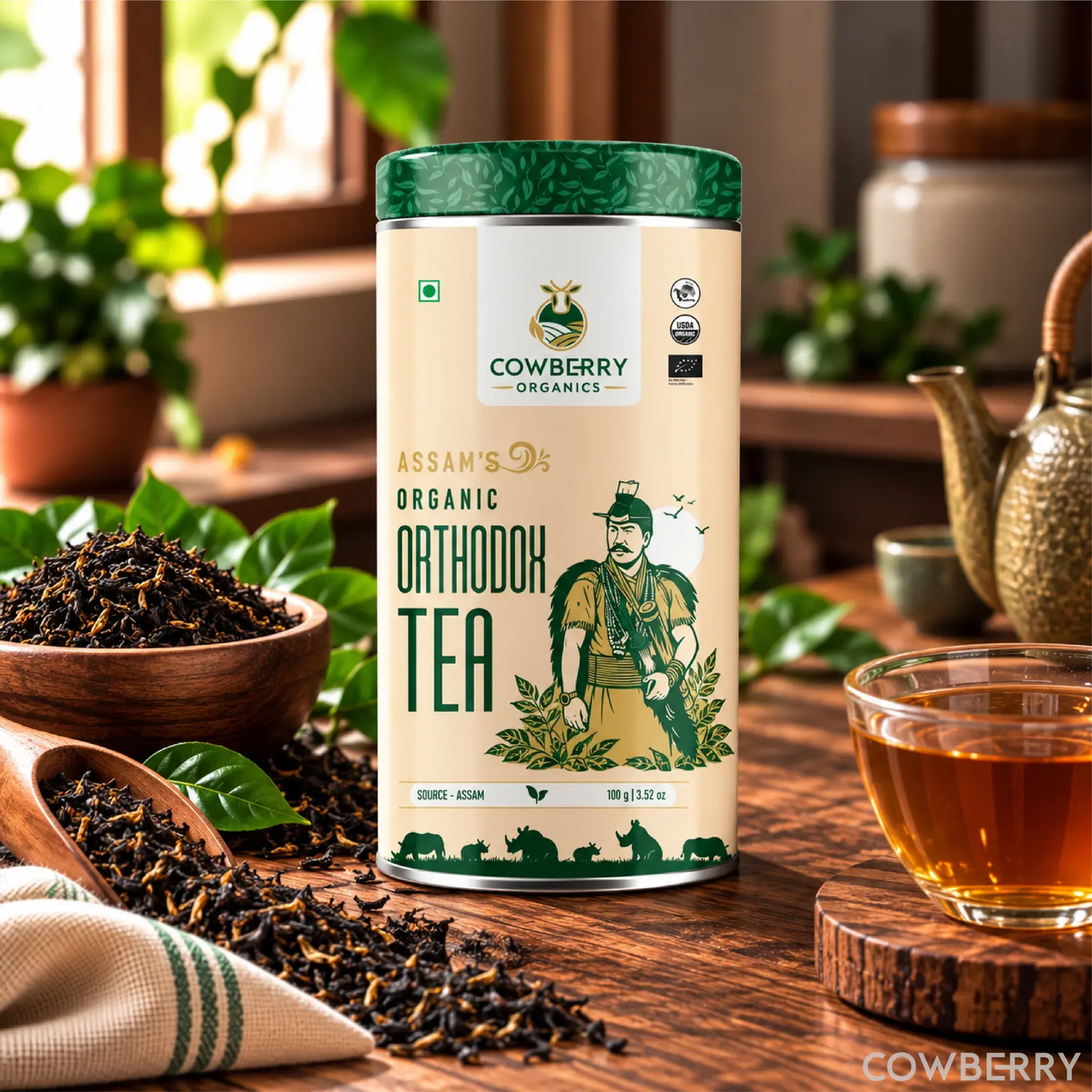
The word sits opposite CTC, the machine method worked out in the 1930s; orthodox is the older, traditional way, and the pack itself is sold as a premium whole leaf black tea. COWBERRY's orthodox tea is grown in the tea gardens of Assam, where traditional tea-making methods have been practised for generations, and the pack carries 100 g of rolled whole leaves. Look inside the pack and the method shows at once: long, whole, rolled leaves, not granules.
How orthodox tea is made: hand-picked and rolled whole
The orthodox route is slower and hands-on at every stage. The leaf is hand-picked in Assam, then the whole leaves are rolled rather than cut, and the rolling is careful work: the process develops the leaf's aroma, layered flavour and balanced strength. What comes out of the rollers is still recognisably a leaf, rolled and dry, not a pellet. The result is the balanced strength that sets orthodox apart from conventionally processed varieties, the pack's own words for the difference.
Because the leaf is left whole, its flavours and aromas unfold gradually in the cup instead of arriving all at once. The tea is organically grown in Assam without synthetic pesticides, and the finished pack holds only the rolled leaves, processed to retain their natural aroma, texture and flavour. No flavours, colours or preservatives go in: the pack is 100% organic whole tea leaves.
Orthodox tea vs CTC tea: whole leaf against machine pellets
The same contrast runs through every cup. The orthodox route keeps whole leaves, carefully rolled, so the cup is smoother, more layered and delicately scented, while the CTC route cuts the leaf into small granules for a stronger, bolder brew. Put the two side by side in a bowl and the difference is plain: long rolled leaves on one side, small even pellets on the other. Pack sizes mirror the habit: the orthodox box holds 100 g for the occasional plain cup, while the CTC bag comes in 500 g or a kilogram, sized for a kitchen that boils chai daily.
In practice the split is simple: CTC is the leaf for the strong, milky chai brewed every day, while orthodox is the leaf for the plain cup where the tea itself is the point. Which one suits whom, and how the two compare in taste and daily use, is laid out on the CTC tea vs orthodox tea page, while the machine method gets its own guide, what is CTC tea. For tea's other names and its nutrition, begin at the chai patti hub; for the whole family of styles, which loose leaf tea is best covers the shelf.
What orthodox tea tastes and smells like
The pack describes the cup as smooth and balanced, with a rich aroma, subtle malty notes and a naturally refreshing finish. The whole-leaf preparation is what lets the delicate flavours and aromas unfold gradually, so the cup builds gently, smoother than the bold hit of CTC, while still carrying a balanced strength. The same smoothness is why the pack calls it an elegant infusion with exceptional depth, a whole leaf black tea from the tea gardens of Assam.
That easy character also makes it a tea for any hour: the pack's own guidance says the smooth flavour suits both morning and evening tea breaks. Smooth as it is, the cup still carries the balanced strength of a black tea, so it stands well on its own without milk; the pack suggests drinking it plain, with lemon, or with honey, for the water temperature, the leaf amount and the steeping times that bring this out, see how to drink orthodox tea.
Is orthodox tea good for health? What the research says
Orthodox tea is black tea, and the health research on tea does not split the two processing styles, so the black tea findings are the relevant ones. The pooled analysis published in 2024 covered thirty-eight cohort data sets and close to two million people; the heaviest tea drinkers showed lower death rates from any cause, from heart and vessel disease and from cancer, with the advantage peaking around one and a half to two cups a day. The strongest numbers sat at about two cups a day when the outcome was death from any cause, and at one and a half cups a day for cancer deaths; more tea beyond that added little. The result is an association, not a proven cause.
For cholesterol, trials pooled in 2015 — ten randomised ones — recorded a drop in LDL of roughly 4.64 mg/dL from black tea, a small but real shift, while total and HDL barely budged; the clearest response showed in people already carrying higher cardiovascular risk. Black tea also carries caffeine, and it locks up some of the iron in a meal before the body can take it, which is why the ICMR-NIN guidelines keep tea away for at least an hour before a meal, during it and soon after it. With the meal itself, fruits that carry vitamin C — guava, pineapple and citrus fruits — improve how much iron the body draws from plant foods. The same guidelines note that excess caffeine from drinks like tea and coffee can adversely affect fetal growth, so in pregnancy the advice is to minimize it; the day's limit is set out on chai patti in pregnancy. Both sides of the leaf are covered on chai patti benefits, and the caffeine numbers are on how much caffeine is in tea.
How to drink and store orthodox tea
For the cup, the pack guidance is simple: one teaspoon of leaves, water at 90-95 °C, a steep of three to five minutes, then strain; drink it plain, or add lemon or honey. Steep towards the five-minute end when you like it stronger and the three-minute end when you like it lighter, and many drinkers top up the pot with hot water for a second, lighter cup from the same leaves. The step-by-step method, with the common mistakes and a timing table, is on how to drink orthodox tea.
Between cups, seal the leaves back in their airtight pack, kept cool, dry and shaded, away from moisture and strong smells, so the freshness and aroma hold; see does chai patti expire for how long the pack stays good. When you buy orthodox tea, check that the leaves are whole and intact and, when organic matters to you, that the label carries a certification mark. COWBERRY's Organic Orthodox Tea is the hand-picked Assam whole-leaf tea of this guide, sold in a 100 g pack. For the milky version, Indian chai is built on CTC, and our chai patti recipe shows that pot.
FAQs
What does orthodox tea mean?
Orthodox names the traditional, whole-leaf way of processing black tea: the leaf is picked and carefully rolled rather than cut into pellets, and the rolling preserves its natural flavour, aroma and character. The word simply marks the older, traditional method against the machine-made CTC style.
Is orthodox tea black tea?
Yes. Orthodox tea is black tea made by the whole-leaf method, and the pack itself is labelled a whole leaf black tea. The word black names the style of the finished leaf, the dark tea that brews the familiar cup, while orthodox names the careful whole-leaf processing behind it. In short, the orthodox tea sold here is a black tea, though not every black tea is orthodox.
Is orthodox tea good for health?
What is shown is for black tea as a family: tea drinking was associated with lower mortality in a large 2024 cohort meta-analysis, and trials reviewed in 2015 found black tea slightly reduced LDL cholesterol. That research does not separate orthodox from CTC, so both share the same evidence; see chai patti benefits.
Does orthodox tea have caffeine?
Yes. Orthodox tea is black tea, and black tea leaves contain caffeine, so the cup carries it. The per-cup amounts for each tea style, and the limits to watch in pregnancy, are set out on our how much caffeine is in tea guide.
Is orthodox tea green tea?
No. Orthodox processing is a way of making black tea, and the orthodox tea here is sold as whole leaf black tea. Green tea is a different style made from whole tea leaves, minimally processed, with its own light character. How the two compare, from processing to caffeine, is on orthodox tea vs green tea.
What is Assam orthodox tea?
It is orthodox tea whose leaves come from the tea gardens of Assam, made the way those gardens have worked for generations. The leaf is hand-picked in Assam and rolled whole, and the tea is organically grown there without synthetic pesticides. COWBERRY's orthodox tea is exactly this, in a 100 g pack.
References
- Kim Y, Je Y. Tea consumption and risk of all-cause, cardiovascular disease, and cancer mortality: a meta-analysis of thirty-eight prospective cohort data sets. Epidemiol Health, 2024
- Zhao Y, Asimi S, Wu K et al. Black tea consumption and serum cholesterol concentration: Systematic review and meta-analysis of randomized controlled trials. Clin Nutr, 2015
- Dietary Guidelines for Indians, ICMR-National Institute of Nutrition
Shop this article
Keep reading

Coffee vs tea: caffeine, benefits and which is better
Coffee calories per 100g: powder, beans and filter coffee

Coffee in pregnancy: how much caffeine is safe