by COWBERRY

8 minute read
What is CTC tea? Meaning, how it is made and how it is used

What is CTC tea? CTC stands for Crush, Tear, Curl, the machine process that cuts whole tea leaves into small, even pellets, and these pellets are the chai patti behind the strong, malty cup of Indian milk chai and masala chai. This page explains the CTC tea meaning, how the pellets are made in Assam and how CTC differs from orthodox tea.
What does CTC stand for? The CTC tea meaning
CTC stands for Crush, Tear, Curl, the three actions the machines perform on the leaf. The CTC tea meaning in English is just that: instead of being rolled whole, the plucked leaf is passed through rollers that crush it, tear it and curl it into small, uniform pellets. What you spoon into the pot is these little granules of dry black tea, not whole leaves.
The method is believed to date to Assam in the 1930s: British tea planters, looking for a quick fix for machinery that was not working properly, hit on cutting, tearing and curling the leaf. COWBERRY's CTC black tea comes from the tea gardens of Assam, where rich alluvial soil, high humidity and abundant rainfall shape the leaf. In the cup, the pellet form reads as strength: the brew comes out full-bodied and deep-coloured. In the Indian kitchen the pellets are simply chai patti, the loose tea leaf every chai starts from.
How CTC tea is made: crush, tear, curl step by step
The route runs from the fresh Assam leaf to a sealed pack. The leaf goes to machines that crush it, tear it and curl it until what is left is not whole leaves but small, uniform pellets. The three actions together are the Crush, Tear, Curl method, the processing that gives the finished tea its strong, aromatic cup.
Straight after processing, the tea is sealed in air-tight packaging, so the flavour and freshness it left the factory with are still there when the pack is opened. The dry pellets in the tin are the finished chai patti, with no artificial flavours or additives. The leaf for this tea is plucked in the Assam gardens, where tea has been grown for over a century, and it is grown without synthetic pesticides, which is what the organic label on such a pack stands for. Because every pellet is cut to a small, even size, the dry tea also measures cleanly with a spoon.
What is CTC tea used for? Milk chai, masala chai and more
CTC tea is the leaf for a milky, strong cup. COWBERRY sells its CTC as a bold, brisk amber cup for milk tea and masala chai, and the CTC method's own story singles out milk tea lovers. The small pellets brew efficiently and give a full-bodied, deep-coloured cup that carries milk and spice well. The same pellets also pour a plain black cup when you want no milk at all, which is why the pack lists versatile brewing among the leaf's strengths.
Start with our chai patti recipe for the classic milky cup, or masala chai when you want ginger and spices in it. More ways with loose leaf tea are in the loose leaf tea recipes round-up. For the leaf's names and nutrition, start at the chai patti hub.
CTC tea vs orthodox tea: how the two processes differ
CTC and orthodox are the two routes from the tea leaf to the packet, and the difference starts with the machine. Orthodox tea keeps the leaf whole and rolls it with care, which is what gives the cup its smoother, more layered flavour and its delicate aroma. CTC tea is processed into small granules, which gives a stronger, bolder brew. One leaf, two textures: rolled whole leaves against even pellets. The packs tell the same story in another way: orthodox whole-leaf tea is sold in a small 100 g pack, while CTC comes in 500 g and 1 kg bags, sized for a household that brews chai every day.
The full contrast, with taste and which to choose, is on our CTC tea vs orthodox tea page, and the older, traditional method is explained in the guide to what is orthodox tea. If the fine dust at the bottom of a chai packet is what you are comparing, see CTC tea vs dust tea.
Is CTC tea good for health? What the studies say
CTC tea is black tea, and the research on tea covers it. A 2024 meta-analysis pooled 38 prospective cohort data sets covering about 1.96 million people and found that the heaviest tea drinkers had a lower risk of death from all causes, cardiovascular disease and cancer than the lightest drinkers, with the lowest risk sitting near two cups a day for all-cause mortality and one and a half cups a day for cancer mortality, with little extra gain beyond that. The authors read these as associations, not proof of cause.
On cholesterol, the trials reviewed together in 2015 — ten randomised ones with 411 participants between them — found regular black tea lowered LDL cholesterol by about 4.64 mg/dL, while total and HDL barely moved. The effect was small but real, and it showed more clearly in people at higher cardiovascular risk. The wider picture of chai patti benefits and its side effects has its own page.
Caffeine, iron and timing: how to drink CTC tea sensibly
Black tea is a caffeinated drink: the NHS estimates a cup of tea at about 75 mg of caffeine and, for pregnant women, sets a ceiling of 200 mg a day from all sources, because too much caffeine has been tied to a higher chance of miscarriage and stillbirth. Cup-by-cup numbers are on our guide to how much caffeine is in tea, and the pregnancy guidance in full is on chai patti in pregnancy.
Tea also binds the iron in food and makes less of it available to the body, which is why the ICMR-NIN dietary guidelines keep tea away for at least an hour before a meal, during it, just after it, and while taking iron-folic acid supplements. A 2017 controlled trial in 12 healthy UK women found that moving the tea to one hour after an iron-containing meal cut this blocking effect roughly in half: iron absorption measured 3.6 percent with tea at the meal and 5.7 percent with tea an hour later. That one-hour gap is the practical takeaway, especially for anyone watching their iron. The same guidelines suggest eating vitamin C rich fruits like guava, pineapple and citrus fruits with the meal itself, since these improve iron absorption from plant foods.
How to brew, store and buy CTC tea
CTC pellets brew a strong cup efficiently, which is what milk chai wants; our chai patti recipe walks through the classic pot, and masala chai adds ginger and spices. Brewed plain, the same pellets give an amber cup that is bold and brisk, the words the pack itself uses for the leaf. Keep the pack or tin shut tight in a cool, dry spot, away from moisture and strong-smelling shelves, and see does chai patti expire for shelf life.
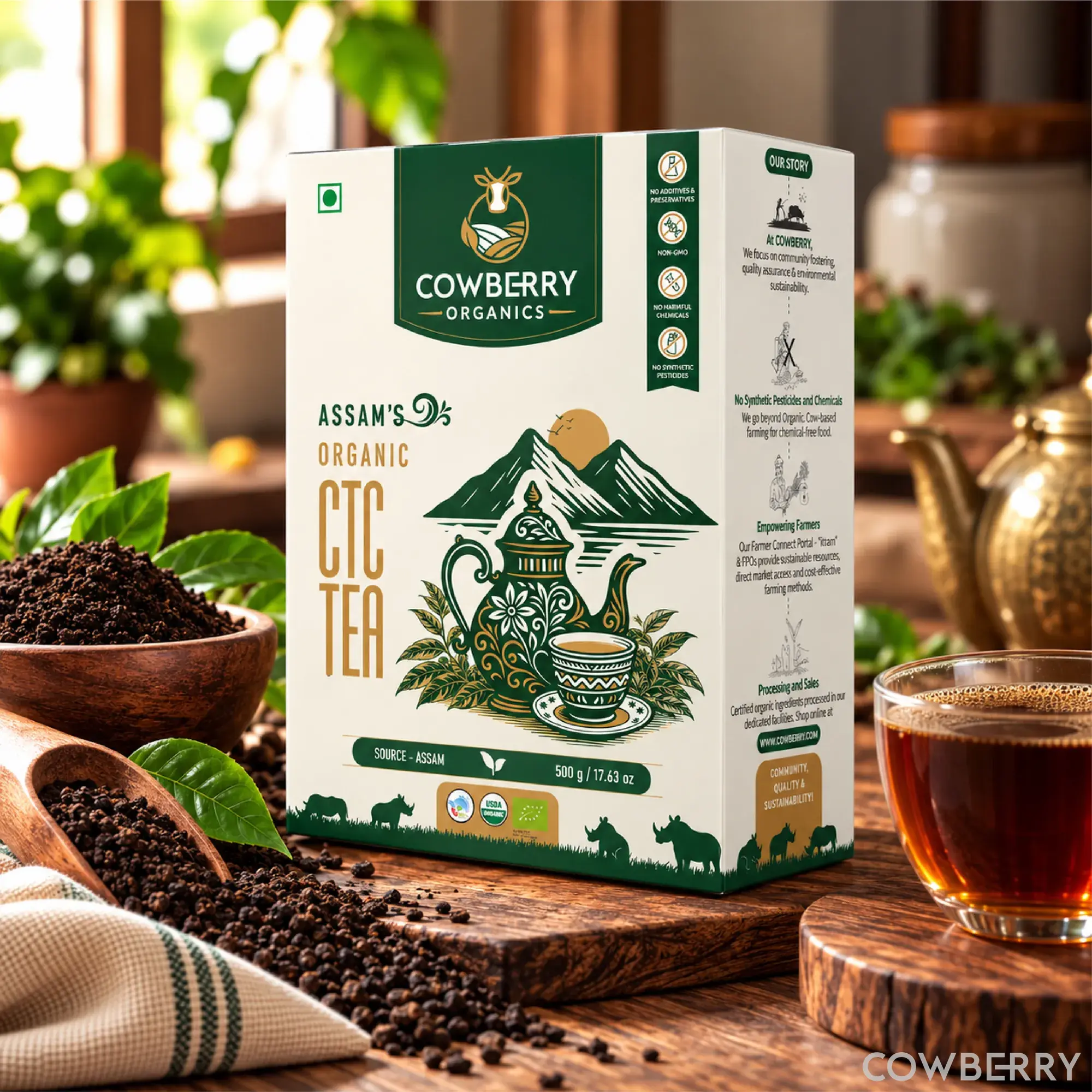
When you buy, look for uniform pellets and a clean, dry pack, and, if organic matters to you, a certification mark on the label. COWBERRY's Organic CTC Black Tea is the Assam CTC of this guide, organically grown without synthetic pesticides, sealed air-tight after processing and packed in 500 g and 1 kg bags.
FAQs
What does CTC tea stand for?
CTC stands for Crush, Tear, Curl. It names the machine method that crushes, tears and curls the plucked tea leaf into small, uniform pellets instead of leaving it as whole leaves. The pellet form is what makes the brew strong and full-bodied, and it is the leaf sold for milk tea and masala chai.
What is CTC tea powder?
CTC tea powder is the same CTC tea, named by its texture. Because the crush-tear-curl process leaves the leaf as small, uniform pellets, the dry tea looks granular, and shops often call it CTC powder or granules. Whatever the name on the pack, the leaf inside has been crushed, torn and curled, not rolled whole.
What is black CTC tea?
Black CTC tea is CTC tea made as a black tea: the leaf is processed into the dark, dry pellets that brew the strong amber cup. Black names the style of tea, the one Indian chai is made from, and CTC names the crush-tear-curl processing that gives the leaf its pellet form. It is the same tea as any CTC chai patti.
Is CTC tea good for health?
As black tea, it belongs to a family with some encouraging findings: a 2024 meta-analysis of 38 cohort data sets linked heavier tea drinking with lower death rates from all causes, cardiovascular disease and cancer, and a 2015 review of trials found black tea modestly lowered LDL cholesterol. These are associations, not proof of cause; the detail is on the chai patti benefits page.
Does CTC tea have caffeine?
Yes. CTC tea is black tea, and the cup carries caffeine. The NHS counts about 75 mg in a cup of black or green tea, and during pregnancy the advice is to stay within 200 mg a day across all drinks. For the full numbers, see how much caffeine is in tea.
Which loose leaf tea is best?
It depends on the cup you want. For a strong, milky chai, CTC is the leaf; for a smooth, layered cup drunk plain, orthodox whole leaves are the choice. The full run-down of styles, from CTC and orthodox to green tea, is on our guide to the types of tea and how to choose.
References
- Kim Y, Je Y. Tea consumption and risk of all-cause, cardiovascular disease, and cancer mortality: a meta-analysis of thirty-eight prospective cohort data sets. Epidemiol Health, 2024
- Zhao Y, Asimi S, Wu K et al. Black tea consumption and serum cholesterol concentration: Systematic review and meta-analysis of randomized controlled trials. Clin Nutr, 2015
- Ahmad Fuzi SF, Koller D, Bruggraber S et al. A 1-h time interval between a meal containing iron and consumption of tea attenuates the inhibitory effects on iron absorption. Am J Clin Nutr, 2017
- Dietary Guidelines for Indians, ICMR-National Institute of Nutrition
- NHS: foods to avoid in pregnancy (caffeine section)
Shop this article
Keep reading
Coffee vs tea: caffeine, benefits and which is better
Coffee calories per 100g: powder, beans and filter coffee

Coffee in pregnancy: how much caffeine is safe