by COWBERRY

14 minute read
Jaggery (gur): what it is, how it's made, nutrition, benefits and uses

Jaggery is unrefined cane sugar: whole sugarcane juice boiled down until it sets, molasses and all, known across North India as gur or gud. Per 100 g it gives 354 kcal, 4.63 mg iron and 107 mg calcium (IFCT 2017), minerals that white sugar loses in refining, yet for blood sugar it still counts as sugar. The sections below take its names, nutrition, benefits, limits, making, storage and buying.
What is jaggery (gur)?
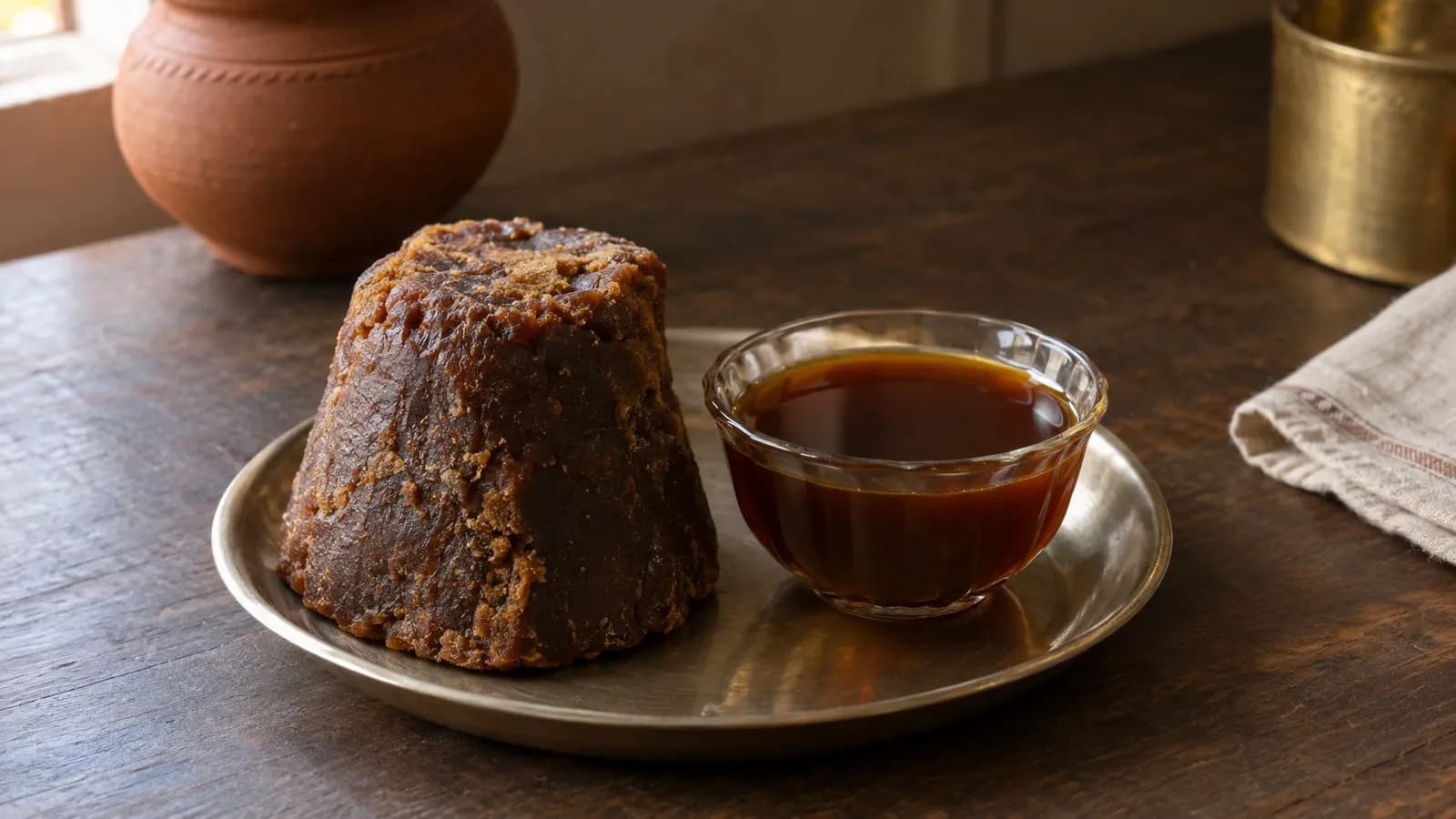
Jaggery is the sugar you get when fresh sugarcane juice is clarified, boiled down until most of the water has gone, and cooled in moulds until it sets. Nothing is spun in a centrifuge, so the molasses that a sugar mill separates out stays in the block, and food scientists call jaggery a non-centrifugal sugar for that reason (Rao and Singh, Sugar Tech, 2022). Jaggery meaning, in one line: sugar made by boiling cane juice down to a solid, without refining. The English word comes from the Portuguese jagara, coarse brown sugar; gur is the Indian word, named as a sweetener in Ayurvedic medicine for more than 3,000 years. The result ranges from pale gold to deep brown, smells of caramel and cane, and breaks with a slightly crumbly snap when fresh.
In India the everyday names are gur and gud in the north, gul in Maharashtra and bellam in Andhra Pradesh and Telangana; the full list is in the table below. What is jaggery made of? In the traditional cane version, only sugarcane juice. FSSAI's definition of gur also takes in palm jaggery, made from the juice of the palmyra or coconut palm, and date jaggery, from the date palm; the IFCT 2017 entry used here is for cane jaggery, so every number in this guide is a cane-jaggery number.
Cane jaggery comes in three forms: solid blocks, cubes or balls; granulated jaggery powder; and liquid jaggery, the syrup taken off the fire before it sets. It is made in cane-growing districts across India, and the step-by-step of how jaggery is made has its own page.
Gur in English and other Indian languages
Gur in English is jaggery; IFCT 2017 lists it as "Jaggery, cane" under food code I001, and its source plant is sugarcane, Saccharum officinarum. Gur and gud are the same Hindi word spelled two ways in Roman letters, and IFCT gives gud for Punjabi and Urdu as well. Marathi says gul, Gujarati god, Bengali gurh, Odia guda and Assamese gur, all close to the Hindi word. The four southern languages use a different word: Kannada bella, Telugu bellam, Malayalam vellam and Tamil mandavellam. Each name in the table is the one IFCT prints; Sanskrit shows a dash because IFCT gives no Sanskrit name, and none has been guessed.
| Language | Name (romanised) |
|---|---|
| English | Jaggery, cane |
| Hindi | Gud |
| Marathi | Gul |
| Gujarati | God |
| Punjabi | Gud |
| Bengali | Gurh |
| Odia | Guda |
| Assamese | Gur |
| Kannada | Bella |
| Telugu | Bellam |
| Tamil | Mandavellam |
| Malayalam | Vellam |
| Urdu | Gud |
| Sanskrit | — |
| Botanical name | Saccharum officinarum |
Source: IFCT 2017 (ICMR-NIN) local-names list. — means no name recorded in the source.
Jaggery nutrition per 100 g
Per 100 g, IFCT 2017 gives cane jaggery 354 kcal, 84.87 g carbohydrate, 1.85 g protein and 0.16 g fat; fibre is not reported. That carbohydrate is mostly sugar, so for blood sugar jaggery counts as sugar. What refining takes out shows in the mineral and folate figures: iron 4.63 mg, calcium 107 mg, magnesium 115 mg, potassium 488 mg, zinc 0.45 mg and folate 14.4 mcg, with only 25.38 mg sodium. White sugar, by comparison, has 0.05 mg iron and 1 mg calcium per 100 g; honey has 0.42 mg iron and 6 mg calcium (USDA FoodData Central).
Keep the serving in mind, though. Nobody eats 100 g of jaggery at a sitting; a level teaspoon of powder is 5 g and a small piece of gur about 10 g. A 10 g serving, two teaspoons of powder or one small piece, gives 35 kcal, 8.5 g carbohydrate, 0.46 mg iron, 10.7 mg calcium, 11.5 mg magnesium and 49 mg potassium: real amounts, but small against a day's needs. Jaggery has a little less energy per gram than white sugar (354 against 387 kcal) because 100 g of it holds 84.87 g carbohydrate where white sugar is all carbohydrate; that does not make it a lighter sweetener in any useful sense. Spoon and piece figures, the free-sugar limits and the glycemic index question are on the jaggery calories and nutrition page.
| Nutrient | Jaggery (cane) | White sugar | Honey |
|---|---|---|---|
| Energy (kcal) | 354 | 387 | 304 |
| Protein (g) | 1.9 | 0 | 0.3 |
| Fat (g) | 0.2 | 0 | 0 |
| Carbohydrates (g) | 85 | 100 | 82 |
| Dietary fibre (g) | — | 0 | 0.2 |
| Iron (mg) | 4.6 | 0.1 | 0.4 |
| Calcium (mg) | 107 | 1 | 6 |
| Magnesium (mg) | 115 | 0 | 2 |
| Potassium (mg) | 488 | 2 | 52 |
| Sodium (mg) | 25 | 1 | 4 |
| Zinc (mg) | 0.5 | 0 | 0.2 |
| Folate (mcg) | 14 | 0 | 2 |
| Vitamin C (mg) | — | 0 | 0.5 |
| Glycemic index (GI) | — | 70 | 63 |
Per 100 g raw, edible portion. Composition: IFCT 2017 (ICMR-NIN); USDA FoodData Central (SR Legacy), FDC ID 169655, NDB 19335; USDA FoodData Central (SR Legacy), FDC ID 169640, NDB 19296. GI: University of Sydney GI database. — means not reported. These are average values for the food; the label on a pack gives the values for that product.
Benefits of jaggery, without the folklore
Jaggery has real advantages over refined sugar, and a much longer list of claimed ones. The first three points below rest on the IFCT 2017 figures and one published review; the fourth is tradition, worth knowing but not the same as evidence. The long version, ten benefits with their sources, is on the jaggery benefits and side effects page, and in Hinglish on gud khane ke fayde.
It keeps minerals that sugar loses
Per 100 g, jaggery still holds 4.63 mg iron, 107 mg calcium, 115 mg magnesium and 488 mg potassium, where refined white sugar has close to none. The honest caveat: a 10 g serving brings 0.46 mg iron and 10.7 mg calcium, so jaggery is a better sugar, not a mineral supplement.
It is less processed than white sugar
Jaggery is cane juice boiled until it sets, with no centrifuge and no refining. Rao and Singh's 2022 review in Sugar Tech lists antioxidants and phenolics in jaggery, along with minerals and vitamins, and suggests it as a healthier substitute for white sugar. How much those compounds matter at a spoonful a day is still an open question.
It brings flavour as well as energy
At 354 kcal per 100 g, jaggery is concentrated energy, and in many homes it is eaten with groundnuts or til in winter. Its caramel taste gives tea, dal and sweets depth as well as sweetness.
Traditional uses, labelled as such
A piece of gur after a meal, gur with ghee in winter, gur and ajwain after childbirth: these are habits in many North Indian homes, and they deserve respect as food culture. They are not proof that jaggery cleans the lungs or settles the stomach, and this site does not claim that. What the sources support is narrower: used in place of white sugar, not on top of it, jaggery brings some minerals along with the sweetness.
Who should limit jaggery
Jaggery counts as sugar, so anyone who has to watch sugar has to watch jaggery in the same way.
- Diabetes and prediabetes: three things to know. Jaggery is mostly sugar, with 84.87 g carbohydrate in every 100 g. The University of Sydney GI data used for this guide prints no glycemic index for it, so none is given here. And for blood sugar it counts as sugar: any you eat joins the day's carbohydrate, and whether it fits your plan at all is a question to put when you talk to your doctor or dietitian.
- Weight: the swap saves little, 354 kcal per 100 g against 387 for white sugar. A cup of jaggery tea takes about 10 g, which is 35 kcal, and three cups a day add up. The page on jaggery for weight loss works through the portions.
- Pregnancy: jaggery counts as sugar in pregnancy too, and a 10 g piece carries 0.46 mg iron. ICMR-NIN's guidelines ask pregnant women to take iron and folic acid supplements, and gur is no substitute for them. With gestational diabetes, ask your doctor before eating any. More on jaggery in pregnancy.
- Children under two: ICMR-NIN's Dietary Guidelines for Indians rule out added sugar before two years of age and list jaggery and honey among added sugars, so gur waits as well. Ask your paediatrician before adding any sweetener after that.
- Teeth: the WHO sugars guideline links free sugars with tooth decay, and jaggery stirred into food counts as a free sugar.
That guideline, published by WHO in 2015, recommends that adults and children get less than a tenth of their daily energy from free sugars (a strong recommendation) and suggests going below a twentieth (a conditional one). ICMR-NIN calls more than 25 g of added sugar a day high, on an average 2000 kcal day. How gur and white sugar compare line by line is on jaggery vs sugar.
How jaggery is made and how to use it
Juice pressed from the cane is cleared of its impurities first, with chemical or plant-based clarificants depending on the maker; COWBERRY's jaggery is made without chemical ones. The clear juice is boiled down to what makers call the striking point, 118 to 120 °C for blocks, then cooled and moulded into blocks and cubes. For powder the set mass is scraped, sieved and dried, and a syrup taken off the heat early, at 105 to 106 °C, stays liquid (Rao and Singh, Sugar Tech, 2022). Each stage, with the moisture left in each form, is on how jaggery is made.
In the kitchen, jaggery replaces sugar almost everywhere, with one rule: do not boil it hard in milk, which can split; dissolve it separately and stir it in off the heat, or use it in water-based dishes.
- Drinks: jaggery tea (gur ki chai) is an everyday use across North India; jaggery also sweetens coffee, kanji and panakam.
- Winter sweets: til ke laddu and peanut chikki both start from a jaggery syrup cooked until a drop sets in cold water, to a soft ball for laddu and to a brittle snap for chikki.
- Everyday cooking: a small piece balances Gujarati dal, sambar, tamarind chutney and Maharashtrian amti; grated jaggery goes into puran poli, modak and payasam.
- Grain sweets: ragi laddu takes jaggery powder in place of sugar, as do many laddus made with roasted flour and ghee.
Jaggery powder vs block vs liquid
All three are the same boiled cane juice at different stopping points and in different shapes. IFCT 2017 prints one entry for cane jaggery, not one per form, so the choice comes down to convenience and use.
- Powder (granulated jaggery): dissolves quickly in tea, coffee, porridge and batter, measures by the spoon, and is an easy swap for sugar in baking. Its weakness is humidity: in the monsoon it can cake into lumps unless the jar is airtight.
- Block, cubes or balls: keep well, and grate or melt easily for chikki, laddu and other sweets. Cubes save the grating. A block also lets you see the colour and texture, which is the first quality check.
- Liquid jaggery: the syrup taken off the fire before it sets, poured over bhakri with ghee in parts of Maharashtra. It holds 30 to 35% water, where FSSAI lets a cane block hold 7% at most, so it is not a gram-for-gram swap for sugar, and it can ferment if left open in the heat.
For a household that mostly sweetens tea and everyday cooking, powder plus a small stock of cubes for sweets covers everything.
How to store jaggery
Jaggery absorbs moisture from the air. That one fact explains every storage problem: blocks turn soft and sticky, powder clumps, and in a wet monsoon a damp block can grow mould. Keep it airtight in glass or steel, somewhere dry and away from the steam of the stove, and take it out only with a dry spoon. Blocks and cubes keep well in a cool, dry cupboard; powder has far more surface to take up moisture, so buy it in smaller packs and go by the best-before date printed on the pack. In the monsoon, a small jar you refill from a sealed larger pack beats one big open jar.
A block that has gone hard is not spoiled; grate it or warm it briefly. A block that is wet, smells sour or fermented, or shows white or green fuzz should go. The fridge is not needed, and a cold block gathers moisture when it comes out, which makes the problem worse; if you do refrigerate in a humid coastal city, keep the jar sealed until it has warmed up.
How to buy jaggery: what to look for
Colour: cane jaggery can be anything from golden to dark brown, and a darker block is not a worse one. A very pale, bright yellow block deserves a second look, since colour alone will not tell you whether chemical clarifying agents were used. FSSAI bans added colour in cane jaggery and limits the sulphite a block may carry to 50 mg per kg, so a label that says no sulphur is telling you something.
Taste and texture: a good piece tastes of caramel and cane and is not salty or bitter. Jaggery does hold a little sodium, 25.38 mg per 100 g, but not enough to taste; a salty or chalky note can mean something was added or the juice was poorly cleaned.
The dissolve test: stir 10 g of jaggery (a small piece, or two level teaspoons of powder) into a transparent glass of water. It should dissolve fully into a brown liquid; grit or a chalky layer at the bottom can point to poor cleaning or an addition.
The label: the ingredient list should say sugarcane juice or jaggery and nothing else. Organic gur should carry a certification mark, not just the word organic; "pure" and "natural" are not certifications.
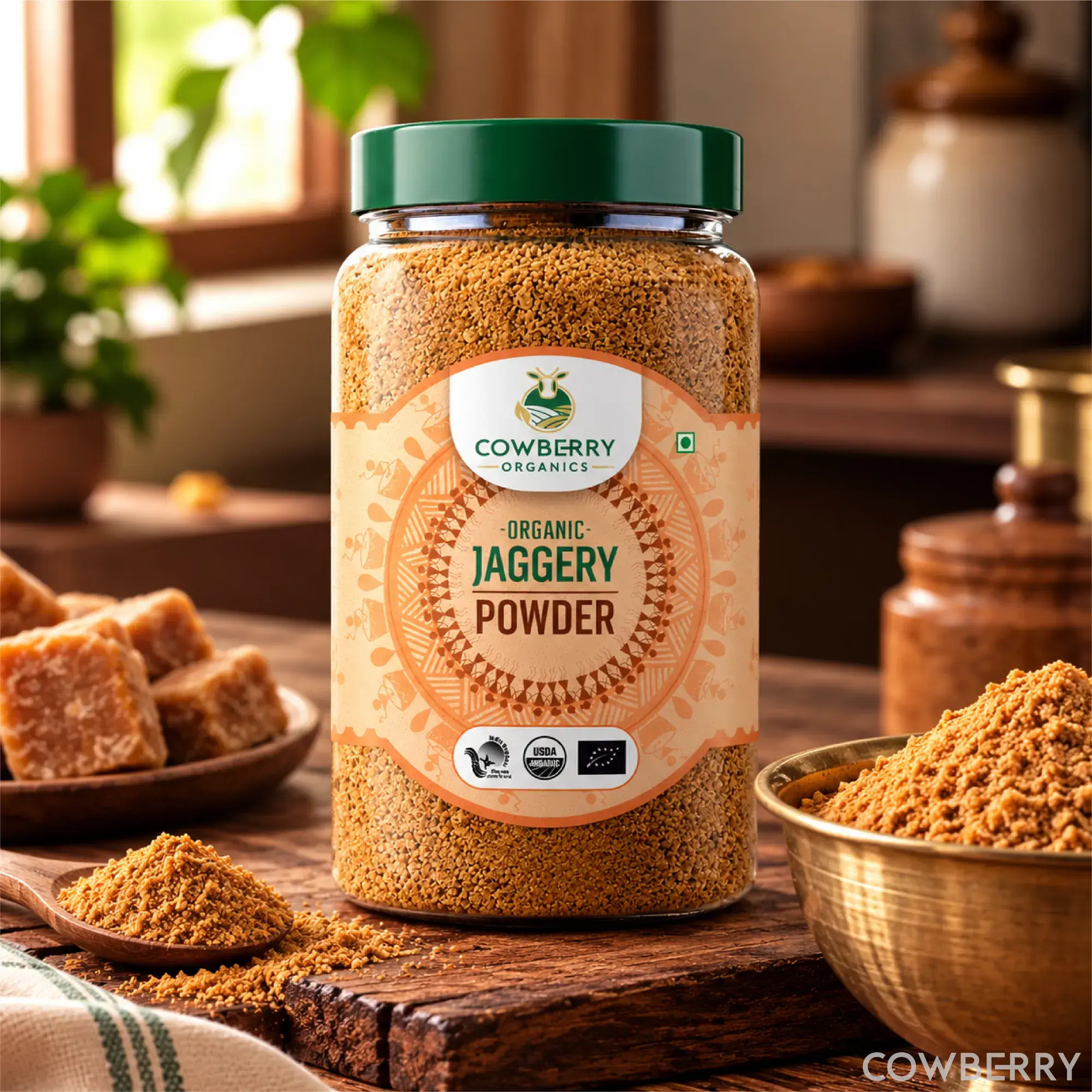
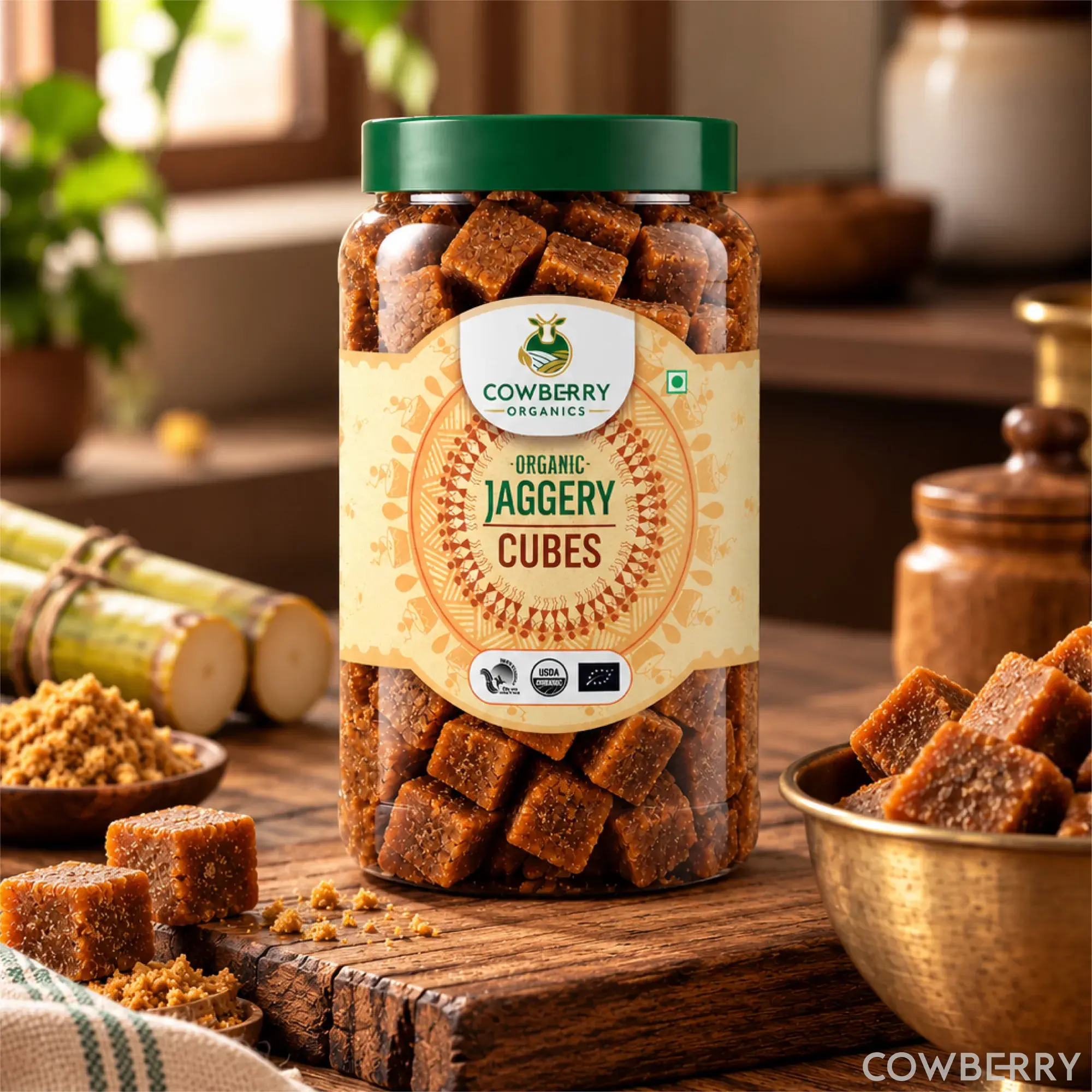
COWBERRY's jaggery comes from sugarcane grown in Kolhapur and Maharashtra's traditional cane belt, slow-cooked without chemical clarifying agents or artificial additives, and is India Organic, USDA & EU certified. The organic jaggery powder is that jaggery finely milled for tea and baking, and the organic jaggery cubes are the block form in small cubes for the kitchen.
More on jaggery
Jaggery's names, its place in a diabetic diet, palm gur and the kitchen side of it each have a page of their own.
- Jaggery in Hindi and the other Indian languages: gud, gul, god, bella, bellam, vellam and more.
- Is jaggery good for diabetes? Why it counts as sugar, and the only way it fits a diabetic diet.
- Palm jaggery benefits and side effects for karupatti and khejur gur, kept apart from the claims.
- Jaggery uses in tea, dal, sweets and baking, and how to swap gur for white sugar.
- Jaggery recipes: drinks, desserts, preserves and snacks, each with a full step-by-step page.
- How to identify pure jaggery: FSSAI's home test, what it cannot prove and what to read on the label.
- How to store jaggery blocks, cubes and powder through the monsoon.
FAQs
What is jaggery?
Jaggery is unrefined cane sugar: sugarcane juice boiled down until it sets, with the molasses left in. It is called gur or gud in Hindi, gul in Marathi and bellam in Telugu. Per 100 g it gives 354 kcal and 4.63 mg iron (IFCT 2017), and it sweetens tea, sweets and everyday cooking across India.
Is jaggery good for health?
It is better than refined sugar, not good in the way a vegetable is good. Jaggery keeps iron, calcium, magnesium and potassium that white sugar loses, but a 10 g serving gives only 0.46 mg iron, and for blood sugar it counts as sugar. The sensible use is as a swap for white sugar rather than an extra sweetener, with every free sugar in the day kept under the WHO limit.
What is jaggery made of?
Traditional cane jaggery is made of one thing: sugarcane juice, boiled down until it sets. Palm jaggery comes from the juice of the palmyra or coconut palm, and date jaggery from the date palm, both covered by FSSAI's definition of gur. A clean label lists only sugarcane juice or jaggery; anything else, such as sugar, colour or preservatives, is an addition you did not ask for.
Which jaggery is best?
For daily tea and cooking, a golden to dark-brown cane jaggery with a clean caramel taste, no salty or chalky note, and a label listing sugarcane juice alone. Choose powder for stirring into drinks and batters, blocks or cubes for chikki and laddu. Colour alone does not settle quality: very pale yellow jaggery may have been whitened, and a dark block is not a worse one.
Is palm jaggery good for diabetes?
No. Palm jaggery is not a diabetes food, and no sweetener is. The data behind this guide has no composition entry or glycemic index for palm jaggery, and no glycemic index for cane jaggery either, so count either one as sugar. If you have diabetes and want either kind of gur as a daily habit, talk to your doctor or dietitian first, since both belong in the day's carbohydrate total.
Is gur good for babies?
Not before the age of two. ICMR-NIN's Dietary Guidelines for Indians say children under two should have no added sugar, and they count jaggery as an added sugar; the 0.46 mg iron in a 10 g piece is no reason to make an exception. After two, gur counts as sugar like any other sweet. Follow your paediatrician's advice.
Does jaggery contain salt?
Not as an ingredient. Cane jaggery naturally holds 25.38 mg sodium per 100 g (IFCT 2017), a trace you cannot taste. If a jaggery tastes clearly salty or chalky, it may mean something was added during boiling or the juice was badly cleaned, and that is a reason to change your source rather than a normal feature of gur.
References
- Indian Food Composition Tables (IFCT) 2017, ICMR-National Institute of Nutrition
- USDA FoodData Central (SR Legacy): Sugars, granulated, FDC ID 169655
- USDA FoodData Central (SR Legacy): Honey, FDC ID 169640
- University of Sydney glycemic index database (GI search)
- Rao GP, Singh P. Value addition and fortification in non-centrifugal sugar (jaggery): a potential source of functional and nutraceutical foods. Sugar Tech, 2022
- WHO guideline: sugars intake for adults and children (2015)
- Dietary Guidelines for Indians, ICMR-National Institute of Nutrition
- FSSAI: Food Products Standards and Food Additives Regulations compendium (Version XXII, 02.03.2022): 2.8.4 Gur or Jaggery
Shop this article
Keep reading
Raw Sugar vs Brown Sugar: Is Demerara the Same Thing?
Does honey contain sugar? Carbs per 100g and the WHO sugar limit
Date Jaggery (Khejur Gur in English): Types, Forms and How to Use It