by COWBERRY

10 minute read
How jaggery is made: from sugarcane juice to gur, step by step

How is jaggery made? Sugarcane juice is cleaned and slow-cooked until most of its water has gone and what remains sets firm; jaggery powder is that set jaggery, milled fine. The juice never goes through a centrifuge and its molasses stays in, which is why researchers class jaggery (gur) as a non-centrifugal sugar. Each step, the usual mistakes and FSSAI's household chalk test follow.
Short answer: what jaggery is made of
Jaggery is made from sugarcane juice, and plain cane jaggery from nothing else; FSSAI's definition of gur also covers jaggery made from the juice of the palmyra or coconut palm (palm jaggery) and of the date palm (date jaggery). The raw juice is clarified to clear out impurities, boiled down until it reaches its striking point, 118 to 120 °C for solid jaggery, and the thick mass is then cooled and moulded into blocks. That is the process Rao and Singh set out in their 2022 review for Sugar Tech, which calls jaggery a non-centrifugal sugar, known for about 3,000 years and still an essential part of the rural diet in many countries.
What remains can be measured. IFCT 2017 gives cane jaggery 354 kcal, 84.9 g carbohydrate, 4.63 mg iron, 107 mg calcium and 488 mg potassium per 100 g, and COWBERRY lists natural molasses among the features of both its jaggery forms. White sugar is refined instead, and ICMR-NIN's Dietary Guidelines for Indians say refined extracted sugars have no vitamins or minerals. The jaggery vs sugar page sets the two side by side; this one follows cane jaggery from juice to jar.
The jaggery making process: from cane to clean juice
Step 1: The cane and its juice
Jaggery starts in the cane field. COWBERRY's comes from organically grown sugarcane in Kolhapur and Maharashtra's traditional cane belt. The juice is extracted from the cut cane, and only the juice goes forward. That juice is thin and mostly water: the ICMR-NIN guidelines put its sugar at 13 to 15 g per 100 ml.
Step 2: Clarifying the juice
Next the raw juice is clarified, that is, cleared of impurities, and this is the step where makers differ most. Rao and Singh note that both chemical and vegetative (plant-based) clarificants are in use, one of the reasons jaggery varies in make-up from one maker to another. They also list heavy use of chemicals for an attractive colour, along with poor hygiene, among the reasons jaggery has lost ground to white sugar. FSSAI's standard for cane jaggery names one clarifying agent, sodium bicarbonate, which must be food grade if it is used, and it caps the sulphite left in any jaggery at 50 mg per kg. COWBERRY cooks its juice slowly and uses neither chemical clarifying agents nor artificial additives, and it states that neither of its jaggery forms has chemical bleaching or sulphur. A buyer cannot see this step in the finished block, so what the maker states about it is worth reading; more on that below.
How to make jaggery: slow cooking until it sets
Step 3: Slow cooking
The clarified juice is then boiled down; slow-cooked is the word COWBERRY uses for its own jaggery. Heat drives the water off as steam, and the juice thickens until it reaches the striking point, the temperature at which it comes off the heat: 118 to 120 °C for solid jaggery, according to Rao and Singh. The job is a big one: a juice that is mostly water has to become a solid that holds no more than 7% moisture under FSSAI's standard for cane jaggery, and IFCT 2017 puts its carbohydrate at 84.9 g per 100 g.
Step 4: Setting into blocks and cubes
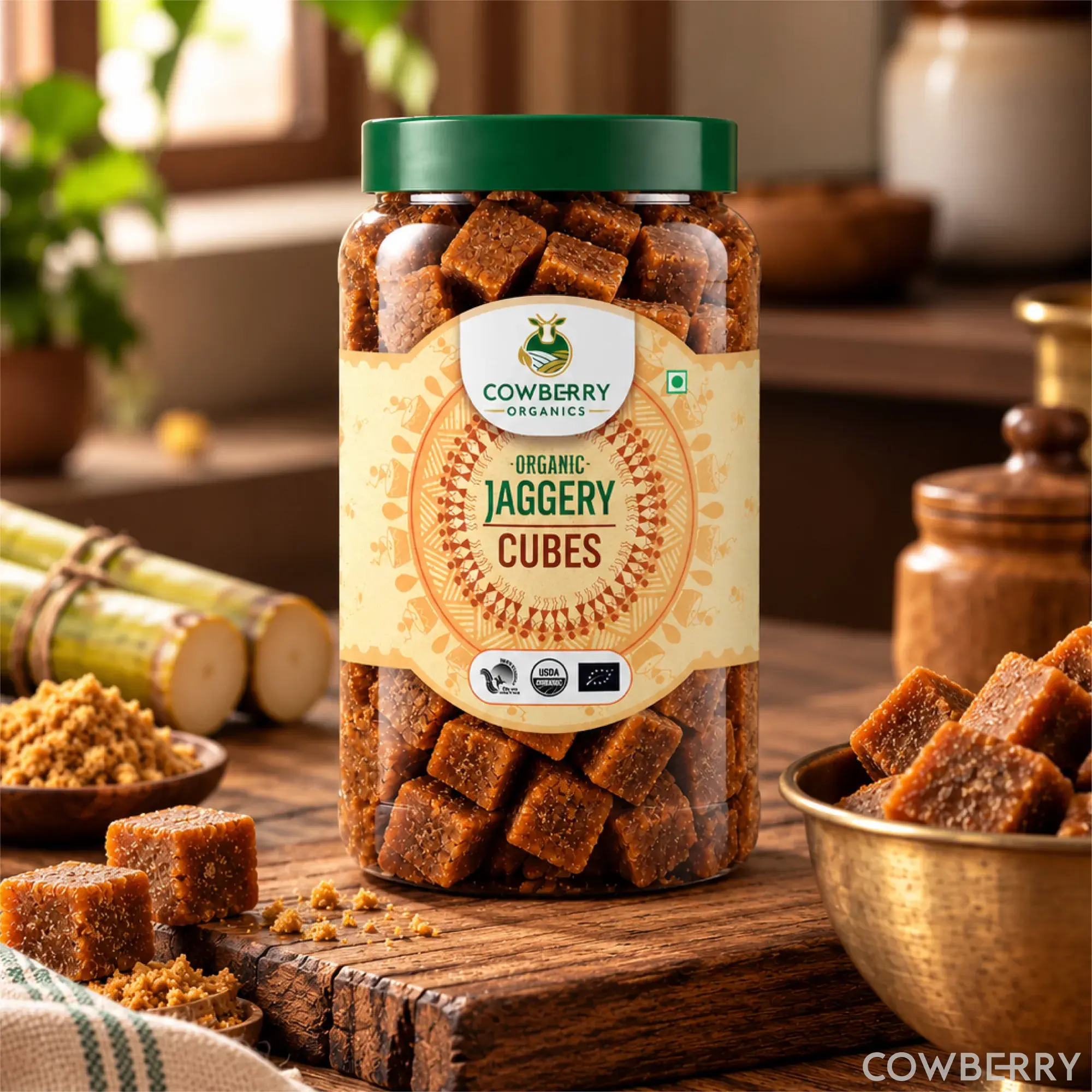
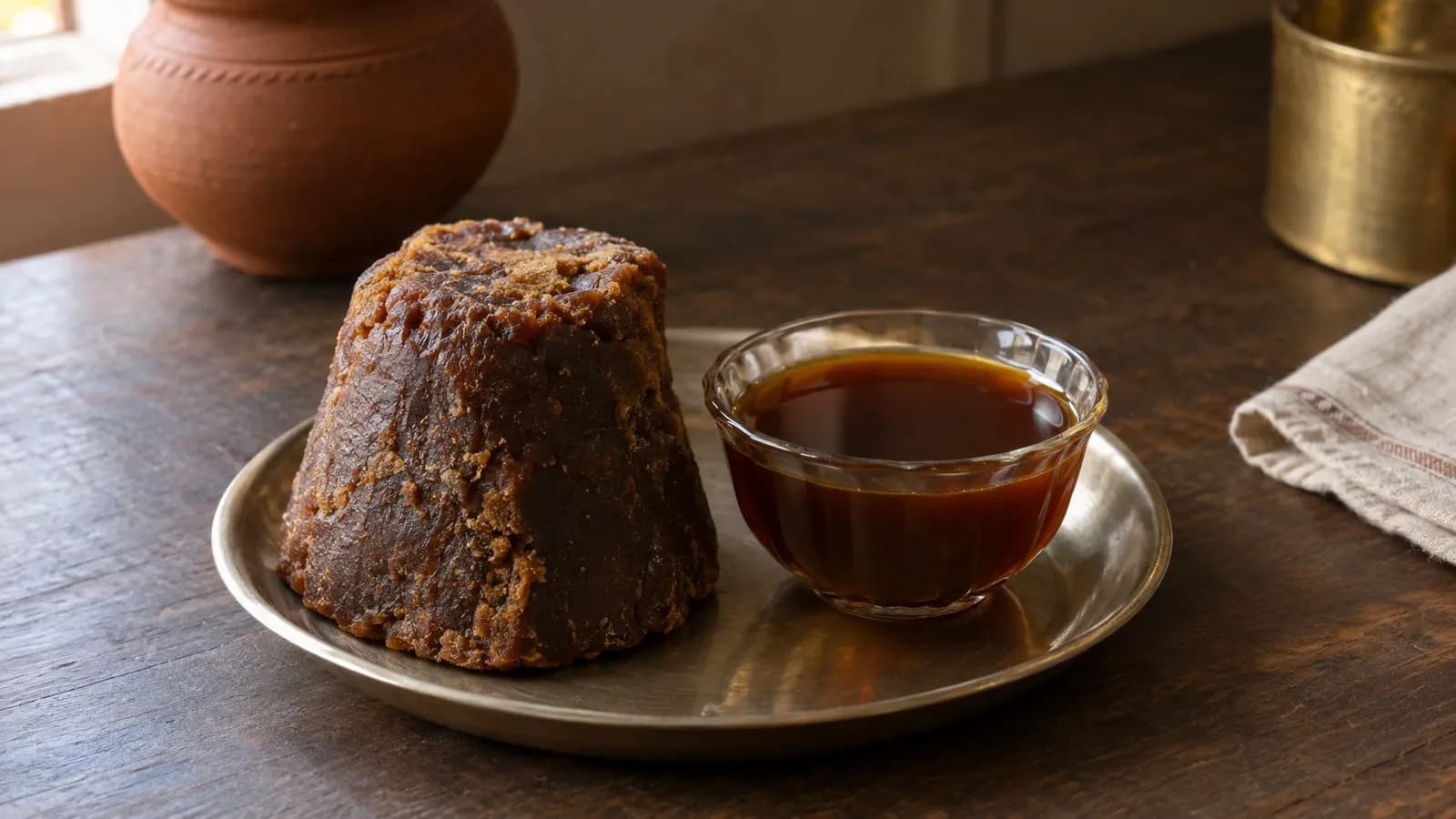
Off the heat, the thick hot mass is cooled and moulded into shapes, and it sets as it cools. Structurally, set jaggery is a mass of tiny, irregular sugar crystals enclosed in a residue of molasses, which carries the vitamin and mineral part of the cane juice. Moulding gives blocks, or smaller cubes such as COWBERRY's jaggery cubes. How far a jaggery syrup is cooked decides how it sets, as the two recipes under common mistakes show.
Jaggery powder and liquid jaggery: the same juice, taken to a different point
Step 5: Making the powder
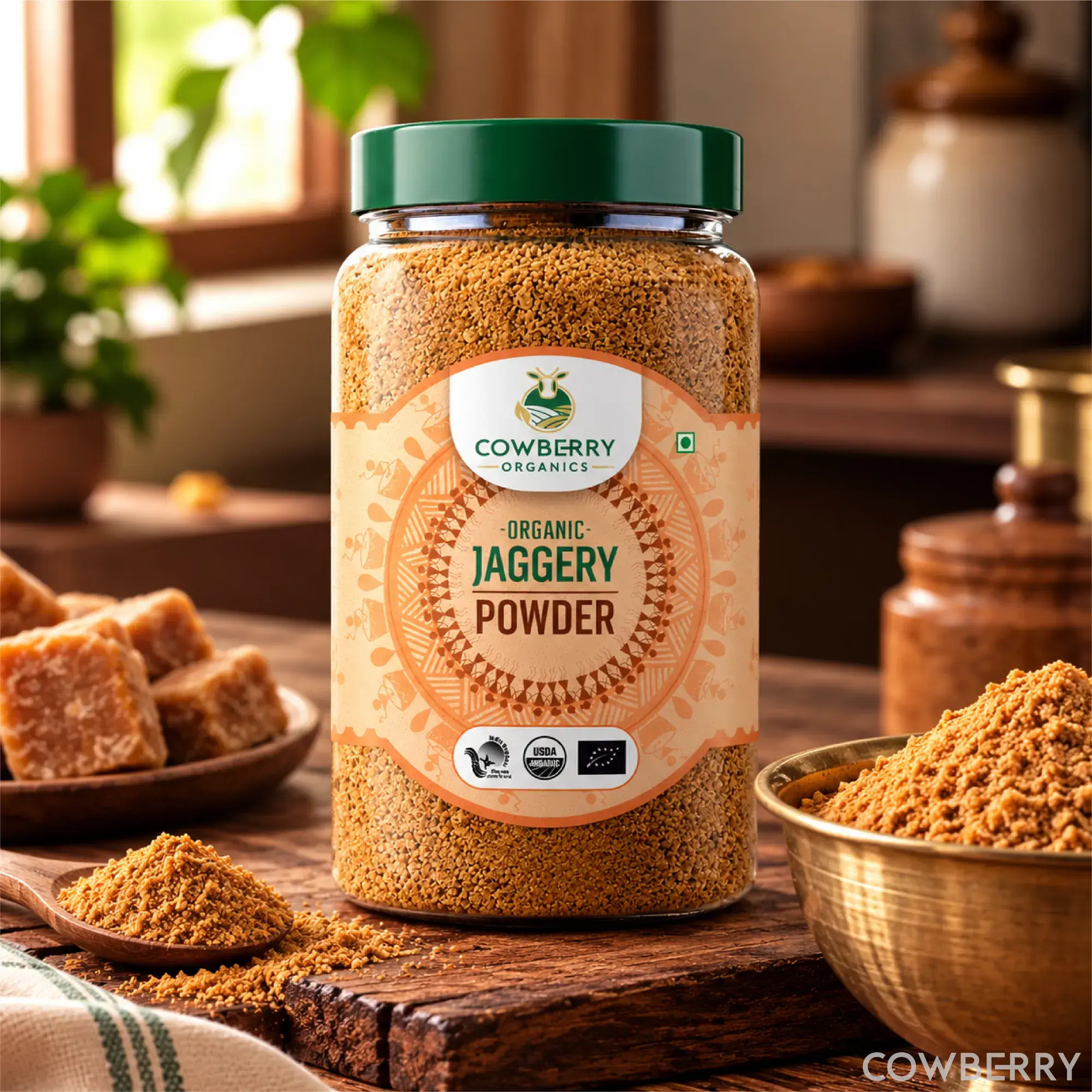
Jaggery powder begins as jaggery that has set. In the powder method Rao and Singh describe, the juice is taken a little further, to 120 to 122 °C, cooled, and moved from the pan to a metal or wooden platform, where it is left unstirred so that crystals form. Once the lump has set it is scraped into powder with wooden scrapers, sieved, and dried to 1 to 2% moisture, and the review credits that low moisture for the powder's better keeping. COWBERRY describes its own powder as finely crushed from traditional jaggery made from natural sugarcane juice, still without chemical clarifying agents or artificial additives. Milled fine, it dissolves instantly, so COWBERRY suggests it for drinks, baking and cooking, or sprinkled over desserts; its cubes dissolve easily too, and are suggested for tea and coffee as well as Indian sweets, curries and sauces.
Liquid jaggery
Liquid jaggery is the same juice taken off the heat much earlier, at a striking point of 105 to 106 °C; at that point, the review says, the syrup keeps its quality with little microbial growth or crystallisation. It holds 30 to 35% moisture, against the 7% at most that FSSAI allows in solid cane jaggery, so it is not a gram-for-gram swap for sugar.
Common mistakes with jaggery, from kadai to jar
These mistakes happen after the jaggery is made: in the kadai, in the teacup, in the jar and at the shop.
- Cooking every jaggery syrup to one stage. How far a syrup is cooked decides how it sets. The til ke laddu recipe stops at the soft-ball stage, when a drop in cold water forms a soft ball that you can still squash flat. The peanut chikki recipe goes on to hard-crack, when a drop goes brittle straight away and snaps; taken off the flame too early, the chikki will not set hard and glassy.
- Boiling jaggery with the milk. Milk tea boiled with jaggery in it can split. The jaggery tea recipe guards against that by turning off the flame, straining, and only then stirring in 10 g (2 tsp) a cup.
- Leaving the pack open. Left open, jaggery powder clumps and cubes harden. COWBERRY gives the same storage advice for both forms: an airtight container, kept cool and dry.
- Counting jaggery as something other than sugar. The Dietary Guidelines for Indians put jaggery on the same added-sugar list as table sugar and honey, so it shares the day's sugar allowance; how that works out in spoons is on jaggery for weight loss.
- Expecting one test to settle everything. FSSAI's household test, below, shows whether chalk was mixed in. It cannot show how the juice was clarified; for that, read what the maker states on the pack.
Stages and quantities at a glance
The table follows the work from cane to jar, with the temperatures and figures that the research and the guidelines report.
| Stage | What happens | Figure or fact | From |
|---|---|---|---|
| Cane | Sugarcane is grown and cut, and its juice extracted | COWBERRY's cane is organically grown, in the traditional cane belt of Kolhapur and Maharashtra | COWBERRY |
| Juice | The only ingredient of plain jaggery | 13 to 15 g of sugar per 100 ml | Dietary Guidelines for Indians (ICMR-NIN) |
| Clarifying | Impurities are cleared from the raw juice | Chemical or plant-based clarificants; FSSAI names food-grade sodium bicarbonate; COWBERRY uses no chemical clarifying agents or artificial additives | Rao and Singh (Sugar Tech, 2022); FSSAI; COWBERRY |
| Boiling down | Water leaves as steam until the striking point | 118 to 120 °C for solid jaggery | Rao and Singh |
| Setting | The hot mass is cooled and moulded into blocks or cubes | At most 7% moisture; 354 kcal and 84.9 g carbohydrate per 100 g of cane jaggery | FSSAI; IFCT 2017 |
| Powder | Taken to 120 to 122 °C, set unstirred, scraped, sieved and dried | 1 to 2% moisture | Rao and Singh |
| Liquid jaggery | Taken off the heat early | 105 to 106 °C; 30 to 35% moisture | Rao and Singh |
| Standard | What FSSAI asks of cane jaggery, on a dry-weight basis | At least 70% sucrose and 90% total sugars; at most 2% insoluble matter; no added colour; sulphite residue at most 50 mg/kg | FSSAI |
| Checking | 10 g dissolved in a transparent glass of water | Any chalk mixed in settles to the bottom | FSSAI DART |
How to check the jaggery you buy
FSSAI's chalk test
FSSAI's DART manual of quick household tests has one for chalk powder in sugar and jaggery. Fill a transparent glass with water and dissolve 10 g of the jaggery in it, which is one 10 g piece or two level teaspoons of powder. If chalk has been mixed in, it settles at the bottom of the glass. It is a test for chalk alone.
What the law asks of cane jaggery
FSSAI's standard sets the bar every pack of cane jaggery must clear. On a dry-weight basis it needs at least 70% sucrose and 90% total sugars, no more than 20% reducing sugars and no more than 2% of extraneous and water-insoluble matter, and its moisture is capped at 7%. Added colour is not permitted, so a bright shade cannot legally come from dye, and the sulphite left in the jaggery may not exceed 50 mg per kg.
What the pack says
Plain jaggery has one ingredient, sugarcane juice, and the pack should say so. Look for what the maker states about the clarifying step and additives, since that step cannot be seen in the finished block. COWBERRY's jaggery powder and cubes both name sugarcane juice, slow cooking and no chemical clarifying agents, and each is India Organic, USDA & EU certified. For kitchen uses and the rest of the story, the jaggery guide is the place to start, and the figures per spoon and per piece are on jaggery calories.
FAQs
What is jaggery made of?
Plain jaggery is made of sugarcane juice and nothing else, cooked down until it sets. Rao and Singh's review in Sugar Tech files it under non-centrifugal sugars, and because nothing is spun off, the juice's molasses stays in. The same review looks at value addition, jaggery fortified with herbs and spices; any such flavoured jaggery lists more than cane juice on its label.
How to make jaggery at home?
The outline is the same as in a jaggery unit, only smaller. Boil fresh sugarcane juice down slowly, stirring, until it reaches the striking point makers use for solid jaggery, 118 to 120 °C (a sugar thermometer helps), then pour it into a greased mould to cool and set. Expect a small block: at 13 to 15 g of sugar per 100 ml, a litre of juice holds only 130 to 150 g of sugar.
How to identify pure jaggery?
Start with FSSAI's household chalk test: stir 10 g of the jaggery into a transparent glass of water until it dissolves, then look at the bottom, where any chalk mixed in will settle. Then read the pack. It should name sugarcane juice as the only ingredient and say how the jaggery was made; FSSAI does not permit added colour in cane jaggery. The test covers chalk only, so the pack fills in the rest.
What is jaggery powder?
Jaggery powder is set jaggery broken down fine. In the method set out in Rao and Singh's review it is scraped from the set lump, sieved and dried to 1 to 2% moisture, which helps it keep; COWBERRY makes its powder by finely crushing traditional jaggery made from natural sugarcane juice. The fine grain dissolves instantly, which suits tea, coffee and baking. Stored airtight somewhere cool and dry, it stays free of clumps.
How is gud made?
Gud is the Hindi name for jaggery, so it is made the same way: sugarcane juice, clarified, boiled down until it is thick enough to set, then cooled in moulds. The IFCT 2017 list of local names gives the same food as gul in Marathi, god in Gujarati, gurh in Bengali, guda in Odia, bella in Kannada, bellam in Telugu, mandavellam in Tamil and vellam in Malayalam.
Which jaggery is best?
The best jaggery is plain cane jaggery with sugarcane juice as its only ingredient, in the form that suits the job. Powder dissolves instantly, which makes it the easy choice for tea, coffee and baking; COWBERRY suggests its cubes for sweets, curries and sauces. Whichever form you pick, the ICMR-NIN guidelines still count it as added sugar, so the amount you use matters as much as the jaggery you choose.
References
- Rao GP, Singh P. Value addition and fortification in non-centrifugal sugar (jaggery): a potential source of functional and nutraceutical foods. Sugar Tech, 2022
- Indian Food Composition Tables (IFCT) 2017, ICMR-National Institute of Nutrition
- Dietary Guidelines for Indians, ICMR-National Institute of Nutrition
- FSSAI DART: Detect Adulteration with Rapid Test, common quick tests for food adulterants at household (Eat Right India)
- FSSAI: Food Products Standards and Food Additives Regulations compendium (Version XXII, 02.03.2022): 2.8.4 Gur or Jaggery
Shop this article
Keep reading
Raw Sugar vs Brown Sugar: Is Demerara the Same Thing?
Does honey contain sugar? Carbs per 100g and the WHO sugar limit
Date Jaggery (Khejur Gur in English): Types, Forms and How to Use It