by COWBERRY

6 minute read
How to Identify Pure Jaggery: Simple Home Purity Tests

How to identify pure jaggery starts with one home test FSSAI publishes for it, the chalk-in-water test, and continues with colour, taste, the label and the standard's own numbers. No kitchen test proves purity; together they catch some common problems. What gur is and how it is made are on the jaggery hub page.
Why jaggery adulteration happens
Jaggery is a single-ingredient food, and the room for adulteration sits in its making and its looks. The 2022 Sugar Tech review puts the problem in one sentence: wider acceptance and consumption of jaggery products are limited by unhygienic making, by heavy use of chemicals to brighten the colour, and by poor storability and shelf life of the produce. Colour is the pressure a buyer can see, and FSSAI's standard for gur answers it with a flat rule: added colour shall not be permitted.
FSSAI's DART list, the household quick-test collection, describes its own purpose as listing common methodologies for food adulterants generally found in India, meant for households so consumers become aware of food safety. Chalk powder is one of the additions that list names for jaggery.
Pure jaggery test at home: FSSAI's chalk-in-water test
FSSAI's chalk test, step by step
- Take a transparent glass of water.
- Dissolve 10 g of the jaggery in the water. Crush a block first; powder dissolves as it is. Ten grams is about two level teaspoons.
What you see
- Chalk settles at the bottom: FSSAI reads it as the sample being mixed with chalk; the adulterant settles down at the bottom of the glass.
- Clear water, no sediment: no chalk has shown up in that 10 g, and nothing else has been ruled out.
What the test cannot prove
The chalk test looks for chalk and nothing else. It says nothing about chemicals used to get an attractive colour, about added colour itself, or about the standard's limits on moisture, ash and extraneous matter, and it is the one test FSSAI's household list names for jaggery. Pour the test water away when you are done; the tested 10 g does not go back in the jar.
Colour, taste and texture: reading the block
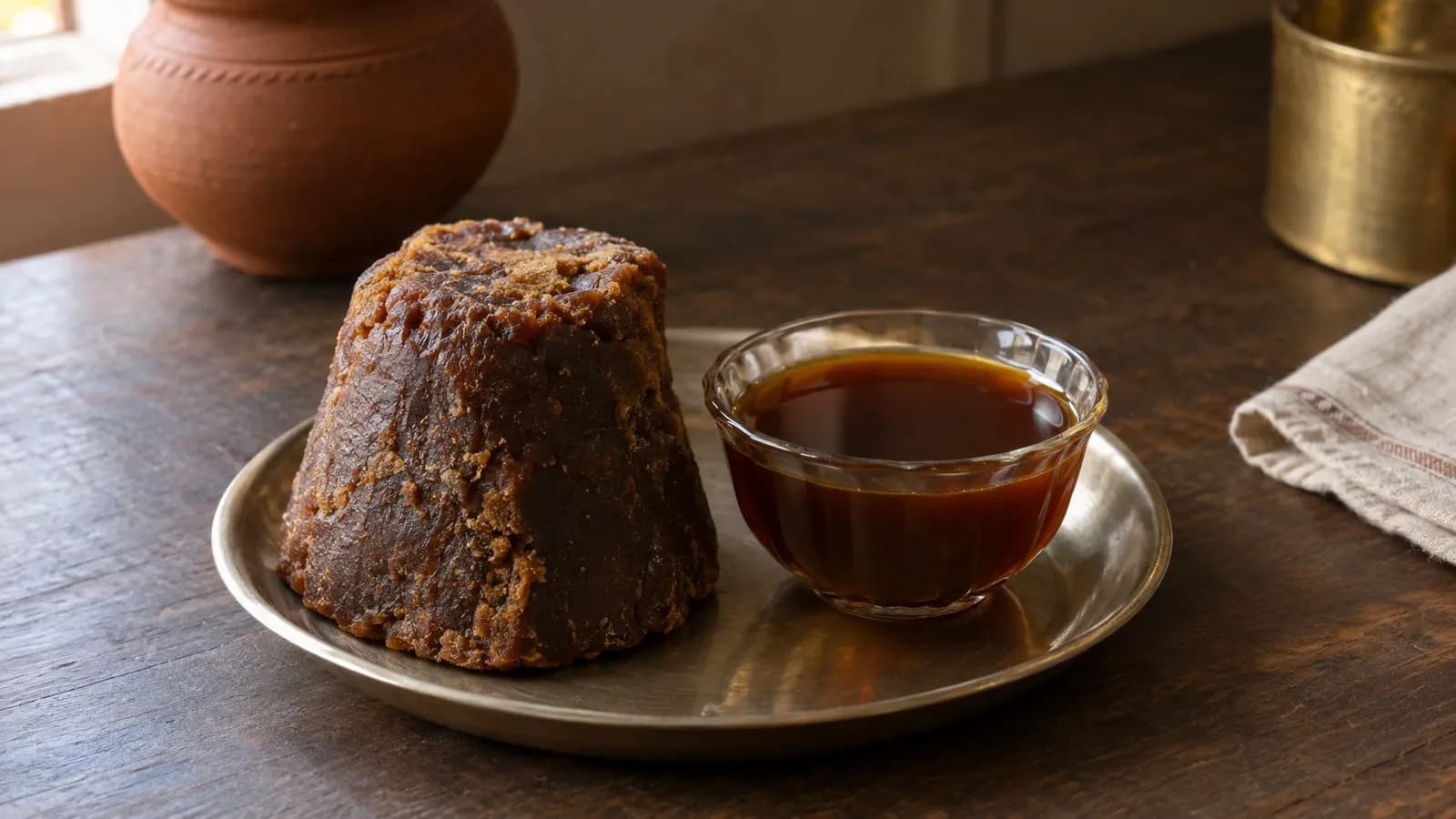
The everyday checks read what the block is made of. The 2022 review describes jaggery as irregular-shaped anhedral microcrystals of sugar, enclosed with residues of molasses, and the molasses is what usually paints the block. Cane gur usually runs golden to dark brown. The taste is usually molasses-sweet with a hint of caramel; a bitter, soapy or chemical aftertaste is a reason to be wary. Dampness belongs to the same reading: the 2022 review lists solid jaggery at 3 to 10 percent moisture, FSSAI caps cane jaggery at 7 percent, and a block that feels wet or sticky is worth a second look.
White is the colour to think twice about: cane gur carries molasses residue, so a white or very pale block is the exception, and the same review counts heavy chemical use for a brighter colour among the reasons jaggery's wider acceptance is limited; FSSAI's standard bans added colour outright. Take a white or very pale block as a signal to run the label checks below, not as proof of anything on its own.
Lab tests and the FSSAI standard for jaggery
Everything beyond chalk is measured in a laboratory against the standard FSSAI sets for gur. Its cane jaggery clause defines the food by its source, sugarcane juice, and sets limits a lab can check:
| Measure | Limit for cane jaggery |
|---|---|
| Moisture | Not more than 7.0 percent |
| Sucrose | Not less than 70 percent |
| Total sugars | Not less than 90 percent |
| Reducing sugars | Not more than 20 percent |
| Sulphate ash | Not more than 4 percent |
| Ash insoluble in dilute HCl | Not more than 0.5 percent |
| Extraneous matter | Not more than 2 percent |
The standard reads all of them on a dry-weight basis. Two rules round it out for a buyer to hold a maker to: sulphites are capped at 50 mg per kg, and added colour is not permitted. A sample that fails these limits does not meet the standard, whatever the label says.
What to read on the label
The label proves nothing by itself, but it names who is answerable for the block. ICMR-NIN's guidelines list what a food label carries, from the food's name, its ingredients and the net weight to the maker's name and address, the making and expiry dates, storage instructions and shelf life. On a pack of jaggery, look at:
- Name: jaggery or gur. Palm jaggery is a different product made from palm sap, so the name tells you which food is in the pack.
- Ingredients: a pure pack is a single ingredient, sugarcane juice. FSSAI's claims rules reserve the word pure for a food of one ingredient, nothing added to it and no avoidable contamination in it, and pure is barred from brand and fancy names.
- FSSAI logo with licence number: in the guidelines' explanation, a logo carrying a licence number marks the maker as licensed by the regulator.
- Dates and storage instructions: expiry dates and how to keep the block at home, which is on how to store jaggery.
Buying sealed, labelled packs puts all of the above within reach; a loose block offers none of it. Once the jar is home, the jaggery hub page has the uses, and the jaggery recipes roundup the dishes to put the block into.
FAQs
How to identify pure jaggery powder?
Run the chalk test on it: dissolve 10 g of the powder in a transparent glass of water, and chalk, if it is mixed in, settles at the bottom. Powder is the easiest form to test because it dissolves without crushing. Then run the label checks above.
How to know pure jaggery?
No kitchen test proves purity, so read the block and the label together. Cane gur is usually golden to dark brown with a molasses-caramel taste; FSSAI's standard says added colour is not permitted. At home, the chalk test rules out one addition; the standard's limits on moisture, sugars and ash are checked in a laboratory.
How to check purity of jaggery at home?
With FSSAI's chalk-in-water test. Dissolve 10 g of jaggery in a transparent glass of water; if the sample is mixed with chalk, the adulterant settles at the bottom. It is the one test FSSAI's household list names for jaggery, and it looks for chalk only. Colour, taste and the label checks on this page cover the rest of the home toolkit.
How to check jaggery quality?
Quality is what the standard measures: moisture, sugars, ash and extraneous matter. Cane jaggery may carry at most 7 percent moisture and 2 percent extraneous matter, and at least 70 percent sucrose and 90 percent total sugars, all on a dry-weight basis. A lab checks those numbers; at home, a block that feels wet or gritty is worth a second look.
Why jaggery is white?
White is unusual for cane jaggery; the molasses left in the boiled juice usually makes gur golden to dark brown. The 2022 review records that chemicals are used to get attractive colors, and FSSAI's standard bans added colour outright. A white or very pale block is a reason to run the label checks before buying.
How to identify pure gur?
Gur is jaggery's Hindi name, so the same checks apply. Dissolve 10 g in a transparent glass of water and watch whether chalk settles at the bottom; then read colour, taste and the label. A cane block usually shows a golden to dark brown colour and a molasses taste, and no home test rules out everything a lab would find.
References
- FSSAI Eat Right India: DART (Detect Adulteration with Rapid Test), salt, spices and condiments tests
- Rao GP, Singh P. Value addition and fortification in non-centrifugal sugar (jaggery): a potential source of functional and nutraceutical foods. Sugar Tech, 2022
- FSSAI: Food Products Standards and Food Additives Regulations compendium (Version XXII, 02.03.2022): 2.8.4 Gur or Jaggery
- FSSAI Food Safety and Standards (Advertising and Claims) Regulations 2018, compendium (PDF)
- Dietary Guidelines for Indians, ICMR-National Institute of Nutrition
Shop this article
Keep reading
Raw Sugar vs Brown Sugar: Is Demerara the Same Thing?
Does honey contain sugar? Carbs per 100g and the WHO sugar limit
Date Jaggery (Khejur Gur in English): Types, Forms and How to Use It