by COWBERRY

9 minute read
Palm Jaggery Benefits and Side Effects: Karupatti and Khejur Gur

Palm jaggery benefits are real but narrower than the claims: karupatti and khejur gur are gur boiled from palm juice, at least 90 percent sugar under FSSAI's standard, with no composition or GI figures published for them. Here is what holds up, what does not, the side effects and the daily amount; the jaggery hub covers cane gur.
Palm jaggery benefits: what they rest on
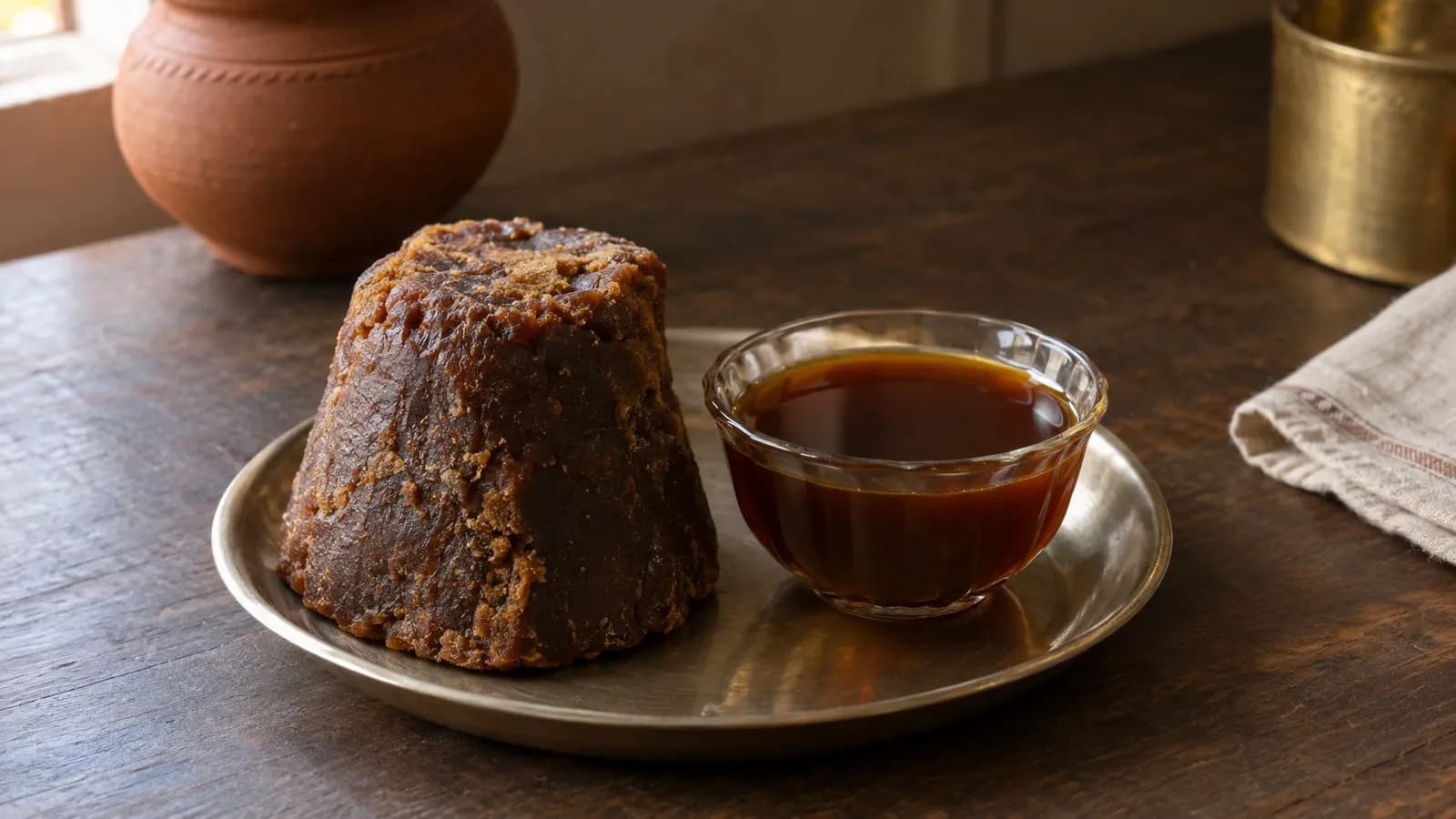
Palm jaggery is gur made by boiling the juice of the palmyra or coconut palm; the date palm's juice gives date jaggery, a category of its own in the FSSAI standard. Karupatti is the palmyra kind, and khejur gur, also searched as nolen gur, the date kind. The benefits people search for rest on three things that are actually on record: the general gur standard, cane jaggery's composition, and the added-sugar guidance. The three kinds are set out on the palm jaggery guide.
The general standard that covers the palm kinds puts a floor under every batch: total sugars of at least 90 percent with sucrose of at least 60 percent, on a dry-weight basis, no more than 2 percent extraneous matter, no more than 6 percent total ash, and no more than 10 percent moisture in every form except the liquid or semi-liquid kind; sulphite residue stays within 50 mg per kg. The first honest palm jaggery benefit is that the food answers to a legal quality standard.
Date palm jaggery benefits: palm juice, not dried dates
Khejur gur is often searched as dates jaggery benefits, and the first thing to get right is the plant. Under FSSAI, date jaggery is gur made from the date palm's own juice, boiled or processed: the syrup comes from the tree, not from the dried fruit. That matters because the benefits people expect from dates belong to the fruit. IFCT 2017 records no composition for date jaggery, so those numbers cannot be quoted for khejur gur.
What is on record for the date kind is the same general standard as for the palm kinds: sugars of 90 percent and above, sucrose of 60 percent and above, solid forms held to 10 percent moisture at most, and sulphites capped at 50 mg per kg. The date palm jaggery benefits that can honestly be claimed stop there: a regulated sugar with a defined quality floor. What it looks like and how it is used is covered on the date jaggery page.
Benefits of karupatti, claim by claim
Minerals: the published numbers belong to cane jaggery
The mineral figures published for gur belong to cane jaggery, per 100 g: 488 mg of potassium, 115 mg of magnesium, 107 mg of calcium and 4.63 mg of iron (IFCT 2017). White sugar, by contrast, carries 0.05 mg of iron, 1 mg of calcium and 2 mg of potassium, and the dietary guidelines give the reason in one line: refined extracted sugars have no vitamins or minerals. The 2022 Sugar Tech review makes the maker's version of the point, that jaggery preserves most of the nutrients present in sugarcane juice.
For karupatti and the other palm kinds, none of those numbers exists: IFCT 2017 records cane jaggery alone. A label promising extra iron or calcium in palm jaggery is therefore a claim with no published figure behind it. That is the honest limit of the minerals benefit.
Molasses residues, and what the numbers measure
The review describes jaggery's sugar crystals as enclosed with residues of molasses and other nutritious constituents of the juice. Those residues are part of what the published figures measure, so no extra number belongs to any one batch. For the palm kinds, no measured amounts exist either way.
A quality standard, and the chemicals to avoid
Every palm and date jaggery sold in India must clear the general gur standard: the sugar, ash, moisture and sulphite limits above. What the standard does not give the palm kinds is the added-colour ban that cane jaggery gets, so for karupatti the weight falls on the sulphite cap and on the maker's stated process. The review lists the troubles that hold gur back in the market: unhygienic manufacture and heavy use of chemicals for attractive colours. The home checks are on the how to identify pure jaggery page.
Khejur gur benefits against sugar: calories, carbs and the glycemic index
Weighed against white sugar, the only published figures are cane jaggery's. Cane jaggery carries 354 kcal and 84.87 g of carbohydrates per 100 g against white sugar's 387 kcal and 100 g, which works out to 33 kcal and 15.13 g of carbohydrate more in 100 g of white sugar. A 10 g piece of the cane kind is 35 kcal with 0.46 mg of iron; for the palm kinds the honest arithmetic is to count them as sugar and keep the piece small.
On the glycemic index, the University of Sydney's database lists nothing for jaggery, so no low-GI number can be quoted for karupatti or khejur gur. White sugar is listed at GI 70, the average of 25 published tests, spread from 48 to 110. Anyone managing blood sugar counts gur as sugar: the detail is on jaggery for diabetes, and the calorie arithmetic on jaggery calories.
Palm jaggery side effects: who should limit it
Palm jaggery's side effects are the side effects of sugar, because that is what it is. The dietary guidelines put jaggery on the added-sugar list with table sugar and honey, and the standard's own floor of 90 percent total sugars underlines it.
- Diabetes. With no glycemic index entry and at least 90 percent sugars, palm jaggery gets no special pass. Measured in as a replacement for white sugar, the day's total stays the same; added on top, it rises. Agree the amount with your doctor or dietitian.
- Babies. Children under two get no added sugar under the guidelines, and jaggery of any kind counts as one. The full guidance is on jaggery for babies.
- Weight. The guidelines call high-sugar foods energy dense and poor in vitamins, minerals and fibre, so an extra spoon of gur is extra energy. The workable use is a swap for white sugar, not an addition, as set out on jaggery and weight loss.
- Adulteration. Unhygienic manufacture and colouring chemicals are the problems the review names, so ask the maker how it was made.
If you live with diabetes or follow a prescribed diet, talk to your doctor or dietitian before palm jaggery takes the place of your usual sweetener.
How much palm jaggery per day
India's guidelines set the adult figure in one line: adults should avoid sugar or hold it to 20 to 25 g a day, and keep sugar under 5 percent of the day's total energy. The WHO's guideline is the same shape: free sugars held under 10 percent of daily energy for adults and children, with a suggested further cut below 5 percent. No smaller allowance is published for palm jaggery, so those limits cover it like any other added sugar.
On the spoon, that budget runs out fast. One level teaspoon (5 g) is 18 kcal and 4.2 g of carbohydrate, and 25 g comes to 89 kcal. Two teaspoons, the amount a cup of jaggery tea takes, is 10 g. Count gur against the same budget as white sugar; how the guidelines place it is on the jaggery hub.
How to eat palm jaggery: drinks, sweets and the daily cup
The recipes on this site are written for cane gur, and the palm kinds work in the same jobs. In drinks, gur melts into warm liquid: the jaggery tea recipe sweetens each cup with 2 teaspoons (10 g), panakam dissolves 100 g into four glasses with ginger, pepper and lemon, and jaggery water makes the plain warm glass. In sweets it melts into syrup or mixes straight into flour: jaggery laddu binds roasted atta with a one-thread syrup.
Two habits make any gur easier to cook with: measure it by weight rather than by eye, because a dense block carries more sweetness than it appears to, and where a recipe is written for cane jaggery, start with its stated amount and adjust to your own taste. The full set is in the jaggery recipes roundup. COWBERRY's own range is cane jaggery: juice from Kolhapur and Maharashtra's traditional cane belt, slow-cooked without chemical clarifying agents or artificial additives. Each carries the India Organic, USDA & EU certified mark: the Organic Jaggery Powder and, in pieces, the Organic Jaggery Cubes.
FAQs
Is palm jaggery good for diabetes?
No. The GI tables list no jaggery of any kind, and the FSSAI standard sets palm jaggery at no less than 90 percent total sugars, so nothing published suggests it is gentler on blood sugar than white sugar. Count it inside the day's carbohydrate, and settle the amount with your doctor or dietitian.
Is jaggery good for health?
For adults it is a sweetener, not a medicine: the guidelines count jaggery among added sugars, and a 5 g teaspoon is 18 kcal. What jaggery adds over white sugar is a mineral trace, 4.63 mg of iron and 107 mg of calcium per 100 g in the cane kind; the palm kinds have no composition published at all.
Can jaggery cause diabetes?
Nothing published ties jaggery alone to diabetes, but it sits on the sugar side of the eating pattern: the guidelines say high-sugar foods increase the risk of non-communicable diseases, and they count jaggery among the added sugars. No study in the references tests jaggery itself, so what matters is the amount and everything else eaten through the day.
Which jaggery is good for health?
None has a published advantage over the others. IFCT 2017 records composition for cane jaggery only, so the palm kinds cannot be compared with numbers, and every kind meets a standard of at least 90 percent total sugars. Choose by the job and keep the amount small; the kind-by-kind comparison is on which jaggery is best.
Why jaggery is better than sugar?
Because cane jaggery keeps more of the cane juice. White sugar has 0.05 mg of iron and 1 mg of calcium per 100 g, cane jaggery 4.63 mg and 107 mg, and the 2022 Sugar Tech review says jaggery preserves most of the juice's nutrients. It is still added sugar, so the advantage is small and only counts when gur replaces sugar one for one.
Is jaggery good for weight loss?
Not by itself. Jaggery is sugar, 354 kcal per 100 g in the cane kind, and every spoon adds energy to the day. It helps only when it replaces white sugar in the same amount, which keeps the day's total steady. The swap and portion arithmetic is on jaggery and weight loss.
References
- Indian Food Composition Tables (IFCT) 2017, ICMR-National Institute of Nutrition
- Dietary Guidelines for Indians, ICMR-National Institute of Nutrition
- University of Sydney glycemic index database (GI search)
- WHO guideline: sugars intake for adults and children (2015)
- Rao GP, Singh P. Value addition and fortification in non-centrifugal sugar (jaggery), Sugar Tech 2022: full text on PubMed Central (PMC8314846)
- FSSAI: Food Products Standards and Food Additives Regulations compendium (Version XXII, 02.03.2022): 2.8.4 Gur or Jaggery
- USDA FoodData Central (SR Legacy): Sugars, granulated, FDC ID 169655
Shop this article
Keep reading
Raw Sugar vs Brown Sugar: Is Demerara the Same Thing?
Does honey contain sugar? Carbs per 100g and the WHO sugar limit
Date Jaggery (Khejur Gur in English): Types, Forms and How to Use It