by COWBERRY

6 minute read
Jaggery in Hindi, Gujarati, Tamil, Telugu and Other Languages

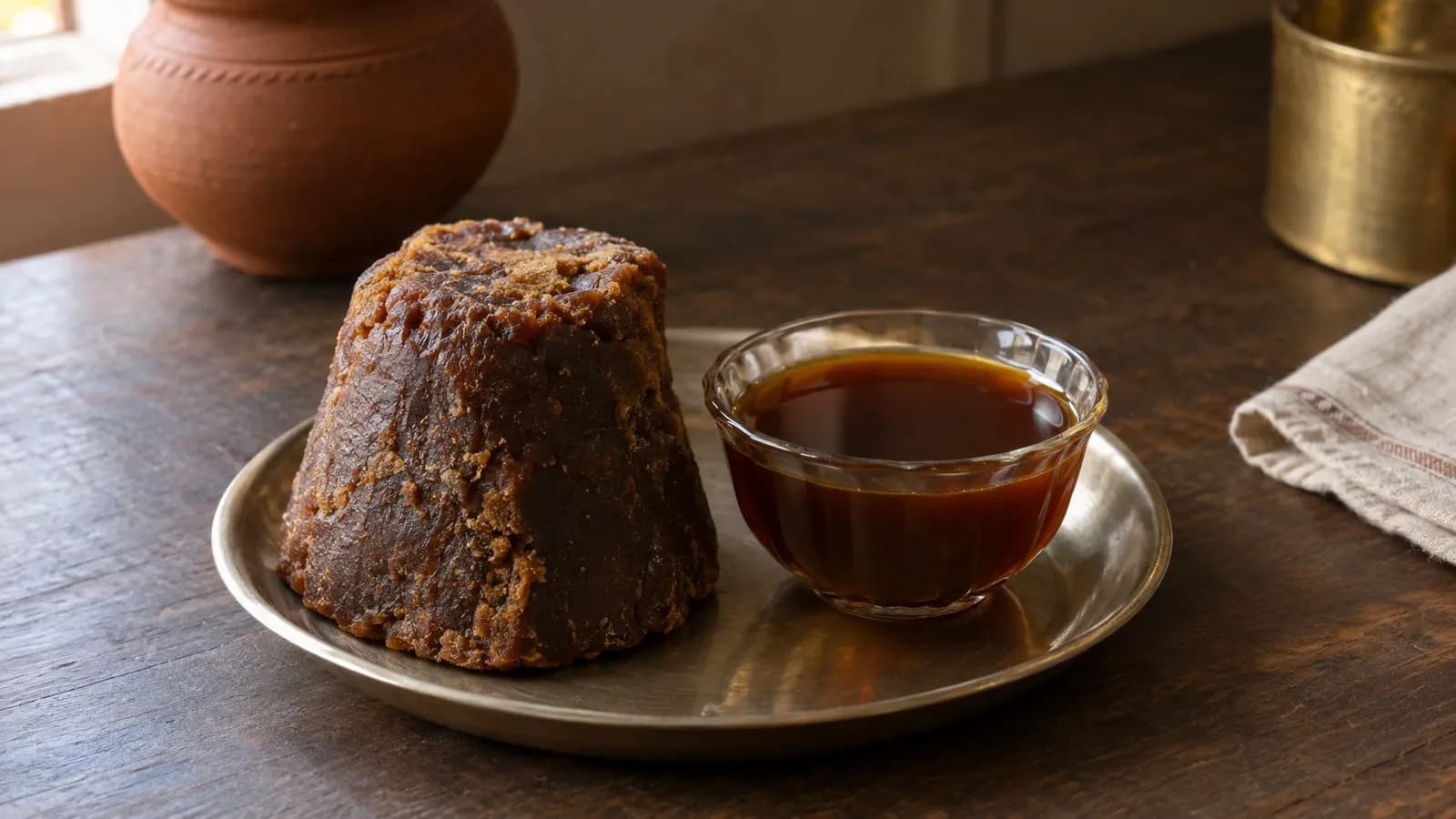
Jaggery in Hindi is gud, written gur in daily use, and jaggery in English is cane jaggery, from the Portuguese word jagara. The same sweetener is gul in Marathi, god in Gujarati and bellam in Telugu. The full table of names with their sources is below; what jaggery is, its nutrition and its uses are on the jaggery hub page.
Jaggery in Hindi, English and the Indian languages: quick answer
In Hindi the word is gud, with gur the everyday spelling; in English the full name is cane jaggery, the boiled-down juice of sugarcane, botanical name Saccharum officinarum. Around India the same food takes a different word in each language: gul in Marathi, god in Gujarati, bella in Kannada, bellam in Telugu, vellam in Malayalam. Every name is in the table below, each one as IFCT 2017 lists it under food code I001.
Two spellings people meet every day are shown next to the IFCT names: gur for the Hindi gud, and gol for the Gujarati god.
| Language | Name (romanised) |
|---|---|
| English | Jaggery, cane |
| Hindi | Gud, Gur |
| Marathi | Gul |
| Gujarati | God, Gol |
| Punjabi | Gud |
| Bengali | Gurh |
| Odia | Guda |
| Assamese | Gur |
| Kannada | Bella |
| Telugu | Bellam |
| Tamil | Mandavellam |
| Malayalam | Vellam |
| Urdu | Gud |
| Sanskrit | — |
| Botanical name | Saccharum officinarum |
Source: IFCT 2017 (ICMR-NIN) local-names list. — means no name recorded in the source.
Hindi ‘Gur’: spelling variant of the IFCT 2017 name ‘Gud’. Gujarati ‘Gol’: spelling variant of the IFCT 2017 name ‘God’.
Jaggery in English and the botanical name
Jaggery in English is jaggery itself, with cane jaggery the full name; IFCT 2017 lists the food as jaggery, cane under code I001. The botanical name of its plant is Saccharum officinarum, sugarcane, the cane that the FSSAI standard for jaggery names in its cane jaggery clause. The English word is a newer arrival than the food: the 2022 Sugar Tech review records that the name jaggery is derived from the Portuguese word jagara, meaning coarse brown sugar, while gur is the Indian word, mentioned as a sweetener in Ayurvedic medicines for over 3000 years.
So gur, gud, jaggery and cane jaggery all point at one food. The spelling differs because Indian words written in Latin letters are transliterations: gud and gur are the same Hindi word, and gul, god, gurh and guda the same food in other languages.
Jaggery names by region
North India: gud and gur in Hindi, Punjabi and Urdu
Hindi, Punjabi and Urdu all use gud for jaggery in IFCT 2017's list. In Hindi the everyday spelling is gur, the word the 2022 review calls the Indian word for jaggery. Jaggery in Hindi, then, is gud in print and gur in speech.
West India: gul in Marathi, god and gol in Gujarati
The Marathi word is gul, the Gujarati word god, also written gol. The two western states sit between the Hindi gud and the southern bella and bellam.
East India: gurh in Bengali, guda in Odia, gur in Assamese
IFCT 2017 lists gurh for Bengali, guda for Odia and gur for Assamese. The Assamese word carries the same spelling as the everyday Hindi one.
South India: bella in Kannada, bellam in Telugu, vellam in Malayalam, mandavellam in Tamil
Kannada lists bella and Telugu bellam, two close words; Malayalam lists vellam and Tamil mandavellam. The same sweetener that is gud in the north is bella on a Kannada shelf and vellam on a Kerala one.
Often confused with: sugar, palm jaggery and jaggery powder
- Jaggery vs sugar: white sugar is a different product. The 2022 review sets them apart in one line: refined white sugar is sucrose, while jaggery holds minerals and vitamins beside its glucose, fructose and sucrose. The two are weighed against each other on jaggery vs sugar.
- Jaggery vs palm jaggery: palm jaggery is boiled palm sap, not cane juice. FSSAI's standard for gur covers both kinds: its cane jaggery clause is built on sugarcane juice, and the general clause on the juices of the palmyra, date and coconut palms. The two are compared on palm jaggery.
- Jaggery vs jaggery powder: one food, two forms. Powder is jaggery granulated and dried to 1 to 2 percent moisture, which the 2022 review says gives it better storability. See what is jaggery powder.
- Gud vs gur: one word, two spellings. Gud is how IFCT writes the Hindi name, gur the everyday spelling of the same word.
Where jaggery comes from and how to buy it
Cane jaggery starts as sugarcane, Saccharum officinarum, pressed and boiled where the cane grows. COWBERRY's jaggery is made from cane grown in the Kolhapur belt of Maharashtra, slow-cooked and set as powder or cubes. The making, from juice to block, is walked through on how jaggery is made, and the jaggery hub page gathers everything from names to nutrition. Cook the same gud as gur roti or jaggery khichdi, or start from the jaggery recipes roundup.
FAQs
What is jaggery in Hindi?
Gud, with gur the everyday spelling. The 2022 Sugar Tech review calls gur the Indian word for jaggery, and IFCT 2017 lists the Hindi name as gud; Punjabi and Urdu use the same word.
What is gur?
Gur is the everyday Indian word for jaggery, and a common spelling of the Hindi gud. Jaggery is the boiled-down, set juice of sugarcane, and the English word came in from the Portuguese jagara for coarse brown sugar; the review notes gur in Ayurvedic medicines for over 3000 years. In other languages the same food is gul, god, bellam, vellam and more.
What is jaggery?
Jaggery is cane juice reduced over heat and set to harden. The 2022 Sugar Tech review describes the making as boiling, concentrating and clarifying the juice, after which it is set into blocks, cubes, granules or syrup. The same review calls it a non-centrifugal sugar. Its names in every Indian language are in the table above.
How is jaggery made?
By boiling sugarcane juice until it thickens, then setting it. The 2022 review gives the process in three verbs: boiling, concentrating and clarifying. The standard FSSAI sets for jaggery adds that sodium bicarbonate, if used for clarification, must be of food grade quality. The step-by-step account is on how jaggery is made.
Is jaggery good for health?
Jaggery is weighed as a sweetener, not a medicine: ICMR-NIN's guidelines place it with honey and table sugar among the added sugars, and keep sugar under 5 percent of a day's energy. The 2022 Sugar Tech review records that jaggery carries minerals and vitamins with its sugars, which plain white sugar does not. That balance is laid out on jaggery benefits and side effects.
References
- Indian Food Composition Tables (IFCT) 2017, ICMR-National Institute of Nutrition
- Rao GP, Singh P. Value addition and fortification in non-centrifugal sugar (jaggery): a potential source of functional and nutraceutical foods. Sugar Tech, 2022
- FSSAI: Food Products Standards and Food Additives Regulations compendium (Version XXII, 02.03.2022): 2.8.4 Gur or Jaggery
- Dietary Guidelines for Indians, ICMR-National Institute of Nutrition
Shop this article
Keep reading
Raw Sugar vs Brown Sugar: Is Demerara the Same Thing?
Does honey contain sugar? Carbs per 100g and the WHO sugar limit
Date Jaggery (Khejur Gur in English): Types, Forms and How to Use It