by COWBERRY

10 minute read
10 benefits of jaggery (gur) and its side effects

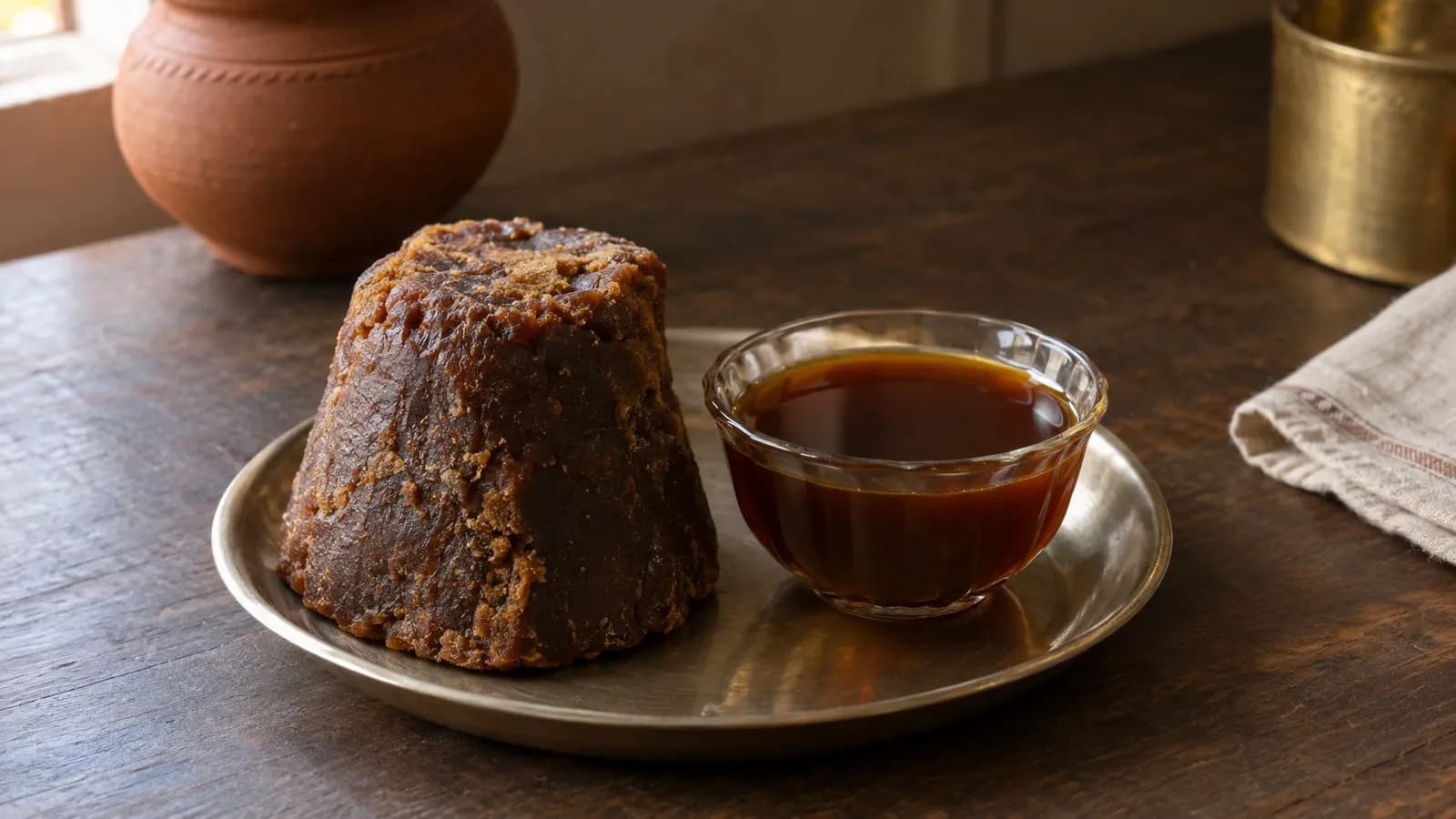
The real jaggery benefits are narrower than the internet claims and still worth having: jaggery keeps 4.63 mg iron, 107 mg calcium, 115 mg magnesium and 488 mg potassium per 100 g (IFCT 2017) that white sugar loses, and it is whole cane juice boiled down, not refined. It is also sugar, with 354 kcal per 100 g, and every benefit below comes with that caveat and its source.
Is jaggery good for health? The short answer
Jaggery is good for health only in the sense that it is a better version of something you should eat little of. Against white sugar it carries more of every mineral and is less processed; against a fruit or a dal it is still a spoon of sugar. So the honest answer to "is jaggery good for health" is this: if you sweeten tea, laddus or dal anyway, jaggery is the sweetener that leaves something behind, and it earns that place by replacing sugar, not by being added to a diet that already has enough.
Three kinds of source sit behind this page. Composition comes from IFCT 2017 (ICMR-NIN), every figure per 100 g of cane jaggery; what jaggery holds beyond those figures comes from Rao and Singh's review of non-centrifugal sugar (Sugar Tech, 2022), which lists its minerals, vitamins, antioxidants and phenolics. The limits come from the World Health Organization's sugars guideline, because any sugar added to food, jaggery included, is a free sugar under its definition, and from ICMR-NIN's Dietary Guidelines for Indians. The spoon-level arithmetic and the comparison table with sugar and honey are on jaggery calories and nutrition.
Benefits of jaggery: the minerals, with the numbers
The first five benefits are the minerals in the IFCT 2017 table, each given per 100 g and then at a realistic 10 g serving, two level teaspoons of powder or one small piece.
1. Iron that refined sugar has lost
Cane jaggery gives 4.63 mg iron per 100 g; white sugar has almost none, because refining takes it out. At a 10 g serving that is 0.46 mg, a small share of a day's need, so the benefit is real for someone who switches from sugar and negligible for someone who adds jaggery on top. Plant iron is also absorbed better alongside vitamin C, one argument for jaggery in nimbu pani rather than in milk tea.
2. Calcium, 107 mg per 100 g
At 107 mg per 100 g, jaggery's calcium is far more than white sugar or honey carries. Per 10 g serving it is 10.7 mg: a contribution, not a source. It matters mainly in sweets that already lean on calcium, such as til ke laddu, where sesame supplies the bulk and jaggery adds a little.
3. Magnesium, 115 mg per 100 g
Magnesium 115 mg per 100 g is one of jaggery's better numbers. A 10 g serving gives 11.5 mg. Refined sugar has none worth counting.
4. Potassium 488 mg, with very little sodium
Jaggery is potassium-rich and sodium-light: potassium 488 mg against sodium 25.38 mg per 100 g. Per 10 g that is 49 mg potassium and 2.5 mg sodium, the opposite of a salty packaged snack, and a modest point in its favour for anyone watching salt.
5. Zinc and folate, in trace amounts
Zinc 0.45 mg and folate 14.4 mcg per 100 g are there, and worth listing because white sugar has neither, but at 0.05 mg zinc and 1.4 mcg folate per 10 g they are trace amounts. Nobody should eat jaggery for its folate.
Benefits of jaggery beyond the minerals
6. It is whole cane juice, not a refined extract
Cane juice is boiled until it sets and never goes through a centrifuge, so the molasses stays in; Rao and Singh's review files jaggery under non-centrifugal sugars for that reason. Less processing is the benefit here, and the minerals above are what it leaves in the block.
7. Antioxidants and phenolics, as the review lists them
The same review names antioxidants and phenolics in jaggery, alongside its minerals and vitamins. That describes what is in the food, not a proven effect in people eating a spoon a day, and this page takes it no further.
8. Energy, and a flavour that goes further
Jaggery is dense energy, 354 kcal per 100 g, and winter plates in many homes pair it with til, groundnuts and ghee. Its caramel depth lets some cooks use a little less of it than of sugar in tea, dal and sweets, and that counts as a benefit only if you actually do.
9. Naturally gluten-free, with almost no fat
Cane jaggery contains no gluten and only 0.16 g fat per 100 g, so it fits coeliac, wheat-free and low-fat kitchens without substitution, in chikki, laddu, payasam and drinks. Check the label for anything added; plain jaggery lists one ingredient.
10. It replaces sugar in Indian cooking without changing the recipe
Jaggery slips into dishes India cooks every day, and many of them use it already: gur ki chai, til ke laddu, chikki, puran poli, Gujarati dal, sambar, tamarind chutney and payasam. Where a recipe calls for jaggery anyway, using it brings the minerals without adding a second sweetener, but its sugar still counts toward the WHO limit of under a tenth of daily energy. The traditional habit of a piece of gur after a winter meal belongs in this list as culture, not as a proven digestive aid.
Side effects of jaggery and who should limit it
Jaggery's side effects are sugar's side effects; the minerals do not cancel them.
- Sugar load and blood sugar: jaggery is mostly sugar, so count it as sugar. No glycemic index is quoted for it here: the University of Sydney figures this page draws on print none for jaggery. With diabetes or prediabetes, any jaggery comes out of the same carbohydrate allowance as sugar; talk to your doctor or dietitian about whether a daily piece fits at all.
- Weight: 354 kcal per 100 g is close to white sugar's energy, and "it is healthy" is how an extra spoon creeps in. How the spoons add up over a day is worked out on jaggery for weight loss.
- Teeth: WHO's sugars guideline connects free sugars with dental caries, and jaggery used in food is a free sugar, so gur sweets get no pass on teeth.
- Pregnancy: ICMR-NIN's guidelines allow sugar in pregnancy but hold it to 25 to 30 g a day, below 5% of energy, and ask overweight pregnant women to avoid added sugar; jaggery counts inside that, and its iron is a small extra, not a supplement. Gestational diabetes needs your doctor's say before any gur; more on jaggery in pregnancy.
- Children under two: none at all. ICMR-NIN wants added sugar totally avoided below two years and counts jaggery as an added sugar; after that age, sweeten only after your paediatrician's advice.
- Quality: chalky sediment or a salty taste can mean something was added, and a very pale, bright yellow block may have been whitened, though colour alone proves nothing; the buying checks are on the jaggery hub.
How much jaggery per day
Count jaggery as sugar. WHO's sugars guideline recommends keeping free sugars under a tenth of daily energy and suggests going under a twentieth; ICMR-NIN, assuming an average 2000 kcal day, sets that twentieth at 25 g and names jaggery among the added sugars it covers. If jaggery is your only sweetener, 25 g is about five level teaspoons (5 g each), or a little over one and a half tablespoons; biscuits, sweets and cold drinks all take their share of the same 25 g. Three cups of tea sweetened with two teaspoons each already use 30 g, about 106 kcal, before any sweet or biscuit. For children the WHO percentages apply to a smaller energy total, so their gram figure is lower.
How to eat jaggery: recipes and everyday uses
The sensible way to eat jaggery is inside a dish that needs it, in place of sugar rather than as an extra.
- Jaggery tea (gur ki chai): two teaspoons (10 g) a cup, stirred into the strained tea after the flame goes off; boiled hard with the milk, it can make the milk split.
- Til ke laddu and peanut chikki: for the laddu the jaggery syrup is taken to the soft-ball stage and holds the sesame together; for the chikki it goes on to the hard-crack stage, where a drop snaps, and sets the groundnuts into a slab.
- Dal, sambar and chutney: a small piece of jaggery rounds off Gujarati dal, Maharashtrian amti, sambar and tamarind chutney, using a few grams where a dessert would use far more.
- Ragi laddu and other flour laddus: jaggery powder in place of sugar, with the roasted flour and ghee doing the rest.
- Straight, after a meal: the traditional small piece of gur, common in many North Indian homes in winter; a habit, not a prescription.
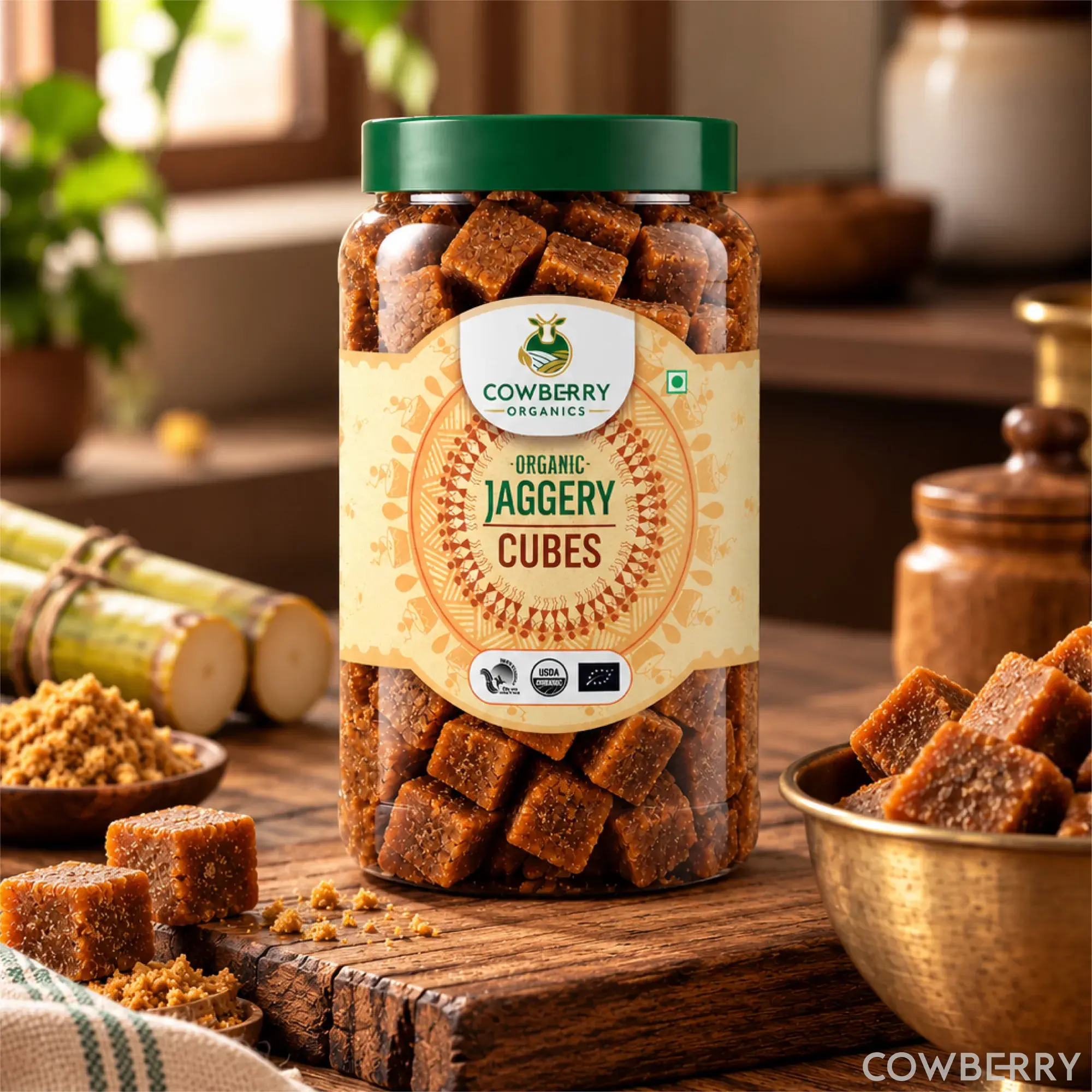
Powder suits drinks and batters, and cubes or a block suit syrups. The same ground is covered in Hinglish on gud khane ke fayde aur nuksan.
FAQs
Is gud good for health?
Gud, or jaggery, is better for you than white sugar because it keeps iron (4.63 mg per 100 g), calcium, magnesium and potassium that refining removes, and it is boiled whole cane juice rather than an extract. It is still sugar, though, with 354 kcal per 100 g, so it is good for health only as a replacement for sugar within the WHO limit, not as an addition.
Can jaggery help in weight loss?
Only indirectly. Jaggery has 354 kcal per 100 g, close to white sugar's energy, so swapping one for the other saves little. What helps is using less of any sweetener; if jaggery's stronger taste lets you use less, that is the whole mechanism. Portions and the full argument are on is jaggery good for weight loss.
Is jaggery good for pregnancy?
Within limits. ICMR-NIN's guidelines let pregnant women have sugar but cap it at 25 to 30 g a day, and ask those who are overweight to avoid added sugar; jaggery counts as sugar there, with a little iron (0.46 mg per 10 g) and calcium. It is no stand-in for the iron and folic acid supplements that ICMR-NIN says must be taken. With gestational diabetes, or if you are unsure, talk to your doctor or dietitian first.
Which jaggery is good for health?
Any cane jaggery whose only ingredient is sugarcane juice, golden to dark brown, that dissolves clean in a glass of water without chalky sediment. Powder and blocks are the same jaggery in different shapes. A very pale, bright yellow block may have been whitened, and a darker one is not a worse one. Palm and date jaggery are sweeteners too; none of the figures used here covers them, so count them as sugar in the same way.
What are jaggery powder benefits?
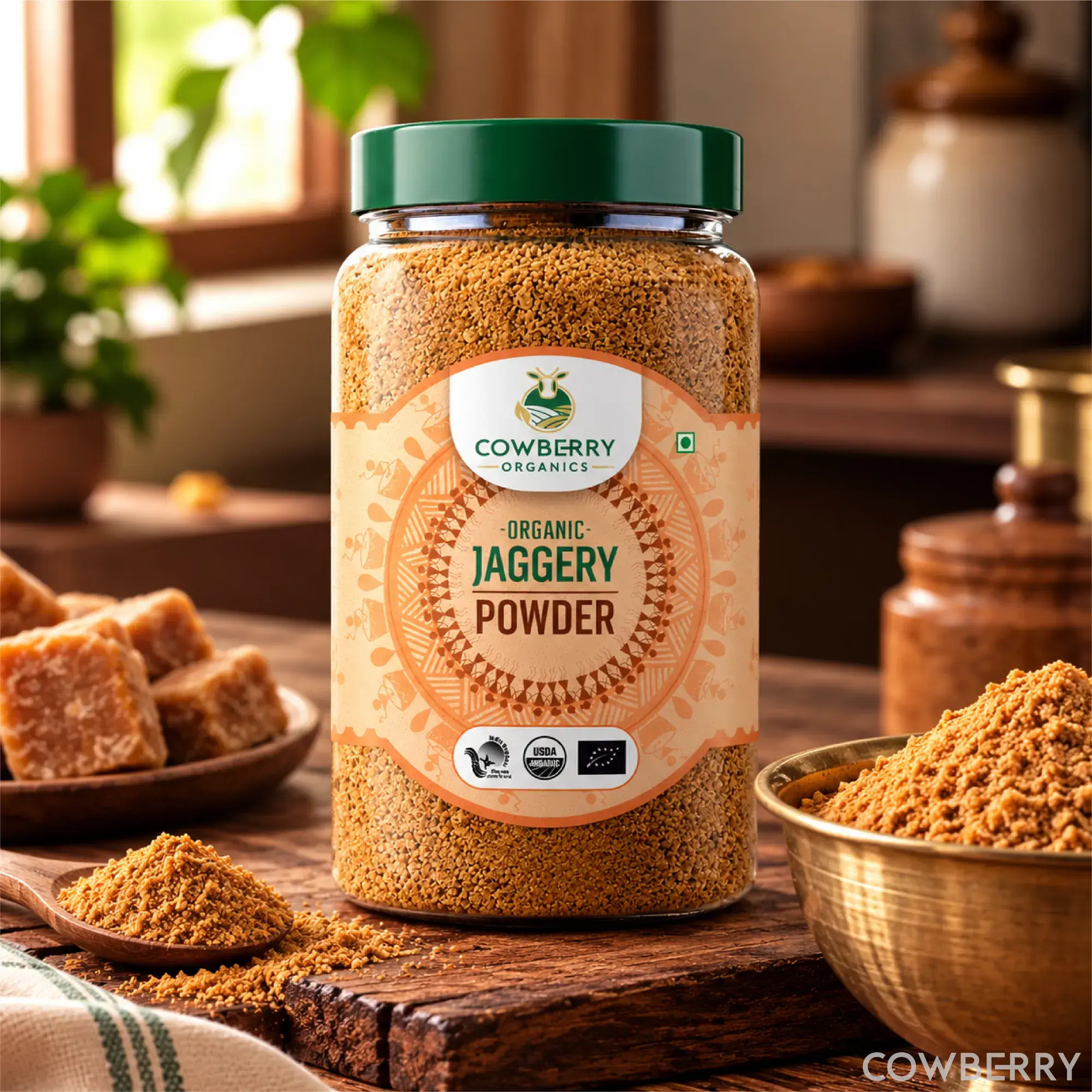
Jaggery powder has the same benefits as block jaggery, because it is the same boiled cane juice, made into granules instead of a block: 4.63 mg iron, 107 mg calcium and 115 mg magnesium per 100 g, no gluten and almost no fat. Its practical benefit is convenience: it dissolves instantly in tea and batter and measures by the spoon, which makes it easy to use in place of sugar and just as easy to over-use.
How much jaggery can I eat in a day?
Keep it inside the WHO free-sugars limit, under a tenth of your daily energy, and under a twentieth if you can. On an average 2000 kcal day, ICMR-NIN puts that twentieth at 25 g of sugar from every source together, enough for about five level teaspoons of jaggery only if nothing else sweet is eaten. With diabetes, ask your doctor or dietitian how much, if any, fits.
References
- Indian Food Composition Tables (IFCT) 2017, ICMR-National Institute of Nutrition
- Rao GP, Singh P. Value addition and fortification in non-centrifugal sugar (jaggery): a potential source of functional and nutraceutical foods. Sugar Tech, 2022
- WHO guideline: sugars intake for adults and children (2015)
- Dietary Guidelines for Indians, ICMR-National Institute of Nutrition
- University of Sydney glycemic index database (GI search)
Shop this article
Keep reading
Raw Sugar vs Brown Sugar: Is Demerara the Same Thing?
Does honey contain sugar? Carbs per 100g and the WHO sugar limit
Date Jaggery (Khejur Gur in English): Types, Forms and How to Use It