by COWBERRY

10 minute read
Jaggery vs sugar: nutrition, glycemic index, taste and which to choose

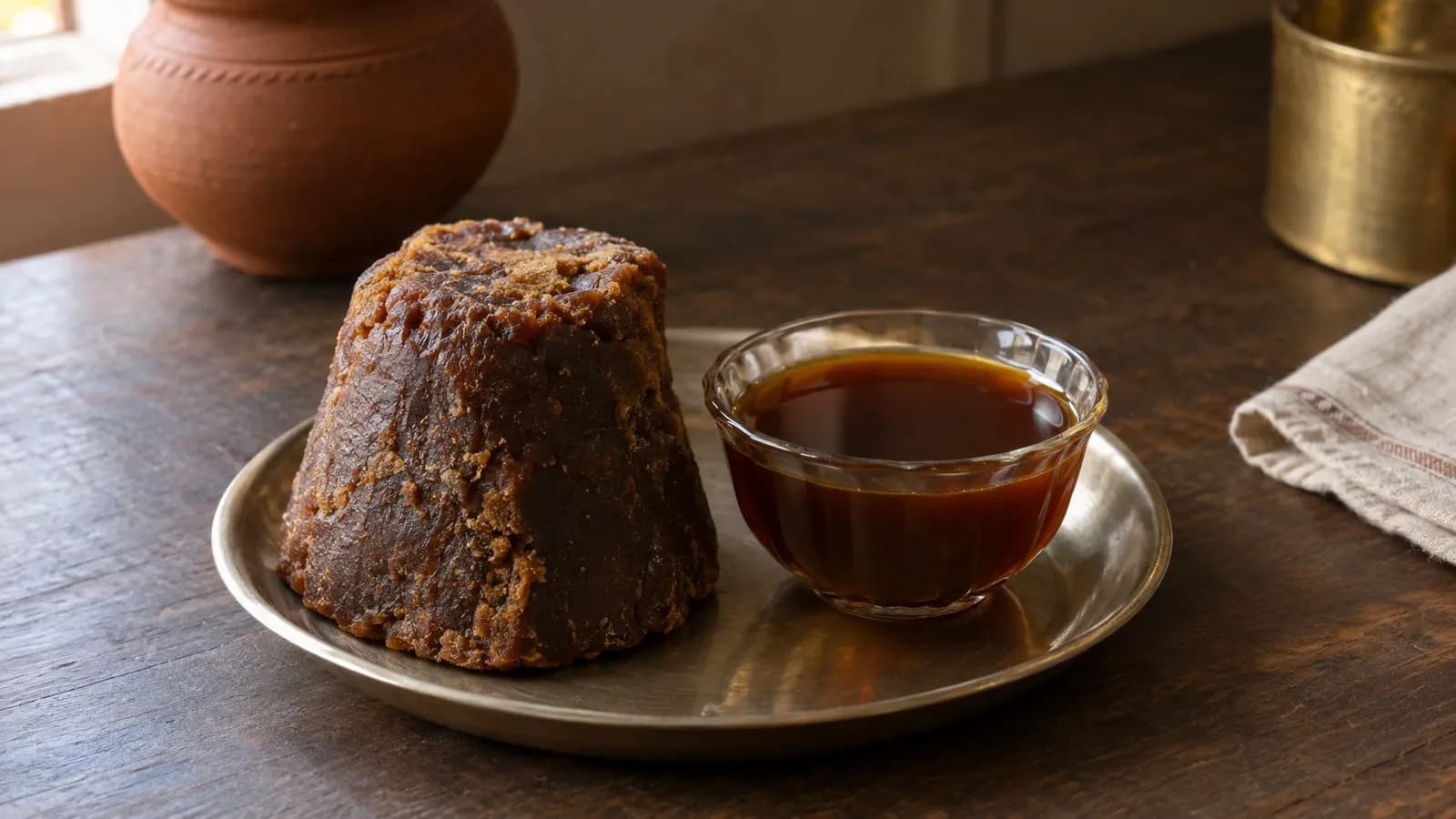
Jaggery vs sugar in one line: jaggery keeps the molasses, and with it a little iron, calcium and potassium and a caramel flavour, while white sugar is refined, with all of that taken out. Both are sugar, 354 kcal and 387 kcal per 100 g, so use less of either. The jaggery hub covers gur itself; here the two are compared on nutrition, GI, taste, cost and use.
Verdict in three lines
Jaggery keeps small amounts of minerals and the molasses flavour that refining removes; it is the more flavourful and slightly more nutritious of the two.
Both are sugar. Jaggery is about 85 percent carbohydrate and white sugar is all carbohydrate, and the calorie gap per teaspoon is a rounding error; neither is a health food, and neither is a free food for anyone with diabetes.
Use less of either. The win is not in the swap but in the spoon: if gur's stronger flavour lets you cut the amount, that is where the benefit lives.
If you want the numbers first, the table below puts jaggery, white sugar and honey side by side; if you want to know how much is too much, the daily limit is explained under the glycemic index; and if you are choosing for a particular person, a diabetic parent, a pregnancy, a child or a weight-loss diet, skip to which for whom. The jaggery guide covers gur on its own, from its regional names to its everyday uses.
Sugar vs jaggery vs honey: side by side per 100 g
The table uses IFCT 2017 for jaggery and USDA FoodData Central for white sugar and honey, since IFCT does not list refined sugar or honey. Read down the mineral rows and the difference between jaggery and sugar is plain: iron 4.63 mg against 0.05 mg, calcium 107 mg against 1 mg, potassium 488 mg against 2 mg, and magnesium 115 mg against none listed, per 100 g. Honey sits between the two but closer to sugar: 0.42 mg iron, 6 mg calcium and 52 mg potassium.
Read across the energy row and the three are much alike: 354 kcal for jaggery, 387 kcal for sugar and 304 kcal for honey. Carbohydrate is 84.9 g, 100 g and 82.4 g respectively, which is why honey comes out lowest. Protein and fat are negligible in all three. So the table says jaggery is sugar with a little mineral that barely registers at a teaspoon a time, and honey is close to sugar in everything except its lower carbohydrate share.
In the amounts people actually use, a 10 g piece of gur gives about 35 kcal, 0.46 mg of iron and 10.7 mg of calcium; a 5 g teaspoon of white sugar gives about 19 kcal and effectively no minerals; a 7 g teaspoon of honey gives about 21 kcal. The per-serving detail continues on the jaggery calories page.
| Nutrient | Jaggery (cane) | White sugar | Honey |
|---|---|---|---|
| Energy (kcal) | 354 | 387 | 304 |
| Protein (g) | 1.9 | 0 | 0.3 |
| Fat (g) | 0.2 | 0 | 0 |
| Carbohydrates (g) | 85 | 100 | 82 |
| Dietary fibre (g) | — | 0 | 0.2 |
| Iron (mg) | 4.6 | 0.1 | 0.4 |
| Calcium (mg) | 107 | 1 | 6 |
| Magnesium (mg) | 115 | 0 | 2 |
| Potassium (mg) | 488 | 2 | 52 |
| Sodium (mg) | 25 | 1 | 4 |
| Zinc (mg) | 0.5 | 0 | 0.2 |
| Folate (mcg) | 14 | 0 | 2 |
| Vitamin C (mg) | — | 0 | 0.5 |
| Glycemic index (GI) | — | 70 | 63 |
Per 100 g raw, edible portion. Composition: IFCT 2017 (ICMR-NIN); USDA FoodData Central (SR Legacy), FDC ID 169655, NDB 19335; USDA FoodData Central (SR Legacy), FDC ID 169640, NDB 19296. GI: University of Sydney GI database. — means not reported. These are average values for the food; the label on a pack gives the values for that product.
Glycemic index of jaggery and sugar
The jaggery vs sugar glycemic index question has a clear answer for sugar and an honest blank for jaggery. In the University of Sydney GI database, white sugar (sucrose dissolved in water) averages a GI of 70 across the tests recorded, which is the start of the high band; honey averages a GI of 63, in the medium band. The University of Sydney classes 55 and below as low and 70 and above as high. Its database has no entry for jaggery, so this page gives it no GI and does not guess one. A 2022 review in Sugar Tech, which calls jaggery non-centrifugal sugar, describes it as containing antioxidants, phenolics, minerals and vitamins; none of these changes how much sugar a spoon of it carries.
For someone with diabetes the practical reading is that neither jaggery nor sugar is a free food, and that the amount, and the meal it comes with, are the parts you control. Fibre in the same meal helps: the Dietary Guidelines for Indians say fibre delays and retards the absorption of carbohydrates. The WHO sugars guideline counts every sugar added by the cook or the manufacturer, gur and white sugar alike, as a free sugar, along with honey and syrups, and recommends keeping free sugars below 10 percent of daily energy, with a further cut to below 5 percent suggested. In grams, ICMR-NIN sets the line for high sugar at 25 g a day, on an average 2000 kcal diet; five level teaspoons of jaggery powder or sugar already make 25 g.
Taste and cooking: colour, storage and curdling in milk
Colour. Jaggery is golden to brown, and it colours whatever it goes into, so a jaggery kheer is beige and a jaggery cake is brown. White sugar is colourless in solution, which is why it is used where the colour of the dish matters, in a rasgulla or a lemon sherbet.
Flavour. Sugar is clean sweetness and nothing else. Jaggery has a rich, earthy caramel taste that goes well with ginger, cardamom, sesame and groundnut, and it is the sweetener in til ke laddu and peanut chikki. The same strong taste can overpower a delicate dish.
Storage. Jaggery wants an airtight container in a cool, dry place; left open, the powder clumps and the blocks harden.
Curdling in milk. Jaggery can be on the acidic side, and stirred into milk on the boil it may split it. The fix is timing: cook the milk or the kheer first, take it off the heat, then stir the gur in; for gur ki chai, add the jaggery once the tea is off the heat and strained, as the jaggery tea recipe does. Sugar can go in at any stage.
Substitution. Replace sugar with jaggery weight for weight, then taste and adjust. Grate or crush a block, or use jaggery powder, so it dissolves evenly. For syrups, the stage depends on the sweet: the til ke laddu recipe takes the jaggery to the soft-ball stage, and the peanut chikki recipe to the hard-crack stage.
Cost and where each fits
White sugar is usually the cheaper of the two per kilo, and organic jaggery usually costs more than ordinary jaggery. Neither is expensive relative to the amount a household uses in a week, so cost rarely decides.
What decides is use. Sugar fits where you want sweetness without colour or flavour: white sweets, sherbets, jams, cakes that must stay pale, and tea for people who dislike the taste of gur. Jaggery fits where its flavour is the point: chai, kheer and payasam, laddu and chikki, sweet pongal, puran poli, Bengali winter sweets, tamarind chutney, dal in the Gujarati and Maharashtrian style, and anything with sesame, groundnut or ginger. Sugar needs only a dry jar; jaggery needs an airtight one, kept somewhere cool. For the journey from cane juice to block, see how is jaggery made.
Which for whom
- Someone with diabetes: neither is a free food. Gur's minerals do not change its sugar load, and the GI evidence for jaggery is missing rather than favourable. If a small amount fits the meal plan, choose by taste; if it does not, neither does. Talk to your doctor or dietitian before adding either back.
- Weight loss: the calorie gap is a rounding error; the only saving is in using less of either. The full arithmetic is on is jaggery good for weight loss.
- Pregnancy: both come out of the same small sugar allowance, and jaggery's iron is a trace, not a supplement. If you have gestational diabetes, check with your doctor or dietitian first. See jaggery in pregnancy.
- Children: none of either before the age of two, because ICMR-NIN allows no added sugar at that age and counts jaggery as one. After two, the WHO sugars guideline covers children too, and tooth decay is one of the two outcomes it was built around, so the goal is less of either; a jaggery laddu is still sugar for the teeth. Follow your paediatrician's advice.
- Cooking and baking: jaggery for flavour and colour; sugar where the dish must stay pale or clean-tasting.
- Low iron: jaggery will not fix it. A 10 g piece gives 0.46 mg of iron; eat iron-rich foods and follow the prescription instead.
- Anyone choosing jaggery: read the pack for how it was made. The wider list of what gur does and does not do is on jaggery benefits.
FAQs
What is the difference between jaggery and sugar?
Jaggery is non-centrifugal sugar: cane juice cooked down without spinning off the molasses, so it keeps colour, a caramel flavour and small amounts of iron (4.63 mg per 100 g), calcium (107 mg) and potassium (488 mg). White sugar is refined, and the ICMR-NIN guidelines note that refined sugars carry no vitamins or minerals. The energy is close: 354 kcal against 387 kcal per 100 g.
Why jaggery is better than sugar?
Only slightly. Jaggery keeps the molasses, so it carries small amounts of iron, calcium, magnesium and potassium that refined sugar lacks, plus a caramel flavour that sugar does not have. It is not lower in calories in any way that matters, it is still free sugar under the WHO guideline, and it is not a free food for anyone with diabetes.
Is palm jaggery good for diabetes?
It counts as sugar in a diabetic meal plan, just as cane gur and white sugar do. Under FSSAI's definitions, palm jaggery is made from the juice of the palmyra or coconut palm rather than sugarcane, and the food tables used here have no composition or GI figures for it, so no numbers are given. Within the plan, pick by taste, and clear any of them with your doctor or dietitian first.
Which is better: sugar, jaggery or honey?
For minerals, jaggery: 4.63 mg iron and 107 mg calcium per 100 g against 0.42 mg and 6 mg in honey and almost nothing in sugar. For calories, honey is lowest per 100 g at 304 kcal, but a spoon of honey weighs more, so per spoon all three are close. For blood sugar, sugar has a GI of 70 and honey 63; jaggery has no entry in the GI database. None is a free food.
Does jaggery raise blood sugar like sugar?
There is no measured answer: the University of Sydney GI database has no entry for jaggery. What is known is that jaggery is about 85 percent carbohydrate and that ICMR-NIN lists it among added sugars, next to table sugar and honey. Without a tested GI, the cautious course is to plan for it as you would for sugar, especially with diabetes.
Can I replace sugar with jaggery in tea and baking?
Yes. For tea, the jaggery tea recipe waits until the tea is strained and off the heat before adding 10 g of jaggery powder (two teaspoons) a cup, so the milk is less likely to split. In baking, swap weight for weight and expect a darker result. In any dish, taste before you add more: the aim is to end up using less sweetener, not the same amount of a different one.
References
- Indian Food Composition Tables (IFCT) 2017, ICMR-National Institute of Nutrition
- USDA FoodData Central
- University of Sydney glycemic index database (GI search)
- University of Sydney: about the glycemic index
- WHO guideline: sugars intake for adults and children (2015)
- Dietary Guidelines for Indians, ICMR-National Institute of Nutrition
- Rao GP, Singh P. Value addition and fortification in non-centrifugal sugar (jaggery): a potential source of functional and nutraceutical foods. Sugar Tech, 2022
- FSSAI: Food Products Standards and Food Additives Regulations compendium (Version XXII, 02.03.2022): 2.8.4 Gur or Jaggery
Shop this article
Keep reading
Raw Sugar vs Brown Sugar: Is Demerara the Same Thing?
Does honey contain sugar? Carbs per 100g and the WHO sugar limit
Date Jaggery (Khejur Gur in English): Types, Forms and How to Use It