by COWBERRY

7 minute read
Does honey contain sugar? Carbs per 100g and the WHO sugar limit

Does honey contain sugar? It is mostly sugar: the USDA record for honey shows 82.4 g of carbohydrate per 100 g, nearly all of it the simple sugars glucose and fructose. This page gives the per-100 g table, what one teaspoon adds, and how the WHO free-sugar limit counts honey. The honey hub covers the food itself.
Does honey contain sugar? The per 100 g table
Yes, and there is no hedge worth adding: per 100 g, honey carries 82.4 g of carbohydrate, and nearly all of it is sugar. A 2008 review in the Journal of the American College of Nutrition describes honey’s carbohydrates as mainly the two simple sugars fructose and glucose, with about 25 different oligosaccharides alongside them. The rest of the table is emptier than the word nutrition suggests: 0.3 g of protein, no fat at all, and 0.2 g of fibre, which is effectively none. White sugar, the natural point of comparison, is 100 g of carbohydrate per 100 g and nothing else of note. The full figures for both foods are below.
| Nutrient | Honey | White sugar |
|---|---|---|
| Energy (kcal) | 304 | 387 |
| Protein (g) | 0.3 | 0 |
| Fat (g) | 0 | 0 |
| Carbohydrates (g) | 82 | 100 |
| Dietary fibre (g) | 0.2 | 0 |
| Iron (mg) | 0.4 | 0.1 |
| Calcium (mg) | 6 | 1 |
| Magnesium (mg) | 2 | 0 |
| Potassium (mg) | 52 | 2 |
| Sodium (mg) | 4 | 1 |
| Zinc (mg) | 0.2 | 0 |
| Folate (mcg) | 2 | 0 |
| Vitamin C (mg) | 0.5 | 0 |
| Glycemic index (GI) | 63 | 70 |
Per 100 g raw, edible portion. Composition: USDA FoodData Central (SR Legacy), FDC ID 169640, NDB 19296; USDA FoodData Central (SR Legacy), FDC ID 169655, NDB 19335. GI: University of Sydney GI database. — means not reported. These are average values for the food; the label on a pack gives the values for that product.
What kind of sugar is in honey
Honey’s sweetness is built from simple sugars, and India’s dietary guidelines say exactly where they fit: the simple carbohydrates glucose and fructose are found in fruits, vegetables and honey. The 2008 review adds the detail that honey’s carbohydrates are mainly fructose and glucose, with roughly 25 different oligosaccharides, and that the exact make-up varies with the flowers the bees visited. That variation is why two jars can taste and look different; the USDA record gives one figure, 82.4 g of carbohydrate per 100 g.
What the sugars are matters less than how they are counted. The WHO guideline defines free sugars to include the monosaccharides and disaccharides added to foods by the manufacturer, cook or consumer, and the sugars naturally present in honey, syrups, fruit juices and fruit juice concentrates. Honey’s sugars, in other words, sit in the same column as the sugar you add yourself.
How much sugar is in a teaspoon of honey
Per spoon, the answer is worth having in grams. A level teaspoon of honey weighs about 7 g, so the 82.4 g per 100 g shrinks to 5.8 g of carbohydrate a teaspoon, with 21 kcal; a tablespoon is three of those spoons, 21 g and 17.3 g of carbohydrate with 64 kcal. Two teaspoons come to 14 g and 11.5 g of carbohydrate.
White sugar makes the comparison honest. Its teaspoon is lighter, 5 g, which carries 5 g of carbohydrate and 19 kcal, so per spoon honey actually brings slightly more sugar than sugar does. The serving table below fixes the numbers, and the honey calories page works out the same spoons in kcal.
| Spoon | Weight | Carbohydrate | Energy |
|---|---|---|---|
| Teaspoon of honey | 7 g | 5.8 g | 21 kcal |
| Tablespoon of honey | 21 g | 17.3 g | 64 kcal |
| Two teaspoons of honey | 14 g | 11.5 g | 43 kcal |
| Teaspoon of white sugar | 5 g | 5 g | 19 kcal |
The WHO counts every one of those grams as free sugar, so a spoon of honey is a spoon of sugar in the day’s arithmetic; the next section shows the limit those spoons draw on.
Does honey count as a free sugar? What the WHO says
It does, and the guideline is explicit. The WHO sugars guideline counts honey among the free sugars, the kind it says to hold below 10 percent of total energy intake, with a further reduction below 5 percent suggested. The guideline also notes that higher intakes of free sugars threaten the nutrient quality of diets, delivering significant energy without specific nutrients. Honey’s 21 kcal and 5.8 g of carbohydrate a teaspoon are exactly that kind of energy.
The Indian dietary guidelines draw the line in grams. For adults they advise avoiding sugar or restricting it to 20 g to 25 g a day, and their list of added sugars names sucrose, jaggery, honey, glucose, fructose and dextrose together. A teaspoon of honey at 5.8 g of carbohydrate is already more than a quarter of a 20 g day, so honey leaves less room for everything else that is sweet. The full benefit and caution picture is on the honey benefits page.
Does the honey and sugar swap help?
Since honey is sugar with a lighter per-100 g load, 82.4 g of carbohydrate against white sugar’s 100 g, the swap question answers itself per gram: yes, slightly. Per spoon it does not, because the honey spoon is heavier, and the glycemic index reads the same way: 63 for honey against 70 for sugar, a small gap, not a free pass. Both are free sugars under the WHO line, so the honest swap is taste, not health.
For the GI detail, the recorded range and the bands, see honey’s glycemic index; the calorie and cooking comparison is on honey vs sugar; and the honey hub gathers every page in this guide.
Honey for babies and children: the sugar rules
The sugar rules get stricter the younger the eater. The Indian dietary guidelines want added sugar totally avoided for children below 2 years, and their definition of added sugars lists honey by name; the NHS advises against food and drink with sugar, the natural sugar found in honey included, for children aged 4 or under, and adds the tooth reason, since avoiding honey helps prevent tooth decay. The same NHS page says no honey at all before a child’s first birthday, because honey can occasionally carry the bacteria behind infant botulism; the honey for babies page has the ages and reasons, and before honey joins any young child’s food, ask your paediatrician.
For everyone else the page’s answer stays one sentence: yes, honey contains sugar, about 82.4 g of carbohydrate per 100 g, and it is counted as free sugar in full. For sweetness without surprises, the honey recipes roundup shows the small-spoon ways to use it.
FAQs
Does honey contain sugar?
Yes, honey is mostly sugar: 82.4 g of carbohydrate per 100 g, nearly all of it the simple sugars fructose and glucose, and the WHO counts honey’s sugars as free sugars. Per teaspoon (7 g) the sugar comes to 5.8 g of carbohydrate. The trace fibre, 0.2 g per 100 g, does not change the picture.
How much sugar is in a teaspoon of honey?
A level teaspoon of honey weighs 7 g and carries 5.8 g of carbohydrate, almost all of it sugar, with about 21 kcal. A tablespoon, three spoons, holds 17.3 g of carbohydrate. Both are free sugar under the WHO definition, so each spoon counts in the day’s sugar total.
Is honey pure sugar?
No. Per 100 g, honey is 82.4 g of carbohydrate, so roughly one sixth of the jar is not sugar: mostly water, with small amounts of proteins, enzymes, amino acids, minerals, vitamins and polyphenols, as a 2008 review lists them. Pure white sugar, beside it, is 100 g of carbohydrate per 100 g and nothing else of note.
What is the glycemic index of honey?
Honey’s glycemic index is 63, the average of the seven plain-honey tests recorded in the University of Sydney GI database, whose readings run from 49 to 87. The University of Sydney’s GI bands put 55 and below in the low range and 70 and above in the high one, so honey sits in the medium band. White sugar averages 70.
Can honey cause diabetes?
No cited study singled out honey as the cause of diabetes, and the honest reading is about sugar generally: a 2023 review ties the rise of obesity and type 2 diabetes, in part, to excess calories from free sugars, and honey is one of those sugars. Count it inside the day’s sugar line; the detail is on the honey for diabetes page.
Is honey good for diabetes?
Honey is not a special sweetener for diabetes: it is 82.4 g of carbohydrate per 100 g with a GI of 63, close to white sugar’s 70, and a 2015 trial found it behaving like sucrose. A small counted amount may fit a meal plan; clear it with your doctor or dietitian. The full answer is on the honey for diabetes page.
References
- USDA FoodData Central (SR Legacy): Honey, FDC ID 169640
- USDA FoodData Central
- University of Sydney glycemic index database (GI search)
- University of Sydney: about the glycemic index
- Bogdanov S, Jurendic T, Sieber R et al. Honey for nutrition and health: a review. J Am Coll Nutr, 2008
- WHO guideline: sugars intake for adults and children (2015)
- Dietary Guidelines for Indians, ICMR-National Institute of Nutrition
- NHS: Foods to avoid giving babies and young children
- Ahmed A, Tul-Noor Z, Lee D et al. Effect of honey on cardiometabolic risk factors: a systematic review and meta-analysis. Nutr Rev, 2023
- Raatz SK, Johnson LK, Picklo MJ. Consumption of Honey, Sucrose, and High-Fructose Corn Syrup Produces Similar Metabolic Effects in Glucose-Tolerant and -Intolerant Individuals. J Nutr, 2015
Shop this article
Keep reading
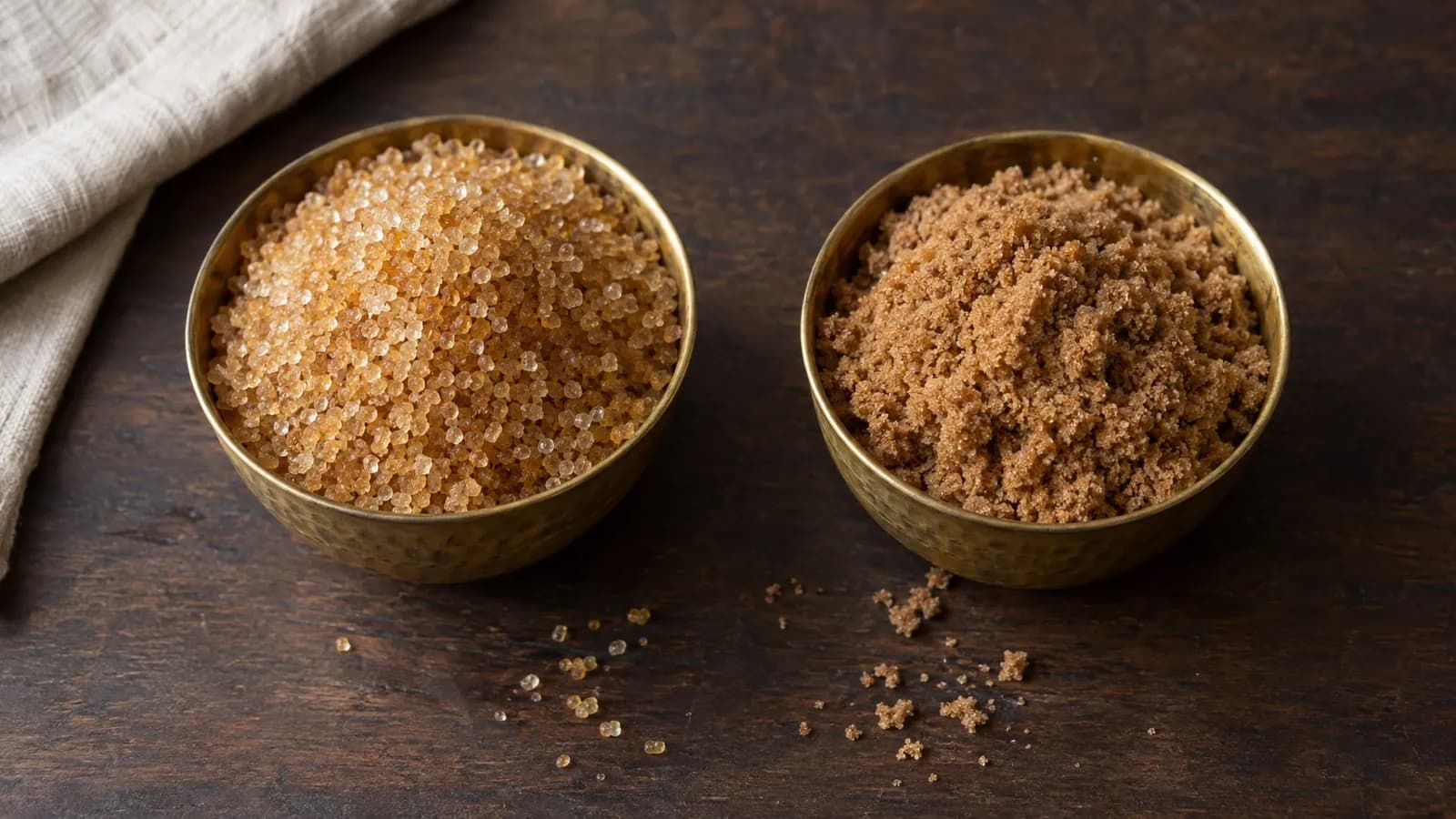
Raw Sugar vs Brown Sugar: Is Demerara the Same Thing?
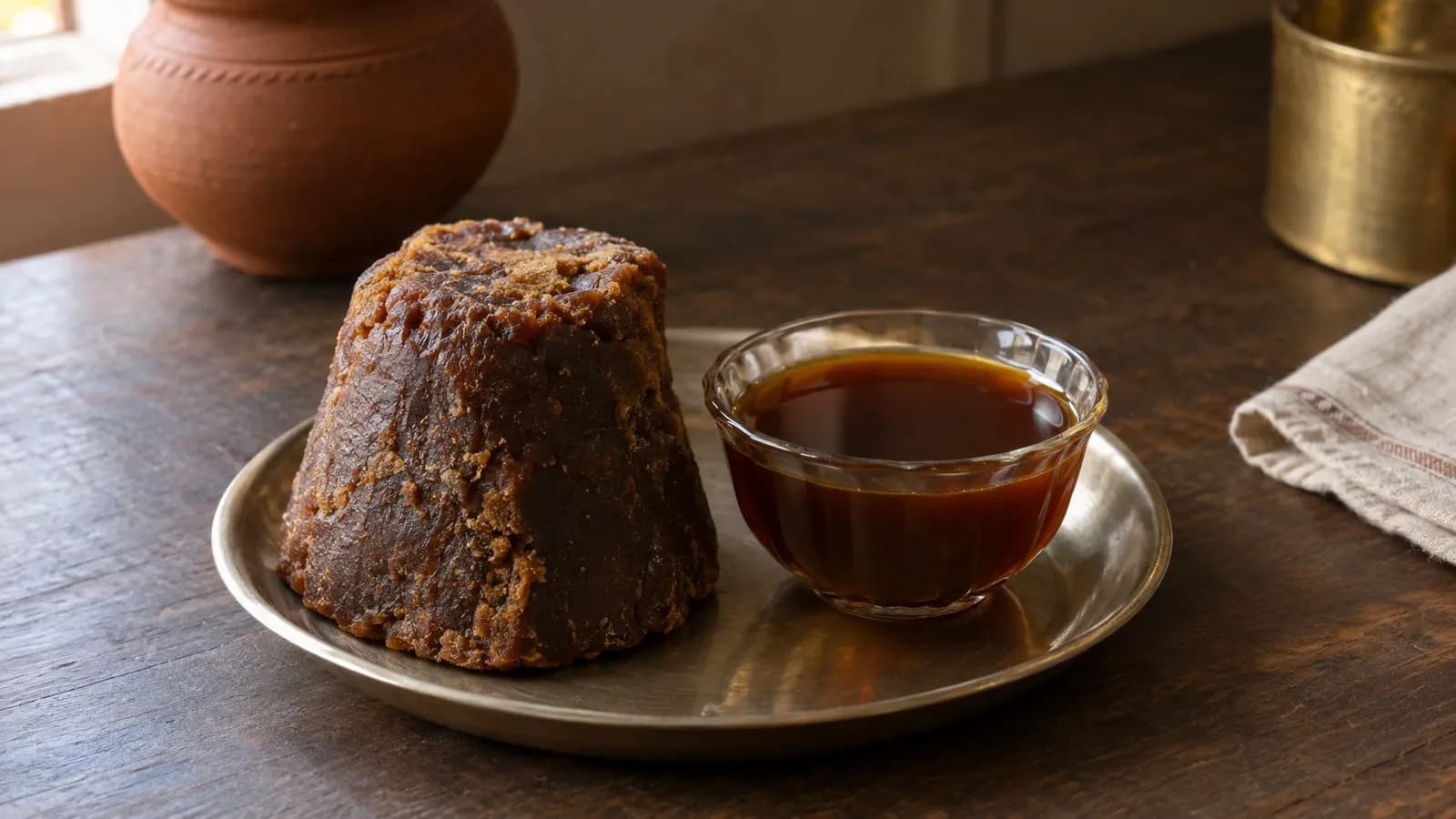
Date Jaggery (Khejur Gur in English): Types, Forms and How to Use It
Brown Sugar vs White Sugar: Calories, GI and Which Is Better