by COWBERRY

10 minute read
Is jaggery good for weight loss? Calories, GI and how to use it

Is jaggery good for weight loss? No, not by itself: jaggery has about the same energy as sugar, 354 kcal per 100 g against 387 kcal for white sugar, so swapping sugar for gur does not cut calories. Jaggery helps only if you end up using less of it than you used of sugar.
Short answer: jaggery is sugar with a little extra
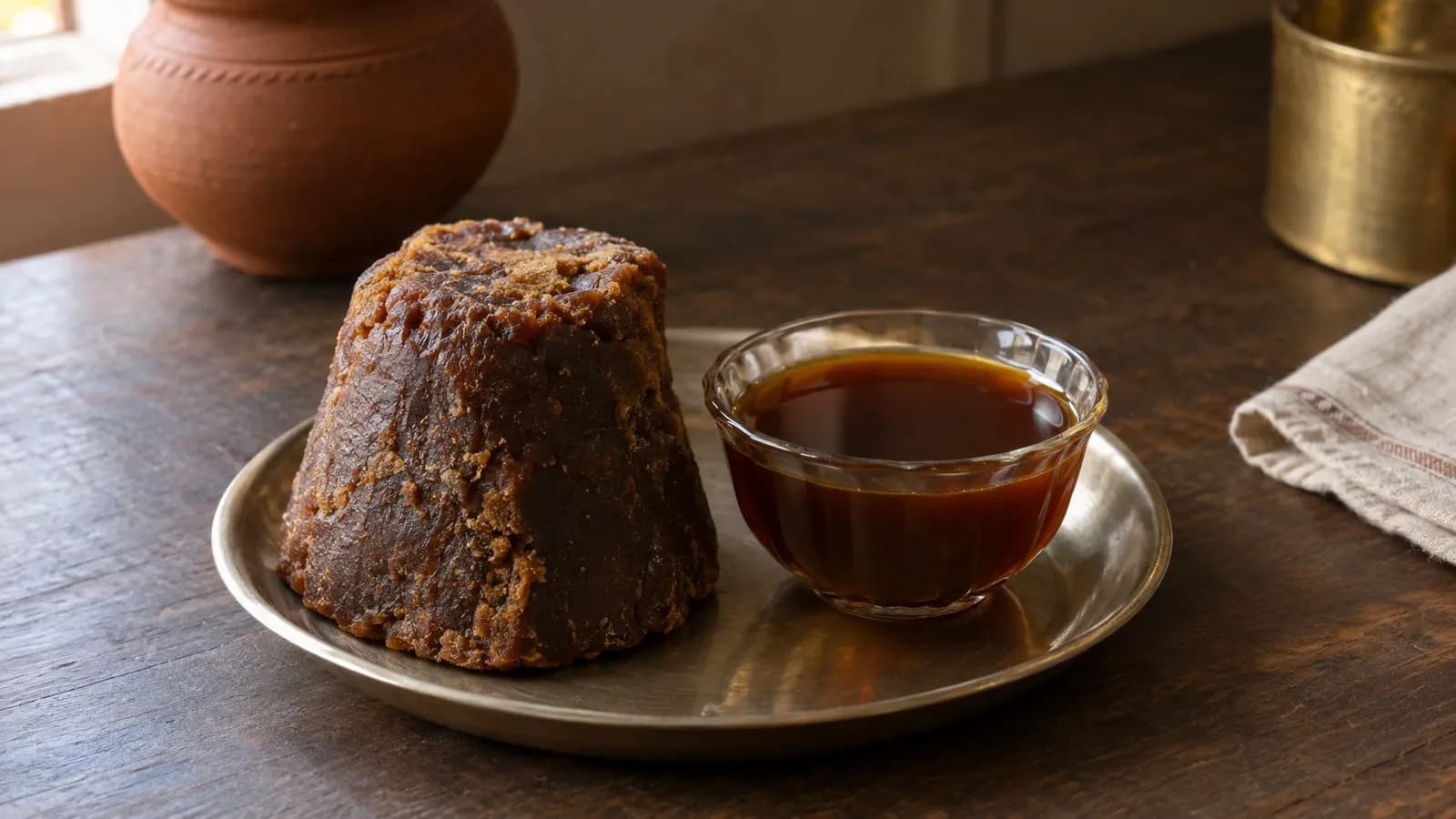
No, jaggery is not a weight-loss food, and switching from sugar to gur will not by itself make you lighter. The ICMR-NIN guidelines count both as added sugars. Jaggery is the unrefined one, made from cane juice with the molasses left in, so it keeps a small amount of iron, calcium, magnesium and potassium and a caramel flavour; white sugar is refined, and by ICMR-NIN's account a refined sugar brings no vitamins or minerals at all. Gram for gram the energy is almost the same: 354 kcal per 100 g for jaggery (IFCT 2017) and 387 kcal per 100 g for white sugar (USDA FoodData Central).
Weight comes down when you eat less energy than you use, over weeks, and a sweetener that is mostly carbohydrate cannot help with that whichever plant or process it came from. If its stronger flavour means you reach for a smaller spoon, gur can sit inside a diet that is working; the saving comes from the smaller spoon. Used as a licence to eat more sweets because "it is healthy", it does the opposite. Everything else about gur, from its names to its uses in the kitchen, is on the jaggery page; here the only question is weight.
What the numbers say: jaggery calories per 100 g and per teaspoon
The table gives the per-100 g values for jaggery and white sugar. In the kitchen the useful units are the teaspoon and the piece, so here is the arithmetic, counting a level teaspoon as 5 g and a piece of gur as 10 g.
- One level teaspoon of jaggery powder (5 g): about 18 kcal.
- One level teaspoon of white sugar (5 g): about 19 kcal.
- One 10 g piece of jaggery: about 35 kcal, with 8.5 g of carbohydrate, 0.46 mg of iron and 10.7 mg of calcium.
- One level tablespoon of jaggery powder (15 g): about 53 kcal.
So two teaspoons of gur in place of two of sugar saves about 3 kcal a day. The minerals are real but small at these amounts; a person would need to eat a lot of jaggery to get a meaningful share of a day's iron or calcium, and would take in far too much sugar doing it.
On the glycemic index, white sugar (sucrose) has a GI of 70 in the University of Sydney database, the bottom of that scale's high band (70 or more). Jaggery has no entry there, so this page shows no GI for it and does not claim that it raises blood sugar faster or slower than sugar. The full breakdown is on the jaggery calories page, and the sugar comparison on jaggery vs sugar.
| Nutrient | Jaggery (cane) | White sugar |
|---|---|---|
| Energy (kcal) | 354 | 387 |
| Protein (g) | 1.9 | 0 |
| Fat (g) | 0.2 | 0 |
| Carbohydrates (g) | 85 | 100 |
| Dietary fibre (g) | — | 0 |
| Iron (mg) | 4.6 | 0.1 |
| Calcium (mg) | 107 | 1 |
| Magnesium (mg) | 115 | 0 |
| Potassium (mg) | 488 | 2 |
| Sodium (mg) | 25 | 1 |
| Zinc (mg) | 0.5 | 0 |
| Folate (mcg) | 14 | 0 |
| Vitamin C (mg) | — | 0 |
| Glycemic index (GI) | — | 70 |
Per 100 g raw, edible portion. Composition: IFCT 2017 (ICMR-NIN); USDA FoodData Central (SR Legacy), FDC ID 169655, NDB 19335. GI: University of Sydney GI database. — means not reported. These are average values for the food; the label on a pack gives the values for that product.
Where jaggery fits in a weight loss diet
Jaggery earns its place in a weight-loss diet in three ways, none of them magic.
Use less of it
Gur has a caramel taste that plain sugar lacks. If that lets you sweeten tea or porridge with a smaller amount than you used of sugar, the smaller amount is what cuts calories; the switch on its own does very little. Put in a little less than you think you need, and cut down from there.
Sweeten whole foods, not empty ones
A spoon of jaggery powder in a katori of ragi porridge or dalia, or a piece with roasted chana, comes with the fibre of the grain or pulse, which, according to the ICMR-NIN guidelines, slows the absorption of carbohydrates and makes a meal more filling. A spoon stirred into juice or eaten in a maida biscuit comes with none. Recipes that use gur as a binder come in set portions: a serving of peanut chikki is two squares and a serving of til ke laddu is one laddu, and the recipe tells you how much jaggery went into the batch.
Replace, never add
Jaggery in your morning tea instead of sugar is a swap. Jaggery in your tea and a gur-based sweet after lunch because it is "natural" is an addition, and additions are how weight goes up. Keep one rule: every gram of gur replaces a gram of some other sweetener, and the total stays inside the limit in the last section. A cup of jaggery tea, sweetened as in the recipe with two teaspoons of jaggery powder, takes 10 g of that limit, about 35 kcal.
Better and worse options among sweeteners
Ranked for someone trying to lose weight, from the option that helps most to the one that helps least.
- Nothing at all. Unsweetened tea and coffee, and fruit for the sweet craving, is the option that removes the calories rather than trading them.
- Whole fruit and dates. The sugar in whole fruit is not a free sugar in the WHO's definition, and it comes with the fruit's fibre. A date in place of a spoon of gur in a laddu is a fair swap; a dozen dates is not.
- Jaggery. 354 kcal per 100 g, a little mineral and a caramel flavour. Better than sugar only if you actually use less of it.
- Honey. A liquid sugar that is easy to over-pour; a spoon of honey weighs more than a spoon of sugar, so the calories per spoon are similar or higher. The "honey and warm water in the morning" habit adds sugar to a day; it does not remove anything.
- White sugar. 387 kcal per 100 g and nothing else. Not worse than gur in a weight-loss diet by any margin that matters; the case against it is flavour and the missing minerals, not calories.
- Sweets and packaged "jaggery" snacks. Gur-coated nuts, jaggery biscuits and mithai carry fat and flour as well as the sweetener. Read them as sweets, not as health foods.
What to avoid
- The gur-and-warm-water morning drink. It is often passed around as a slimming habit, but a 10 g piece in warm water is about 35 kcal of sugar and nothing more. If you like it, count it; do not expect it to do anything for your weight.
- "Jaggery is healthy, so more is fine." The minerals in gur are worth having only at amounts that keep the sugar small. Beyond a couple of pieces a day you are eating sugar for the iron, which defeats the purpose.
- Jaggery sweets as diet food. A laddu bound with gur is still a sweet: in til ke laddu the sesame and ghee add their own calories to the jaggery's.
- Swapping without measuring. Because gur comes in irregular lumps, it is easy to drop a 20 g chunk into a cup that used to get a 5 g teaspoon of sugar. Use jaggery powder and a measuring spoon, or break cubes to a known size, for the first few weeks.
- Skipping the label. Not a weight point, but while you are choosing, pick a pack that says how the jaggery was made, for example that no chemical clarifying agents were used. The steps from cane to block, and FSSAI's household check for chalk in jaggery, are on how is jaggery made.
The daily sugar limit, and when to talk to your doctor
Two guidelines set the yardstick here. The World Health Organization's guideline on sugars intake (2015) counts as free sugars everything added by the manufacturer, the cook or the person eating, plus the sugars in honey, syrups and fruit juices, so gur stirred into tea counts in full. Its advice is to get less than 10 percent of total energy from free sugars, it suggests going below 5 percent, and it notes that the extra body weight linked to free sugars comes from the extra energy they add. The Dietary Guidelines for Indians put that in grams: on an average intake of 2000 kcal a day, sugar above 25 g a day, or over 5 percent of energy, counts as high, and limiting it to 25 g is better for health. That is five level 5 g teaspoons for the whole day, including the sugar already inside biscuits, ketchup, packaged drinks and mithai, so the gur in your tea is sharing it with all of them.
In practice that can mean two teaspoons of jaggery a day, in tea or porridge, inside a diet built on dal, vegetables, whole grains and curd, and no sweetened drinks. Whether those two teaspoons are gur or sugar changes the day by about 3 kcal. If you have diabetes, prediabetes, PCOS, a fatty liver or are on any medical diet, the sugar budget is set by your care team, not by this page; talk to your doctor or dietitian before you change it.
FAQs
Can jaggery help in weight loss?
Not on its own. Jaggery has 354 kcal per 100 g, close to sugar's 387 kcal, so replacing sugar with gur does not remove calories from your day. It helps only indirectly: if its caramel flavour means you use less, or a piece of gur after a meal replaces a bowl of mithai, the saving is real. The weight comes off from the total, not from the type.
Can jaggery cause diabetes?
Jaggery counts as a free sugar, and one worry with free sugars is weight gain, which in turn raises diabetes risk. The WHO sugars guideline links more free sugar with more body weight and notes that the risk of type 2 diabetes is often mediated through overweight and obesity. Gur carries the same concern as sugar and goes into the same daily count, which ICMR-NIN advises keeping to 25 g.
How many calories are in a teaspoon of jaggery?
About 18 kcal for a level 5 g teaspoon of jaggery powder, against about 19 kcal for the same weight of white sugar. A 10 g piece of solid gur is about 35 kcal and a 15 g tablespoon of powder about 53 kcal. The calories follow the weight, so a heaped spoon or a large lump counts for more; measure rather than guess.
Is jaggery better than sugar for weight loss?
Only marginally, and only if you use less of it. Gram for gram jaggery has slightly fewer calories (354 kcal against 387 kcal per 100 g) and a small amount of iron, calcium and potassium that sugar lacks; neither difference will show on a weighing scale. What cuts calories is a smaller spoon, whichever sweetener is in it.
Can I eat jaggery every day while losing weight?
Yes, within a budget. Two level teaspoons a day, about 10 g and 35 kcal, in tea or porridge, sits well inside the 25 g a day above which ICMR-NIN calls sugar intake high, and leaves room for the sugar hidden in other foods. Count any sweets against the same budget, and skip it on days you have had mithai.
Is jaggery tea good for weight loss?
It is a better habit than sugared tea only if you use less sweetener; the tea itself is not slimming. One cup of gur ki chai with 10 g (two teaspoons) of jaggery powder, as in the jaggery tea recipe, is about 35 kcal. Three such cups make 30 g of jaggery and about 106 kcal, already past the 25 g a day that ICMR-NIN counts as high on an average 2000 kcal day.
References
- Indian Food Composition Tables (IFCT) 2017, ICMR-National Institute of Nutrition
- USDA FoodData Central
- WHO guideline: sugars intake for adults and children (2015)
- University of Sydney glycemic index database (GI search)
- University of Sydney: about the glycemic index
- Dietary Guidelines for Indians, ICMR-National Institute of Nutrition
Shop this article
Keep reading
Raw Sugar vs Brown Sugar: Is Demerara the Same Thing?
Does honey contain sugar? Carbs per 100g and the WHO sugar limit
Date Jaggery (Khejur Gur in English): Types, Forms and How to Use It