by COWBERRY

7 minute read
Raw Sugar vs Brown Sugar: Is Demerara the Same Thing?

Raw sugar vs brown sugar in one line: USDA FoodData Central has one entry, 'Sugars, brown', which stands for both sugars, so the numbers are the same — 380 kcal and 98.1 g of carbohydrate per 100 g — and no number can tell them apart. The brown sugar guide covers demerara and its types; this page separates raw from brown.
Verdict in three lines
Same figures on paper. The one USDA entry, which stands for both, lists: 380 kcal, 98.1 g of carbohydrate, 0.71 mg of iron and 83 mg of calcium per 100 g, plus a GI of 71 from the database's single brown-sugar test.
Different on the shelf. What the sources describe is brown sugar's side: minimally processed (COWBERRY's wording) sugar that keeps its natural molasses, with a moist texture and a gentle caramel taste. For raw sugar the references carry no separate numbers, and none are invented.
White sugar is the real contrast. The refined end of the scale, shown in the table's second column, holds 387 kcal and 100 g of carbohydrate per 100 g with almost no minerals.
The full picture of sugar and blood sugar lives on the white sugar glycemic index page.
Raw sugar vs brown sugar: side by side per 100 g
IFCT 2017 lists no raw sugar, no brown sugar and no white sugar, so both columns come from USDA FoodData Central. The first column is the single USDA brown-sugar entry, which stands for raw sugar and brown sugar; the second is granulated white sugar, the refined end of the scale. Reading the two columns shows where the real difference lives: iron is 0.71 mg against 0.05 mg, calcium 83 mg against 1 mg, potassium 133 mg against 2 mg, and magnesium 9 mg against none listed, with energy at 380 kcal against 387 kcal. Between raw and brown sugar the figures cannot separate them, because one entry stands for both. A level teaspoon (5 g) of either gives about 19 kcal, and a 15 g tablespoon about 57 kcal.
| Nutrient | Brown sugar (demerara) | White sugar |
|---|---|---|
| Energy (kcal) | 380 | 387 |
| Protein (g) | 0.1 | 0 |
| Fat (g) | 0 | 0 |
| Carbohydrates (g) | 98 | 100 |
| Dietary fibre (g) | 0 | 0 |
| Iron (mg) | 0.7 | 0.1 |
| Calcium (mg) | 83 | 1 |
| Magnesium (mg) | 9 | 0 |
| Potassium (mg) | 133 | 2 |
| Sodium (mg) | 28 | 1 |
| Zinc (mg) | 0 | 0 |
| Folate (mcg) | 1 | 0 |
| Vitamin C (mg) | 0 | 0 |
| Glycemic index (GI) | 71 | 70 |
Per 100 g raw, edible portion. Composition: USDA FoodData Central (SR Legacy), FDC ID 168833, NDB 19334; USDA FoodData Central (SR Legacy), FDC ID 169655, NDB 19335. GI: University of Sydney GI database. — means not reported. These are average values for the food; the label on a pack gives the values for that product.
Demerara sugar vs brown sugar: what the names cover
Demerara and turbinado are usually sold as raw sugars, and brown sugar is often the moister of the family. The references carry no separate figures for raw sugar, turbinado or muscovado, so any number for them is the brown-sugar figure from USDA.
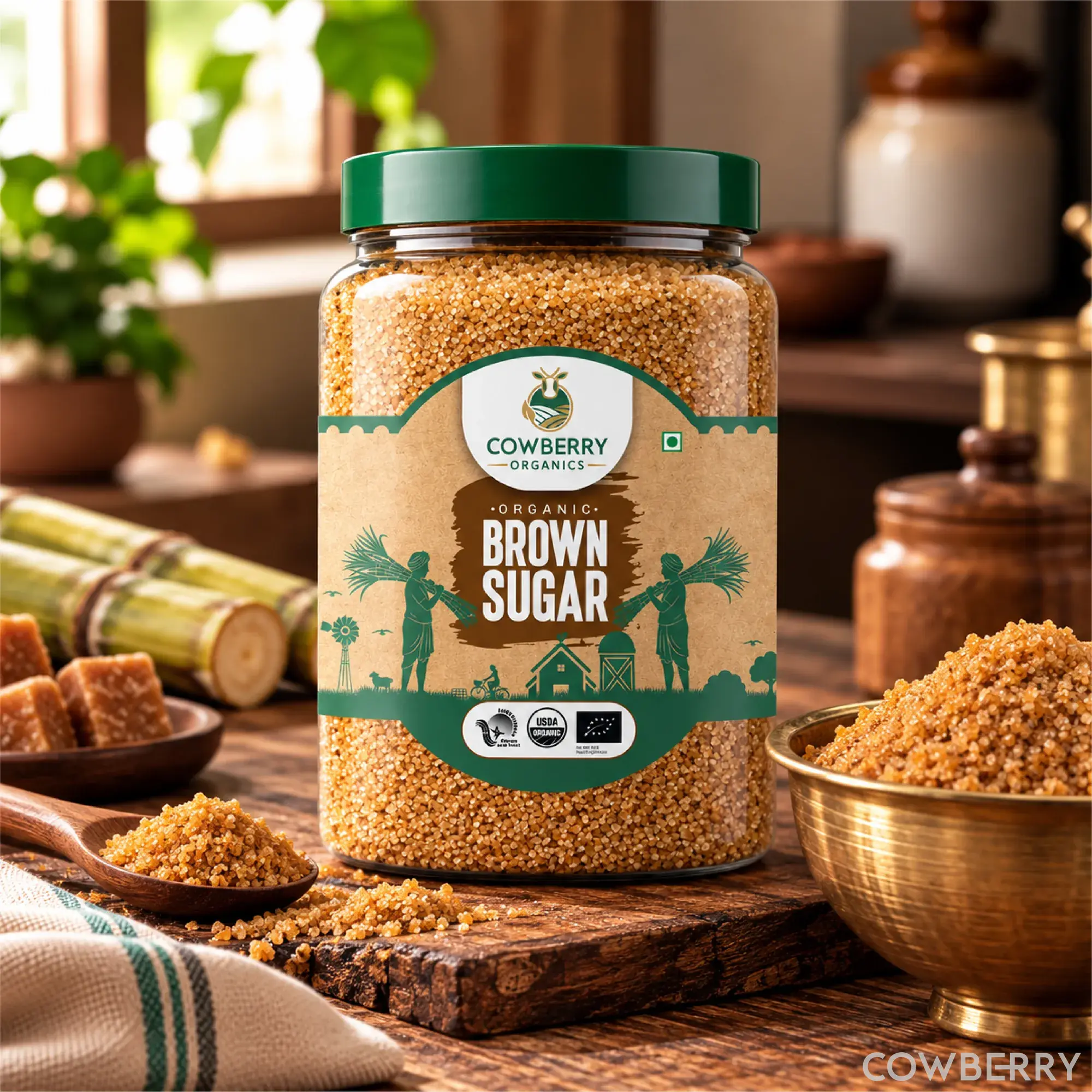
What the sources describe sits on brown sugar's side. COWBERRY's brown sugar starts from organically grown Maharashtra sugarcane and is minimally processed, skipping artificial colouring and unnecessary refining, so the natural molasses stays; its copy calls the texture moist and the taste a gentle caramel. The white sugar column shows what full refining removes: the Dietary Guidelines for Indians note that refined extracted sugars hold no vitamins or minerals.
The words are tangled too. Jaggery's name comes from the Portuguese word jagara, which means coarse brown sugar, as Rao and Singh note in their 2022 review. The brown sugar guide sets the types apart.
Glycemic index: one small test stands for both
Raw and brown sugar sit under one GI in the database: 71, from a single brown-sugar test in China with six participants, with no reference listed. It is the only brown-sugar entry the database holds, and it stands for raw sugar too, since no separate raw-sugar entry is listed. White sugar, tested as sucrose across 25 entries from many countries, comes out at a mean GI of 70, the individual tests running from 48 to 110. The University of Sydney marks the low band as 55 and below and the high band as 70 and above, which places both sugars at the start of the high band.
The amount, not the type, is the lever: the WHO counts sugars that the cook or the maker adds as free sugars, recommends keeping them below 10 percent of daily energy, a further step being suggested, cutting below 5 percent. ICMR-NIN's plate for a 2000 kcal diet says sugar must be restricted to 25-30 g a day; five level teaspoons already make 25 g.
Taste, texture and where each is used
Brown sugar's texture is moist, and its taste is a gentle caramel; those are the qualities COWBERRY's product copy names for its brown sugar, and they are what baking wants from it, moisture and caramel flavour in cookies, cakes and desserts, as its product page notes. For raw sugar the references hold no figures and say nothing on texture or taste, so that is left unclaimed; the numbers are the same for both, so they give no nutritional reason to prefer one. In tea both work; the brown sugar tea recipe is built on demerara. The full list of kitchen uses is on the how to use brown sugar page.
Cost and where each fits
White sugar is usually the cheapest of the three, and the raw and brown sugars usually cost a little more; the differences are small enough that cost rarely decides.
Use decides. Brown sugar fits tea, cookies, cakes and desserts where caramel and moisture help; raw sugar, with the same numbers, can go wherever brown sugar would, and the texture is what you would notice. White sugar stays for dishes that want plain sweetness and nothing else. The brown sugar vs jaggery page places the family alongside gur.
Which for whom
- Someone with diabetes: none of the three is a free food. Raw and brown share a GI of 71 from one small test, white sugar averages 70 across 25, and all sit in the high band; the trace minerals in brown sugar are small beside its sugar. If a modest amount fits the meal plan, pick by taste; otherwise, leave all three out. Talk to your doctor or dietitian first. The brown sugar for diabetes page runs the numbers.
- Weight loss: no figure separates raw from brown, and switching to white saves a rounding error of 7 kcal per 100 g. A BMJ review from 2012, covering 30 trials and 38 cohort studies, linked cutting sugars to a mean loss of 0.8 kg of body weight in adults eating freely; the lever is the amount.
- Children: ICMR-NIN allows no added sugar below the age of two, whichever type; after that, keep all of them low, because the WHO ceiling covers children too.
- Baking and tea: brown sugar where moisture and caramel help; raw sugar where its texture suits; white sugar where the sweetness must stay plain.
FAQs
Difference between demerara sugar and brown sugar?
In the numbers, none: one USDA entry, 'Sugars, brown', stands for both, giving 380 kcal and 98.1 g of carbohydrate per 100 g. Demerara is usually sold as a raw sugar, and COWBERRY describes its brown sugar as moist.
Is demerara sugar the same as brown sugar?
By the figures, yes: one USDA FoodData Central entry stands for both, so the calories, minerals and GI figure shown are identical. They are often sold as different products, but no number separates them.
Is demerara sugar better than brown sugar?
Not by any figure. One composition entry stands for both, so no table shows a difference in calories, minerals or GI between them, and no published source in the references ranks one above the other.
What's the difference between demerara sugar and raw sugar?
Demerara is usually sold as a raw sugar, so the two are not rivals. The references carry no separate figures for raw sugar, so its numbers are the brown-sugar figures from USDA FoodData Central: 380 kcal of energy and 98.1 g of carbohydrate per 100 g.
Difference between demerara sugar and turbinado sugar?
The references carry no separate figures for the two, so no numbers distinguish them; both take the brown-sugar figure of 380 kcal and 0.71 mg of iron per 100 g from USDA FoodData Central. Check the pack for how each is described.
Difference between demerara sugar and muscovado?
No numbers are given for muscovado, so every brown sugar number rests on the 'Sugars, brown' record from USDA FoodData Central; there is no muscovado figure to tell it apart. Check the pack for how each is described.
References
- Indian Food Composition Tables (IFCT) 2017, ICMR-National Institute of Nutrition
- USDA FoodData Central (SR Legacy): Sugars, brown, FDC ID 168833
- USDA FoodData Central (SR Legacy): Sugars, granulated, FDC ID 169655
- University of Sydney glycemic index database (GI search)
- University of Sydney: about the glycemic index
- WHO guideline: sugars intake for adults and children (2015)
- Dietary Guidelines for Indians, ICMR-National Institute of Nutrition
- Rao GP, Singh P. Value addition and fortification in non-centrifugal sugar (jaggery): a potential source of functional and nutraceutical foods. Sugar Tech, 2022
- Te Morenga L, Mallard S, Mann J. Dietary sugars and body weight: systematic review and meta-analyses of randomised controlled trials and cohort studies. BMJ, 2012
Shop this article
Keep reading
Does honey contain sugar? Carbs per 100g and the WHO sugar limit
Date Jaggery (Khejur Gur in English): Types, Forms and How to Use It
Brown Sugar vs White Sugar: Calories, GI and Which Is Better