by COWBERRY

16 minute read
Chana dal (bengal gram): names, nutrition, benefits and how to cook it

Chana dal is split Bengal gram: the small desi chickpea (Cicer arietinum) with its brown skin removed and split in two, giving a matte, golden-yellow dal with 21.55 g protein and 15.15 g fibre per 100 g (IFCT 2017) and, boiled, a GI of 11. Besan is its flour, kala chana its whole form. Below: its names, numbers and cautions, and how to cook and choose it.
What is chana dal, and what is bengal gram?
Chana dal is made from the desi chickpea, the small, dark-brown, thick-skinned type of Cicer arietinum. The whole seed is cleaned, dried, dehusked and split in a dal mill; what comes out is chana dal. The same plant gives four things you will see on a shelf: kala chana (the whole desi seed, also sold as brown chana), chana dal (the skinned, split seed), besan (flour milled from chana dal) and sattu (flour from roasted chana). Kabuli chana, the large cream-coloured chickpea used for chole, is the other type of the same species: bigger, thinner-skinned and usually cooked whole.
In English, "gram" covers several pulses: IFCT 2017 calls toor red gram, moong green gram and urad black gram, and prints "Bengal gram" for both the whole desi chickpea and its dal. So bengal gram and chana dal are the same food at two stages: bengal gram is the crop, chana dal is the split, skinned seed. When an older English recipe says "split Bengal gram", it means chana dal.
Chickpea is grown and eaten all over the world, especially in Afro-Asian countries, says a 2012 review in the British Journal of Nutrition, which also rates its protein quality above that of other pulses. Chana dal cooks to a nutty, slightly sweet, firm-bodied dal that holds its shape, which is why it is used where texture matters: puran poli, cholar dal, kootu, vada and the tempering of lemon rice. Its names across the country (kadle bele, sanaga pappu, kadalai paruppu, cholar dal) are on the chana dal in English and Indian languages page, and how it sits beside toor, moong and urad is on the types of dal page.
Chana dal names in Indian languages
Most Indian kitchens do not say "Bengal gram" at all. In Hindi and Urdu it is chana dal or chane ki dal, in Marathi harbara dal, in Gujarati chana ni dal, in Bengali cholar dal, in Odia buta dali, in Kannada kadle bele (IFCT spells it kadale bele), in Telugu sanaga pappu, in Tamil kadalai paruppu and in Malayalam kadala parippu. The English name, as IFCT 2017 prints it, is Bengal gram dal; "split chickpea" is the plainer modern English. Each language's IFCT 2017 name is in the table below; the more common spellings used in this guide, and the everyday Hindi chana dal, sit beside them with a footnote.
The whole seed changes name too: chana or kala chana in Hindi, harbara in Marathi, kadale in Kannada, sanagalu in Telugu, kondaikadalai in Tamil and kadala in Malayalam. That matters when you shop, because "kadala curry" in Kerala is made from the whole black seed, not the dal, and "chana" alone in a North Indian shop may get you the whole seed. The full list, with the names people search most (kadle bele in English, kadalai paruppu in Hindi, bengal gram in Malayalam), is on the chana dal in English page.
| Language | Name (romanised) |
|---|---|
| English | Bengal gram, dal |
| Hindi | Chan-ki-dal, Chana dal |
| Marathi | Harabara dal, Harbara dal |
| Gujarati | Chana-ni-daad, Chana ni dal |
| Punjabi | Sholedi dal |
| Bengali | Cholar dal |
| Odia | Channa dali (Buta dali) |
| Assamese | Boot dail |
| Kannada | Kadale bele, Kadle bele |
| Telugu | Sanaga papu, Sanaga pappu |
| Tamil | Kadalaiparuppu, Kadalai paruppu |
| Malayalam | Kadala parippu |
| Urdu | Chane ki dal |
| Sanskrit | — |
| Botanical name | Cicer arietinum |
Source: IFCT 2017 (ICMR-NIN) local-names list. — means no name recorded in the source.
Hindi ‘Chana dal’: Wikipedia: Chickpea. Marathi ‘Harbara dal’: spelling variant of the IFCT 2017 name ‘Harabara dal’. Gujarati ‘Chana ni dal’: spelling variant of the IFCT 2017 name ‘Chana-ni-daad’. Kannada ‘Kadle bele’: spelling variant of the IFCT 2017 name ‘Kadale bele’. Telugu ‘Sanaga pappu’: spelling variant of the IFCT 2017 name ‘Sanaga papu’. Tamil ‘Kadalai paruppu’: spelling variant of the IFCT 2017 name ‘Kadalaiparuppu’.
Chana dal nutrition per 100 g (bengal gram nutrition)
Per 100 g of raw dal, IFCT 2017 reports 329 kcal, 21.55 g protein, 5.31 g fat, 46.72 g carbohydrate and 15.15 g total fibre. Among minerals it carries more iron (6.08 mg), zinc (3.65 mg) and folate (182 mcg) than either toor or moong dal, but less magnesium (118 mg) and potassium (957 mg); IFCT gives no figure for its vitamin C. The table sets it beside toor dal and moong dal, two dals that many Indian homes rotate it with.
Three things jump out. Protein is a near tie: 21.55 g against toor dal's 21.7 g and moong dal's 23.88 g. Fibre is not: chana dal's 15.15 g is 60 to 70 percent more than toor dal's 9.06 g or moong dal's 9.37 g, and the fat, 5.31 g, is three to four times that of the other two. The glycemic index of boiled chana dal is 11 in the University of Sydney database (one India-tested entry), against 20 for toor, measured on whole pigeon peas, and 38 for green gram that was soaked, kept moist for a day and steamed, in an entry that does not say whether it was split.
Cooked, one katori of dal needs about 30 g of the dry dal and brings roughly 99 kcal, 6.5 g protein, 4.5 g fibre and 1.8 mg iron. The chana dal protein per 100 g page works through katori and serving sizes, cooked weight and the minerals in detail; dal protein per 100 g across the common dals ranks them all, and the toor dal and moong dal guides cover the two peers.
| Nutrient | Chana dal | Toor dal | Moong dal |
|---|---|---|---|
| Energy (kcal) | 329 | 331 | 326 |
| Protein (g) | 22 | 22 | 24 |
| Fat (g) | 5.3 | 1.6 | 1.4 |
| Carbohydrates (g) | 47 | 55 | 53 |
| Dietary fibre (g) | 15 | 9.1 | 9.4 |
| Iron (mg) | 6.1 | 3.9 | 3.9 |
| Calcium (mg) | 46 | 72 | 43 |
| Magnesium (mg) | 118 | 119 | 155 |
| Potassium (mg) | 957 | 1395 | 1268 |
| Sodium (mg) | 21 | 18 | 10 |
| Zinc (mg) | 3.6 | 2.6 | 2.5 |
| Folate (mcg) | 182 | 108 | 92 |
| Glycemic index (GI) | 11 | 20 | 38 |
Per 100 g raw, edible portion. Composition: IFCT 2017 (ICMR-NIN). GI: University of Sydney GI database. — means not reported. These are average values for the food; the label on a pack gives the values for that product.
Benefits of chana dal
The figures come from the table above; the explanations from three sources: a 2012 chickpea review by Jukanti and colleagues, Mudryj and colleagues' 2014 review of pulses, and ICMR-NIN's Dietary Guidelines for Indians. A Hinglish version is chana dal khane ke fayde.
Protein that pairs well with grain
At 21.55 g per 100 g, chana dal has about as much protein as toor dal and delivers 6.5 g in a katori. The chickpea review names the sulphur-containing amino acids as its one shortfall and says cereals in the daily diet make up for them, which rice or roti beside the dal does.
More fibre than toor or moong dal
Chana dal has 15.15 g of fibre per 100 g, against about 9 g in toor and moong dal. Fibre, the ICMR-NIN guidelines say, delays absorption of carbohydrates and fats and adds to the satiety value of food; pulses appear on their list of fibre-rich foods that improve satiety.
A low glycemic index
The one India-tested entry for boiled chana dal in the University of Sydney database gives a GI of 11, a long way below 55, the upper limit of the low band, for plain dal eaten on its own. For people with diabetes, the pulses review counts the high fibre and low GI of pulses as a help in maintaining healthy blood sugar and insulin; the dal is still part of their carbohydrate.
Iron, folate and zinc
Per 100 g, chana dal gives 6.08 mg iron, 182 mcg folate and 3.65 mg zinc, more of each than toor or moong dal. The ICMR-NIN guidelines note that plant iron is absorbed less well than iron from meat or fish and that vitamin C in the same meal helps, so squeeze lemon over the bowl or keep tomato in the masala; pressure cooking also cuts the phytic acid that holds back iron and zinc.
Unsaturated fat and no gluten
Chana dal's 5.31 g of fat per 100 g is more than toor or moong dal carries, and the chickpea review describes chickpea as rich in unsaturated fatty acids such as linoleic and oleic acid. It also contains no gluten, and nor does besan, so chilla, dhokla, kadhi and pakora made only with besan suit anyone avoiding it.
Potassium and magnesium
Chana dal gives 957 mg potassium and 118 mg magnesium per 100 g. Toor and moong dal carry more of both, but the chickpea review singles out potassium among the minerals present in chickpea seeds.
Side effects: who should limit chana dal
For most people chana dal in normal portions is an everyday food. Five situations call for care.
- Gas and bloating: chickpeas carry oligosaccharides, and a 2019 review of how people tolerate pulses explains that these sugars pass the small intestine undigested and are fermented in the colon, which releases gas, though it adds that they may not be the whole story. Soak the dal for 1 to 2 hours, throw away the soaking water and cook it soft. Start with small portions if you rarely eat pulses: the same review reports that most people who get gas adapt within a few weeks if they keep eating pulses. The chickpea review notes that cooking reduces or removes its anti-nutritional factors.
- High uric acid or gout: uric acid is what the body makes when it breaks down purines, mostly its own and a smaller part from food, and pulses are among the plant foods people worry about. In a 12-year study of 47,150 men, eating more of the plant foods richer in purines, such as peas, beans and lentils, was not linked to more gout, while eating more meat or seafood was. A 2019 review places cooked chickpeas in the lowest purine band of its table, but asks people who already have gout or advanced kidney disease to take care with high-purine plant foods. If that is you, settle the amount of dal with your doctor or dietitian.
- Kidney disease on a potassium limit: 957 mg potassium per 100 g is a lot. Anyone on a restricted-potassium diet should count chana dal against that limit.
- Diabetes: the GI is low, but a katori of dal still carries 14 g of carbohydrate. Eat it in place of some rice or roti, not on top of a full plate.
- Toddlers and elders: chana dal keeps its shape when cooked and can be hard to chew or digest; give it well cooked and mashed, or as besan or a moong-chana khichdi.
Following a diet set for a health condition? Then talk to your doctor or dietitian before chana dal goes on the menu every day.
How to cook chana dal
Soak first. Rinse chana dal once or twice and soak it for 1 to 2 hours; an overnight soak is fine too and cuts the cooking time further. The soak helps in another way too: ICMR-NIN's guidelines list it with sprouting and fermenting as household methods that improve how well legumes are digested.
Pressure cook. Use three times the dal's volume of water with a pinch of turmeric and cook for 3 to 4 whistles on medium, then let the pressure drop on its own. Soaked chana dal is done in about 15 minutes; unsoaked needs 6 to 8 whistles and still comes out uneven. Unlike toor or moong, chana dal should keep its shape, so stop while the grains are soft but whole for dal fry, and cook longer and mash for a smooth dal or for puran.
Where it goes. The everyday dish is chana dal fry: cooked dal folded into an onion-tomato masala, then finished with a ghee tadka of cumin, hing and a broken dried red chilli. A handful of soaked chana dal goes into the tempering of lemon rice, upma and poha in South India, into lauki or methi sabzi in the North, and in Bengal it is cooked with coconut as cholar dal. Cooked and sweetened with jaggery it becomes the puran of puran poli and the base of chana dal payasam. Ground raw, it makes masala vada and dalwada, and its roasted form thickens coconut chutney.
Besan and the whole seed. FSSAI's standard defines besan as flour ground from dehusked Bengal gram, which is chana dal, so half of what chana dal can do happens as besan: besan chilla for breakfast, kadhi, dhokla, pakora and besan laddu. The whole seeds have their own dishes: kala chana curry from the desi seed and chole from kabuli chana.
How to store chana dal
Pulses keep well, and the FAO notes their long shelf life; chana dal stays good for months in an airtight steel, glass or food-grade plastic container in a cool, dry cupboard. A bitter, musty or oily smell means the batch is past its best. Buy 1 kg packs for a family and use them within a couple of months of opening.
The pest to watch for is the pulse beetle. A 2009 study of stored chickpeas describes how it works: the female glues her eggs to the grain, the grub grows inside it, and the adult leaves through a round exit hole, with losses of up to 30% in two months. Damp is the other enemy. ICMR-NIN's guidelines ask for food grains to be dried well and kept in airtight containers, and note that dried neem leaves in storage bins are a traditional way to keep some infestations away. So before you put a batch away for long, spread it in the sun for two or three hours, then fill the container to the top and keep the lid tight, since a half-empty jar lets in damp air. From June to September, an opened pack is better off on a fridge shelf. Unpolished dal carries no oil coating that could turn rancid, one more reason to buy it that way. Atta and whole grains need the same monsoon care; the how to store atta guide covers them alongside dals.
Chana dal recipes to start with
Five recipes cover the ways this one plant is eaten across India, from the split dal to its flour and its whole seed.
- Chana dal fry: soaked, pressure-cooked dal with a ghee tadka; the weeknight dal with rice or roti.
- Besan chilla: a savoury besan pancake with onion, tomato and green chilli; eight take about 45 minutes, the batter's rest included.
- Besan laddu: besan roasted slowly in ghee and bound with sugar or jaggery.
- Kala chana curry: the whole desi seed, soaked overnight and simmered in a thin onion-tomato gravy.
- Chole: kabuli chana in the Punjabi style, for bhature or rice.
Two more that need no page. For cholar dal, cook chana dal until just soft, then temper it in ghee with cumin, bay leaf, dry red chilli, ginger, a little sugar and fried coconut slivers. For masala vada, soak chana dal for 2 hours, grind it coarsely without water, mix with onion, curry leaves, fennel and chilli, and deep-fry flat rounds until brown.
How to buy chana dal: what to look for
Unpolished, not polished. Some chana dal is polished with water, oil or leather rollers to give it a glossy, uniform look. Polished dal looks prettier, but an oil coating can turn rancid and the shine hides age. Unpolished dal is matte, slightly uneven in colour and size, and tastes nuttier; if a pack looks as if it has been varnished, it has been polished.
Colour, size and dust. Good chana dal is a deep golden-yellow with a few darker grains, split cleanly with almost no unsplit or broken pieces. A pale, chalky yellow can mean an old batch; a lot of powder at the bottom of a pack means either heavy polishing or insects. Pour a handful on a white plate and look for small round holes: that is where adult pulse beetles have left the grain.
Smell and pack date. Fresh dal smells faintly nutty and sweet, never musty or oily. Check the packing date and prefer the newest pack; dal is a stored crop, but the fresher the milling, the better the taste.
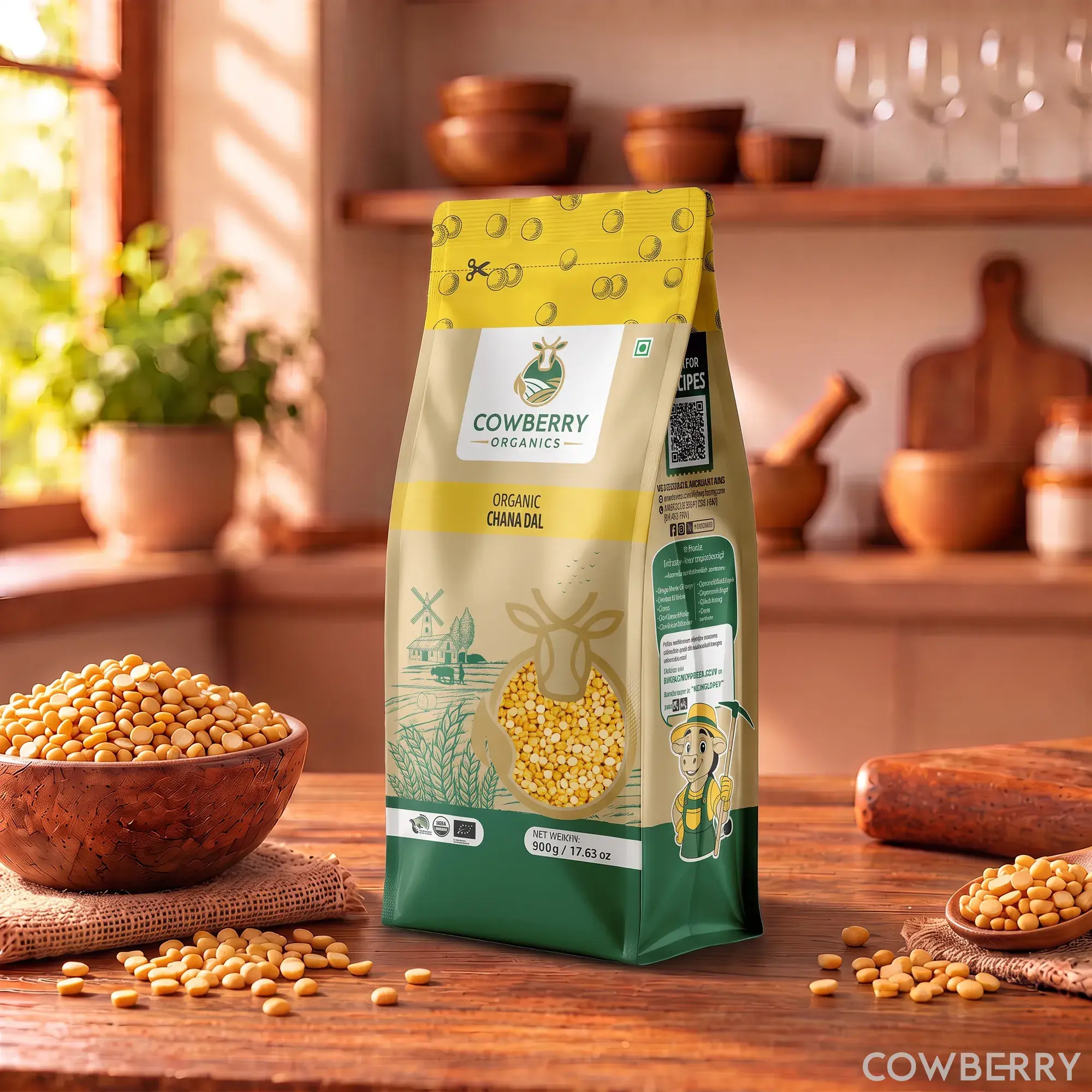
Certification and farming. A pack sold as organic should carry a certification mark; "natural" is not a certification. COWBERRY's chana dal is India Organic, USDA & EU certified: desi brown chickpeas from Central India, grown through cow-based organic farming and milled without any water, oil or leather polishing, so its golden colour is its own.
More on chana dal
Chana dal's benefits, its place in a diabetes or weight-loss diet and the dishes it goes into are each set out in full on these pages.
- Bengal gram benefits and side effects, each benefit with the nutrient behind it, plus notes on gas and uric acid.
- Chana dal glycemic index, the glycemic load per katori and how to portion and pair it.
- Is chana dal good for weight loss? Calories, protein and fibre in a katori, and portions.
- Toor dal vs chana dal: which dal brings more of what, and how each behaves in the pot.
- Chana dal in pregnancy: protein, iron and folate per katori, with the cooking and safety notes.
- Chana dal recipes by meal, from Karnataka roti and steamed upma to chana dal khichdi and a jaggery laddu.
- Dal pakwan: the Sindhi breakfast of tempered chana dal with crisp pakwan and green chutney.
FAQs
What is bengal gram?
Bengal gram is the English name IFCT 2017 uses for the desi chickpea, the small brown Cicer arietinum. Whole, it is kala chana; skinned and split, it is chana dal; milled, it is besan. In most Indian kitchens it goes by chana, and the split form by chana dal.
Is chana dal good for weight loss?
It can fit a weight-loss diet if it replaces part of the rice or roti rather than joining a full plate. A katori of this dal, 30 g before cooking, is about 99 kcal. The ICMR-NIN guidelines count pulses among the fibre-rich foods that improve satiety, and raw chana dal has 15.15 g fibre per 100 g. If a medical condition shapes your diet, talk to your doctor or dietitian.
Does chana dal cause gas?
It can. Chickpeas carry oligosaccharides, sugars that pass the small intestine undigested and are fermented in the colon, releasing gas. Soak the dal for 1 to 2 hours, drain the water and pressure cook it soft; the ICMR-NIN guidelines say soaking and pressure cooking improve the digestibility of pulses. Start with a small katori: a 2019 review reports that most people who get gas from pulses adapt within a few weeks if they keep eating them.
Can chana dal be cooked without soaking?
Yes, in a pressure cooker: 6 to 8 whistles instead of 3 to 4, with a little more water. The grains cook less evenly, and you lose the soak, which the ICMR-NIN guidelines list among the household steps that improve the digestibility of legumes. Even a 30-minute soak in hot water helps if you are short of time.
Is bengal gram and chana dal same?
Yes. Chana dal is Bengal gram with the skin removed and the seed split, so a label reading "split Bengal gram" or "Bengal gram dal" means chana dal, and "whole Bengal gram" means kala chana. Kabuli chana belongs to the same species but is the other type; IFCT 2017 keeps the name Bengal gram for the desi seed.
Which chana dal is used for chutney?
Roasted chana dal: whole chana roasted and skinned so it is crisp and eaten without cooking. It thickens coconut chutney and goes into chutney powder. Raw chana dal is used differently, fried in oil for the tempering of many South Indian chutneys.
Does chana dal have protein?
Yes, 21.55 g in every 100 g of raw dal by IFCT 2017, level with toor dal's 21.7 g and a little under moong dal's 23.88 g. Cooked, one katori (30 g of the dal, weighed dry) holds roughly 6.5 g. Rice or roti on the side fills the one gap the chickpea review points to, the sulphur-containing amino acids, which cereals supply.
References
- Indian Food Composition Tables (IFCT) 2017, ICMR-National Institute of Nutrition
- University of Sydney glycemic index database (GI search)
- Jukanti AK, Gaur PM, Gowda CL et al. Nutritional quality and health benefits of chickpea (Cicer arietinum L.): a review. Br J Nutr, 2012
- Mudryj AN, Yu N, Aukema HM. Nutritional and health benefits of pulses. Appl Physiol Nutr Metab, 2014
- Dietary Guidelines for Indians, ICMR-National Institute of Nutrition
- FAO: World Pulses Day (pulses and their role in diets)
- Thompson HJ. Improving human dietary choices through understanding of the tolerance and toxicity of pulse crop constituents. Curr Opin Food Sci, 2019
- Jakse B, Jakse B, Pajek M, Pajek J. Uric acid and plant-based nutrition. Nutrients, 2019
- Choi HK, Atkinson K, Karlson EW, Willett W, Curhan G. Purine-rich foods, dairy and protein intake, and the risk of gout in men. N Engl J Med, 2004
- Erler F, Ceylan F, Erdemir T, Toker C. Preliminary results on evaluation of chickpea, Cicer arietinum, genotypes for resistance to the pulse beetle, Callosobruchus maculatus. J Insect Sci, 2009
- FSSAI: Food Products Standards and Food Additives Regulations compendium (Version XXII, 02.03.2022): 2.4.4 Besan and 2.4.33 Roasted Bengal Gram Flour (Chana Sattu)
Shop this article
Keep reading
Green gram plant: crop, varieties and how it grows in India
Rajma vs lobia: difference, nutrition and which to choose
Rajma plant: how rajma is grown in India (it is not a tree)