by COWBERRY

7 minute read
Toor dal vs chana dal: protein, fibre, GI, taste and which to choose

Toor dal vs chana dal in one line: toor melts into the soft mash of sambar with more calcium and potassium, while chana keeps its grains firm with more fibre, iron, zinc and folate. Protein is level, 21.7 g against 21.55 g per 100 g, so the dish and the nutrients decide. The toor dal hub covers toor on its own; here the two dals are compared side by side.
Verdict in three lines
Toor is the dal that melts: pressure-cooked toor usually falls apart into a soft, smooth mash, which is what sambar, rasam and the everyday dal are built on, and per 100 g it carries the bigger share of calcium and potassium.
Chana is the dal that holds: its grains usually stay whole and firm in the pot, which suits dry fries and temperings, and per 100 g it carries more fibre, iron, zinc and folate.
Protein is a draw. 21.7 g against 21.55 g per 100 g, with energy at 331 kcal against 329 kcal, so the choice belongs to the dish and to the nutrients you want more of. The chana side has its own chana dal guide, and the table below puts the two dals side by side.
Chana dal vs toor dal: side by side per 100 g
Both columns in the table are IFCT 2017 values for the raw dals, per 100 g. Protein is level at 21.7 g and 21.55 g, and the energy row runs 331 kcal against 329 kcal; the story sits in the other rows. Chana dal carries about 3.4 times the fat, 5.31 g against 1.56 g, and much more fibre, 15.15 g against 9.06 g. Toor leads on calcium, 71.73 mg against 46.32 mg, and potassium, 1395 mg against 957 mg, while magnesium is level at 119 mg and 118 mg. Iron and zinc go to chana, 6.08 mg and 3.65 mg against 3.90 mg and 2.63 mg, and folate to chana, 182 mcg against 108 mcg. Neither dal has a vitamin C entry in IFCT 2017.
| Nutrient | Toor dal (arhar) | Chana dal (bengal gram) |
|---|---|---|
| Energy (kcal) | 331 | 329 |
| Protein (g) | 22 | 22 |
| Fat (g) | 1.6 | 5.3 |
| Carbohydrates (g) | 55 | 47 |
| Dietary fibre (g) | 9.1 | 15 |
| Iron (mg) | 3.9 | 6.1 |
| Calcium (mg) | 72 | 46 |
| Magnesium (mg) | 119 | 118 |
| Potassium (mg) | 1395 | 957 |
| Sodium (mg) | 18 | 21 |
| Zinc (mg) | 2.6 | 3.6 |
| Folate (mcg) | 108 | 182 |
| Glycemic index (GI) | 20 | 11 |
Per 100 g raw, edible portion. Composition: IFCT 2017 (ICMR-NIN). GI: University of Sydney GI database. — means not reported. These are average values for the food; the label on a pack gives the values for that product.
Difference between toor dal and chana dal: the numbers
Turn the values into ratios and each dal's pattern sharpens. Chana dal beats toor on fibre by 67 percent, 15.15 g against 9.06 g; on iron by 56 percent, 6.08 mg against 3.90 mg; on zinc by 39 percent, 3.65 mg against 2.63 mg; and on folate by 69 percent, 182 mcg against 108 mcg. It also carries about 3.4 times the fat, while toor holds about 18 percent more carbohydrate, 55.23 g against 46.72 g. Toor wins calcium by 55 percent, 71.73 mg against 46.32 mg, and potassium by 46 percent, 1395 mg against 957 mg, while magnesium stays level at 119 mg and 118 mg.
Cooked, the gaps keep their direction but shrink to spoon level. A katori of dal comes from 30 g of dry dal: toor then gives about 99 kcal, 6.5 g of protein, 2.7 g of fibre and 1.2 mg of iron, and chana about 99 kcal, 6.5 g of protein, 4.5 g of fibre and 1.8 mg of iron. The rest of toor's numbers are on arhar dal protein per 100g, and chana's on chana dal protein per 100g.
Glycemic index: toor dal vs chana dal
Both dals are low GI, but the two figures are not equally firm. Chana dal's GI is 11, the mean of a single India-tested entry of boiled Bengal gram dal; a Pakistani chana dhal boiled in salted water, GI 13, is recorded but stays out of the mean. Toor's mean GI is 20, from four pigeon pea entries recorded in the Philippines and Jamaica that run from 7 to 43; three of the four were soaked and then boiled, every test used the whole pea instead of the split dal on shop shelves, and none came from India. Both dals land inside the low band: the University of Sydney counts 55 and under as low, and only 70 and over as high. What that means at mealtimes is on toor dal for diabetes.
Taste and cooking: which dal for which dish
The difference between the two dals shows first in the pot. Toor usually cooks down soft into a smooth yellow mash, the texture sambar, dal tadka, rasam and Andhra pappu are built on; chana usually keeps its grains whole and firm, so it carries the dry fries and the temperings of lemon rice and poha. In the kitchen both go into the pressure cooker; toor's soak times are on toor dal soaked overnight, and chana's cooking, soak and all, is on the chana dal guide. Try toor in sambar and chana in a chana dal fry.
Where each dal fits
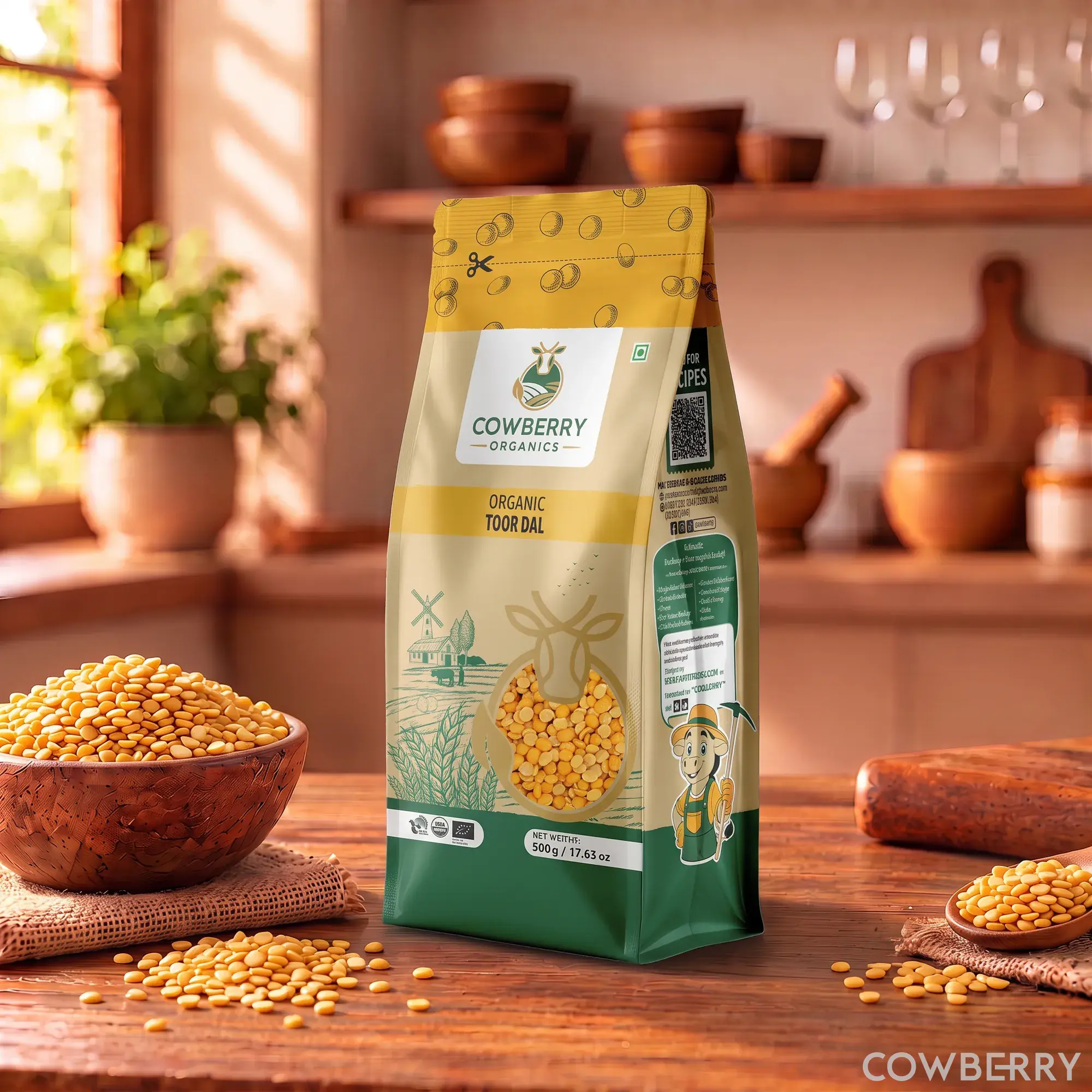
Both are everyday dals, and the choice is mostly about the dish. Toor belongs in the soft, soupy dal of sambar, rasam, dal tadka and khichdi; chana belongs in dry fries, temperings, sabzi and firm-grained dals. COWBERRY's pack of organic toor dal is sold unpolished, with no water, oil or leather polishing anywhere in its processing; for toor on its own, from names to storage, start at the toor dal hub.
Which for whom
- Sambar and the south Indian pot: toor. Sambar, rasam and pappu start from toor, whose soft mash is the texture they are built on.
- Dry fries and temperings: chana, whose grains hold their shape instead of melting.
- More fibre and iron: chana, by 67 and 56 percent; more calcium and potassium: toor, by 55 and 46 percent. On protein and energy the two are level.
- Less fat in the dal: toor, at 1.56 g per 100 g against chana's 5.31 g.
- Someone with diabetes: both are low GI on the database figures, chana at 11 and toor at 20, and neither figure is the whole story, because the meal around the dal decides more. The toor dal for diabetes page works through portions, and your own portions are best cleared with your doctor or dietitian.
- Weight loss: a katori of either dal is about 99 kcal, so swapping one for the other changes nothing by itself; the size of the katori and the tadka are what move the numbers.
- A gassy stomach: both are pulses, so both bring the sugars that end up fermenting in the colon, and gas follows. The 2019 review of how people tolerate pulses (Current Opinion in Food Science) finds this usually passes: on a steady diet most people settle within a few weeks, and whether those sugars are the real culprit has lately been questioned.
FAQs
Difference between toor dal and chana dal?
Two different plants, two different seeds. Toor is the split pigeon pea, Cajanus cajan, which IFCT 2017 records as red gram; chana is split Bengal gram, Cicer arietinum. Toor cooks to a soft mash with more calcium and potassium; chana keeps firm grains with more fibre, iron, zinc and folate. On protein the two are level, 21.7 g against 21.55 g per 100 g.
Is arhar dal and toor dal same?
Yes. Arhar is the Hindi name for the same dal, with Marathi calling it turdal and Tamil tuvaram paruppu; English names it red gram or pigeon pea. So the difference between arhar dal and chana dal is the very comparison this page runs: arhar is toor.
Does toor dal have protein?
Yes: IFCT 2017 prints 21.7 g per 100 g for raw toor dal against 21.55 g for chana, so the two run level. The cooked katori answers on protein too: with each dal measured from 30 g dry, a katori comes to roughly 6.5 g for either one. For the full table, calories and glycemic index, see arhar dal protein per 100g.
Can toor dal cause gas?
Toor can, like any pulse. The 2019 review puts the blame on galacto-oligosaccharides, sugars that pass through the small intestine untouched and only ferment once they reach the colon, giving off gas; the same review adds two cautions, that this mechanism is now in doubt and that the trouble fades for most people as the weeks go by, provided the dal stays on the plate. The extent varies from person to person.
What is arhar dal?
Arhar is what Hindi calls this dal: the split seed of the pigeon pea, Cajanus cajan, which IFCT 2017 records in English as red gram, dal. It is the soft-cooking yellow dal behind sambar and dal tadka, and its names across India sit on the names of toor dal page.
Which toor dal is best?
It depends on the dish and the pack; the guide to which toor dal is best sorts oily, plain, polished and unpolished toor and what to buy for sambar and everyday dal. COWBERRY's product page describes unpolished toor as keeping its golden colour and natural flavour.
References
- Indian Food Composition Tables (IFCT) 2017, ICMR-National Institute of Nutrition
- University of Sydney glycemic index database (GI search)
- University of Sydney: about the glycemic index
- Thompson HJ. Improving human dietary choices through understanding of the tolerance and toxicity of pulse crop constituents. Curr Opin Food Sci, 2019
Shop this article
Keep reading
Green gram plant: crop, varieties and how it grows in India
Rajma vs lobia: difference, nutrition and which to choose
Rajma plant: how rajma is grown in India (it is not a tree)