by COWBERRY

8 minute read
Rajma plant: how rajma is grown in India (it is not a tree)

Rajma tree is one of those names that sticks without being right: rajma is not a tree, and the rajma plant is a legume whose dry seeds end up in the curry. Here is what the rajma plant is, how rajma is grown in India, and where the tree confusion comes from. The rajma beans hub has the kitchen side.
Short answer: is there a rajma tree?
No. Rajma grows on a leguminous plant, and the part we cook is its dry seed — which is exactly how the FAO defines a pulse: edible seeds of leguminous plants, cultivated for food and feed. The tree name is loose everyday talk; what stands in the field is a bean plant, Phaseolus vulgaris, the species whose red seeds are sold as rajma or red kidney beans. Whatever 'rajma ka ped' suggests, rajma is a bean plant, a field legume. That one species carries many names across India — Rajmah in Hindi, Lal rajmah in Punjabi, Thugare bele in Kannada — but every name points to the same plant and the same seed (IFCT 2017). Pulses are among the most extensively used foods in the world (Mudryj 2014).
What is a rajma plant? The species and the seed
Rajma's botanical identity is short and precise: Phaseolus vulgaris, the common bean (IFCT 2017). It sits in the bean branch of the pulses — the FAO names beans among the best-known and most-eaten pulse types — and the clinical literature describes kidney beans as common legumes, eaten worldwide (Kumar 2013). Pulses as a family have been eaten for at least ten thousand years (Mudryj 2014). COWBERRY's product page says Kashmiri red kidney beans are believed to have come from Central and South America.
The seed the plant is grown for
What the plant is grown for is the seed: deep red, characteristically small and glossy. That is also why the crop is classed as a pulse rather than a vegetable — pulses are the sub-group of legumes harvested for their dry seeds (FAO). Pulses have a long shelf-life (FAO).
What the dry seed holds
The dry seed is dense: IFCT 2017 lists raw rajma at 19.9 g protein, 16.6 g fibre and 300 kcal per 100 g, with 6.1 mg of iron. Pulses provide protein and fibre, as well as a significant source of vitamins and minerals such as iron, zinc, folate and magnesium (Mudryj 2014). The full table sits on the rajma protein per 100g page.
How rajma is grown in India: Himachal Pradesh and Jammu
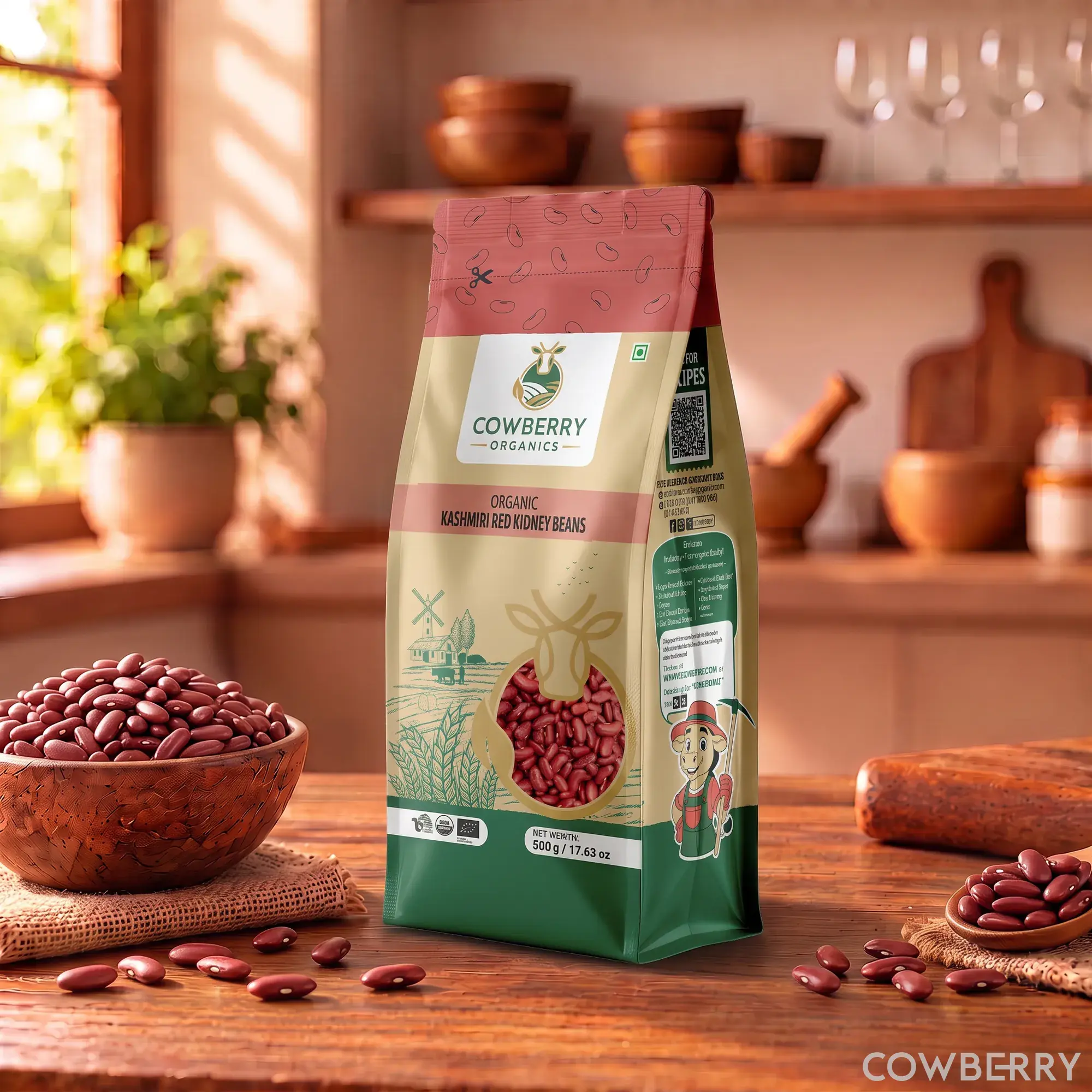
The rajma COWBERRY sells is a hill crop: its Kashmiri red kidney beans come from Himachal Pradesh and Jammu, raised in mountain country where the beans are traditionally grown with care and patience.
How the crop is raised
The growing story is traditional: natural cultivation through traditional cow-based farming, grown organically without harmful chemicals, and left to reach full maturity before harvest. Each bean is then hand-picked and left unpolished, so the seed you buy is close to the seed the plant made — small and glossy, deep red, with a creamy texture, a hint of sweetness and the habit of cooking soft while holding its shape. In short, the rajma COWBERRY sells is a mountain crop raised by hand. The variety names sit on the types of rajma page, and the nutrition numbers sit on the rajma protein per 100g page; what follows here is the field side.
The rajma plant in the field: nitrogen, soil and rotations
The rajma plant earns its keep before the harvest. As a pulse, it pulls nitrogen out of the air and fixes it in the ground, a service the FAO credits with better soil biodiversity and fertility. The FAO says including pulses in crop rotations can improve chemical fertilizer use efficiency. It also says pulses in multiple cropping systems enhance agrobiodiversity, climate change resilience and ecosystem services. The FAO's 2024 World Pulses Day put the spotlight on the vital role of pulses in promoting soil health and nourishing people.
Rajma names in Indian languages
One plant, many names: the IFCT 2017 tables record the same seed across Indian languages, from Rajmah in Hindi and Assamese to Makussttaka in Sanskrit, with the English entry 'Rajmah, red' and the botanical name Phaseolus vulgaris. The name is the same story everywhere — lal rajmah in Punjabi, Phansi (lal) in Gujarati, Karamani Payir in Tamil — one red bean, many labels. Urdu keeps Rajma, Bengali writes Barbati beej, Telugu Barigalu, and Marathi has its own Shravangheveda. How the names are used on the plate is covered on the kidney beans in Hindi page.
| Language | Name (romanised) |
|---|---|
| English | Rajmah, red |
| Hindi | Rajmah |
| Marathi | Shravangheveda |
| Gujarati | Phansi (lal) |
| Punjabi | Lal rajmah |
| Bengali | Barbati beej |
| Odia | — |
| Assamese | Rajmah |
| Kannada | Thugare bele |
| Telugu | Barigalu |
| Tamil | Karamani Payir |
| Malayalam | Rajmah |
| Urdu | Rajma |
| Sanskrit | Makussttaka |
| Botanical name | Phaseolus vulgaris |
Source: IFCT 2017 (ICMR-NIN) local-names list. — means no name recorded in the source.
Rajma tree images: what there is to photograph
The search term rajma tree images is chasing something that does not exist, which is why the honest picture is the crop itself: the legume stands in hill fields in Himachal Pradesh and Jammu, where the beans are traditionally grown, and the harvest is the red seeds picked by hand at full maturity. There is no tree to photograph, no bark and no canopy — there is the plant, the field and the seed, and those are what a rajma album actually contains. The seed is deep red, small and glossy, which makes the close-up.
From the plant to your plate
The journey from plant to plate is short and gentle. The beans are harvested at full maturity, then hand-picked and left unpolished, which keeps each seed whole and close to how the plant made it. In the kitchen the steps are simple: an overnight soak, a good rinse, and full cooking in stews, soups or curries. That is the soak-then-cook rule worked out in detail on the rajma soaking time page, with full cooking steps on how to cook rajma.
The soak and the full cooking matter here: the raw seed carries lectins, anti-nutritional factors that can cause intestinal disorders (He 2018), and Kumar 2013 counts lectins, saponins, phytates and protease inhibitors among the sources of kidney bean toxicity. Soaking and proper cooking remove the lectin activity, and there is no evidence that properly cooked pulses contain harmful lectins (Thompson 2019).
Because pulses have a long shelf-life (FAO), a bag of rajma waits patiently in the cupboard between harvests; keeping it well is the how to store rajma page's job. In the cupboard the rule is simple: a cool, dry place and an airtight container, as the product page advises. What the dry bean becomes is the familiar curry: rajma chawal, rajma curry, or the five ways on the rajma recipe roundup.
Rajma's bean relatives, and why the plant matters
Rajma's relatives matter for the kitchen. The FAO's bean group spans two genera, Phaseolus and Vigna, with rajma in the first — and the rajma vs lobia page sorts the two dals apart.
More than a curry ingredient
The FAO says pulses grow almost all over the world, provide employment and entrepreneurial opportunities for rural women and youth, and have a long shelf-life that helps reduce food loss and waste while increasing the diversity of diets. The FAO also calls pulses nutrient-dense, a good source of vitamins and minerals that are vital for good health. Building on the 2016 International Year of Pulses, the United Nations General Assembly designated 10 February as World Pulses Day. Rajma is one of the beans the FAO names among the most well-known pulses.
FAQs
What is rajma?
Rajma is the red kidney bean — the dried seed of the common bean plant, Phaseolus vulgaris (IFCT 2017). On the IFCT names list the English entry is 'Rajmah, red' and the Hindi entry Rajmah. It sits among the beans the FAO calls the most well-known pulses, grown for those dry seeds, and in Indian kitchens it becomes rajma curry, most famously ladled over rice as rajma chawal.
How rajma is grown?
COWBERRY's Kashmiri rajma is a hill crop raised the traditional way: it comes from the mountain regions of Himachal Pradesh and Jammu, farmed with traditional cow-based methods, without harmful chemicals, and harvested at full maturity, then hand-picked and left unpolished (COWBERRY product page). In the field the story is the same: the plant is a legume — rajma pulls nitrogen from the air into the ground, a service the FAO credits pulses for.
Which rajma is best?
No source ranks rajma varieties, so choose the one you like and cook it fully. COWBERRY's Kashmiri red kidney beans are small and deep red, grown in Himachal Pradesh and Jammu, hand-picked and unpolished. The types of rajma guide compares Kashmiri, chitra, red, white and jammu rajma.
Is kidney beans and rajma same?
Yes — the same seed, the same plant. Rajma is the Hindi name for red kidney beans; the IFCT 2017 tables give the English entry as 'Rajmah, red' and the botanical name Phaseolus vulgaris for both. Any recipe or nutrition figure for rajma is a figure for kidney beans.
How much protein in rajma?
IFCT 2017 lists raw rajma at 19.9 g of protein per 100 g, with 16.6 g of fibre and 300 kcal. A 50 g serving of dry beans — the usual measure for a plate of rajma chawal — carries about 10 g of that protein. The full nutrition table sits on the rajma protein per 100g page.
Which rajma is good for health?
Every rajma type — Kashmiri, chitra, red, white and jammu — is the same species, Phaseolus vulgaris, and IFCT 2017 gives one composition entry for the family, so the protein and fibre figures above hold whichever type you choose. What the nutrients do, and the portions that make sense, sit on the rajma benefits page.
Can rajma be cooked without soaking?
The soaked-then-cooked route is the one to follow: lectins sit in the raw seed, and the soak-and-cook routine removes their activity (Thompson 2019). When there is no time for an overnight soak, the rajma soaking time page's quick-soak method is the alternative — the one thing to never do is eat the bean raw or half-cooked.
References
- FAO: World Pulses Day (pulses and their role in diets)
- Indian Food Composition Tables (IFCT) 2017, ICMR-National Institute of Nutrition
- Mudryj AN, Yu N, Aukema HM. Nutritional and health benefits of pulses. Appl Physiol Nutr Metab, 2014
- Kumar S, Verma AK et al. Clinical complications of kidney bean (Phaseolus vulgaris L.) consumption. Nutrition, 2013
- He S, Simpson BK et al. Phaseolus vulgaris lectins: a systematic review of characteristics and health implications. Crit Rev Food Sci Nutr, 2018
- Thompson HJ. Improving human dietary choices through understanding of the tolerance and toxicity of pulse crop constituents. Curr Opin Food Sci, 2019
Shop this article
Keep reading
Green gram plant: crop, varieties and how it grows in India
Rajma vs lobia: difference, nutrition and which to choose
Rajma in pregnancy: benefits, safety and how to eat it