by COWBERRY

12 minute read
Dal protein per 100 g: the common dals compared (and per katori)

Dal protein per 100 g runs from 18.8 g for kala chana to 24.4 g for masoor dal (IFCT 2017, raw), with moong dal at 23.9 g, urad 23.1 g, toor 21.7 g and chana dal 21.6 g. One katori of cooked dal, from about 30 g dry, gives 5.6 to 7.3 g of protein. Below: ten dals per 100 g and per katori, with calories, fibre and GI.
Protein in dal per 100 g: toor, moong and chana dal
The three split dals found in many kitchens are close on protein: moong dal 23.9 g per 100 g, toor dal 21.7 g and chana dal 21.6 g (IFCT 2017, raw). Calories are equally close at 326, 331 and 329 kcal. The real difference is fibre and fat: chana dal has 15.2 g fibre and 5.3 g fat, against 9.1 g fibre and 1.56 g fat in toor and 9.4 g fibre and 1.35 g fat in moong dal. Chana dal also takes longer to cook than the other two, and moong dal is the usual dal for khichdi. The numbers are for the raw dal before soaking, and cooked dal is mostly water, which is why the per-katori figures further down matter more than these.
| Nutrient | Toor dal (arhar) | Moong dal | Chana dal |
|---|---|---|---|
| Energy (kcal) | 331 | 326 | 329 |
| Protein (g) | 22 | 24 | 22 |
| Fat (g) | 1.6 | 1.4 | 5.3 |
| Carbohydrates (g) | 55 | 53 | 47 |
| Dietary fibre (g) | 9.1 | 9.4 | 15 |
| Iron (mg) | 3.9 | 3.9 | 6.1 |
| Calcium (mg) | 72 | 43 | 46 |
| Magnesium (mg) | 119 | 155 | 118 |
| Potassium (mg) | 1395 | 1268 | 957 |
| Sodium (mg) | 18 | 10 | 21 |
| Zinc (mg) | 2.6 | 2.5 | 3.6 |
| Folate (mcg) | 108 | 92 | 182 |
| Glycemic index (GI) | 20 | 38 | 11 |
Per 100 g raw, edible portion. Composition: IFCT 2017 (ICMR-NIN). GI: University of Sydney GI database. — means not reported. These are average values for the food; the label on a pack gives the values for that product.
Masoor dal protein per 100 g: the highest on this page
Masoor dal, the split red lentil, has the most protein of any dal here: 24.4 g per 100 g raw, just ahead of moong dal at 23.9 g (IFCT 2017). It matches the other split dals on calories at 323 kcal, has 10.4 g of fibre, and has the least fat of any dal on this page at 0.75 g. Its iron is the highest here too, 7.1 mg per 100 g, while its folate is the lowest at 50 mcg. The table gives its full values, with a glycemic index of 25 from five boiled red lentil tests in the University of Sydney database. For its names and how to tell it from the other dals, see types of dal.
| Nutrient | Masoor dal |
|---|---|
| Energy (kcal) | 323 |
| Protein (g) | 24 |
| Fat (g) | 0.8 |
| Carbohydrates (g) | 53 |
| Dietary fibre (g) | 10 |
| Iron (mg) | 7.1 |
| Calcium (mg) | 44 |
| Magnesium (mg) | 75 |
| Potassium (mg) | 786 |
| Sodium (mg) | 10 |
| Zinc (mg) | 3.6 |
| Folate (mcg) | 50 |
| Glycemic index (GI) | 25 |
Per 100 g raw, edible portion. Composition: IFCT 2017 (ICMR-NIN). GI: University of Sydney GI database. — means not reported. These are average values for the food; the label on a pack gives the values for that product.
Urad dal, sabut moong and lobia
Urad dal comes third among the ten dals on this page with 23.1 g protein per 100 g, along with 11.9 g fibre and 324 kcal, which is part of why idli and dosa batter, urad ground with rice, is a better protein than rice alone. Whole green moong (sabut moong) keeps its skin and so carries 17 g fibre with 22.5 g protein and 294 kcal, against 326 kcal for skinned moong dal. Lobia, the cowpea or black-eyed pea, gives 21.3 g protein, 11.7 g fibre and 321 kcal, close to toor on protein and calories. Sabut moong has nearly twice the fibre of skinned moong dal from the same seed.
| Nutrient | Urad dal | Sabut moong (whole) | Lobia (cowpea) |
|---|---|---|---|
| Energy (kcal) | 324 | 294 | 321 |
| Protein (g) | 23 | 23 | 21 |
| Fat (g) | 1.7 | 1.1 | 1.1 |
| Carbohydrates (g) | 51 | 46 | 54 |
| Dietary fibre (g) | 12 | 17 | 12 |
| Iron (mg) | 4.7 | 4.9 | 5 |
| Calcium (mg) | 56 | 92 | 84 |
| Magnesium (mg) | 173 | 198 | 213 |
| Potassium (mg) | 1157 | 1177 | 1243 |
| Sodium (mg) | 19 | 12 | 13 |
| Zinc (mg) | 3 | 2.7 | 3.6 |
| Folate (mcg) | 89 | 145 | 249 |
| Glycemic index (GI) | 43 | 38 | 37 |
Per 100 g raw, edible portion. Composition: IFCT 2017 (ICMR-NIN). GI: University of Sydney GI database. — means not reported. These are average values for the food; the label on a pack gives the values for that product.
Rajma, kabuli chana and kala chana
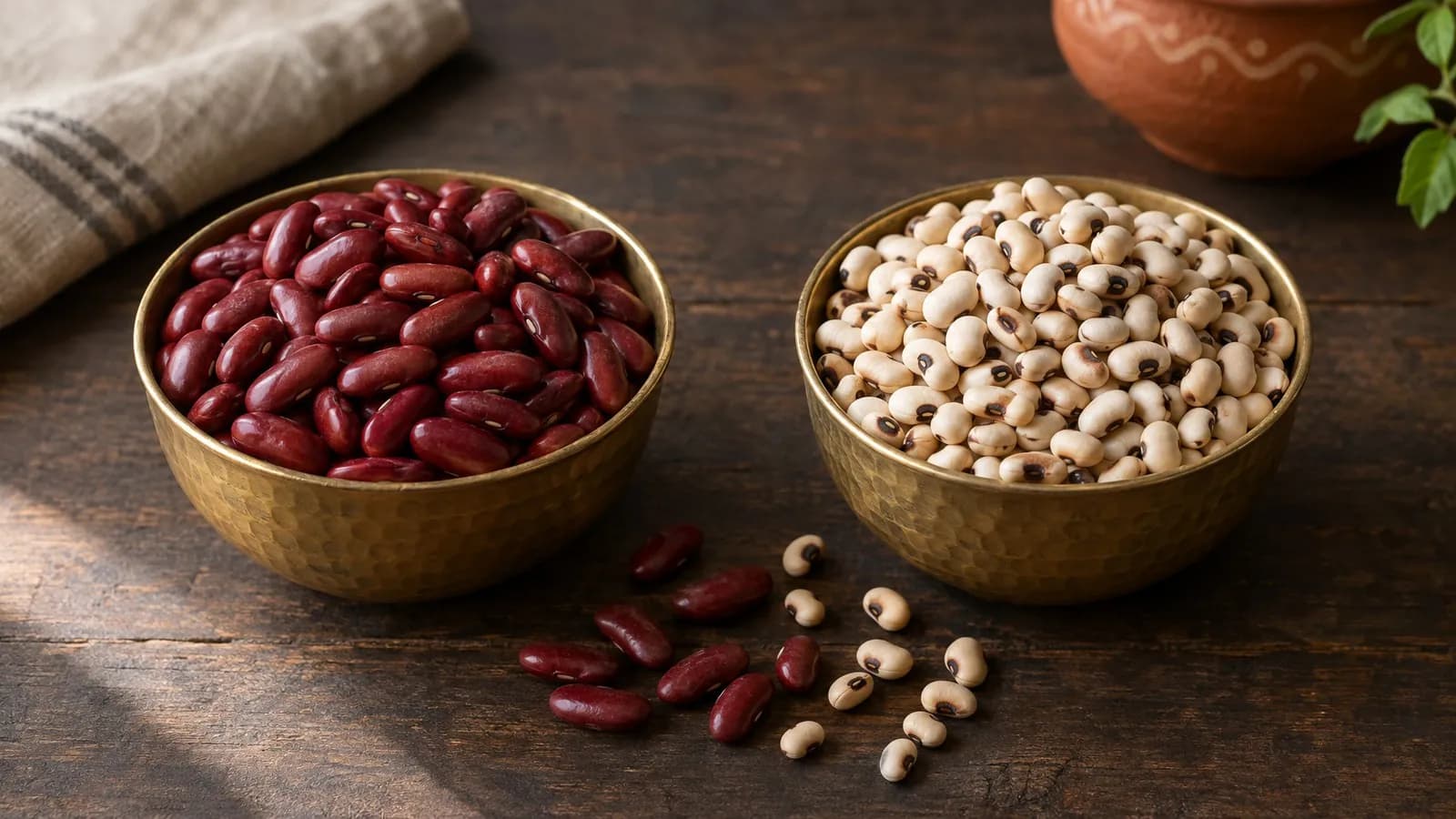
Whole beans that are soaked overnight and cooked whole sit a little lower on protein than the split dals, and rajma and kala chana carry more fibre than any split dal. Rajma gives 19.9 g protein and 16.6 g fibre per 100 g with 300 kcal; kala chana, the small brown desi chickpea, gives 18.8 g protein and 25.2 g fibre, the most fibre of any dal here, with 287 kcal; kabuli chana gives 20.5 g protein and 12.2 g fibre with 378 kcal. The kabuli figures come from USDA FoodData Central because IFCT 2017 lists only the desi whole chickpea; the two are the same species and USDA does not separate the types, so read the kabuli numbers as close rather than exact. Rajma and kabuli chana also lead the dals on this page on folate, at 316 mcg and 557 mcg per 100 g.
| Nutrient | Rajma | Kabuli chana (USDA) | Kala chana |
|---|---|---|---|
| Energy (kcal) | 300 | 378 | 287 |
| Protein (g) | 20 | 20 | 19 |
| Fat (g) | 1.8 | 6 | 5.1 |
| Carbohydrates (g) | 49 | 63 | 40 |
| Dietary fibre (g) | 17 | 12 | 25 |
| Iron (mg) | 6.1 | 4.3 | 6.8 |
| Calcium (mg) | 126 | 57 | 150 |
| Magnesium (mg) | 173 | 79 | 160 |
| Potassium (mg) | 1324 | 718 | 935 |
| Sodium (mg) | 10 | 24 | 27 |
| Zinc (mg) | 2.7 | 2.8 | 3.4 |
| Folate (mcg) | 316 | 557 | 233 |
| Vitamin C (mg) | — | 4 | — |
| Glycemic index (GI) | 45 | 23 | 23 |
Per 100 g raw, edible portion. Composition: IFCT 2017 (ICMR-NIN); USDA FoodData Central (SR Legacy), FDC ID 173756, NDB 16056. GI: University of Sydney GI database. — means not reported. These are average values for the food; the label on a pack gives the values for that product.
Protein in one katori dal (and calories in one bowl of dal)
Per-100 g numbers are for raw dal, and nobody eats 100 g of raw dal at a sitting. A standard 200 ml katori of cooked dal is made from roughly 30 g of dry dal; a thick dhaba-style dal takes more, 50 g of toor per serving in our dal tadka. On the 30 g basis, one katori gives:
| Dal (30 g dry, one katori cooked) | Protein | Energy | Fibre |
|---|---|---|---|
| Masoor dal | 7.3 g | 97 kcal | 3.1 g |
| Moong dal | 7.2 g | 98 kcal | 2.8 g |
| Urad dal | 6.9 g | 97 kcal | 3.6 g |
| Sabut moong | 6.8 g | 88 kcal | 5.1 g |
| Toor dal | 6.5 g | 99 kcal | 2.7 g |
| Chana dal | 6.5 g | 99 kcal | 4.5 g |
| Lobia | 6.4 g | 96 kcal | 3.5 g |
| Kabuli chana | 6.2 g | 113 kcal | 3.7 g |
| Rajma | 6 g | 90 kcal | 5 g |
| Kala chana | 5.6 g | 86 kcal | 7.6 g |
Worked out from the per-100 g values above (IFCT 2017; USDA for kabuli chana) at 30 g dry dal per katori, before any tadka.
So the honest answer to "protein in one katori dal" is 6 to 7.3 g for every common dal, 5.6 g for kala chana, and about 10.9 g from the dal in a 50 g serving of toor dal tadka. Calories in one bowl of dal run from 86 to 113 kcal before the tadka; each teaspoon of ghee or oil in the tempering adds fat and energy on top, and a restaurant dal fry or dal makhani, finished with cream and butter, can carry more calories from fat than from the dal itself. Two katoris a day, one at each meal, come to about 60 g of dry dal, within the 85 g a day of raw pulses that the ICMR-NIN Dietary Guidelines for Indians give for a vegetarian plate.
Protein quality: why dal needs rice or roti
Protein is not only about grams. According to the ICMR-NIN Dietary Guidelines for Indians, pulses carry plenty of lysine but little methionine and cysteine, cereals are the other way round, and the two together, in the right proportion, can meet the need for every essential amino acid. The guidelines set the mix at 3:1, cereal to pulse, by raw weight, and add that milk in the day's diet raises the quality further. That is the logic behind dal-chawal, dal-roti, khichdi and idli.
Digestion counts as well. When Shivakumar and colleagues (2019) measured amino acid digestibility in Indian children under two, mung bean scored lowest of the four foods tested, below finger millet and rice, and egg scored highest. It tested moong, not toor or chana dal, and young children, not adults, so read it as a pointer and not as a figure for every dal.
In grams: one katori of toor dal (30 g dry, 6.5 g protein) with a katori of rice cooked from 40 g raw rice (3.2 g protein) gives about 9.7 g; the same dal with two rotis from 60 g whole wheat atta (6.4 g protein) gives about 12.9 g. The roti plate carries more because it holds more grain, 60 g against 40 g, and wheat brings more protein per gram than rice, 10.6 g per 100 g against 7.9 g; the dal fills the lysine gap either way. The table compares toor dal with rice and wheat, the grains it is usually eaten with.
| Nutrient | Toor dal | Rice (raw, milled) | Whole wheat atta |
|---|---|---|---|
| Energy (kcal) | 331 | 357 | 322 |
| Protein (g) | 22 | 7.9 | 11 |
| Fat (g) | 1.6 | 0.5 | 1.5 |
| Carbohydrates (g) | 55 | 78 | 65 |
| Dietary fibre (g) | 9.1 | 2.8 | 11 |
| Iron (mg) | 3.9 | 0.7 | 4 |
| Calcium (mg) | 72 | 7.5 | 39 |
| Magnesium (mg) | 119 | 19 | 125 |
| Potassium (mg) | 1395 | 108 | 366 |
| Sodium (mg) | 18 | 2.3 | 2.5 |
| Zinc (mg) | 2.6 | 1.2 | 2.9 |
| Folate (mcg) | 108 | 9.3 | 30 |
| Glycemic index (GI) | 20 | 50 | 47 |
Per 100 g raw, edible portion. Composition: IFCT 2017 (ICMR-NIN). GI: University of Sydney GI database. — means not reported. These are average values for the food; the label on a pack gives the values for that product.
Which dal has the most protein? The ranking in words
Per 100 g raw, the order in IFCT 2017 (USDA for kabuli chana) is: masoor dal (24.4 g), moong dal (23.9 g), urad dal (23.1 g), sabut moong (22.5 g), toor dal (21.7 g), chana dal (21.6 g), lobia (21.3 g), kabuli chana (20.5 g), rajma (19.9 g) and kala chana (18.8 g). The whole spread is about 5.6 g, so no single dal is "the protein dal" and none is a poor one; choose by digestion, cooking time and the dish, not by the protein column.
Fibre separates them far more: kala chana (25.2 g), sabut moong (17 g), rajma (16.6 g) and chana dal (15.2 g) lead, and toor (9.1 g), moong dal (9.4 g) and masoor (10.4 g) trail. Calories sit between 287 kcal (kala chana) and 378 kcal (kabuli chana, USDA) per 100 g raw, with every IFCT split dal within 323 to 331 kcal. Where each dal comes from and what it is called in other Indian languages is on the types of dal page; the everyday dal to start with is toor dal.
Glycemic index of dals: which dal has a low GI
On its mean value in the University of Sydney database, every dal compared here sits in the low band, at or under the cut-off of 55. India-tested entries: chana dal 11, moong 38, urad 43 and rajma 45 (the rajma mean covers two Indian tests that ranged from 19 to 70). Entries from other countries: toor 20 (four boiled whole pigeon pea tests, range 7 to 43), kabuli and kala chana 23 (nine whole-chickpea tests, range 5 to 36), masoor 25 (five boiled red lentil tests from Canada and the UK, range 18 to 32) and lobia 37 (ten cowpea tests, range 7 to 58). The 2021 international GI tables by Atkinson and colleagues likewise found legumes usually low on the GI scale, with similar values wherever they were tested, and named the testing of regional foods as a priority. Two cautions: the pigeon pea tests used whole boiled seeds rather than split, well-cooked toor dal, and a GI is a property of the food alone, so the rice or roti on the plate and the ghee in the tadka change the response of the meal. Chana dal's GI of 11 is the lowest India-tested value here; the practical rule for any dal is a measured katori with a measured portion of grain.
Iron, folate, calcium and potassium in dal
Protein gets the attention, but the dals differ more in the mineral columns. Mudryj, Yu and Aukema, in their 2014 paper on pulses, name iron, zinc, folate and magnesium among the minerals and vitamins that pulses supply. Iron: masoor dal 7.1 mg, kala chana 6.8 mg, rajma 6.1 mg, chana dal 6.1 mg, lobia 5 mg, sabut moong 4.9 mg, urad dal 4.7 mg, kabuli chana 4.3 mg, and toor and moong dal 3.9 mg per 100 g. Eaten in the same meal, vitamin C helps the body take up iron from plant foods, according to the ICMR-NIN guidelines; a squeeze of lemon over the dal or a coriander and green chilli chutney on the side does the job. Folate: kabuli chana 557 mcg, rajma 316 mcg, lobia 249 mcg, kala chana 233 mcg, chana dal 182 mcg, sabut moong 145 mcg, toor 108 mcg, moong dal 92 mcg, urad dal 89 mcg and masoor 50 mcg. Calcium: kala chana 150 mg, rajma 126 mg, sabut moong 92.4 mg, lobia 84.1 mg and toor 71.7 mg. Potassium is led by toor at 1395 mg, rajma 1324 mg and moong dal 1268 mg, with kabuli chana lowest here at 718 mg. Sodium is low in all of them until the salt goes in.
FAQs
How much protein in dal?
Between 18.8 g and 24.4 g per 100 g of raw dal across the ten dals compared here (IFCT 2017; USDA for kabuli chana): masoor dal 24.4 g, moong dal 23.9 g, urad 23.1 g, toor 21.7 g, chana dal 21.6 g, rajma 19.9 g and kala chana 18.8 g. In the bowl that is 5.6 to 7.3 g of protein per katori of cooked dal, from about 30 g of dry dal, before any rice or roti.
How much protein in one katori dal?
About 6.5 g for toor and chana dal, 7.3 g for masoor, 7.2 g for moong dal, 6.9 g for urad, 6 g for rajma and 5.6 g for kala chana, taking one katori of cooked dal as 30 g of dry dal, so two katoris of toor dal a day give about 13 g. A heartier dal tadka serving with 50 g of toor gives about 10.9 g from the dal.
Which dal has the highest protein?
Of the ten dals compared here, masoor dal: 24.4 g per 100 g raw in IFCT 2017, just ahead of moong dal at 23.9 g and urad dal at 23.1 g. Whole green moong follows at 22.5 g, then toor and chana dal at 21.7 g and 21.6 g. The gap down to the lowest of the ten, kala chana at 18.8 g, is only about 5.6 g.
Which dal has low glycemic index?
All ten dals compared here, on their mean values in the University of Sydney database: chana dal 11, toor dal 20, kabuli and kala chana 23, masoor 25, lobia 37, moong dal and sabut moong 38, urad 43 and rajma 45, every one under the low-GI cut-off of 55. Chana dal has the lowest India-tested value. Remember that the GI describes the dal alone; the rice or roti on the same plate counts too.
Which dal is best for diabetic patient?
Chana dal has the lowest India-tested GI (11) and more fibre than toor or moong dal, 15.2 g per 100 g; moong follows among the India-tested values at 38, and toor at 20 is also low but was tested as whole peas abroad. The portion matters more than the pick: one katori of dal with a measured helping of rice or roti. Before you change a diabetic diet, talk to your doctor or dietitian.
Can you soak dal overnight?
Yes, and for whole pulses it is the rule: rajma, kabuli chana and kala chana need 8 to 12 hours. Split dals need less: 20 to 30 minutes for toor or moong dal and about an hour for chana dal, though an overnight soak in the fridge does no harm and cuts cooking time. Drain, rinse and cook in fresh water as soon as the soak is done.
References
- Indian Food Composition Tables (IFCT) 2017, ICMR-National Institute of Nutrition
- USDA FoodData Central
- University of Sydney glycemic index database (GI search)
- University of Sydney: about the glycemic index
- Atkinson FS, Brand-Miller JC et al. International tables of glycemic index and glycemic load values 2021: a systematic review. Am J Clin Nutr, 2021
- Mudryj AN, Yu N, Aukema HM. Nutritional and health benefits of pulses. Appl Physiol Nutr Metab, 2014
- Shivakumar N, Kashyap S et al. Protein-quality evaluation of complementary foods in Indian children. Am J Clin Nutr, 2019
- Dietary Guidelines for Indians, ICMR-National Institute of Nutrition
Shop this article
Keep reading
Green gram plant: crop, varieties and how it grows in India
Rajma vs lobia: difference, nutrition and which to choose
Rajma plant: how rajma is grown in India (it is not a tree)