by COWBERRY

7 minute read
Rajma vs lobia: difference, nutrition and which to choose

Rajma vs lobia in one line: rajma is the red kidney bean (Phaseolus vulgaris) and lobia is the cowpea (Vigna catjang), different species that no recipe swaps unnoticed. Per 100 g, lobia carries a little more protein and energy, rajma noticeably more fibre and iron. Nutrition, GI, cooking and which to choose are below; the rajma beans guide covers rajma itself.
Verdict in three lines
Different beans, different dishes. Rajma is the deep-red bean of rajma chawal; lobia is the white cowpea, the black-eyed bean, of lobia curry. The difference between lobia and rajma is botany first: Phaseolus vulgaris against Vigna catjang.
Close on protein, split on the rest. Lobia has a shade more protein and energy per 100 g, while rajma has clearly more fibre and more iron, and lobia has more magnesium and zinc.
Both sit in the low GI band. The measured GI is 45 for rajma and 37 for lobia, both below the 55 line, so the choice is about the dish and the plate, not about one bean being the good one.
The numbers first, in the table below; then GI, taste and cooking, the names that cause the mix-ups, and which bean suits which eater. The lobia guide covers the cowpea on its own.
Rajma vs lobia: side by side per 100 g
The table uses IFCT 2017 for both beans, dry and raw. Read down the rows and the pattern is a near tie with two clear splits. Protein is 19.9 g in rajma and 21.2 g in lobia, about 7 percent more for the cowpea, and energy follows the same way: 300 kcal against 321 kcal. Then the splits: rajma carries 16.6 g of fibre against lobia's 11.7 g, about 42 percent more, and 6.1 mg of iron against 5.0 mg, about 22 percent more. Rajma also leads on calcium, 126 mg against 84.1 mg, about 50 percent more. Lobia answers on magnesium, 213 mg against 173 mg, and on zinc, 3.6 mg against 2.7 mg, about 33 percent more. Potassium is close, 1324 mg against 1243 mg, while rajma has more folate, 316 mcg against 249 mcg. Both are negligible in fat, and both are dry-bean numbers: a cooked bowl weighs more and carries water.
In the amount a plate actually uses, a 50 g serving of dry rajma gives 150 kcal, 10 g of protein and 8.3 g of fibre; the same 50 g of lobia gives 160 kcal, 10.6 g of protein and 5.9 g of fibre. The per-serving arithmetic for rajma is on rajma nutrition per 100 g, and lobia's on lobia nutrition per 100 g.
| Nutrient | Rajma (red kidney beans) | Lobia (cowpea, white) |
|---|---|---|
| Energy (kcal) | 300 | 321 |
| Protein (g) | 20 | 21 |
| Fat (g) | 1.8 | 1.1 |
| Carbohydrates (g) | 49 | 54 |
| Dietary fibre (g) | 17 | 12 |
| Iron (mg) | 6.1 | 5 |
| Calcium (mg) | 126 | 84 |
| Magnesium (mg) | 173 | 213 |
| Potassium (mg) | 1324 | 1243 |
| Sodium (mg) | 10 | 13 |
| Zinc (mg) | 2.7 | 3.6 |
| Folate (mcg) | 316 | 249 |
| Glycemic index (GI) | 45 | 37 |
Per 100 g raw, edible portion. Composition: IFCT 2017 (ICMR-NIN). GI: University of Sydney GI database. — means not reported. These are average values for the food; the label on a pack gives the values for that product.
Glycemic index: rajma 45, lobia 37
Both beans are tested, and both land in the low band. In the University of Sydney GI database, boiled kidney beans carry a GI of 45, an average of two India-tested entries spread across 19 to 70, and plain boiled cowpeas a GI of 37, an average of ten entries spread across 7 to 58. The University of Sydney puts the cut-offs at 55 for the top of the low band and 70 for the start of the high band, so both beans sit comfortably low, with lobia's number the lower of the two. Remember what the figure is: the GI of the plainly boiled bean, not of the rajma masala or lobia curry that surrounds it, where oil, rice and the rest of the plate change the picture. The Dietary Guidelines for Indians give the supporting rule: fibre in the meal puts the brakes on the absorption of carbohydrate and fat and adds to satiety. The full GI story for rajma is on rajma glycemic index, and the cowpea's on black eyed peas glycemic index.
Taste, cooking and where each fits
Rajma's character is on the record: COWBERRY's pack copy describes its Kashmiri red kidney beans as small and glossy, with a deep red colour, a creamy bite, a slightly sweet taste, and the ability to cook soft while holding their shape. Lobia is the white cowpea of the food tables, the pale bean with the black eye in its common English name, and its dishes here are lobia curry and lobia khichdi. Rajma should never be eaten raw or half-cooked: the lectins in raw kidney beans are the reason, so it is cooked until completely soft; the soaking method is on how to soak rajma. Where each fits is by dish, not by swap: rajma belongs in rajma chawal and rajma curry, lobia in lobia curry and lobia khichdi, and swapping one for the other makes a different dish.
Names, and the same-dish myth settled
Part of the confusion is linguistic. Rajma is the Hindi name of the red kidney bean, and lobia is the Hindi name of the cowpea, so in Hindi the two are as distinct as their words. The mix-ups start in other languages: IFCT 2017 prints karamani payir for rajma in Tamil and plain karamani for the cowpea, barbati beej for rajma in Bengali and barbati for the cowpea, and the same Kannada words, thugare bele, for both rajma and pigeon pea. The full name map is on kidney beans in Hindi. The myth to settle in one line: lobia is not rajma under another name. A lobia curry is its own dish, with its own bean. If a recipe calls for one and the pantry holds the other, pick a different recipe rather than forcing the swap.
Which to choose
- For rajma chawal or rajma masala: rajma, no question; the dish is built on its soft, creamy centre and deep red colour.
- For lobia curry or a dry tempered curry: lobia, the bean those dishes are written around.
- For more fibre and iron per plate: rajma, with 16.6 g of fibre and 6.1 mg of iron per 100 g against lobia's 11.7 g and 5.0 mg.
- For a little more protein: lobia, at 21.2 g of protein per 100 g against rajma's 19.9 g.
- For blood sugar: both are low GI, lobia's measured 37 a touch below rajma's 45; what surrounds the beans on the plate matters more than the gap.
- For protein quality: neither bean works alone. The Dietary Guidelines for Indians note that combining cereals and pulses in a 3 to 1 ratio, weighed raw, can cover every essential amino acid, so rajma or lobia with rice or roti improves protein quality, and the guidelines' balanced-diet plate lists 85 g of pulses and legumes a day.
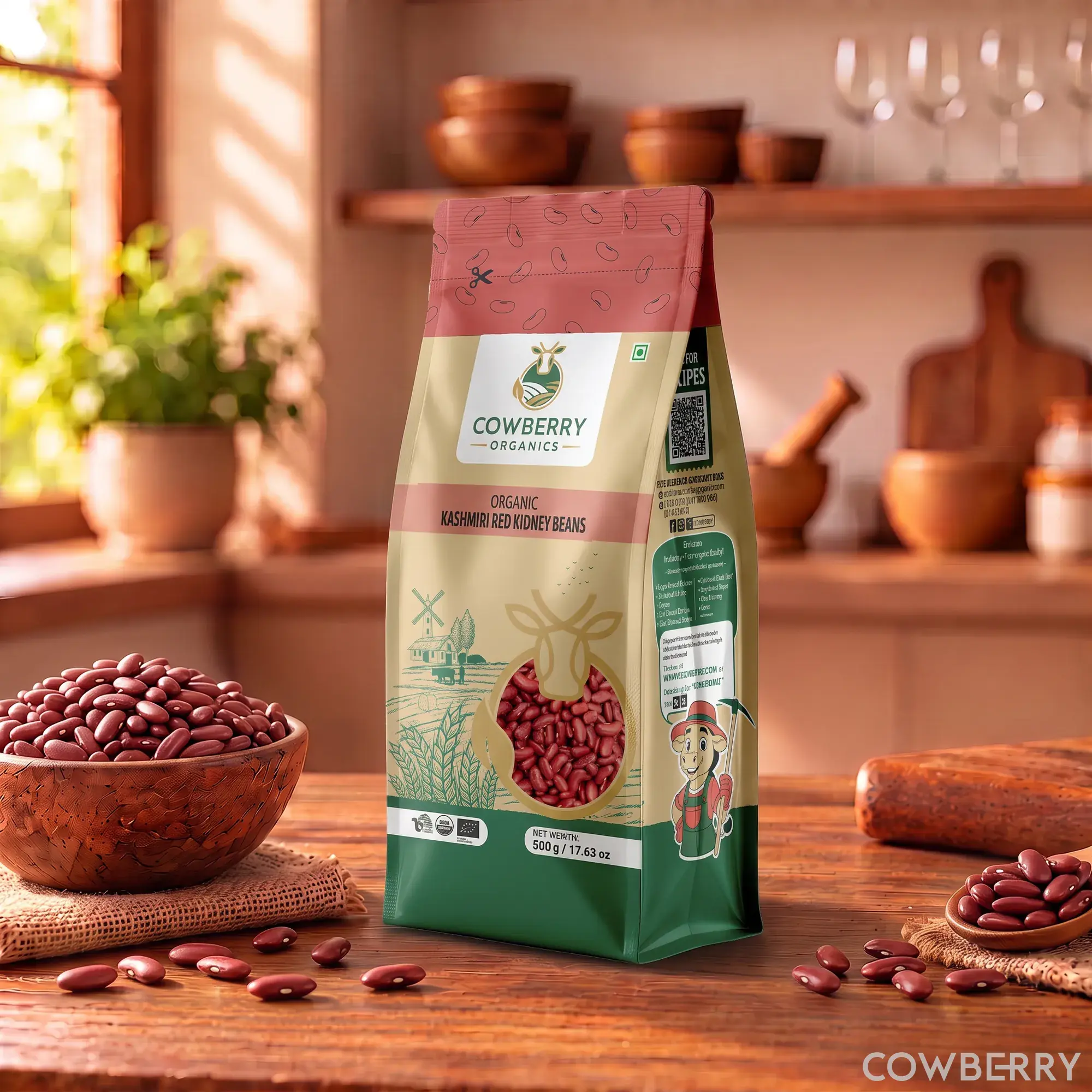
- For anyone trying both: COWBERRY's organic Kashmiri red kidney beans are the rajma to start with, sourced from Himachal Pradesh and Jammu's mountain farms. The bean itself, benefits and side effects included, is on the rajma beans guide.
FAQs
Difference between lobia and rajma?
They are different species: rajma is the red kidney bean, Phaseolus vulgaris, and lobia is the cowpea, Vigna catjang, the white bean with the black eye. Per 100 g dry, lobia has slightly more protein, 21.2 g against 19.9 g, while rajma has clearly more fibre, 16.6 g against 11.7 g, and more iron. Their dishes are separate: rajma chawal against lobia curry.
Difference between rajma and kidney beans?
None: rajma is kidney beans in Hindi, one bean under two names, so the two phrases name one bean. The real comparison is rajma against lobia, the cowpea, which is a different species with different dishes. The names across languages are on kidney beans in Hindi.
Can kidney beans cause gas?
They can, in some people: pulses contain galacto-oligosaccharides, raffinose among them, which leave the small intestine undigested and are fermented lower down in the colon, releasing gas; whether that is the whole story has lately been questioned. In one report cited by Thompson (2019), most people who got gas adapted within a few weeks if they kept eating pulses; how much gas varies from person to person.
Is rajma rich in protein?
Yes, as pulses go: IFCT 2017 prints 19.9 g of protein per 100 g of dry rajma, a touch behind lobia's 21.2 g. India's dietary guidelines note that pulses carry more lysine than cereals and that cereals and pulses in a 3 to 1 ratio (raw weight) can meet the need for all essential amino acids.
Which rajma is best?
No variety is the best for everyone. For rajma chawal, COWBERRY sells small organic Kashmiri red kidney beans, grown on Himachal Pradesh and Jammu mountain farms, hand-picked and harvested at full maturity. The varieties are compared on types of rajma.
References
- Indian Food Composition Tables (IFCT) 2017, ICMR-National Institute of Nutrition
- Dietary Guidelines for Indians, ICMR-National Institute of Nutrition
- University of Sydney glycemic index database (GI search)
- University of Sydney: about the glycemic index
- Thompson HJ. Improving human dietary choices through understanding of the tolerance and toxicity of pulse crop constituents. Curr Opin Food Sci, 2019
Shop this article
Keep reading
Green gram plant: crop, varieties and how it grows in India
Rajma plant: how rajma is grown in India (it is not a tree)
Rajma in pregnancy: benefits, safety and how to eat it