by COWBERRY

9 minute read
Green gram plant: crop, varieties and how it grows in India

The green gram plant is Vigna radiata, a legume whose dry seeds are harvested as one of India's everyday pulses: whole as sabut moong, split as moong dal. This guide follows the plant from field to seed to sprout, and ends in the kitchen: what it is, how the crop grows, where it is eaten, what the seed holds and how to sprout it at home.
What is the green gram plant?
The green gram plant is a legume grown for its dry seeds. The FAO defines pulses as the edible seeds of leguminous plants cultivated for food and feed, and names the beans of the Phaseolus and Vigna groups among the most well-known types of pulses. IFCT 2017 records the seed under food code B011 as 'Green gram, whole', with the botanical name Vigna radiata. A 2019 review in Nutrients calls mung bean an important pulse eaten worldwide, above all in Asian countries. The FAO adds that pulses are the legume sub-group harvested for their dry seeds, and the grain this page follows is one of them. That dry-seed harvest is what separates a pulse from a vegetable, and it is why the same plant is known by its seed names: green gram in English, mung in Hindi, and a local word in every language the table below carries. On Indian shelves the seed appears whole as sabut moong and split as moong dal, and the two forms sit side by side on green gram vs moong dal. The full table of its names follows.
| Language | Name (romanised) |
|---|---|
| English | Green gram, whole |
| Hindi | Mung |
| Marathi | Mun |
| Gujarati | Mug |
| Punjabi | Sabut moong dal |
| Bengali | Moog |
| Odia | Muga |
| Assamese | Gota mogu mah |
| Kannada | Hesare kalu |
| Telugu | Pesalu |
| Tamil | Pasipayir |
| Malayalam | Cheru Pararu |
| Urdu | Moong |
| Sanskrit | Mudra |
| Botanical name | Vigna radiata |
Source: IFCT 2017 (ICMR-NIN) local-names list. — means no name recorded in the source.
The green gram crop: how it is grown
Green gram is grown as a pulse crop, and pulse crops earn their place in the field. The FAO lists what pulses do for the farm: pulses fix atmospheric nitrogen into the soil, contributing to soil biodiversity and fertility; pulses in multiple cropping systems enhance agrobiodiversity, climate change resilience and ecosystem services; and including pulses in crop rotations can improve chemical fertiliser use efficiency. A 2014 review adds that a wide variety of pulses can be grown globally, which makes them important economically as well as nutritionally.
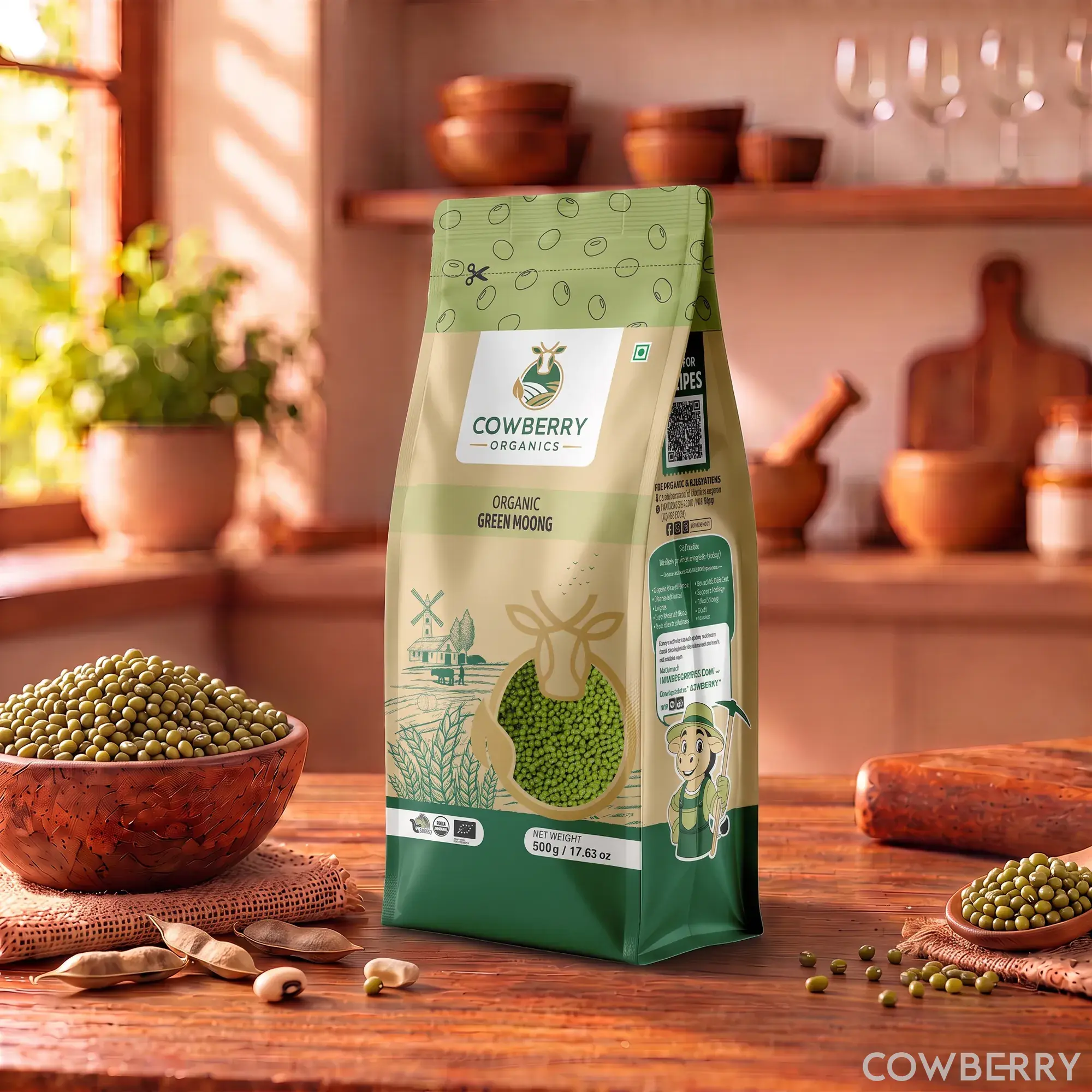
In India, the green moong COWBERRY sells comes from the fields of Rajasthan and Central India, where organic farmers grow it with cow-based, chemical-free methods and harvest it at peak maturity, then clean and minimally process it with nothing added. The pack's promise is farm-first: no additives or preservatives, and the India Organic, USDA & EU certified mark on the pouch. The grain keeps its natural sprouting ability, so a pack of Organic Green Moong can go from shelf to sprout jar.
Green gram origin and where it is eaten
What the record shows is spread rather than a single birthplace. Pulses have been eaten for at least 10,000 years and rank among the most heavily used foods worldwide (a 2014 review), while mung bean, the 2019 review adds, is eaten worldwide and most of all in Asia, with a long history of usage as traditional medicine.
In India the spread is visible on the shelf: IFCT 2017 records a local name for green gram in all thirteen languages its names list covers, from Mung in Hindi to Pasipayir in Tamil. The same seed travels under its dal entry, 'Green gram, dal' (B010), the split form sold beside the whole one in the same shop. The grain has been grown for generations in Rajasthan and Central India, where COWBERRY's crop comes from. The complete name list is on the page for sabut moong in English.
Green gram varieties and the forms sold in India
Shoppers ask about green gram varieties; IFCT 2017 lists none. It keeps one composition entry for the whole seed, B011, and one for the dal, B010, with no variety split, and the FAO's pulses pages discuss the Vigna beans as one group. No variety list is given, because neither IFCT 2017 nor the FAO pulses pages records one; what Indian shops actually distinguish is form. The dal entry lists its own names, Mug dal in Hindi and Hesara bele in Kannada, the words for the split form.
The forms are three: sabut moong, the whole seed, for dal and sprouting; moong dal, the split and husked seed, for everyday dal; and the sprouted seed, germinated at home. The whole-versus-split choice is laid out in numbers on green gram vs moong dal.
What the seed holds: green gram nutrition
Per 100 g of raw whole seed, IFCT 2017 lists 22.53 g of protein, 17.04 g of fibre, 46.13 g of carbohydrate, 1.14 g of fat and 294 kcal. The minerals follow: 4.89 mg of iron, 92.43 mg of calcium, 198 mg of magnesium, 1177 mg of potassium, 12.48 mg of sodium and 2.67 mg of zinc, with 145 mcg of folate. That fibre figure, 17.04 g per 100 g, is the whole seed's answer to the split dal's 9.37 g, the one number that changes most between the two forms.
ICMR-NIN's Dietary Guidelines name green gram among the pulses that are rich sources of protein, and a 2018 review of mung bean proteins calls the seed a good protein source except for the sulphur amino acids methionine and cysteine. Cereals are strong exactly there, and the guidelines say a 3:1 cereal-to-pulse mix can meet the requirement for every essential amino acid.
On the glycemic index, the University of Sydney database holds one India-tested entry for plain green gram, soaked, kept moist and steamed, at a GI of 38, the low band. What diabetes means for the portion is on whether green gram is good for diabetes.
| Nutrient | Whole green gram (sabut moong), raw |
|---|---|
| Energy (kcal) | 294 |
| Protein (g) | 23 |
| Fat (g) | 1.1 |
| Carbohydrates (g) | 46 |
| Dietary fibre (g) | 17 |
| Iron (mg) | 4.9 |
| Calcium (mg) | 92 |
| Magnesium (mg) | 198 |
| Potassium (mg) | 1177 |
| Sodium (mg) | 12 |
| Zinc (mg) | 2.7 |
| Folate (mcg) | 145 |
| Glycemic index (GI) | 38 |
Per 100 g raw, edible portion. Composition: IFCT 2017 (ICMR-NIN). GI: University of Sydney GI database. — means not reported. These are average values for the food; the label on a pack gives the values for that product.
How green gram sprouts
Green gram is the seed people sprout at home, and the guidelines give the method. ICMR-NIN's steps: place the cleaned grains in a strainer, rinse well and drain, keep the jar out of direct light at room (warm) temperature, and the grains should sprout in 1 to 3 days. The sprout is ready when it is about as long as the grain kernel itself; grown longer, the sprout begins to use up the nutrients stored in the seed. Sprouts can be eaten as they are or with a garnish, though raw sprouts need care: see the FAQ below.
Why sprouting changes the seed is documented: a 2018 review explains that germination activates the seed's own enzymes, which degrade anti-nutritional factors and break complex macronutrients into simpler, more digestible forms. ICMR-NIN adds that sprouting also increases the content of certain vitamins, and a 2023 study that optimised germination conditions found the polyphenol content of germinated mung bean rose more than threefold compared with the ungerminated seed. The study's optimised conditions were a soak at 25 °C for 11 hours followed by germination at 28 °C for 3 days, and the polyphenol rise came with the sprout. In the same study the sprouted seed's polyphenol extract cut blood sugar and eased insulin resistance in type 2 diabetic mice, an early laboratory result.
The step-by-step method with timings lives on how to sprout moong.
Green gram in the kitchen and on the shelf
Whole green gram cooks into sabut moong dal; soaked and ground, it becomes pesarattu; sprouted, it tops a sprouts chaat or fills a sprouts salad.
Dry whole green gram keeps for many months in an airtight container in a cool, dry place, and the FAO notes that pulses have a long shelf-life and help to increase the diversity of diets while reducing food loss and waste. Before cooking, wash the grains well but not repeatedly, as the guidelines advise. Cooked moong keeps up to two days in the fridge (UK Food Standards Agency); the dry seed in an airtight jar simply waits.
The plant's place in the wider story of pulses is on the green gram hub, with the health side on green gram benefits.
FAQs
What is green gram?
Green gram is the whole seed of the legume Vigna radiata, sold as sabut moong; split and husked it becomes moong dal. IFCT 2017 lists it as 'Green gram, whole' under food code B011, with 22.53 g of protein per 100 g. Its names, nutrition and recipes are on the green gram hub.
Is green gram a pulse?
Yes. The FAO defines pulses as the edible seeds of leguminous plants cultivated for food and feed, and names the Vigna beans, green gram's group, among the most well-known types. Green gram is harvested for its dry seeds, which is what makes it a pulse rather than a vegetable.
Does green gram have protein?
Yes, and plenty of it: 22.53 g per 100 g of raw whole seed (IFCT 2017). ICMR-NIN's guidelines name green gram among the pulses that are rich sources of protein. Like other pulses it is short on methionine and cysteine, so the classic dal-with-rice plate supplies the amino acids the bean lacks.
How green gram grow?
As a field crop. The plant fixes atmospheric nitrogen into the soil and is grown in rotations and mixed cropping, which the FAO says improves soil fertility and chemical fertiliser use efficiency. COWBERRY's green moong comes from Rajasthan and Central India, where it is harvested at peak maturity.
How green gram sprouts?
Rinse the dry seed, drain it, and keep it out of direct light at warm room temperature; the grains should sprout in 1 to 3 days (ICMR-NIN). The sprout is ready when it is about as long as the grain itself. The full method with timings is on how to sprout moong.
Can green gram sprouts be eaten raw?
ICMR-NIN's guidelines say sprouts can be consumed without further processing or with a garnish. Sprouts are grown warm and humid, though, and the US FDA warns that raw or lightly cooked mung bean sprouts may carry bacteria such as Salmonella, Listeria and E. coli. It says children, older adults, pregnant women and people with weakened immune systems should avoid them raw or lightly cooked. Wash sprouts well, keep them cool and eat them soon.
References
- Indian Food Composition Tables (IFCT) 2017, ICMR-National Institute of Nutrition
- Dietary Guidelines for Indians, ICMR-National Institute of Nutrition
- University of Sydney glycemic index database (GI search)
- Mudryj AN, Yu N, Aukema HM. Nutritional and health benefits of pulses. Appl Physiol Nutr Metab, 2014
- FAO: World Pulses Day (pulses and their role in diets)
- Hou D, Yousaf L, Xue Y et al. Mung bean (Vigna radiata L.): bioactive polyphenols, polysaccharides, peptides, and health benefits. Nutrients, 2019
- Yi-Shen Z, Shuai S, FitzGerald R. Mung bean proteins and peptides: nutritional, functional and bioactive properties. Food Nutr Res, 2018
- Li B, Shen X, Shen H et al. Effect of optimized germination technology on polyphenol content and hypoglycemic activity of mung bean. Front Nutr, 2023
- Nkhata SG, Ayua E, Kamau EH, et al. Fermentation and germination improve nutritional value of cereals and legumes through activation of endogenous enzymes. Food Sci Nutr, 2018
- US FDA: Selecting and Serving Produce Safely
- UK Food Standards Agency: How to chill, freeze and defrost food safely
Shop this article
Keep reading
Rajma vs lobia: difference, nutrition and which to choose
Rajma plant: how rajma is grown in India (it is not a tree)
Rajma in pregnancy: benefits, safety and how to eat it