by COWBERRY

13 minute read
Toor dal (arhar, pigeon pea): names, nutrition, benefits, how to cook

Toor dal is pigeon pea (Cajanus cajan) with the husk removed and the seed split in two; Hindi calls it arhar dal and western India tur or tuvar. It gives 21.7 g of protein and 9.1 g of fibre per 100 g (IFCT 2017). Sambar, dal tadka, Andhra pappu and Gujarati tuver dal all start with it.
What is toor dal (arhar dal)?
Toor dal begins as the seed of the pigeon pea, Cajanus cajan, a hardy shrub of the pulse family. The whole seed is small, round and brownish. A dal mill cleans it, loosens the husk, removes it and splits the seed in two, and what comes out is the flat, dull-yellow dal that sits in a steel dabba in Indian kitchens. IFCT 2017 lists it as "red gram, dal"; in everyday English it is split pigeon pea.
The same dal wears three names. Hindi speakers say arhar dal, Marathi and Gujarati speakers say tur or tuvar, and packs print "toor dal" for both, so arhar dal, tur dal and toor dal are one and the same thing. In the south it is the base of sambar, so a Telugu speaker searching for kandi pappu in English and a Tamil speaker asking about thuvaram paruppu are asking about this dal too.
Maharashtra and Karnataka are two of the states that grow it. Toor is one of the everyday types of dal in an Indian kitchen and a common choice for the daily dal.
Toor dal in English and other Indian languages
"Toor dal in English" is a common question about this dal, and the answer has two parts: the botanical name is Cajanus cajan, and the English food name is pigeon pea (IFCT 2017 calls it red gram). The regional names in the table are the ones IFCT 2017 prints in its list of local names. Two spellings that people actually type, the Kannada togari bele and the Tamil thuvaram paruppu, are added as spelling variants because IFCT prints them as thugare bele and tuvaram paruppu.
A few of the names carry a clue to the grain. Kandi pappu in Telugu and tuvaram paruppu in Tamil end in pappu and paruppu, the southern words for any split dal, so both simply mean "pigeon pea dal". Every name with its region, the spellings you will meet on packs, and the pulses toor is often confused with are on the page for toor dal in English, Hindi and all Indian languages.
| Language | Name (romanised) |
|---|---|
| English | Red gram, dal |
| Hindi | Arhar dal |
| Marathi | Turdal |
| Gujarati | Tuver ni daad |
| Punjabi | Arhar dal |
| Bengali | Arhar dal |
| Odia | Harada dal |
| Assamese | Rohor dail |
| Kannada | Thugare bele, Togari bele |
| Telugu | Kandi pappu |
| Tamil | Tuvaram paruppu, Thuvaram paruppu |
| Malayalam | Tuvaru parippu |
| Urdu | Tuvar ki dal |
| Sanskrit | Aaddhakii |
| Botanical name | Cajanus cajan |
Source: IFCT 2017 (ICMR-NIN) local-names list. — means no name recorded in the source.
Kannada ‘Togari bele’: spelling variant of the IFCT 2017 name ‘Thugare bele’. Tamil ‘Thuvaram paruppu’: spelling variant of the IFCT 2017 name ‘Tuvaram paruppu’.
Toor dal nutrition per 100 g
Per 100 g of raw dal, IFCT 2017 reports 331 kcal, 21.7 g protein, 1.56 g fat, 55.2 g carbohydrate and 9.1 g fibre. The minerals matter as much on a vegetarian plate: 3.9 mg iron, 71.7 mg calcium, 119 mg magnesium, 1395 mg potassium, 2.6 mg zinc and 108 mcg folate.
Against moong dal and chana dal, toor sits in the middle on protein and fat. Moong dal has a little more protein (23.9 g) and about the same fibre (9.4 g); chana dal matches it on protein (21.6 g) but carries far more fibre (15.2 g) and more fat (5.3 g), and it takes longer to cook. All three land within a few calories of each other, between 326 and 331 kcal per 100 g raw.
At the table the unit is the katori. One katori of cooked toor dal starts as about 30 g of dry dal, which works out to about 99 kcal, 6.5 g protein and 2.7 g fibre before the tadka goes on. The University of Sydney database gives cooked pigeon peas a glycemic index of 20, averaged over four entries that range from 7 to 43; none was tested in India and all are whole peas rather than split dal, so read it as "low" rather than as an exact score. The dal protein per 100 g page sets toor beside the other common dals, per 100 g and per katori.
| Nutrient | Toor dal (arhar) | Moong dal | Chana dal |
|---|---|---|---|
| Energy (kcal) | 331 | 326 | 329 |
| Protein (g) | 22 | 24 | 22 |
| Fat (g) | 1.6 | 1.4 | 5.3 |
| Carbohydrates (g) | 55 | 53 | 47 |
| Dietary fibre (g) | 9.1 | 9.4 | 15 |
| Iron (mg) | 3.9 | 3.9 | 6.1 |
| Calcium (mg) | 72 | 43 | 46 |
| Magnesium (mg) | 119 | 155 | 118 |
| Potassium (mg) | 1395 | 1268 | 957 |
| Sodium (mg) | 18 | 10 | 21 |
| Zinc (mg) | 2.6 | 2.5 | 3.6 |
| Folate (mcg) | 108 | 92 | 182 |
| Glycemic index (GI) | 20 | 38 | 11 |
Per 100 g raw, edible portion. Composition: IFCT 2017 (ICMR-NIN). GI: University of Sydney GI database. — means not reported. These are average values for the food; the label on a pack gives the values for that product.
Benefits of toor dal (arhar dal)
Each benefit below rests on the table above or on a listed reference. The ICMR-NIN Dietary Guidelines for Indians plan 85 g of raw pulses into a vegetarian day, and the FAO supports pulses as part of healthy diets. A katori of dal at both meals, about 60 g dry, fits inside that.
Protein that completes rice and roti
At 21.7 g per 100 g, toor dal has well over twice the protein of the rice it is usually eaten with. The ICMR-NIN guidelines explain why the pair works: pulses are high in lysine and low in methionine and cysteine, cereals show the opposite pattern, and a meal with both is of higher quality than pulses or grains alone. The ratio they give is 3:1, cereals to pulses, weighed raw. Two katoris of dal give about 13 g protein.
Fibre that slows the meal down
Toor dal has 9.1 g of fibre per 100 g, or about 2.7 g per katori. Fibre holds back how fast carbohydrate and fat are absorbed and makes a meal more filling, the ICMR-NIN guidelines explain. A 2014 paper in Applied Physiology, Nutrition and Metabolism (Mudryj, Yu and Aukema) reports better serum lipid profiles with pulse consumption and, for people with diabetes, help in keeping blood glucose and insulin at healthy levels; it adds that long-term trials are still needed.
Folate, iron, potassium and magnesium
Toor gives 108 mcg folate per 100 g, along with 3.9 mg iron, 1395 mg potassium, 119 mg magnesium and 2.6 mg zinc. Plant foods give up their iron poorly, the ICMR-NIN guidelines note, and vitamin C from citrus fruits such as lemon helps the body absorb it, so the lemon squeezed over the bowl is doing useful work.
A low glycemic index
Boiled pigeon peas average a GI of 20 in the University of Sydney database, which counts 55 or less as low. That score is for the pulse alone; on the plate the rice or roti counts too. People with diabetes should plan their portions with their doctor or dietitian; the GI of the common dals is on the dal comparison page.
Very little fat
Toor dal has 1.56 g fat per 100 g. Almost all the fat in a bowl of dal comes from the tadka, so one teaspoon of ghee per katori keeps it light.
Side effects: who should limit toor dal
A katori or two of toor dal a day suits most people. Two complaints come up often, and a diet set by your doctor comes before anything here.
- Gas and bloating: some people feel gassy after dal, toor included. Soak it before cooking, since the ICMR-NIN guidelines name soaking as a home method that makes legumes more digestible, and cook it until it is fully soft.
- Heaviness at night: a thick, heavily tempered toor dal late at night sits heavy for some people. A thinner dal, less fat in the tadka and an earlier dinner may help.
Toor dal gives 21.7 g protein and 1395 mg potassium per 100 g raw. If your doctor has set limits on protein, potassium or pulses, check with them or with your dietitian before you raise or cut your dal.
How to cook toor dal: soak, pressure cook, whistles
Rinse and soak. Wash the dal twice in fresh water, then leave it covered with water for 20 to 30 minutes. The ICMR-NIN guidelines advise against washing pulses again and again, because some minerals and vitamins are lost with the water. Soaking is optional but shortens the cooking; an overnight soak in the fridge is fine and cuts the time further (drain it and use fresh water).
Pressure cook. One cup of dal (about 200 g) with three cups of water, a quarter teaspoon of turmeric, and three or four drops of ghee or oil to keep the froth down. Three whistles on medium heat for soaked dal, four to five for unsoaked, then switch off the heat and open the cooker only once the pressure has fallen by itself. A grain pressed between two fingers should crush to a paste; whisk it smooth for dal tadka, leave it slightly grainy for sambar. In an open pot the same dal takes 35 to 45 minutes with the lid ajar. The ICMR-NIN guidelines call boiling or pressure cooking the best way to improve the nutritional quality of pulses, since it destroys the enzyme inhibitors that get in the way of digestion, and they warn that overcooking lowers the quality of the protein. Salt can go in at the start; it is sour ingredients such as tomato, tamarind and kokum that slow the softening, so add those once the dal is soft.
What to make. Toor is the dal of sambar in Tamil Nadu and Karnataka, of the sweet-and-sour Gujarati tuver dal, of Maharashtra's plain varan and spiced amti, of Andhra's tomato pappu and of the north's dal tadka, where the cooked dal is tempered twice with ghee, cumin, garlic and whole red chillies. It also stands in for moong in a Gujarati khichdi and thickens a mixed-dal panchmel. A cup of dry dal makes six to seven katoris of cooked dal, enough for a family lunch.
Unpolished vs polished toor dal
Walk down a dal aisle and you will see two kinds of toor: a bright, glossy, perfectly uniform yellow, and a duller matte yellow with a little dal powder at the bottom of the pack. The first has usually been polished; the second has not.
Polishing is a finishing step at the mill that gives the dal its shine, done with water, with a little edible oil or with leather. The ICMR-NIN guidelines put highly polished dal in the same processing group as polished rice and maida: foods whose nutrient losses are small, but which lose some fibre.
Unpolished dal looks less even and needs a good rinse because of the powder. In return you see the dal as it came off the mill: its own colour and no added oil.
How to store toor dal
Dry, split dal keeps for many months if the jar is steel or glass, shuts tight and stands in a cool, dark cupboard well clear of the stove. The enemies are moisture and weevils. Before you put away a large lot, spread the dal in the sun for a couple of hours, let it cool fully, and slip a few dried neem leaves in with the dal, a household practice the ICMR-NIN guidelines say keeps some infestations away. In the monsoon, when even airtight jars sweat, buy only what you will finish in two to three months and keep the lid closed between scoops.
Check a jar that has stood for months for fine webbing, holes in the grains or a musty smell; any of the three means the batch goes. For the wet months, follow our guide to storing atta, grains and dals in the monsoon.
How to buy toor dal: what to look for
Unpolished first. Prefer a matte, unpolished dal (see the section above); a glossy, uniform shine points to polishing.
Colour and size. Good toor dal is an even dull yellow with the odd darker or reddish-edged half; a single flat, bright yellow suggests polish. Grains should be of similar size with few broken bits. Some fine dal powder in an unpolished pack is normal.
Smell. Fresh dal smells faintly nutty and of nothing else. A stale or musty smell is a reason to put the pack back.
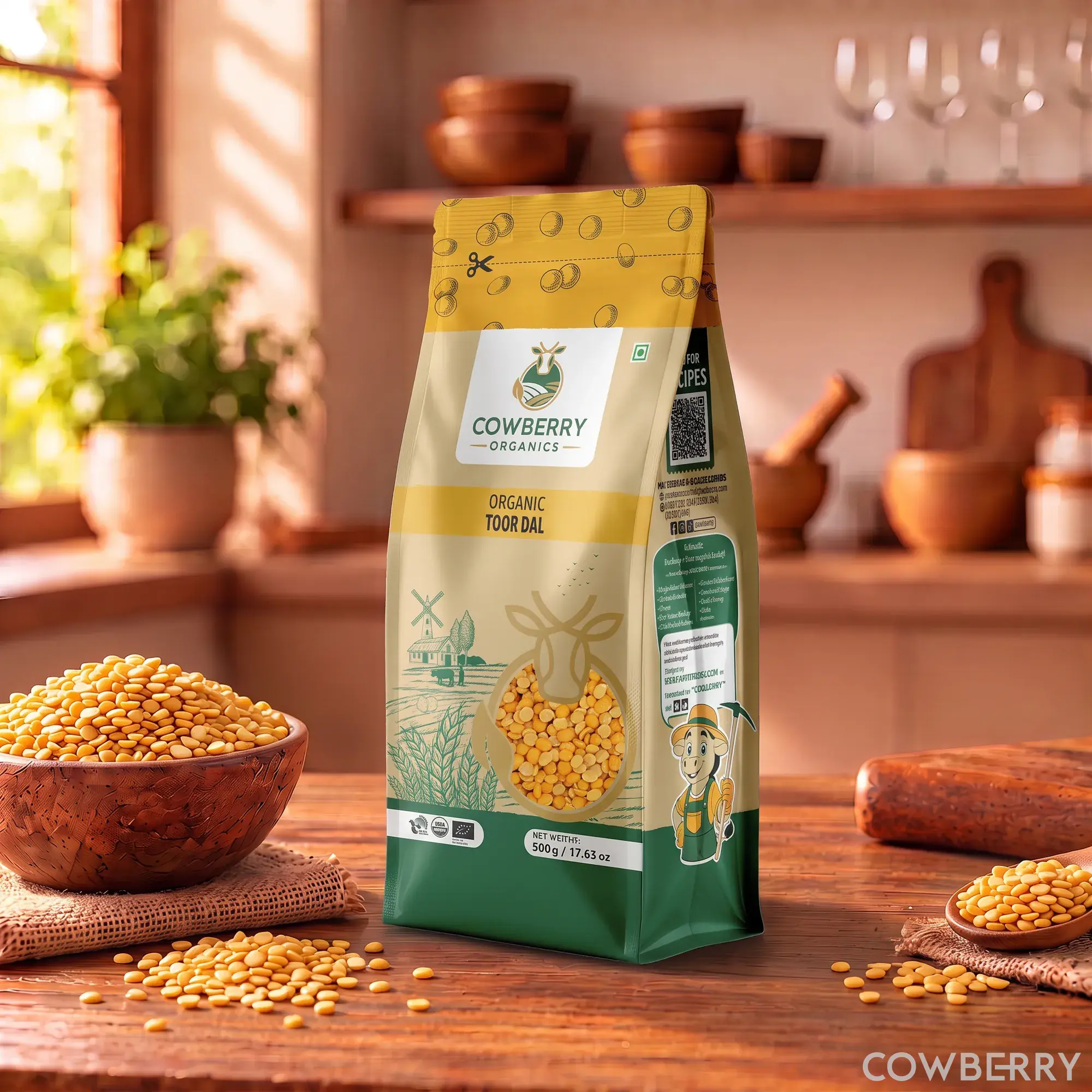
Origin and farming. A pack that names its growing region tells you where the dal came from. COWBERRY sources its toor dal from Andhra Pradesh, Karnataka and Maharashtra, from farms that practise cow-based farming, and mills it without water, oil or leather polishing.
Certification. For organic dal, look for a certification mark on the pack; COWBERRY's toor dal is India Organic, USDA & EU certified. "Natural" and "farm fresh" are descriptions and certify nothing.
Pack date and size. Check the packing date and pick the most recently packed one. A 1 kg pack gives a family of four about a week of daily dal at a katori each, so buy the size you will finish within two or three months, and the smaller pack in the monsoon.
More on toor dal
Toor dal goes into more dishes, and raises more questions, than one guide can hold. These pages take the numbers, the comparisons and the cooking further.
- Arhar dal protein per 100 g and the rest of toor dal's nutrition, with the arithmetic for a katori of cooked dal.
- Toor dal benefits, each with the number behind it, and notes on gas and uric acid.
- Toor dal vs chana dal: protein, fibre, GI and taste side by side.
- Toor dal for diabetes: its GI and the caveat that comes with it, carbohydrate per katori and how to eat it.
- Toor dal for weight loss: calories and protein in a katori, and a day of meals built around it.
- Toor dal recipes on one page, from plain dal and sambar to khichdi, dal dhokli and dal roti.
- Sambar, toor dal and vegetables in a tamarind stew with a roast-and-grind masala, and rasam, a light tomato-pepper soup with mashed toor dal.
FAQs
What is toor dal?
Toor dal is pigeon pea (Cajanus cajan) that has been dehusked and split, a yellow dal called arhar in Hindi and tur or tuvar in Marathi and Gujarati. It gives 21.7 g protein and 9.1 g fibre per 100 g (IFCT 2017) and goes into sambar, pappu, dal tadka and the Gujarati tuver dal. Wash it, soak it briefly and pressure cook it for three whistles.
Is arhar dal and toor dal same?
Yes. Hindi speakers say arhar, Marathi and Gujarati speakers say toor, tur or tuvar, and both mean the same split pigeon pea; Telugu kandi pappu, Kannada togari bele and Tamil thuvaram paruppu are the same dal again. There is no difference in the grain, the nutrition or the cooking; only the label changes with the language of the shop.
Does toor dal cause gas?
It can for some people. Start with a 20 to 30 minute soak: soaking is one of the household steps that the ICMR-NIN guidelines say make legumes easier to digest. Then cook the dal until it is completely soft, with no hard centre left. If the discomfort keeps coming back, ask your doctor.
Can toor dal be soaked overnight?
Yes. In warm weather soak it in the fridge rather than on the counter, then drain and rinse it and cook it in fresh water. An overnight soak cuts the cooking time to about two whistles. Cook it once the soak is done: dal left standing in water starts to smell sour.
Is toor dal good for kidney patients?
Ask your doctor or dietitian, because the answer depends on your kidney function and your diet plan. Take the numbers with you: per 100 g raw, toor dal gives 21.7 g protein and 1395 mg potassium (IFCT 2017), and one katori of cooked dal starts from about 30 g of dry dal. They can then set how much dal fits your day.
Which toor dal is best?
An unpolished dal from a named growing region, packed recently: matte yellow rather than glossy, similar-sized grains and a nutty smell. If organic matters to you, check the pack for an organic certification mark; "natural" on its own certifies nothing.
References
- University of Sydney: about the glycemic index
- Indian Food Composition Tables (IFCT) 2017, ICMR-National Institute of Nutrition
- University of Sydney glycemic index database (GI search)
- Mudryj AN, Yu N, Aukema HM. Nutritional and health benefits of pulses. Appl Physiol Nutr Metab, 2014
- Dietary Guidelines for Indians, ICMR-National Institute of Nutrition
- FAO: World Pulses Day (pulses and their role in diets)
Shop this article
Keep reading
Green gram plant: crop, varieties and how it grows in India
Rajma vs lobia: difference, nutrition and which to choose
Rajma plant: how rajma is grown in India (it is not a tree)