by COWBERRY

11 minute read
Besan (gram flour): names, nutrition, benefits and how to cook it

Besan is gram flour: the fine golden powder milled from dehusked Bengal gram, the chickpea behind pakoras, kadhi, chilla and a whole shelf of Indian sweets. Per 100 g it carries 22.4 g of protein and 10.8 g of fibre, has no gluten, and cooks into everything from a breakfast upma to a festive barfi.
What is besan?
Besan is chickpea flour. The FSSAI standard for it fits in one line: the product of grinding dehusked Bengal gram (Cicer arietinum), with no added colouring matter, free of abnormal odours and living insects, moisture capped at 12 percent and protein set at a 20 percent floor on a dry basis. In the kitchen that means chana dal, the split and skinned chickpea, milled to a powder.
Because the seed is a pulse and not a cereal, the flour has no gluten, so its batters and flatbreads fit wheat-free cooking; what to check on the pack is the subject of is besan gluten free. One kitchen rule runs through every recipe: besan is never eaten raw; it is roasted, steamed, simmered or fried before it becomes food. Gram roasted before grinding becomes chana sattu, a different flour with its own standard, compared later on this page.
Besan names: gram flour in English and Hindi
Asked for besan in English, the answer is chickpea flour, which is how the USDA files the flour; everyday English says gram flour. Hindi keeps the word besan, and it is the name the FSSAI standard is written under. Besan powder is simply the milled flour itself; besan atta and chana atta are two more names for it, both of them listed by COWBERRY for its own besan. The table below shows only names a published source gives; a blank cell means no published source gives a name for that language. The dal behind the flour has names in nearly every IFCT 2017 language column, but the flour itself has none there, so the table carries only names a source gives. The fuller story, including what graham flour is not, sits on besan in English, Hindi and Indian languages.
| Language | Name (romanised) |
|---|---|
| English | Chickpea flour (besan) |
| Hindi | Besan |
| Marathi | — |
| Gujarati | — |
| Punjabi | — |
| Bengali | — |
| Odia | — |
| Assamese | — |
| Kannada | — |
| Telugu | — |
| Tamil | — |
| Malayalam | — |
| Urdu | — |
| Sanskrit | — |
| Botanical name | — |
Source: USDA FoodData Central record 174288 (English and scientific name only; no Indian-language names in source). — means no name recorded in the source.
Hindi ‘Besan’: Wikipedia: Gram flour.
Besan nutrition per 100 g
The USDA figures for 100 g of raw chickpea flour (besan) read 387 kcal, 22.4 g of protein, 57.8 g of carbohydrate, 6.69 g of fat and 10.8 g of fibre, with 4.86 mg of iron, 437 mcg of folate, 45 mg of calcium, 166 mg of magnesium, 846 mg of potassium, 2.81 mg of zinc and 64 mg of sodium. Against whole wheat flour, besan shows 22.4 g of protein where wheat has 10.6 g, and 387 kcal where wheat has 322 kcal, with a lighter carbohydrate load.
The glycaemic index database holds no figure for plain besan flour. What it does hold is GI 55 and GI 68 for two breads made from chickpea flour, tested in Australia (Johnson et al. 2004); those numbers belong to the breads, not to the raw flour. In portion terms, one besan roti starts from 30 g of flour, which gives 116 kcal, 6.7 g of protein and 17.3 g of carbohydrate before any ghee. The per-serving numbers and the micronutrient detail are on the gram flour nutrition per 100 g page.
| Nutrient | Besan (chickpea flour), raw | Whole wheat flour, raw |
|---|---|---|
| Energy (kcal) | 387 | 322 |
| Protein (g) | 22 | 11 |
| Fat (g) | 6.7 | 1.5 |
| Carbohydrates (g) | 58 | 65 |
| Dietary fibre (g) | 11 | 11 |
| Iron (mg) | 4.9 | 4 |
| Calcium (mg) | 45 | 39 |
| Magnesium (mg) | 166 | 125 |
| Potassium (mg) | 846 | 366 |
| Sodium (mg) | 64 | 2.5 |
| Zinc (mg) | 2.8 | 2.9 |
| Folate (mcg) | 437 | 30 |
| Vitamin C (mg) | 0 | — |
| Glycemic index (GI) | — | 47 |
Per 100 g raw, edible portion. Composition: USDA FoodData Central (SR Legacy), FDC ID 174288, NDB 16157; IFCT 2017 (ICMR-NIN). GI: University of Sydney GI database. — means not reported. These are average values for the food; the label on a pack gives the values for that product.
Benefits of besan
Protein
At 22.4 g per 100 g, besan reads as a protein flour. A 2012 review considers chickpea's protein quality better than other pulses, significant in every essential amino acid except the sulphur ones, a gap cereals in the daily diet can fill. ICMR-NIN makes the point in kitchen terms, that a combination of cereals, millets and pulses provides most of the amino acids, which complement each other.
Fibre and satiety
The 10.8 g of fibre per 100 g is the other half of the story. India's dietary guidelines credit fibre with slowing the uptake of carbohydrates and fats and adding to a meal's staying power.
Folate and iron
The flour also carries 437 mcg of folate and 4.86 mg of iron per 100 g; what those numbers mean on a pregnancy or baby's plate is on besan in pregnancy and besan for babies.
Weight and blood sugar
For weight, a 2016 pooling of 21 trials found whole pulses at a median 132 g a day gave 0.34 kg more loss over a median six weeks; for blood sugar, a 2009 pooling of 41 trials in people with and without diabetes saw fasting glucose and insulin fall with pulses. Besan flour itself was not the food tested in either, so the honest version of both findings, with the caveats, sits on besan for weight loss and besan for diabetes. The full evidence list is on besan benefits and side effects, and the same points in Hindi are on besan ke fayde aur nuksan.
Side effects and who should limit besan
Besan suits most people as an everyday flour, and the cautions are few.
- Gas: some people find chickpea dishes heavy. A 2012 review puts oligosaccharides among chickpea's carbohydrates, and heat, part of every besan dish, is what that review credits with lowering the pulse's anti-nutritional factors.
- Allergy: as with any food, an allergy is possible. For a baby starting solids, ICMR-NIN's rule is one new food at a time, kept up for 4 to 5 days, which shows up an intolerance or allergy; the age and texture rules belong to your paediatrician, and besan for babies lays them out.
- Pregnancy: besan is ground chickpea, eaten cooked; the trimester notes and the raw-sprout warning are on besan in pregnancy.
- The sweet and fried versions: laddu, halwa, barfi and pakoras add jaggery, sugar, ghee or frying oil to the flour; keep those occasional if calories or blood sugar are part of your plan.
Besan vs maida and besan vs sattu
Besan is often weighed against two other flours on the shelf.
Maida is refined wheat flour; besan is a pulse flour with 22.4 g of protein per 100 g and no gluten. The Indian dietary guidelines place maida in a processing group where some fibre is lost, and the nutrition table on this page carries no maida figures. In batters besan often stands in for maida; in risen breads that depend on wheat flour's stretch, it will not. The side-by-side comparison is difference between maida and besan.
Sattu is gram with one extra step: roasted before grinding, so it is used as it comes while besan is always cooked first. Each flour has its own FSSAI standard, with sattu held to 8 percent moisture against besan's 12 percent; the whole split is on besan vs sattu.
How to cook and use besan
Heat is part of every besan recipe, and the flour behaves well once three moves are right.
- Roast first for sweets and porridge. Roasting the flour until it smells nutty cooks out the raw gram taste; laddu, halwa and porridge all begin with that roast.
- Whisk for batters and slurries. Stirring water into the flour off the flame, or whisking a smooth slurry before it meets the hot pan, keeps chilla batter, kadhi and zunka lump-free.
- Work around the missing gluten. Besan roti dough is rolled between two sheets instead of on a floured board, dhokla rises on fruit salt and steam, and besan thickens as it simmers, which is what carries kadhi and pakora batter.
New to the flour? A plain chilla or a bowl of upma is a good first dish, and a roti can replace one wheat chapati in a meal.
How to store besan flour
Besan keeps like any milled flour: a clean, dry, airtight jar on a cool dark shelf, dipped into only with a dry spoon. The FSSAI standard caps the flour's moisture at 12 percent as sold, so it arrives dry; the jar's work is to keep damp out. In warm, humid weather the fridge is the better home, and the freezer suits long gaps when the flour is double-sealed. Smell it before each use: a fresh batch smells mildly nutty, and a sharp or bitter smell can mean the fat has gone rancid, so throw that batch out instead of cooking with it. The full routine, pests included, is on how to store besan flour.
Besan recipes to start with
The besan recipes roundup groups the full list by meal, and the highlights follow.
- Breakfast: besan chilla, a thin savoury pancake of gram flour batter; besan upma, toasted flour rained into tempered water, four bowls in 19 minutes; besan porridge, roasted flour whisked smooth and sweetened with jaggery.
- Mains: besan roti, a no-wheat flatbread rolled between sheets, about 175 kcal a roti; besan ki sabji (zunka), the dry crumbly sabji; besan gatte ki sabji, boiled dumplings sliced into a curd gravy; missi roti, besan mixed with whole wheat; sev tamatar, a sev-and-tomato curry.
- Snacks: besan dhokla, a steamed sponge lifted with fruit salt; khandvi, thin rolls of cooked batter; fafda, deep-fried strips.
- Sweets: besan ke laddu, roasted flour bound with ghee and jaggery; besan barfi, firm squares cut from a tray; besan halwa, the glossy pudding-sweet; mohanthal, the crumb-textured cousin; mysore pak, flour, sugar and ghee.
- Kadhi: kadhi pakora, punjabi kadhi, gujarati kadhi and sindhi kadhi, four ways with the same flour.
How to buy besan: what to check
Purity. The FSSAI standard is plain: dehusked Bengal gram, ground, with no added colouring matter and no abnormal odour. The pack should say Bengal gram, and the flour should look a uniform golden-yellow.
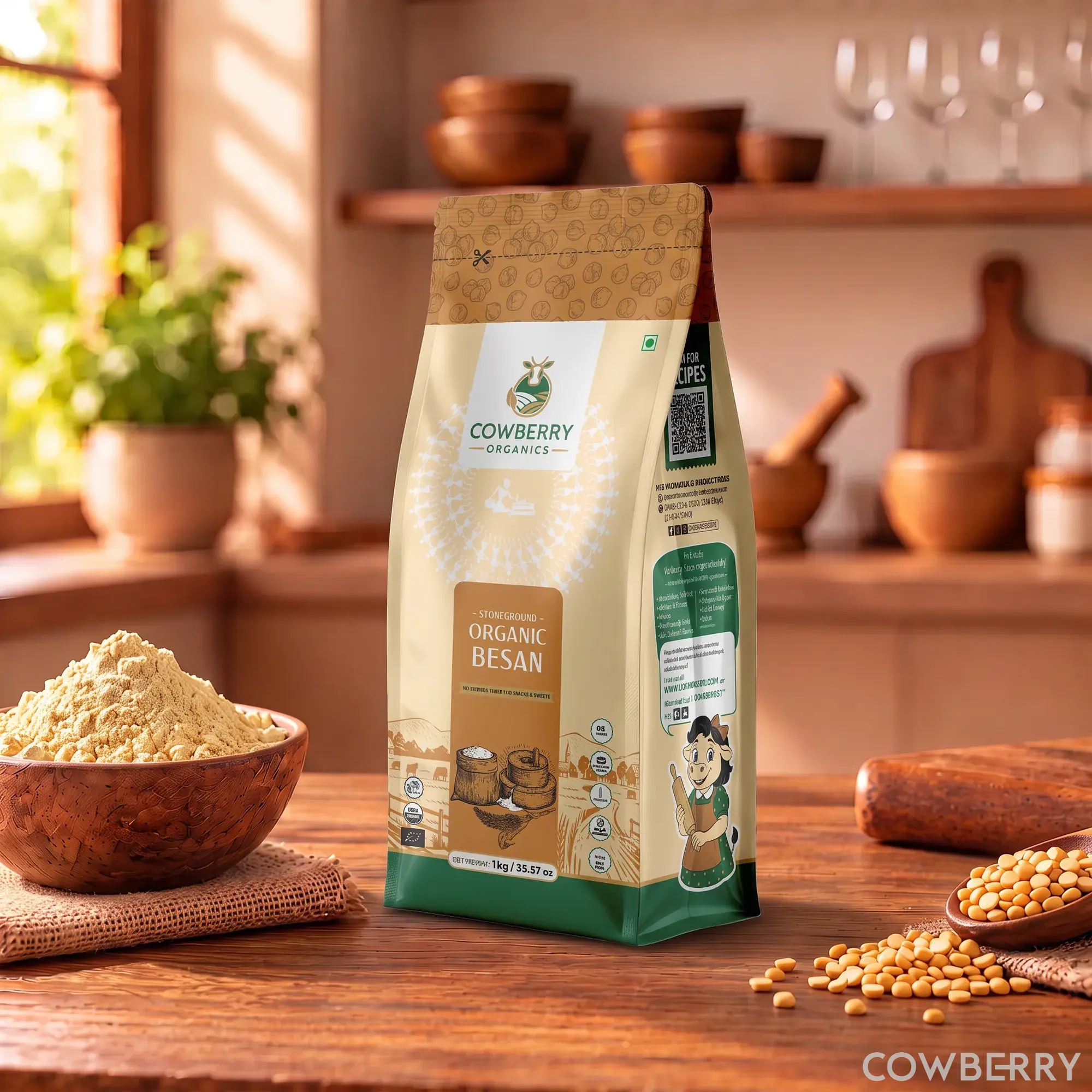
Organic. An organic pack carries a certification mark, so look for it on the label. COWBERRY's Organic Besan is stone-ground from chickpeas grown with cow-based natural farming in Maharashtra and Madhya Pradesh, and is India Organic, USDA & EU certified.
Freshness and pack size. Check the milling or packing date, buy a size the household will finish while the flour still smells nutty, and follow the storage rules above once it is home.
FAQs
What is gram flour?
Gram flour is besan: dehusked Bengal gram (Cicer arietinum), ground to a powder with no added colouring matter, per the FSSAI standard for the flour. In English it is called chickpea flour or gram flour, and in Hindi besan. It is always eaten cooked, in batters, flatbreads, kadhi and sweets.
Is gram flour besan?
Yes. Both words name one flour: the USDA record is titled chickpea flour (besan), everyday English says gram flour, and Hindi says besan. Bengal gram, dehusked and ground with no added colour, is what the FSSAI standard describes; the label only switches language.
What is gram flour used for?
Gram flour cooks both ends of an Indian menu: batters for chilla, pakora and dhokla, the thickener in kadhi, the base of roti and gatte, and the roasted-flour sweets laddu, barfi and halwa. It is also the flour behind sev, fafda and khandvi. Each dish starts from the same one ingredient.
Does besan have protein?
Yes. The USDA record for chickpea flour lists 22.4 g of protein per 100 g, more than twice whole wheat flour's 10.6 g. The FSSAI standard sets a floor of at least 20 percent protein on a dry basis, and one roti from 30 g of flour carries 6.7 g.
Difference between maida and besan?
Maida is refined wheat flour; besan is dehusked Bengal gram, ground. Besan is a pulse flour with 22.4 g of protein per 100 g and no gluten, while maida is a wheat flour, and India's dietary guidelines note that some fibre is lost in its processing. The full comparison is on the difference between maida and besan page.
Can we eat besan in fast?
That depends on the fast, because fasting rules on pulses differ between families and traditions, so follow the practice of your household. Where besan is part of the fast, the usual rules still apply: cook it fully and keep the sweet and fried dishes occasional. If a health condition sets your diet, agree the fast with your doctor first.
Can gram flour cause gas?
For some people, chickpea dishes can feel heavy. A 2012 review places oligosaccharides among chickpea's carbohydrates, and heat, which every besan dish involves, cuts the pulse's anti-nutritional factors per the same review. If a dish keeps sitting heavy, a doctor or dietitian can help you sort the cause.
References
- USDA FoodData Central (SR Legacy): Chickpea flour (besan), FDC ID 174288
- FSSAI: Food Products Standards and Food Additives Regulations compendium (Version XXII, 02.03.2022): 2.4.4 Besan and 2.4.33 Roasted Bengal Gram Flour (Chana Sattu)
- Dietary Guidelines for Indians, ICMR-National Institute of Nutrition
- Jukanti AK, Gaur PM, Gowda CL et al. Nutritional quality and health benefits of chickpea (Cicer arietinum L.): a review. Br J Nutr, 2012
- University of Sydney glycemic index database (GI search)
- Kim SJ, de Souza RJ, Choo VL, et al. Effects of dietary pulse consumption on body weight: a systematic review and meta-analysis of randomized controlled trials. Am J Clin Nutr, 2016
- Sievenpiper JL, Kendall CW, Esfahani A, et al. Effect of non-oil-seed pulses on glycaemic control: a systematic review and meta-analysis of randomised controlled experimental trials in people with and without diabetes. Diabetologia, 2009
- Indian Food Composition Tables (IFCT) 2017, ICMR-National Institute of Nutrition
Shop this article
Keep reading
Green gram plant: crop, varieties and how it grows in India
Rajma vs lobia: difference, nutrition and which to choose
Rajma plant: how rajma is grown in India (it is not a tree)