by COWBERRY

7 minute read
Besan (gram flour) nutrition per 100g: protein, calories, carbs, GI

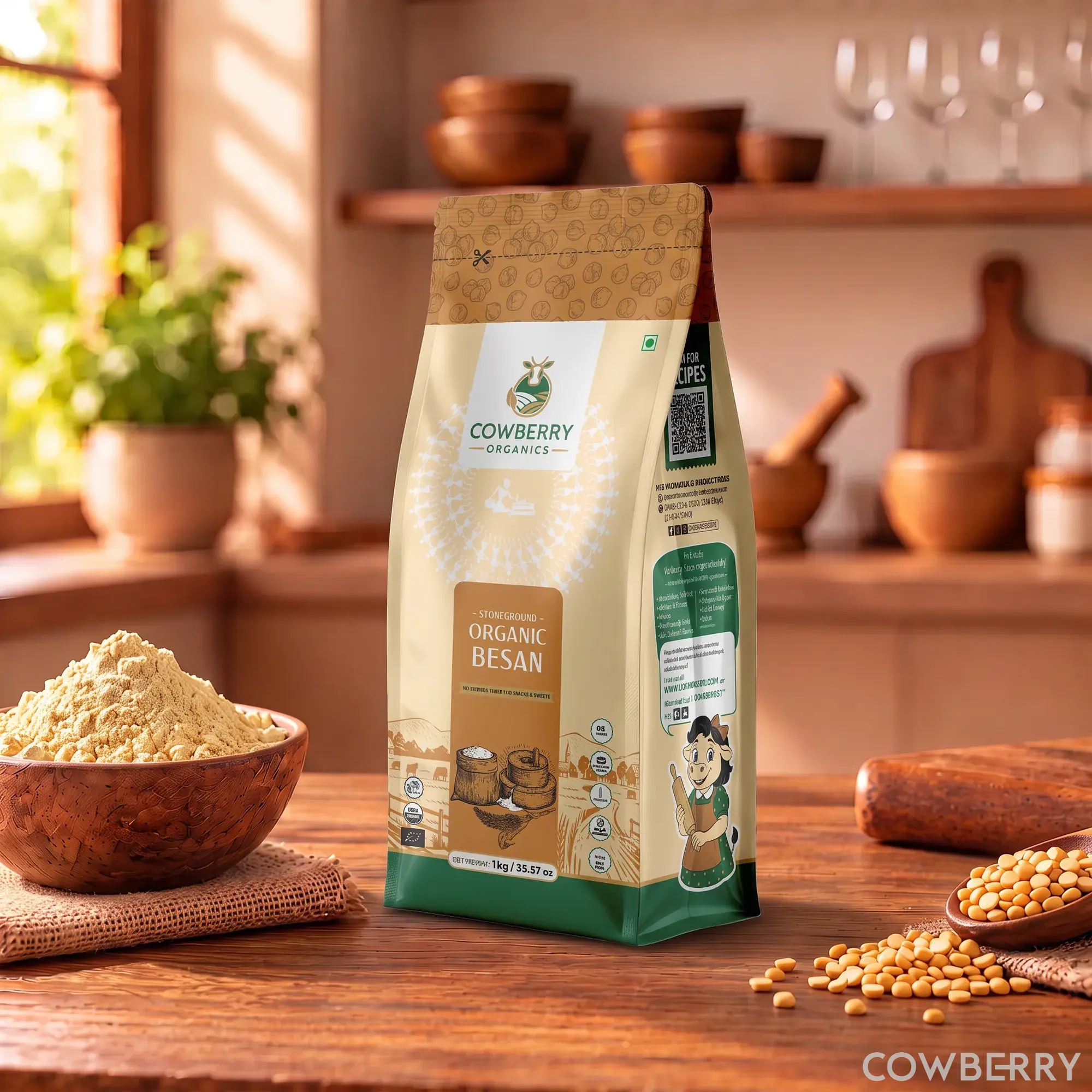
Gram flour nutrition per 100 g, and how the flour cooks: besan (chickpea flour) is ground dehusked Bengal gram, and the USDA record lists 387 kcal, 22.4 g of protein, 57.8 g of carbohydrate, 10.8 g of fibre and 4.86 mg of iron. The full table, per-spoon figures and the honest GI gap follow; the family's hub is besan.
Gram flour nutrition per 100 g: the full table
The table sets besan beside chana dal, which is split Bengal gram, and whole wheat flour, all raw, per 100 g. Besan's figures come from the USDA SR Legacy record for chickpea flour, FDC 174288; the dal and wheat columns come from IFCT 2017, India's food composition tables. Besan itself is not in IFCT 2017, so the USDA record carries the besan column. Read down the besan column and you get 387 kcal, 22.4 g of protein, 6.69 g of fat, 57.8 g of carbohydrate, 10.8 g of fibre and 4.86 mg of iron per 100 g.
| Nutrient | Besan (chickpea flour), raw | Chana dal, raw | Whole wheat flour, raw |
|---|---|---|---|
| Energy (kcal) | 387 | 329 | 322 |
| Protein (g) | 22 | 22 | 11 |
| Fat (g) | 6.7 | 5.3 | 1.5 |
| Carbohydrates (g) | 58 | 47 | 65 |
| Dietary fibre (g) | 11 | 15 | 11 |
| Iron (mg) | 4.9 | 6.1 | 4 |
| Calcium (mg) | 45 | 46 | 39 |
| Magnesium (mg) | 166 | 118 | 125 |
| Potassium (mg) | 846 | 957 | 366 |
| Sodium (mg) | 64 | 21 | 2.5 |
| Zinc (mg) | 2.8 | 3.6 | 2.9 |
| Folate (mcg) | 437 | 182 | 30 |
| Vitamin C (mg) | 0 | — | — |
| Glycemic index (GI) | — | 11 | 47 |
Per 100 g raw, edible portion. Composition: USDA FoodData Central (SR Legacy), FDC ID 174288, NDB 16157; IFCT 2017 (ICMR-NIN). GI: University of Sydney GI database. — means not reported. These are average values for the food; the label on a pack gives the values for that product.
Besan nutritional value per 100g beside chana dal and whole wheat
Read the columns together and besan's pattern shows. Protein: 22.4 g per 100 g in besan, 21.55 g in chana dal and 10.59 g in whole wheat, so gram flour holds more than twice the protein of wheat flour. Fibre: 10.8 g in besan, 15.15 g in chana dal and 11.23 g in wheat, with the dal keeping the most. Energy: 387 kcal, against 329 kcal for chana dal and 322 kcal for wheat. Carbohydrate runs 57.8 g, 46.72 g and 64.72 g, and fat 6.69 g, 5.31 g and 1.47 g, besan carrying the most fat of the three. For what these numbers mean on a plate, see besan benefits and side effects, and the whole family picture sits on the besan hub.
Gram flour calories per teaspoon, tablespoon and cup
Per 100 g is not how anyone cooks, so here are the spoon and cup figures worked out from the USDA entry. A level teaspoon holds about 5 g of besan: 19 kcal and 1.1 g of protein. A tablespoon holds about 15 g: 58 kcal and 3.4 g of protein. A 240 ml measuring cup holds about 120 g: 464 kcal, 26.9 g of protein and 13.0 g of fibre. In the recipes, one besan roti uses 30 g of flour, which brings 116 kcal, 6.7 g of protein, 17.3 g of carbohydrate and 3.2 g of fibre, and the recipe's ghee takes the roti to 175 kcal. A serving of two besan chillas uses 45 g of flour: 174 kcal and 10.1 g of protein from the flour, 242 kcal with the recipe's oil. More ways to cook it sit in the besan recipes roundup.
Besan protein per 100 g and how complete that protein is
Besan carries 22.4 g of protein per 100 g, and the quality question is separate from the quantity. A 2012 review of chickpea in the British Journal of Nutrition notes its protein quality is considered to be better than that of other pulses, with significant amounts of all the essential amino acids except the sulphur-containing ones, which cereals added to the daily diet can complement. India's dietary guidelines make the same point in kitchen terms: pulses have higher levels of lysine and lower levels of methionine and cysteine, and combining cereals with pulses in the ratio of 3:1 (raw food weight) can meet the requirement of all the essential amino acids. On the guidelines' 2000-calorie plate, pulses and legumes get 85 g a day beside 250 g of cereals, and besan is one everyday way that gram appears on the plate.
Gram flour glycemic index: the honest gap
The University of Sydney GI database carries no entry for plain besan flour, so no glycemic index can honestly be given for besan itself. The closest published values are for two chickpea-flour breads from an Australian study (Johnson et al. 2004): GI 55 and GI 68. By the University of Sydney bands, which count 55 or under as low and 70 or above as high, one bread lands on the low line and the other in the medium band. Neighbouring foods do carry entries: boiled chana dal, which is split Bengal gram, is GI 11 on the strength of a single Indian test (Dilawari 1981), and whole wheat flour is GI 47, an average of two Indian tests, one run on steamed whole kernels. And the 2021 international GI tables record legumes as usually low-GI foods, with values that hold steady worldwide; that note is about legumes as tested, and covers neither besan flour nor the breads baked from it. Read the bread, dal and wheat figures as neighbours, not as besan's own number.
Iron, folate and the minerals in gram flour
The USDA record also lists besan's micronutrients per 100 g: 4.86 mg of iron, 437 mcg of folate, 166 mg of magnesium, 846 mg of potassium, 45 mg of calcium, 64 mg of sodium and 2.81 mg of zinc, with 0 mg of vitamin C. A 2012 review of chickpea lists folate among the vitamins chickpea is a good source of. One caution from India's dietary guidelines: the phytic acid in cereals and legumes slows the uptake of minerals, and its concentration drops a great deal with boiling or pressure cooking, leaving iron, calcium, magnesium and zinc easier to absorb. The same guidelines say boiling with just enough water, without having to drain it, is the best method to retain folate in legumes. Besan is cooked before it is eaten, so the roti, chilla and porridge are where these numbers come to life.
FAQs
Does besan have protein?
Yes: 22.4 g of protein per 100 g, more than twice the 10.59 g in whole wheat flour and just above chana dal's 21.55 g. The quality side matters too, since chickpea protein is considered better than that of other pulses, and cereals added to the daily diet can complement the sulphur-containing amino acids it is short on.
Is besan complete protein?
Not quite on its own. Chickpea has significant amounts of all the essential amino acids except the sulphur-containing ones, so besan is short on those. Adding cereals to the daily diet complements them, and India's dietary guidelines suggest combining cereals with pulses in the ratio of 3:1 (raw food weight) to meet all the essential amino acids.
Does besan have fiber?
Yes: 10.8 g of fibre per 100 g, slightly under whole wheat flour's 11.23 g and clearly under chana dal's 15.15 g. Fibre matters in practice, because India's dietary guidelines say eating enough fibre-rich foods such as pulses improves satiety. A roti from 30 g of flour still carries about 3.2 g of fibre.
Is besan high in calories?
Yes, as flours go: 387 kcal per 100 g, beside 322 kcal for whole wheat flour and 329 kcal for chana dal. The spoons are the practical numbers: a teaspoon of besan is about 19 kcal, a tablespoon about 58 kcal, and one roti from 30 g of flour is 116 kcal before any ghee.
What is gram flour?
Gram flour is besan, the flour milled from Bengal gram, the chickpea. Under the FSSAI standard, besan is flour milled from dehusked Bengal gram, with no added colouring matter allowed; the standard caps moisture at 12 per cent and asks for not less than 20 per cent protein on the dry basis. The USDA files it under chickpea flour.
How besan is made?
Dehusked Bengal gram is ground to a fine flour; under the FSSAI standard no added colouring matter is allowed. Chickpeas carry anti-nutritional factors, which a 2012 review says different cooking techniques can reduce or eliminate; India's dietary guidelines call boiling or pressure cooking the best way to improve a pulse's nutritional quality. Besan is cooked before it is eaten.
References
- USDA FoodData Central (SR Legacy): Chickpea flour (besan), FDC ID 174288
- Indian Food Composition Tables (IFCT) 2017, ICMR-National Institute of Nutrition
- Dietary Guidelines for Indians, ICMR-National Institute of Nutrition
- University of Sydney glycemic index database (GI search)
- University of Sydney: about the glycemic index
- Jukanti AK, Gaur PM, Gowda CL et al. Nutritional quality and health benefits of chickpea (Cicer arietinum L.): a review. Br J Nutr, 2012
- Atkinson FS, Brand-Miller JC et al. International tables of glycemic index and glycemic load values 2021: a systematic review. Am J Clin Nutr, 2021
- FSSAI: Food Products Standards and Food Additives Regulations compendium (Version XXII, 02.03.2022): 2.4.4 Besan and 2.4.33 Roasted Bengal Gram Flour (Chana Sattu)
Shop this article
Keep reading
Green gram plant: crop, varieties and how it grows in India
Rajma vs lobia: difference, nutrition and which to choose
Rajma plant: how rajma is grown in India (it is not a tree)