by COWBERRY

8 minute read
How to store besan flour: shelf life, fridge, freezer and pests

How to store besan flour comes down to three rules: keep it dry, keep it sealed and let your nose decide when a batch is past it. An airtight jar on a cool, dark shelf does the job; in warm, humid weather the fridge is better. No one keeping time fits every batch, so judge each by smell, and see the besan hub for the rest.
Short answer: how to store besan flour
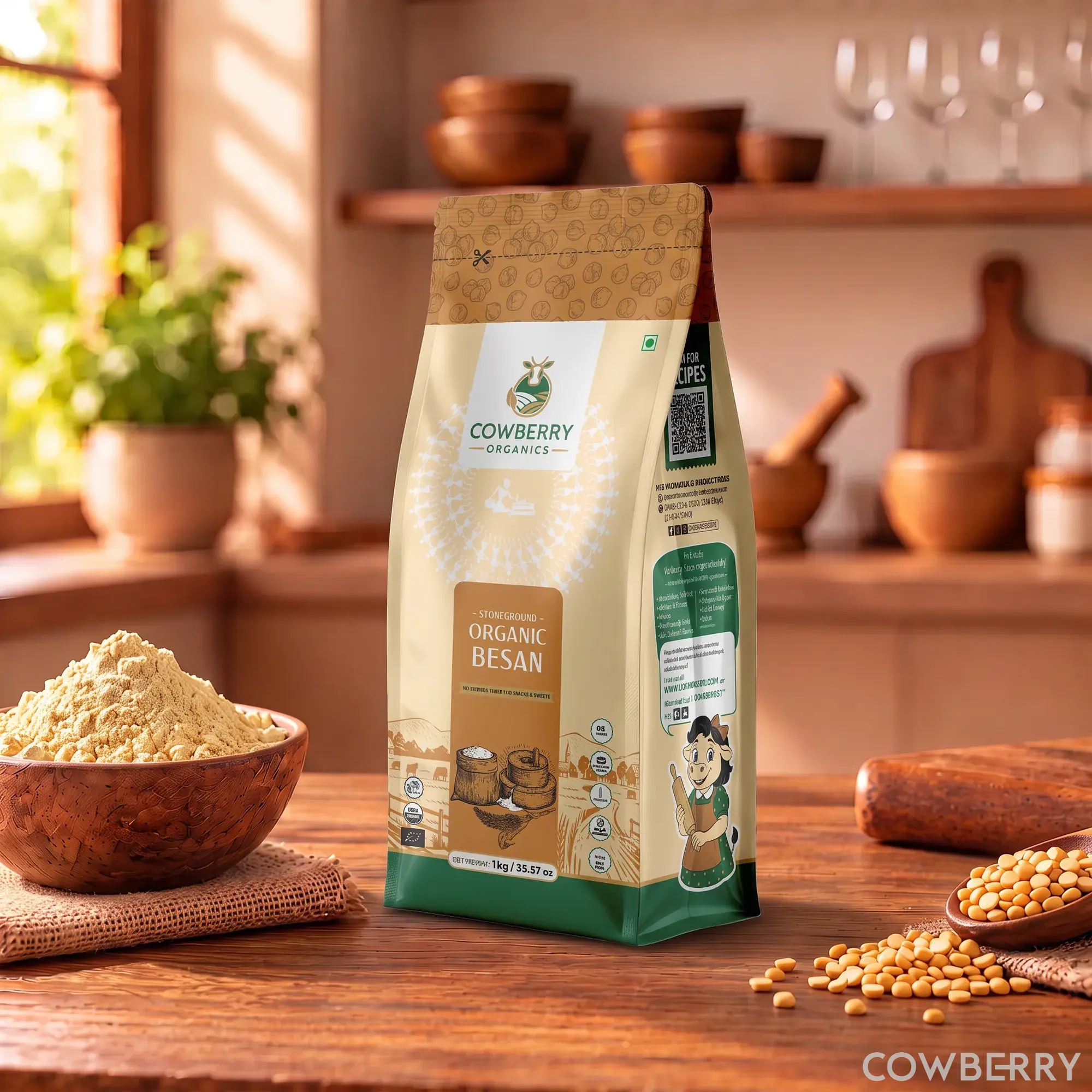
Store besan in a clean, completely dry, airtight container — steel or glass with a tight-fitting lid — on a cool, dark shelf, and dip into it only with a dry spoon. COWBERRY's own storage advice says the same in one line: store it in an airtight container in a cool, dry place, or refrigerate it in warm climates for longer freshness. The FSSAI standard for besan allows no more than 12 percent moisture in the flour as sold, so it starts dry; the jar's job is to keep damp out. How long does besan last? No one keeping time fits every batch, so beyond the date on the pack, the honest answer is the nose: fresh besan usually smells mildly nutty, and a batch that smells sharp, bitter or musty should be thrown away.
Step by step: how to store besan for long time
- Dry the container first. Wash a steel or glass jar with a lid that seals, then dry it fully; even a little water can start lumps.
- Pour the whole pack in at once. Decant the flour in one go so old and new batches do not mix in the jar.
- Pick a cool, dark spot. A closed shelf away from the stove, the steamer and the sink; heat and steam are the enemies.
- Keep one dry spoon for the jar. Never dip in with a wet or hot spoon, and never hold the jar over a steaming pan while scooping.
- In warm, humid weather, refrigerate. Keep the same sealed jar in the fridge, which should be set between 0 and 5 °C, and let the flour come back to room temperature before opening so condensation does not settle on it.
- Freeze for the long term. A freezer should be around -18 °C; pack besan in a double-sealed pouch or box and freeze in small portions.
- Buy what you will finish. A smaller pack is finished sooner than a big one opened for months; check the printed date on the pack when you buy.
- Check before each use. Smell the flour and glance for lumps, webs or insects — ten seconds that save a dish.
None of these steps carries a printed month count; the Indian dietary guidelines give the general rule for stored food grains — dry them adequately and keep them in airtight containers to protect them from moisture and from microbes like toxin-producing moulds — and a flour jar follows the same principle.
Common mistakes (and the fix)
- Wet spoon or wet jar. The fastest route to lumps and mould; dry both fully before the flour goes in.
- An open or loosely rolled pack. Moisture and pantry pests walk in; always close the pack or move the flour to a jar.
- A shelf near the stove or the sink. Heat and steam harm stored flour; the container should sit in the coolest, driest corner.
- Topping up an old tin with a new pack. The old flour stays at the bottom under each new pack; finish or clean out the tin first.
- Freezing without sealing. Flour in an open pack can pick up freezer smells; double-seal before it goes in.
- Trusting a date over the nose. Damp and heat affect flour as well as time, so a date alone does not settle it; smell the flour, and if it smells sharp or bitter, throw it out.
- Trying to cook away a bitter batch. Roasting or frying will not bring back flour whose oils have turned; a bitter smell means the batch is done.
Fridge or freezer, and how long besan lasts
Fridge or freezer, the flour stays in a sealed container — both places trade one enemy for another: the fridge's moisture and the freezer's smell pickup. The UK Food Standards Agency gives the numbers for both: a fridge should be set between 0 and 5 °C and a freezer around -18 °C. Keep the flour sealed in either. In warm, humid weather the fridge is the right home for besan, as COWBERRY advises; take out what you need and close the jar again so cold flour does not sweat. The freezer suits long gaps between uses; freeze in the portions you actually cook with.
How long does besan keep? This page gives no keeping time for besan flour, and the Food Standards Agency's guidance gives none for dry foods, so the honest rule is the smell test rather than a month count. For comparison, for plain milled pearl millet flour, a 2025 review states that milled flour cannot be kept for more than a week due to rancidity and off-flavour — that figure belongs to bajra, not besan, and it shows that milled flour can turn. Besan itself carries 6.69 g of fat per 100 g, so it can turn too; a sharp or bitter smell is the sign to throw it out, and fresh flour usually smells nutty. The full lowdown on besan, its nutrition and its cooking, sits on the hub page.
Pests and moisture: a quick checklist for the besan store
Pantry pests are the next risk, and the jar is the defence. The pulse beetle is an important pest of stored chickpeas, and a 2009 paper on chickpea notes losses of up to 30 percent within two months, with eggs cemented to the seeds and larvae burrowing inside. For flour itself the check is by eye: live insects, webs, clumps or fine powder trails mean the batch has been invaded. The FSSAI standard for besan requires the flour to be free from living insects and filth and free of any abnormal odour — the same checklist in a regulator's words.
Moisture is the other thief. The Indian dietary guidelines note that humidity, temperature and storage time influence the quality of stored food, and record that dried neem leaves placed in storage bins are known to prevent some infestations. The FAO's grain storage manual gives whole chapters to moulds and mycotoxins and to insect control in stored grain. A well-run besan store, then, is three things: a dry, sealed jar, a cool dark shelf, and a look-and-smell check before each use.
| Check | What to look for |
|---|---|
| Smell | Usually mildly nutty when fresh; sharp, bitter or musty means gone off |
| Sight | Free-flowing powder; no lumps, webs, live insects or powder trails |
| Container | Dry inside, lid sealing tight |
| Place | Cool, dark, away from stove, steamer and sink |
| Before use | Dry spoon only; smell the flour again |
For cooking with the flour once it is stored right, start with besan recipes or a quick besan chilla.
FAQs
Can we store besan in fridge?
Yes. Keep besan in its sealed, airtight jar in the fridge, which should be set between 0 and 5 °C; COWBERRY advises refrigerating in warm climates for longer freshness. The one rule: close the jar tightly so fridge moisture stays out, and let the flour come back to room temperature before you open it, so condensation does not settle on it.
Can you freeze gram flour?
Yes. Seal gram flour in a double-sealed pouch or box; a freezer should be around -18 °C. Freeze it in the portions you use in one go, press the air out, and thaw the sealed pack completely before opening so the cold flour does not draw moisture. Give it the smell check before use.
Does besan expire?
Besan can go off, but no one keeping time fits every batch, so this page gives no month figure; go by the pack date and your nose. A dry batch in a sealed jar, checked by smell before each use, keeps well; moisture, heat and pests, not a calendar, are what end it. A sharp, bitter or musty smell means the batch is past it.
Why besan taste bitter?
A bitter taste in stored besan can mean its fat has gone rancid. The flour carries 6.69 g of fat per 100 g, and rancid flour tastes and smells off; fresh besan usually smells mildly nutty instead. There is no fix, so a bitter batch should be thrown away rather than roasted or fried into a dish.
What is besan made of?
Ground dehusked Bengal gram (Cicer arietinum), per the FSSAI standard, with no added colour. Because the gram is milled to a powder, the flour keeps some fat and can turn if stored damp or warm — the reason the storage rules on this page matter. Its per-100 g figures sit on the gram flour nutrition page.
How besan is made?
The FSSAI standard describes it: dehusked Bengal gram, ground to a powder, with no added colour and no abnormal odour. The standard also caps moisture at 12 percent and requires the flour free of living insects. COWBERRY's besan is stone-ground and slow-processed to keep its natural nutty aroma.
References
- Dietary Guidelines for Indians, ICMR-National Institute of Nutrition
- FAO: Grain storage techniques, evolution and trends in developing countries
- Naraharasetti B, Chakraborty S. Thermal and nonthermal processing of pearl millet flour: impact on microbial safety, enzymatic stability, nutrients, functional properties, and shelf-life extension. Compr Rev Food Sci Food Saf, 2025
- UK Food Standards Agency: How to chill, freeze and defrost food safely
- Erler F, Ceylan F, Erdemir T, Toker C. Preliminary results on evaluation of chickpea, Cicer arietinum, genotypes for resistance to the pulse beetle, Callosobruchus maculatus. J Insect Sci, 2009
- FSSAI: Food Products Standards and Food Additives Regulations compendium (Version XXII, 02.03.2022): 2.4.4 Besan and 2.4.33 Roasted Bengal Gram Flour (Chana Sattu)
- USDA FoodData Central (SR Legacy): Chickpea flour (besan), FDC ID 174288
Shop this article
Keep reading
Green gram plant: crop, varieties and how it grows in India
Rajma vs lobia: difference, nutrition and which to choose

Rajma plant: how rajma is grown in India (it is not a tree)