by COWBERRY

6 minute read
Is besan gluten free? What to check on coeliac and gluten-free diets

Is besan gluten free? Yes: besan is ground chickpea, and chickpea is not one of the cereals that carry gluten. This page gives the reason, the one thing to check on the pack, what coeliac disease actually involves, and gluten-free ways to cook with besan. The flour itself gets its own page on the besan hub.
Short answer: is besan gluten free?
Yes. The NHS describes gluten as a dietary protein found in three types of cereal: wheat, barley and rye, and in any food that contains those cereals. Chickpea is a pulse, not a cereal, so besan milled from chickpeas contains none of it. India's food standards agree on what besan is: the FSSAI standard defines besan as the product obtained by grinding dehusked Bengal gram, with no added colouring matter, a single-ingredient description with no wheat in it anywhere. The only real-world caveat is not the flour itself but where it was milled, which this page covers below.
Why packs say naturally gluten free
Besan earns the claim from its plant, not from processing. India's claim rules say a food that is by its nature free of a specific nutrient or substance may say so only when the claim carries the word natural or naturally, as in a naturally free food. That is why a besan pack may read naturally gluten-free rather than a bare gluten-free. The label rule and the plant line up: chickpea is a pulse and wheat a cereal, and nothing in milling gram removes gluten, because there was never any to remove. A besan pack that also says 0% maida is making the same point from the wheat side, since maida is a wheat flour.
The one thing to check: shared milling lines
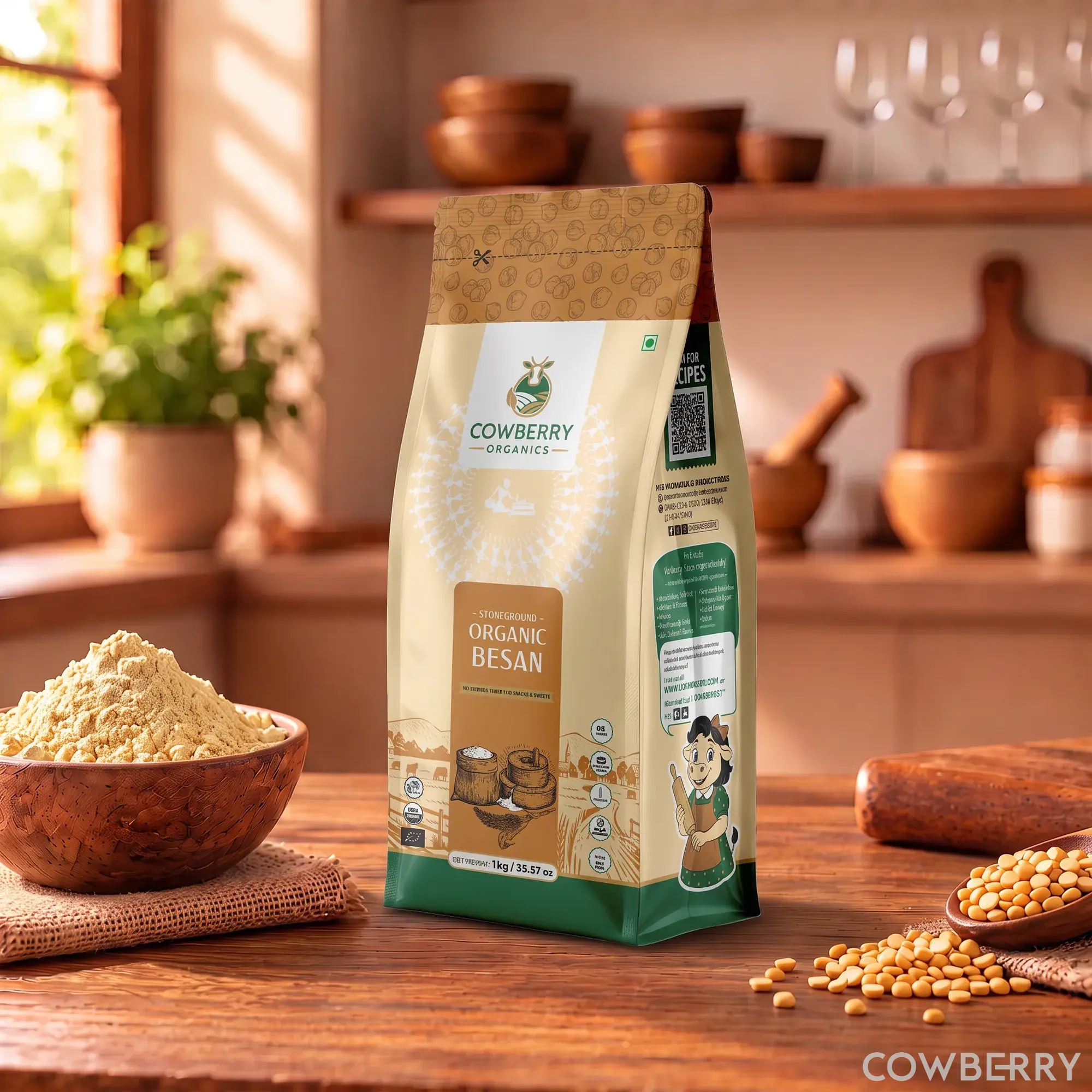
Pure besan is gluten-free; a particular pack may not be. A mill that also grinds wheat could carry traces into gram flour, so on a strict gluten-free diet the pack is worth checking. Look for a gluten-free statement or mark, and read the fine print for a shared-line warning; a 0% maida line tells you no maida was added, not how the mill runs. COWBERRY describes its besan as naturally gluten-free with 0% maida. This is a pack question, not a recipe question: no amount of home cooking removes gluten that entered at the mill.
Who this matters for: coeliac disease
The NHS describes coeliac disease as a condition where your immune system attacks your own tissues when you eat gluten, damaging the gut (the small intestine) so the body cannot properly take in nutrients. It has no medicine that removes it; the NHS says following a gluten-free diet should help control symptoms and hold off the long-term complications of the condition. First-degree relatives, parents, brothers, sisters and children, of people with coeliac disease are at increased risk and should be tested. For anyone on that diet, a naturally free flour like besan widens the menu rather than narrowing it.
Gluten-free ways to cook with besan
Besan works across a gluten-free menu because so many classic dishes never needed wheat. A besan chilla is a gram-flour pancake with vegetables; besan roti is a flatbread with no wheat in it; besan upma and besan porridge are breakfasts; besan ki sabji is a main course; kadhi is thickened with besan, not wheat; and besan barfi and halwa are sweets. None of these recipes uses wheat, barley or rye, but the upma and sabji use hing, so check that pack and every other one. Flatbreads, batters and thickeners are besan's home ground; risen loaves need other ingredients. More ideas sit in the besan recipes roundup, and the flour's full story sits on the besan hub.
Read the label on mixes, sauces and ready foods
The NHS reminds that gluten is found in any food containing wheat, barley or rye, including certain sauces and some ready meals. For a besan cook that means the flour can be right while the rest of the dish is not: a ready spice mix, a curry paste or a pack of namkeen may carry wheat flour, and a snack mix may blend besan with maida. If the comparison is the question, the besan vs maida page lays the two flours side by side. On a strict gluten-free diet, read every pack that is not a single ingredient.
Talk to your doctor
If you suspect coeliac disease, or a parent, brother, sister or child has it, the NHS points to testing as the right step, and that step belongs with your doctor, not with a new bag of flour. This page is information about besan, not a diagnosis or a diet plan for one person. If you plan to change what you eat, talk to your doctor or dietitian first.
FAQs
Does gram flour have gluten?
No. Gram flour is milled chickpea, and gluten is a dietary protein found in three cereals: wheat, barley and rye (NHS). Chickpea is a pulse, so pure gram flour contains no gluten. The only caveat is cross-contact at shared mills, which is a pack question: check the label before a strict diet.
Is gram flour grain free?
In the everyday sense, yes: gram comes from the chickpea plant, which is a pulse and not a cereal grain, and that is exactly why gram flour is gluten-free while wheat, barley and rye flours are not. The FSSAI defines besan simply as ground dehusked Bengal gram, with no added colouring matter.
Can gram flour be used to make bread?
Yes, for flatbreads: besan roti and the pancake-like chilla are made from gram flour with no wheat in them. A risen sandwich loaf is a different matter, and gluten-free loaf recipes that use besan add other ingredients for structure, so follow one written for that purpose.
Is besan gluten free?
Yes, naturally: besan is ground chickpea, and gluten lives in wheat, barley and rye, not in pulses. India's claim rules allow a food to be described as free of something by nature only with the word naturally, which is why packs read naturally gluten-free. Check the pack for a shared-milling warning, and it fits a gluten-free diet.
Can coeliac patients eat besan?
Besan made from pure chickpeas fits a gluten-free diet, the diet the NHS says helps control coeliac symptoms. The one condition is the pack: if it carries a gluten-free mark or statement and no shared-line warning, it suits that diet; if it is silent, choose one that says so, and ask your doctor or dietitian if you are unsure.
Is besan chilla gluten free?
Yes, when the flour is: a plain besan chilla is gram flour, water, vegetables and spices, with no wheat in the recipe. Keep the topping gluten-free too, since some chutneys and mixes add wheat, and it stays a gluten-free meal.
References
Shop this article
Keep reading
Green gram plant: crop, varieties and how it grows in India
Rajma vs lobia: difference, nutrition and which to choose
Rajma plant: how rajma is grown in India (it is not a tree)