by COWBERRY

6 minute read
Besan vs sattu: what is different, and which to use for what

Besan vs sattu is one pulse, two processes: besan is raw dehusked Bengal gram, ground, and sattu is the same gram roasted and then ground, each with its own FSSAI standard. This page sets the two standards side by side from besan's angle, with the data gap stated up front: we found no published nutrition figures for sattu. The besan hub covers the raw flour's wider story.
Verdict in three lines
Line one: besan is dehusked Bengal gram, ground raw — the flour of batters, kadhi and laddus. Line two: sattu is clean, washed, dried gram, roasted and then ground, so it arrives already cooked. Line three: same pulse, different process, and the difference decides the dish — besan needs cooking before it is food, sattu does not, and we found no published nutrition figures for sattu.
Besan vs sattu: side by side from the FSSAI standard
The FSSAI compendium defines both flours, and the two definitions carry the whole difference between besan and sattu in miniature. The gram flour vs sattu question is really the raw-versus-roasted question, and each column below is one clause from the standard that governs that flour.
| Point | Besan (2.4.4) | Chana sattu (2.4.33) |
|---|---|---|
| What it is | Dehusked Bengal gram, ground | Clean, washed, dried, sound gram, roasted, then ground |
| Process | Raw grinding | Roasting, then grinding |
| Moisture cap | Not more than 12 percent | Not more than 8 percent |
| Protein floor | Not less than 20 percent on a dry basis | Not less than 20 percent on a dry basis |
| Fibre | No cap printed | Crude fibre not more than 3 percent on a dry basis |
| Look and smell | No added colour, free from abnormal odours | Uniform colour, characteristic taste, smell and flavour |
| Particle size | Not printed | 100 percent passes a 35-mesh sieve |
| Freedom from pests | Free from living insects and filth | Free from insects, mould and mites |
Read down the columns and the story is consistent: besan is the raw flour, held to a 12 percent moisture cap, and sattu is the roasted one, held to 8 percent moisture and ground fine enough to pass 35 mesh. The protein floor is the one line in this table the two standards share: 20 percent on a dry basis each.
Nutrition: what is printed and what is not
Besan's figures are printed: 387 kcal, 22.4 g of protein, 6.69 g of fat, 57.8 g of carbs and 10.8 g of fibre per 100 g, from the USDA record. Sattu's are not: the flour is absent from IFCT 2017 and from the USDA records we checked, so this page gives no per-100 g figures for sattu rather than guess them. What is printed for sattu is its standard's floor — at least 20 percent protein on a dry basis — the same floor besan's standard sets. With no sattu figures to quote, the table below shows besan alone. Neither plain flour has an entry in the University of Sydney glycaemic index database, so no GI figure is given for either.
| Nutrient | Besan (gram flour) |
|---|---|
| Energy (kcal) | 387 |
| Protein (g) | 22 |
| Fat (g) | 6.7 |
| Carbohydrates (g) | 58 |
| Dietary fibre (g) | 11 |
| Iron (mg) | 4.9 |
| Calcium (mg) | 45 |
| Magnesium (mg) | 166 |
| Potassium (mg) | 846 |
| Sodium (mg) | 64 |
| Zinc (mg) | 2.8 |
| Folate (mcg) | 437 |
| Vitamin C (mg) | 0 |
Per 100 g raw, edible portion. Composition: USDA FoodData Central (SR Legacy), FDC ID 174288, NDB 16157. — means not reported. These are average values for the food; the label on a pack gives the values for that product.
Taste and use: raw flour vs roasted flour
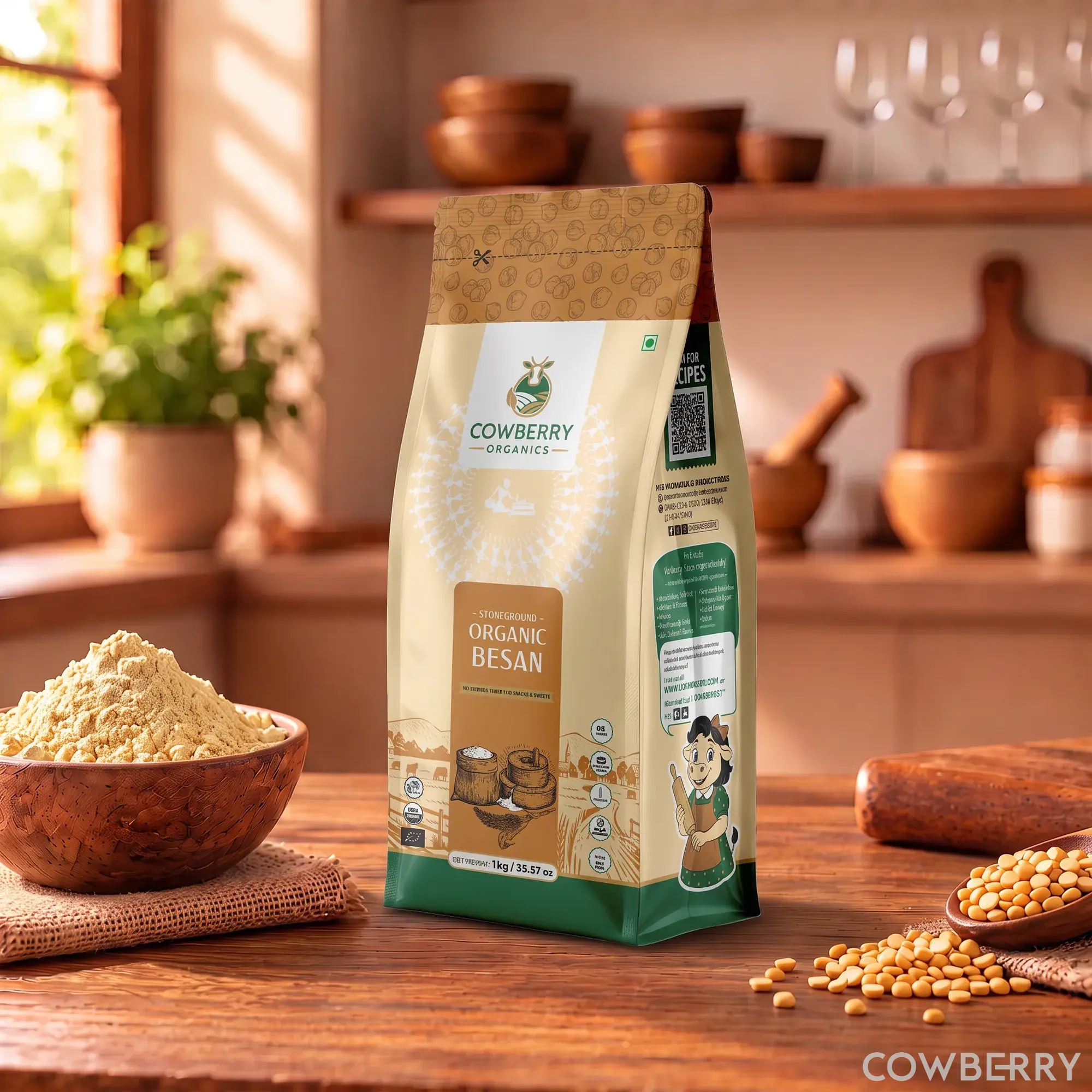
Taste is where the two standards point hardest. Besan's standard asks for freedom from abnormal odours; sattu's asks for the characteristic taste, smell and flavour of the roasted product, plus a uniform colour. In the kitchen that reads as the golden, nutty flour that must be cooked — pakoras, kadhi, laddus — against the roasted flour that is already cooked and is used as it comes, often stirred into drinks. COWBERRY lists its besan's uses — pakoras on rainy evenings, smooth kadhi, festive laddus — along with its natural nutty aroma, fine texture and golden colour. For sattu's side of the kitchen, the sattu hub covers the roasted flour's own pages.
The process difference has a practical echo: besan needs heat before it is food — raw gram flour is not eaten straight — while sattu, roasted before grinding, skips that step. That is the whole difference between gram flour and sattu in the kitchen, and the single most useful line of the comparison when you are standing in the flour aisle.
Cost and where each fits
Both are Bengal gram flours. Prices vary by brand and pack, so this page does not compare them; what decides is which flour the dish wants. Besan is the raw starting point, for every recipe that cooks the flour — chillas, pakoras, kadhi, halwa, laddus. Sattu is the finished roasted flour, for preparations that use it as it comes, with the roasting and the fine grinding already done before it reaches your kitchen. Where each fits follows from that one line, and nothing else on the shelf needs to be weighed.
Which for whom
Pick besan when the dish cooks the flour: besan chilla, pakoras, kadhi pakora, besan ke laddu, dhokla — and when you want printed nutrition, since besan's 22.4 g of protein and 10.8 g of fibre per 100 g are the only numbers this comparison has. Pick sattu when the recipe wants roasted flour used as it comes, and accept that we found no published per-100 g figures for it. Both flours share one printed floor: 20 percent protein on a dry basis, each by its own FSSAI standard. For everything else about the raw flour — storage, names, benefits — the besan hub is the index.
FAQs
Is besan and sattu same?
No. Besan is dehusked Bengal gram ground raw; sattu is clean, washed, dried gram roasted and then ground. Same pulse, different process — each has its own FSSAI standard, with besan capped at 12 percent moisture and sattu at 8 percent. Roasting is what separates them.
Difference between besan and sattu powder?
Besan powder is the raw milled dal, meant to be cooked; sattu powder is the roasted, pre-cooked gram flour used as it comes. The FSSAI standard for each prints the split: besan is dehusked gram, ground, while sattu is gram roasted and ground fine enough to pass 35 mesh.
Difference between gram flour and roasted gram flour?
Gram flour is raw ground gram — besan, in Hindi. Roasted gram flour is the same gram roasted before grinding — chana sattu, in the FSSAI standard's own name. The roast changes the taste and makes the flour ready to use without cooking; the pulse is the same.
Does besan have protein?
Yes — 22.4 g of protein per 100 g in the USDA record, and the FSSAI standard sets a floor of 20 percent protein on a dry basis. Sattu's standard carries the same 20 percent floor, though we found no published per-100 g figures for sattu.
What is besan made of?
Dehusked Bengal gram (Cicer arietinum), ground to a powder, with no added colour — the FSSAI standard in one line. Sattu starts from the same gram but is roasted before grinding, which is the whole difference between besan and sattu.
Difference between besan and sattu?
Besan is raw: dehusked Bengal gram, ground, capped at 12 percent moisture by its FSSAI standard. Sattu is roasted: sound gram, roasted, ground, capped at 8 percent moisture by its own standard. Besan must be cooked; sattu is used as it comes. Nutrition is printed for besan only.
References
- FSSAI: Food Products Standards and Food Additives Regulations compendium (Version XXII, 02.03.2022): 2.4.4 Besan and 2.4.33 Roasted Bengal Gram Flour (Chana Sattu)
- USDA FoodData Central (SR Legacy): Chickpea flour (besan), FDC ID 174288
- Indian Food Composition Tables (IFCT) 2017, ICMR-National Institute of Nutrition
Shop this article
Keep reading
Green gram plant: crop, varieties and how it grows in India
Rajma vs lobia: difference, nutrition and which to choose
Rajma plant: how rajma is grown in India (it is not a tree)