by COWBERRY

17 minute read
A2 cow ghee: what it is, how bilona ghee is made, benefits and uses

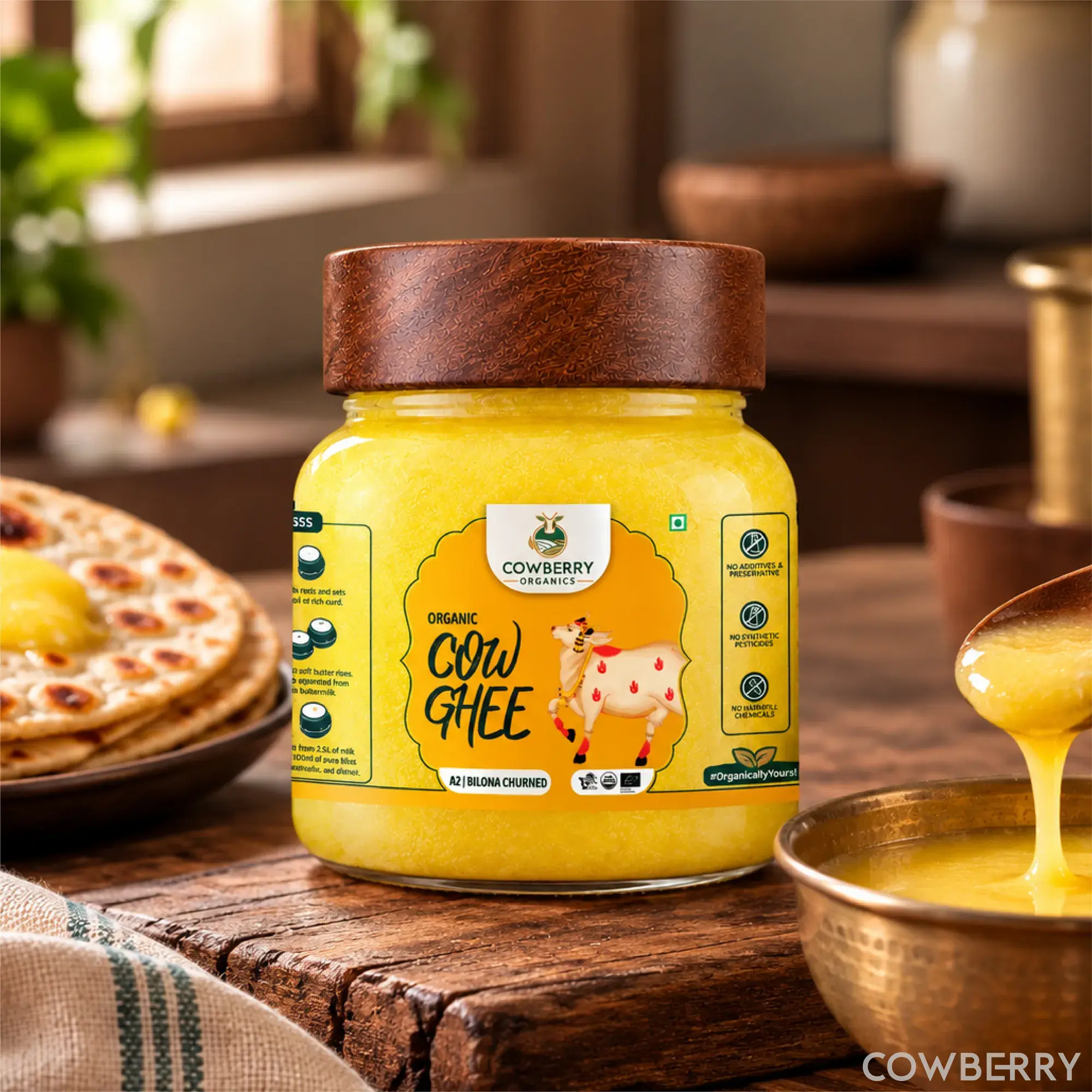
Bilona ghee is ghee made the traditional way: milk is set into curd, the curd is churned into makkhan, and the makkhan is slow-heated until golden fat is left. A2 cow ghee is ghee made from A2 cow milk, which for COWBERRY means the milk of indigenous Gir cows. Below: both words explained, nutrition per spoon, benefits, limits, uses and a buying guide.
What is bilona ghee, and what is A2 ghee?
Ghee is clarified butter: butter heated until its water boils off and its milk solids brown and settle, then strained so that only the fat is left. That fat has a high smoke point, and it keeps in a cool, dry place without a fridge. What separates one jar from another is how the butter was made in the first place.
Bilona ghee starts with milk, not cream. The milk is boiled and cooled, a spoon of culture sets it into curd overnight, and the curd is churned with a wooden churner, the bilona, until the makkhan gathers on top of the buttermilk. That makkhan is then heated slowly into ghee. Cream ghee takes a shorter path: machine-separated cream, or butter churned from it, goes straight to the pan.
A2 is about the milk, not the churning: the label names the kind of milk the ghee started from. A1 and A2 are the two main forms of beta-casein, one of the proteins in milk, and they differ by one amino acid; early Indian research at NBAGR, Karnal, found only the A2 form in milk from the country's native cows. Ghee itself keeps almost no protein. USDA FoodData Central lists 0 g protein per 100 g of ghee, since the proteins of the milk are removed along with the solids, and that entry covers ghee in general. None of the studies on our list compares A2 ghee with other ghee, so read "A2" on a jar as a statement about the milk, not a health claim.
How A2 Gir cow ghee compares with cultured, cream and other labels is a guide of its own, and so is the difference in colour between cow ghee and buffalo ghee.
Ghee names in Indian languages
The English word is the Indian one, ghee, and IFCT 2017 gives ghrita as its Sanskrit name. The same tables print ghee with its regional names: tup in Marathi, ghyo in Punjabi, ghia in Odia, tuppa in Kannada, neyyi in Telugu, nei in Tamil and neyy in Malayalam. The Tamil and Malayalam words are also spelt ney, and the Marathi one toop; those spellings are added to the table as variants. IFCT leaves the Hindi, Gujarati, Bengali, Assamese and Urdu columns blank, so the table shows a dash there instead of a guess; in everyday Hindi and Urdu the word is simply ghee.
In the market, "desi ghee" means ghee made from cow or buffalo milk fat, as against vanaspati, the partially hydrogenated vegetable fat also called vegetable ghee. "Gay ka ghee" is cow ghee and "bhains ka ghee" is buffalo ghee.
| Language | Name (romanised) |
|---|---|
| English | Ghee |
| Hindi | — |
| Marathi | Tup, Toop |
| Gujarati | — |
| Punjabi | Ghyo |
| Bengali | — |
| Odia | Ghia |
| Assamese | — |
| Kannada | Tuppa |
| Telugu | Neyyi |
| Tamil | Nei, Ney |
| Malayalam | Neyy, Ney |
| Urdu | — |
| Sanskrit | Ghrita |
| Botanical name | — |
Source: IFCT 2017 (ICMR-NIN) local-names list. — means no name recorded in the source.
Marathi ‘Toop’: spelling variant of the IFCT 2017 name ‘Tup’. Tamil ‘Ney’: spelling variant of the IFCT 2017 name ‘Nei’. Malayalam ‘Ney’: spelling variant of the IFCT 2017 name ‘Neyy’.
Ghee nutrition per 100 g and per spoon
Ghee is fat and almost nothing else. In USDA FoodData Central the entry for clarified butter (ghee) reads 900 kcal, 100 g fat, 0 g protein, 0 g carbohydrate and 0 g fibre per 100 g, and sodium, calcium and iron all come to nil. The Indian tables, IFCT 2017, carry ghee in their fatty-acid section alone and print no energy value for it, which is why the figures here are USDA's. There is no glycemic index because there is no carbohydrate.
Nobody eats 100 g at a sitting, so the useful numbers are per spoon. By ICMR-NIN's household measures, a teaspoon holds 5 g and a tablespoon 15 g. A teaspoon of ghee is therefore 45 kcal and 5 g fat, a tablespoon 135 kcal and 15 g fat, and a thin smear on a phulka, which this page takes as 3 g, about 27 kcal. The 1 spoon ghee calories page does the sums for two spoons, a roti, a pot of dal and a serving of halwa.
Set beside the two oils Indian kitchens use every day, the calorie column barely moves: mustard oil and groundnut oil are 884 kcal per 100 g against ghee's 900, a gap that disappears in a teaspoon. The difference lies in the type of fat. The ICMR-NIN guidelines place ghee with the animal foods that bring cholesterol and saturated fat, with some unsaturated fat as well, while plant foods, oils among them, have no cholesterol and supply unsaturated fat in fair measure. The table gives the per-100 g figures for all three.
| Nutrient | Cow ghee | Mustard oil | Groundnut oil |
|---|---|---|---|
| Energy (kcal) | 900 | 884 | 884 |
| Protein (g) | 0 | 0 | 0 |
| Fat (g) | 100 | 100 | 100 |
| Carbohydrates (g) | 0 | 0 | 0 |
| Dietary fibre (g) | 0 | 0 | 0 |
| Iron (mg) | 0 | 0 | 0 |
| Calcium (mg) | 0 | 0 | 0 |
| Magnesium (mg) | — | 0 | 0 |
| Potassium (mg) | — | 0 | 0 |
| Sodium (mg) | 0 | 0 | 0 |
| Zinc (mg) | — | 0 | 0 |
| Folate (mcg) | — | 0 | 0 |
| Vitamin C (mg) | 0 | 0 | 0 |
Per 100 g raw, edible portion. Composition: USDA FoodData Central (SR Legacy), FDC ID 171314, NDB 1323; USDA FoodData Central (SR Legacy), FDC ID 172337, NDB 4583; USDA FoodData Central (SR Legacy), FDC ID 171410, NDB 4042. — means not reported. These are average values for the food; the label on a pack gives the values for that product.
Ghee benefits: what the evidence supports
Ghee is a cooking fat, and its benefits come with using it by the spoon. Five are worth knowing here. The longer list, with what each study did and did not find, is on the ghee benefits page, and the same ground is covered in Hindi under ghee khane ke fayde.
It holds up at tadka heat
A high smoke point makes ghee suitable for cooking, frying and sauteing, as COWBERRY's product facts put it, and so for a tadka, a paratha or shallow frying.
It carries fat-soluble vitamins
COWBERRY lists vitamins A, D, E and K among what its ghee contains. ICMR-NIN's dietary guidelines add that fat in a meal is the vehicle for these vitamins and for carotenes and promotes their absorption, which is why a spoon of ghee, or of oil, with palak or gajar is not wasted.
It contains butyric acid
Butyric acid, a short-chain fatty acid, is on COWBERRY's list as well. Much is claimed for it, but the review in the next section finds modern studies of ghee's benefits limited, so take it as a point of interest, not a promise.
It makes a plain meal satisfying
The same guidelines note that fats add flavour and give a feeling of fullness that delays hunger. A smear on a roti or a spoon in dal does that job; it is a reason to eat ghee with the meal, not a reason to eat more of it.
Lactose and milk protein are all but gone
Clarifying removes the water and the milk solids, and the lactose and milk proteins go with them; USDA's entry shows 0 g carbohydrate and 0 g protein. People who limit milk because of lactose can usually use ghee, which COWBERRY calls generally lactose-free; with a diagnosed milk allergy, ask your doctor first.
Ghee in Ayurveda and in modern trials
A 2024 review by Kataria and Singh calls ghee one of the most important ingredients in the materia medica of Ayurveda. The reviewers read eleven classical texts and counted 774 mentions of ghee for its benefits, more than for any other milk product. They also found the texts and the laboratories looking at different things: Ayurveda gives priority to cognitive benefits, gastrointestinal health and nourishment, while recent research has concentrated on cardiovascular health, wounds and skin. Modern studies of ghee's benefits, the reviewers note, are still limited.
The modern results point both ways. A 2010 paper in AYU tested ghee on Fischer rats, a strain used as a model of inherited risk: after four weeks on a diet that was one-tenth ghee, their serum total cholesterol showed no significant change, their triglycerides went up, and liver lipid peroxidation did not rise. The authors' reading of the older studies was that ghee in moderate amounts had not been shown to harm people in general; among the things that may lie behind the rise of heart disease in Indians they named vanaspati, with its trans fats.
In people, the closest test is a 2022 randomised trial from Iran. Thirty healthy men and women included ghee or olive oil in their usual diets, in equal calories, for four weeks each. Ghee left apo B and non-HDL cholesterol higher than olive oil did. No significant difference showed up in LDL cholesterol, in the total-to-HDL ratio, or in triglycerides, glucose and insulin. For the authors, the result adds to the case for swapping fats rich in saturated fat for unsaturated ones.
That replacement is what the WHO guideline on saturated fat (2023) recommends, along with bringing saturated fat down to a tenth of the day's energy. Put together, the amount decides: the guidelines keep ghee to spoonfuls, and nothing in this evidence argues for more. Its use on the skin, as a moisturiser and not as a food, is covered under ghee benefits for skin.
Side effects of ghee: who should limit it
Five points decide who should cut back on ghee, and by how much.
- Saturated fat: the WHO guideline sets one mark for adults and children alike, saturated fat at a tenth of total energy intake, with the difference made up by polyunsaturated fat, by monounsaturated fat from plants, or by fibre-rich foods such as whole grains and pulses. ICMR-NIN's own advice is simpler: ghee or butter should stop at a teaspoon or two a day, and be left out wherever possible. Milk, paneer, curd and other milk products carry saturated fat too, so ghee should be one of the fats in the kitchen, not the only one.
- Calories: at 900 kcal per 100 g, ghee is as energy-dense as any oil. The 45 kcal in a teaspoon adds up fast in a halwa that takes several tablespoons. Anyone managing weight counts it the way they count oil.
- Cholesterol and heart disease: if a doctor has asked you to lower your cholesterol, or you have heart disease, ghee is a fat to measure, not pour: the 2022 trial saw apo B and non-HDL cholesterol rise on ghee compared with olive oil. Both sides of the evidence are on is ghee good for cholesterol.
- Milk allergy: USDA prints 0 g protein for ghee, but a diagnosed milk-protein allergy still needs a doctor's view before ghee goes on the plate.
- Babies under six months: the ICMR-NIN guidelines advise exclusive breastfeeding for the first six months; ghee can come in later, a little at a time, with the first complementary foods and after your paediatrician's advice.
Constipation is a separate question: nothing in the studies cited here links a spoon of ghee to it, and the ICMR-NIN guidelines tie regular bowels to fibre and fluids. If you are pregnant, on a medical diet, taking cholesterol medicine or managing diabetes, please talk to your doctor or dietitian before ghee becomes an everyday habit.
How to use ghee: tadka, roti, rice and sweets
Ghee does three jobs in an Indian kitchen: it carries the aromatics of a tadka, it finishes a plain staple, and it binds and browns sweets.
Tadka: heat a teaspoon of ghee until it shimmers, add cumin, a pinch of hing and a dried chilli, let them crackle for a few seconds and pour the lot over dal, kadhi or rasam. Its high smoke point suits that heat.
Roti, rice and khichdi: a thin smear on a hot phulka, or a small spoon stirred into hot rice with dal or into khichdi, is a common way to eat it. For a child past six months, the ICMR-NIN guidelines recommend adding foods such as oil or ghee to make the family diet more nutrient-dense, and their sample diet charts for infants measure it by the teaspoon; begin only after your paediatrician's advice.
Sweets: in laddus and halwas ghee is the structure, not the seasoning. Roasted flour, ghee and jaggery make ragi laddu and besan ke laddu; moong dal soaked, coarsely ground and slow-roasted in ghee makes moong dal halwa, and wheat flour roasted in ghee makes atte ka halwa.
Frying: puris, parathas and shallow-fried tikkis all work in ghee, and the flavour is the point; keep deep frying in ghee for occasions, because of the quantity involved. When an oil is the better choice, and how ghee differs from butter, is set out under ghee vs oil, and the butter and ghee difference.
How bilona ghee is made, step by step
Bilona is the name of the wooden churner and, by extension, of the method. Every step is slow, and the slowness is the product.
- Set the curd. Milk is brought to a boil, left to cool to lukewarm, cultured with a spoon of the previous day's curd and kept overnight until it sets into dahi.
- Churn. In the morning the curd is churned, traditionally with the bilona turned by a rope pulled back and forth, until grains of makkhan gather and float on the buttermilk. The chaas that is left is drunk, not thrown away.
- Wash the makkhan. The butter is lifted out and rinsed in cold water so that no buttermilk is left in it to turn sour.
- Heat slowly. The makkhan goes into a heavy pan on a low flame. It foams as the water boils off, then quietens as the milk solids turn golden and sink. When the foam settles, the fat turns clear and the kitchen smells nutty, the flame goes off.
- Strain and rest. The ghee is strained through muslin into a clean, dry jar and left to cool undisturbed. The browned solids left in the pan are eaten with sugar or jaggery.
Cream ghee leaves out the curd: the cream is separated from the milk by machine and heated into ghee, which is faster. Either way, many litres of milk go into every kilo of ghee.
COWBERRY makes its A2 cow ghee by the bilona route. The milk is the A2 milk of indigenous Gir cows kept on the grasslands of Gujarat, where cow-based farming is the practice; it is cultured to curd and hand-churned slowly in small quantities, and the butter is heated gently. Nothing else goes in: no additives, no preservatives.
How to store ghee
Ghee keeps in the cupboard and does not need the fridge. A clean, dry glass or steel jar with a tight lid, on a cool, dark shelf away from the stove and out of direct sun, is in line with COWBERRY's storage advice for its own ghee.
Cold makes ghee grainy and firm, heat makes it clear and liquid; both are normal. Ghee that has gone off smells sharp and rancid, or shows specks of mould. Throw it out; reheating does not rescue it.
How to buy A2 cow ghee: what to look for
Milk source: the label should say cow ghee or buffalo ghee and, for an A2 ghee, name the breed. Colour is a first check. When researchers at the National Dairy Research Institute in Karnal measured the two in 2022, cow ghee scored far higher on yellowness and buffalo ghee far higher on whiteness, and the whiteness index was one of the two measures that could tell them apart. A very pale jar sold as cow ghee deserves a question.
Method: "bilona", "cultured" or "curd-churned" on the label points to the curd route, and "cream" to the cream route. Both are ghee, but they are different products and should not be confused.
Ingredient list: one line, milk fat from the stated animal, and nothing else. Begum and Jain's 2024 review of adulteration reports that ghee is repeatedly found mixed with animal fats, synthetic materials or vanaspati, and the ICMR-NIN guidelines advise buying ghee from reliable sources only. The one home test, for added starch, and what it cannot catch have a page to themselves, how to check ghee purity.
Certification: if you want organic ghee, look for a certification on the pack, not just the word. COWBERRY's A2 cow ghee is India Organic, USDA & EU certified, and its product facts say the cows graze on certified chemical-free grasslands and are fed chemical-free fodder. Words such as "pure", "desi" and "natural" are descriptions, not certifications.
Pack and date: a recent packing date, a jar that closes tight, and a size you will finish in a season.
COWBERRY's A2 cow ghee answers the first two questions plainly: the milk of Gir cows, and the bilona method.
More on ghee
Many questions about A2 ghee are really questions about ghee in general. These pages cover the A2 label, the numbers and ghee in the kitchen.
- A2 ghee benefits and side effects: what the ghee studies support and what the A2 label adds.
- A2 ghee vs normal ghee: what differs in the milk, what stays the same in the jar, and what the studies say.
- Desi ghee nutrition per 100 g, what each spoon adds, and ghee beside mustard and groundnut oil.
- Desi ghee in English and in Indian languages, with what desi, pure and A2 mean on a label.
- How to make A2 ghee at home the bilona way, from curd to butter to ghee.
- How to make desi ghee from butter, with the foam, colour and smell cues.
- Ghee instead of butter: the swap on roti and toast, in tadka and in baking.
- Ghee in pregnancy: what WHO and ICMR-NIN guidance says about visible fat, and when to ask your doctor.
FAQs
What is A2 ghee?
A2 ghee is ghee made from A2 cow milk, milk whose beta-casein protein is the A2 type rather than A1; COWBERRY's comes from indigenous Gir cows raised in Gujarat. Ghee keeps almost no protein, 0 g per 100 g in USDA's table, and none of the trials we cite sets A2 ghee against ordinary ghee. So the label tells you where the milk came from, not a health difference anyone has measured.
Is A2 ghee better?
No study on our list shows that it is. USDA's entry covers ghee in general, so an A2 ghee and any other cow ghee count the same 45 kcal and 5 g fat per teaspoon. What an A2 bilona label does tell you is the kind of milk and the method, which is useful to know about the source but is not a health claim. Whether ghee suits you at all is covered under ghee benefits.
How is bilona ghee different from regular ghee?
Bilona ghee is churned from curd, while cream ghee skips the curd and starts from cream. For bilona ghee, milk is set into curd, the curd is churned into butter, and the butter is slow-heated. COWBERRY credits the bilona method with a rich aroma and texture; the USDA entry makes no distinction between methods, so both count the same calories.
Does ghee have cholesterol?
Yes. Only foods of animal origin contain cholesterol, and ghee is one of them: the ICMR-NIN guidelines name butter, ghee, whole milk and cream together as sources of cholesterol and saturated fat. For blood cholesterol, the fat that the WHO guideline asks people to cut is saturated fat, by replacing part of it with unsaturated fat. The evidence and the amounts are on the is ghee good for cholesterol page.
Can we use ghee instead of butter?
Yes, in most Indian cooking. Ghee is butter cooked until its water has gone and its milk solids have been strained off, leaving pure fat with a high smoke point that suits cooking, frying and sauteing. Laddus, halwa and parathas take to ghee easily; the butter and ghee difference is set out under ghee vs oil.
Is ghee good for pregnancy?
Only in small amounts. For pregnancy the ICMR-NIN guidelines ask for visible fat, ghee included, to be restricted, and for the baby's higher fat needs to be met from oilseeds, nuts, beans and fish. Their everyday limit on ghee still applies: no more than a teaspoon or two a day, and none where you can do without, so pregnancy is no reason to eat more. For a diet plan of your own, please talk to your doctor or dietitian.
Is A2 cow ghee lactose-free?
Generally, yes. COWBERRY's product facts describe ghee as generally lactose-free, since the milk solids are removed during clarification and the lactose goes with them. Generally is not the same as always, so with a diagnosed milk allergy, or if small amounts of lactose trouble you, ask your doctor or dietitian before using ghee.
References
- USDA FoodData Central
- Indian Food Composition Tables (IFCT) 2017, ICMR-National Institute of Nutrition
- Dietary Guidelines for Indians, ICMR-National Institute of Nutrition
- WHO guideline: saturated fatty acid and trans-fatty acid intake for adults and children (2023)
- Kataria D, Singh G. Health benefits of ghee: review of Ayurveda and modern science perspectives. J Ayurveda Integr Med, 2024
- Sharma H, Zhang X, Dwivedi C. The effect of ghee (clarified butter) on serum lipid levels and microsomal lipid peroxidation. AYU, 2010
- Mohammadi Hosseinabadi S, Nasrollahzadeh J. Effects of diets rich in ghee or olive oil on cardiometabolic risk factors in healthy adults: a two-period, crossover, randomised trial. Br J Nutr, 2022
- Mor S, Sharma V, Arora S et al. Physico-chemical and color parameters to distinguish cow ghee from buffalo ghee. J Food Sci Technol, 2022
- Begum A, Jain BP. Adulteration in edible oil (mustard oil) and ghee; detection and their effects on human health. Int J Biochem Mol Biol, 2024
- Sodhi M, Mukesh M, Kataria RS, Mishra BP, Joshii BK. Milk proteins and human health: A1/A2 milk hypothesis. Indian J Endocrinol Metab, 2012
- Brooke-Taylor S, Dwyer K, Woodford K, Kost N. Systematic review of the gastrointestinal effects of A1 compared with A2 beta-casein. Advances in Nutrition, 2017
Shop this article
Keep reading
Cold pressed oil benefits: why they survive processing better
Mustard oil vs refined oil: nutrition, cooking and which to choose
Mustard oil omega 3: nutrition, calories and fat per 100g