by COWBERRY

6 minute read
Ghee in pregnancy: is it safe, how much and what guidance says

Ghee in pregnancy is safe as a small everyday fat, and no guidance asks for more of it: WHO's antenatal-care advice is about a varied diet and avoiding excess weight gain, while ICMR-NIN's guidelines say visible fat should be restricted during pregnancy and the extra fat needs met from oilseeds, nuts, beans and fish. A teaspoon (5 g) is 45 kcal. The bilona ghee guide covers the food itself.
Short answer: is ghee good in pregnancy?
Safe in everyday amounts, and no guidance asks a pregnant woman to eat more of it. The claim that ghee is good for pregnancy in some special way appears in neither the WHO nor the ICMR-NIN guidance; what appears is restraint. Ghee is pure fat: 100 g of fat and 900 kcal per 100 g, 45 kcal a teaspoon, with 0 g of protein, 0 mg of iron and nothing else the pregnancy guidance names. The WHO's antenatal-care recommendations are about a varied diet and avoiding excessive weight gain, and the ICMR-NIN guidelines say visible fat, ghee included, should be restricted during pregnancy. A teaspoon in the usual dal or khichdi is ordinary; doubling the ghee "for the baby" is in neither.
What the guidance actually says about ghee in pregnancy
The WHO recommendation on antenatal care (2016) says counselling about healthy eating and keeping physically active is recommended for pregnant women to stay healthy and to avoid excessive weight gain during pregnancy. Its picture of a healthy diet is adequate energy, protein, vitamins and minerals from a variety of foods: green and orange vegetables, meat, fish, beans, nuts, whole grains and fruit. Ghee appears in none of those lists.
The ICMR-NIN dietary guidelines say the same thing from the fat side. During pregnancy and lactation, the intake of oilseeds, nuts, beans and fish must be encouraged, while visible fat should be restricted and trans fatty acids avoided. They add a line worth keeping: there is no need to avoid any specific food based on wrong food beliefs and taboos. Ghee is neither a required pregnancy food nor a forbidden one; it is a visible fat, and the rule for visible fat in pregnancy is restraint. What the ghee itself is, the bilona ghee guide explains.
How much ghee in pregnancy: teaspoons and the 20 ml
The pregnancy diet chart in the ICMR-NIN guidelines (Figure 2.2, for a normal pregnancy) prints cooking oils and fats at 20 ml a day, next to cereals at 240 g, pulses at 80 g, nuts and oilseeds at 40 g and vegetables at 300 g. That 20 ml is the oils-and-fats line of the normal-pregnancy chart, not the general adult fat limit. In spoon terms, the everyday rule still applies: no more than 1 to 2 teaspoons of ghee or butter a day, or none, if possible.
Measured, a tablespoon (15 g) is 135 kcal, a teaspoon (5 g) is 45 kcal and two teaspoons come to 90 kcal. The second and third trimesters add 350 kcal a day to the diet (ICMR-NIN), and the guidelines are explicit that this energy should come from micronutrient-dense foods and not from foods containing only calories; ghee is 100 g of fat per 100 g, so it is the taste, not the answer to those 350 kcal.
Better and worse ways to eat ghee during pregnancy
Better: the usual teaspoon in dal, sabzi or khichdi; a smear on a roti, the desi ghee roti way; ghee in a meal that already carries vegetables and pulses, which is where the pregnancy nutrients are. One job the guidelines give fats is helping the body absorb the fat-soluble vitamins A, D, E and K, so the ghee in a carrot-and-dal dish is doing that job. Worse: doubling the ghee as a "strength food", ghee-soaked parathas and sweets as a daily habit, and ghee in sweetened milk every night. The WHO's saturated-fat guideline asks adults to keep saturated fat to 10% of total energy intake, and ICMR-NIN restricts added sugar to less than 5% of daily energy in pregnancy; both lines point away from ghee-plus-sugar routines.
What the evidence does not say
The honest part is what is missing. A 2024 review found that modern research on ghee has concentrated on cardiovascular health and skin; pregnancy is not among the areas it names. A 2022 controlled trial relevant to the fat question, a four-week crossover in 30 healthy adults, compared ghee with olive oil on cardiometabolic markers, and pregnant women were not its subjects. So the amount rests on the antenatal and dietary guidance, not on a study of ghee in pregnancy.
Talk to your doctor or dietitian
Ghee in pregnancy is settled by three numbers that only your care team has: your weight-gain target for your own body mass index, your allowed grams of visible fat a day, and whether gestational diabetes or your lipid values change either. WHO antenatal care recommends counselling on healthy eating and physical activity during pregnancy, so take the teaspoon question to those visits. Talk to your doctor or dietitian, and follow their amount over any family advice.
FAQs
Is ghee good for pregnancy?
Safe, and not required: neither WHO nor ICMR-NIN guidance asks a pregnant woman to eat more ghee. It is a visible fat, and the ICMR-NIN pregnancy rules say visible fat should be restricted while oilseeds, nuts, beans and fish meet the higher fat needs. A teaspoon (5 g, 45 kcal) in the daily dal is ordinary; more is not supported by either.
Can i eat ghee during pregnancy?
Yes, in everyday measured amounts: the ICMR-NIN rules restrict visible fat in pregnancy, they do not ban ghee, and they add that no specific food needs avoiding because of food beliefs and taboos. Keep it to the general 1 to 2 teaspoons a day, or none, if possible, and count it inside the day's fat.
How to eat ghee in pregnancy?
The usual ways, measured: a teaspoon in dal, sabzi or khichdi, a smear on a roti, ghee inside a meal that carries vegetables and pulses. The pregnancy chart prints cooking oils and fats at 20 ml a day, and the everyday rule for ghee or butter stays 1 to 2 teaspoons a day or none, if possible; skip the ghee-and-sugar routines.
Should i eat desi ghee in pregnancy third trimester?
The fat guidance does not change in the third trimester: the 350 extra daily calories of the second and third trimesters are meant to come from micronutrient-dense foods, not from foods containing only calories, and ghee is pure fat. The 20 ml oils-and-fats line and the 1 to 2 teaspoon rule stay the same right through the third trimester.
Are there benefits of ghee during pregnancy?
The guidelines record one benefit that fits ghee: fats help the body absorb the fat-soluble vitamins A, D, E and K, so a teaspoon in a vegetable dal helps the meal's vitamins along. Beyond that, neither guideline names a pregnancy-specific benefit of ghee, and ghee itself adds no protein or iron.
Can ghee cause constipation?
None of the pregnancy guidance links ghee to constipation. The ICMR-NIN guidelines answer constipation in pregnancy with fibre-containing foods, whole grain cereals, pulses and vegetables, plus enough fluids, and ghee appears in neither that answer nor any caution. If constipation is the worry, start with fibre and fluids, and ask your doctor if it persists.
References
- WHO recommendations on antenatal care for a positive pregnancy experience (2016)
- Dietary Guidelines for Indians, ICMR-National Institute of Nutrition
- WHO guideline: saturated fatty acid and trans-fatty acid intake for adults and children (2023)
- Mohammadi Hosseinabadi S, Nasrollahzadeh J. Effects of diets rich in ghee or olive oil on cardiometabolic risk factors in healthy adults: a two-period, crossover, randomised trial. Br J Nutr, 2022
- Kataria D, Singh G. Health benefits of ghee: review of Ayurveda and modern science perspectives. J Ayurveda Integr Med, 2024
- USDA FoodData Central (SR Legacy): Butter, Clarified butter (ghee), FDC ID 171314
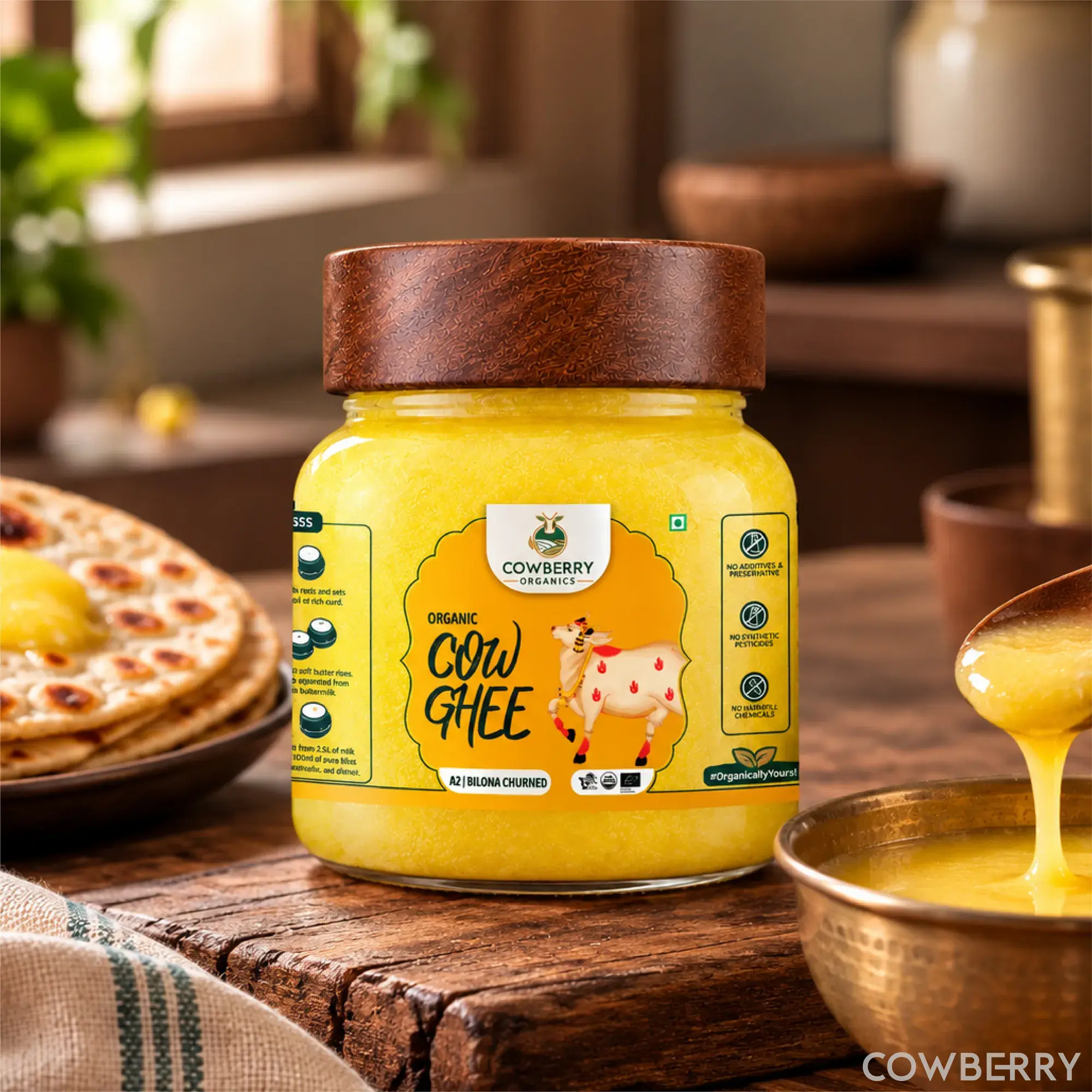
Shop this article
Keep reading
Cold pressed oil benefits: why they survive processing better
Mustard oil vs refined oil: nutrition, cooking and which to choose
Mustard oil omega 3: nutrition, calories and fat per 100g