by COWBERRY

9 minute read
A2 ghee benefits and side effects: what the research supports

A2 ghee benefits, honestly stated: the ghee research supports a handful of modest findings — a 2024 review lists what Ayurveda and modern studies each emphasise — and the A2 part itself rests on early milk studies rather than on ghee research. Here are the benefits with their sources, the side effects, and the amount that fits the guidelines; the bilona ghee guide covers the ghee itself.
A2 ghee health benefits, tied to what ghee actually is
Measured energy, 900 kcal per 100 g
Ghee is a fat, and its first benefit is the measured one: 900 kcal per 100 g (USDA FoodData Central), 45 kcal a teaspoon and 135 kcal a tablespoon. The ICMR-NIN guidelines note that each gram of fat gives 9 kcal against 4 kcal for protein or carbohydrate, and that fats contribute energy, texture, flavour and taste. For a meal that has to carry a long day, a measured spoon of ghee is dense, counted energy; it is never free energy.
Fat that goes with the meal's fat-soluble vitamins
Ghee itself carries 0 mg of vitamin C per 100 g, and no B-vitamin or folate values (USDA FoodData Central); IFCT 2017 carries no vitamin values for ghee either. Its vitamin role sits one step removed: the ICMR-NIN guidelines state that fats promote absorption of the fat-soluble vitamins A, D, E and K, so the ghee in a dal or sabzi may help the body absorb the meal's own fat-soluble vitamins. Ghee here is a fat that goes with the vitamins on the plate, not a source of them.
Fullness that delays the onset of hunger
The same guidelines record that fats bring a sense of fullness and satisfaction, and in that way they delay the onset of hunger. This is a property of fats in general, and it holds for fats in general; the calorie side of the same spoon is on desi ghee for weight loss.
A high smoke point for the hot pan
COWBERRY describes its A2 ghee as holding a high smoke point and suiting cooking, frying and sauteing, which is what makes ghee a workable cooking fat. For how it swaps into baking, see can we use ghee instead of butter.
What the ghee studies support: lipids, weight and the reviews
One finding in the literature is historical: a 2024 review counted ghee's mentions in eleven important Ayurveda texts and found 774 mentions among 2913 therapeutic mentions of milk products, the highest of any milk-based product, grouped by the authors into 15 benefit clusters (Kataria and Singh, Journal of Ayurveda and Integrative Medicine). Ayurveda prioritized cognitive benefits, gastrointestinal health and nourishing, while the same review found modern research (1990 to 2023) concentrated on cardiovascular health and skin health, and that modern studies of ghee's functional benefits are limited.
Two human studies then pull in opposite directions. A 2022 study in Bioinformation tracked fasting serum lipids in healthy volunteers before and after cow ghee and found total cholesterol and LDL-cholesterol significantly decreased, with its other parameters unchanged and no significant change in its normolipidaemia group. A 2022 crossover trial published in the British Journal of Nutrition found the opposite on two markers: over four weeks, ghee diets pushed fasting apo-B and non-HDL cholesterol upward in 30 healthy adults relative to olive-oil diets, while fasting and post-meal glucose, insulin and body weight did not differ. Read together, they show a mixed picture rather than a settled one.
The animal evidence is cautionary, not a verdict. A 2010 study in AYU fed Fischer inbred rats a diet with 10 percent ghee for four weeks: serum total cholesterol showed no significant change, triglycerides rose, and liver microsomal lipid peroxidation was not increased. The same paper closes with the literature reading that the available data do not support a conclusion of harmful effects of the moderate consumption of ghee in the general population.
What the A2 label adds, and what it does not
The A2 story is about the milk, not the jar. Beta-casein makes up about 30 percent of the protein in cow's milk (a 2017 systematic review in Advances in Nutrition), and its A1 and A2 forms differ at position 67 of the protein chain: histidine in A1, proline in A2. A 2012 paper in the Indian Journal of Endocrinology and Metabolism adds that twelve genetic variants of beta-casein are known, with A1 and A2 the most common, and reports initial studies in which Indian native dairy cows and buffalo carried only the A2 form; it calls for deeper research. The 2017 review further notes that an EFSA review from 2008 saw no convincing evidence of physiological effects in humans, and classes the human clinical evidence as emerging, from one clinical study on intestinal transit and two on stool consistency; it also discloses that three of its authors had ties with the a2 Milk Company or the A2 Corporation: consulting or support.
None of it reaches the ghee jar as nutrition. The USDA ghee entry lists 0 g of protein per 100 g, 900 kcal and 100 g of fat per 100 g, and none of the references records a difference between A2 ghee and normal ghee. The A2 label is about the milk and the method, not a different fat; the a2 ghee vs normal ghee page works through the comparison.
A2 ghee side effects: saturated fat, calories and who should limit it
ICMR-NIN's limit is 1 to 2 teaspoons of ghee a day. The side effects worth knowing are on the fat side, saturated fat and calories, and both add up with the amount.
- Saturated fat and blood lipids. The ICMR-NIN guidelines describe what saturated fatty acids do to the body: they raise serum total and LDL-cholesterol, increase inflammation, cut insulin sensitivity and lift the risk of heart attack and stroke; the same guidelines also place ghee among the animal foods whose fat brings cholesterol and saturated fatty acids into the diet. In the 2022 crossover trial, the weeks on ghee lifted fasting apo-B and non-HDL cholesterol above the olive-oil weeks.
- The WHO's line. The WHO's 2023 guideline recommends that adults and children keep saturated fatty acids within 10 percent of total energy (a strong recommendation), with a further cut below that suggested as conditional. Ghee's saturated fat counts inside that line like any other.
- The calorie side. 45 kcal a teaspoon is small only until the spoons add up: an extra teaspoon daily comes to 315 kcal over a week, and extra ghee behaves like extra fat anywhere.
- High use and reheating. ICMR-NIN counts saturated-fat use as high when more than 10 g of visible saturated fat comes from ghee or butter over the day (on a 2000 kcal diet), and the guidelines warn that cooking oils heated again and again form harmful oxidative (polar) compounds and must be avoided.
If you manage cholesterol, diabetes or heart disease, talk to your doctor or dietitian about how much ghee fits your eating plan before making it a daily habit.
How much a2 ghee per day: the guideline amounts
ICMR-NIN advises limiting ghee or butter to just 1 to 2 teaspoons over the day, or avoiding it, if possible. Measured, that is 5 to 10 g: one teaspoon (5 g) is 45 kcal, two teaspoons (10 g) are 90 kcal, and a tablespoon (15 g) is 135 kcal, so one tablespoon is already more than the whole day's ghee. Ghee sits inside the day's visible-fat count too: the guidelines put total visible fat for the day between 20 and 50 g, and sedentary adults sit at the lower end, 20 g for women and 30 g for men; ghee counts as visible fat, so the ghee in a tadka belongs in that count along with the oil. The whole spoon arithmetic is on the 1 spoon ghee calories page.
How to eat a2 ghee: the measured ways
Four recipes on this site use it as the lead: desi ghee roti, a teaspoon brushed on a hot roti; desi ghee churi, crumbled rotis mixed with warm ghee and jaggery powder; motichoor ladoo, boondi ladoos fried in ghee; and ghee rusk, an eggless twice-baked rusk. The measured everyday ways — tadka, khichdi, warm water, tea — are on desi ghee how to eat, and the per-100 g numbers behind each spoon are on desi ghee nutrition. How the ghee itself is made, its types and buying notes are in the bilona ghee guide.
FAQs
Is a2 ghee good for health?
In measured amounts, as a fat with a job: a teaspoon in dal or on roti, inside the ICMR-NIN limit of 1 to 2 teaspoons a day, or avoid it, if possible. The reading of the research is mixed: one 2022 study reported lower total and LDL-cholesterol after ghee in healthy volunteers, another found higher apo-B and non-HDL cholesterol against olive oil. Health comes from the whole plate, not from adding ghee.
What is a2 ghee good for?
Measured energy (45 kcal a teaspoon), fat that, per ICMR-NIN, promotes absorption of fat-soluble vitamins A, D, E and K, and hot-pan cooking: COWBERRY's product facts give its A2 ghee a high smoke point, suiting cooking, frying and sauteing. What it is not good for: being a protein or vitamin source, since the USDA ghee entry lists 0 g of protein per 100 g and no B-vitamin or folate values.
Does a2 ghee increase cholesterol?
The evidence is mixed rather than one-way. A 2022 crossover trial saw fasting apo-B and non-HDL cholesterol higher on ghee than on olive oil in 30 healthy adults, while a 2022 study in Tirupati found total cholesterol and LDL-cholesterol significantly lower after ghee in healthy volunteers. ICMR-NIN also counts ghee among sources of cholesterol and saturated fatty acids; ask your doctor to read the rest. The is ghee good for cholesterol page has the full fat picture.
Is a2 ghee good for diabetes?
Ghee itself adds no glucose: 0 g of carbohydrate per 100 g and no GI figure. But it does add 45 kcal a teaspoon and saturated fat, which the ICMR-NIN guidelines link to reduced insulin sensitivity. ICMR-NIN's general limit is 1 to 2 teaspoons a day, or avoid it if possible; ask your doctor what amount suits your diabetes plan. The full detail is on the is a2 ghee good for diabetes page.
Does a2 ghee have omega 3?
No published figure gives ghee an omega-3 value per 100 g. In the ICMR-NIN guidelines the plant n-3 list runs walnuts, flax seeds, chia seeds, soyabean, fenugreek seeds, mustard and green leafy vegetables — ghee is absent from it. Ghee sits on the saturated-fat side, not the omega-3 side.
Which a2 ghee is best?
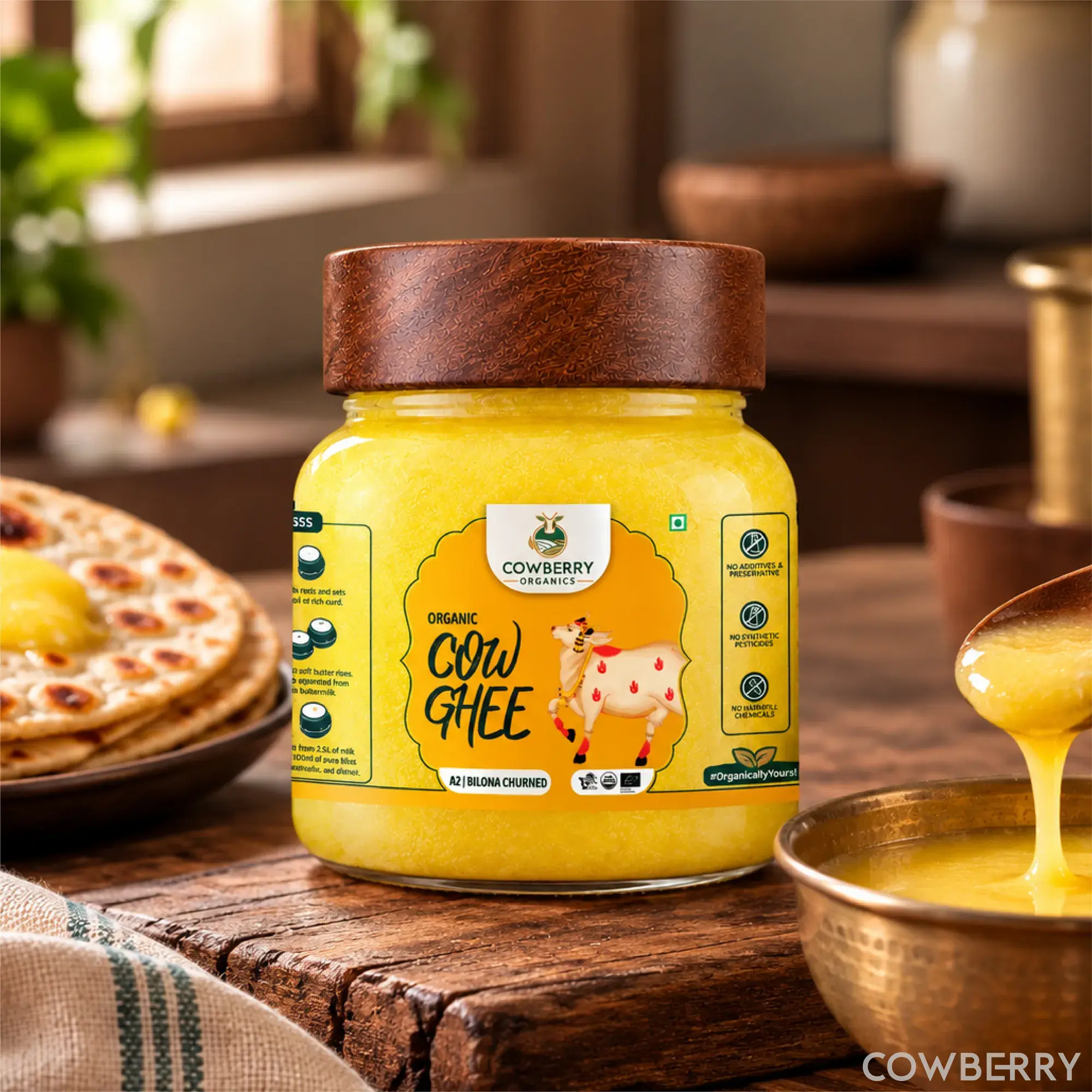
Neither USDA nor IFCT 2017 ranks ghees, so no honest answer picks one. The checks you can make are printed on the label: the milk source, the method (bilona churning from cultured curd), and whether the pack carries an organic certification mark. COWBERRY's A2 ghee is bilona-made from the milk of Gir cows in Gujarat; the a2 gir cow ghee guide compares the kinds.
References
- Dietary Guidelines for Indians, ICMR-National Institute of Nutrition
- WHO guideline: saturated fatty acid and trans-fatty acid intake for adults and children (2023)
- Mohammadi Hosseinabadi S, Nasrollahzadeh J. Effects of diets rich in ghee or olive oil on cardiometabolic risk factors in healthy adults: a two-period, crossover, randomised trial. Br J Nutr, 2022
- Kataria D, Singh G. Health benefits of ghee: review of Ayurveda and modern science perspectives. J Ayurveda Integr Med, 2024
- Munisekhar K, Singh MSB, Rao PS et al. Lipid profile in healthy human volunteers before and after consuming ghee. Bioinformation, 2022
- Sharma H, Zhang X, Dwivedi C. The effect of ghee (clarified butter) on serum lipid levels and microsomal lipid peroxidation. AYU, 2010
- Sodhi M, Mukesh M, Kataria RS, Mishra BP, Joshii BK. Milk proteins and human health: A1/A2 milk hypothesis. Indian J Endocrinol Metab, 2012
- Brooke-Taylor S, Dwyer K, Woodford K, Kost N. Systematic review of the gastrointestinal effects of A1 compared with A2 beta-casein. Advances in Nutrition, 2017
- USDA FoodData Central (SR Legacy): Butter, Clarified butter (ghee), FDC ID 171314
Shop this article
Keep reading
Cold pressed oil benefits: why they survive processing better
Mustard oil vs refined oil: nutrition, cooking and which to choose
Mustard oil omega 3: nutrition, calories and fat per 100g