by COWBERRY

8 minute read
A2 ghee vs normal ghee: what differs and what the studies say

A2 ghee vs normal ghee in one line: the difference is in the milk, not in the fat. A2 names the beta-casein of the milk it came from, and ghee's table entry shows 0 g of that protein per 100 g, so the two sit in one composition entry: 900 kcal and 100 g of fat per 100 g. The bilona ghee guide covers A2 ghee itself.
A2 ghee vs normal ghee: verdict in three lines
The difference is in the milk. A1 and A2 are two forms of beta-casein, a milk protein; normal milk is often a mix, and A2 milk carries only the A2 form. Ghee is the fat of that milk, and its table entry shows 0 g of protein.
The fat is the same. The composition tables print one entry for cow ghee: 900 kcal and 100 g of fat per 100 g, 0 g of protein. The tables list no A2 ghee and no A1 ghee separately, because what ends up in the jar is the same fat.
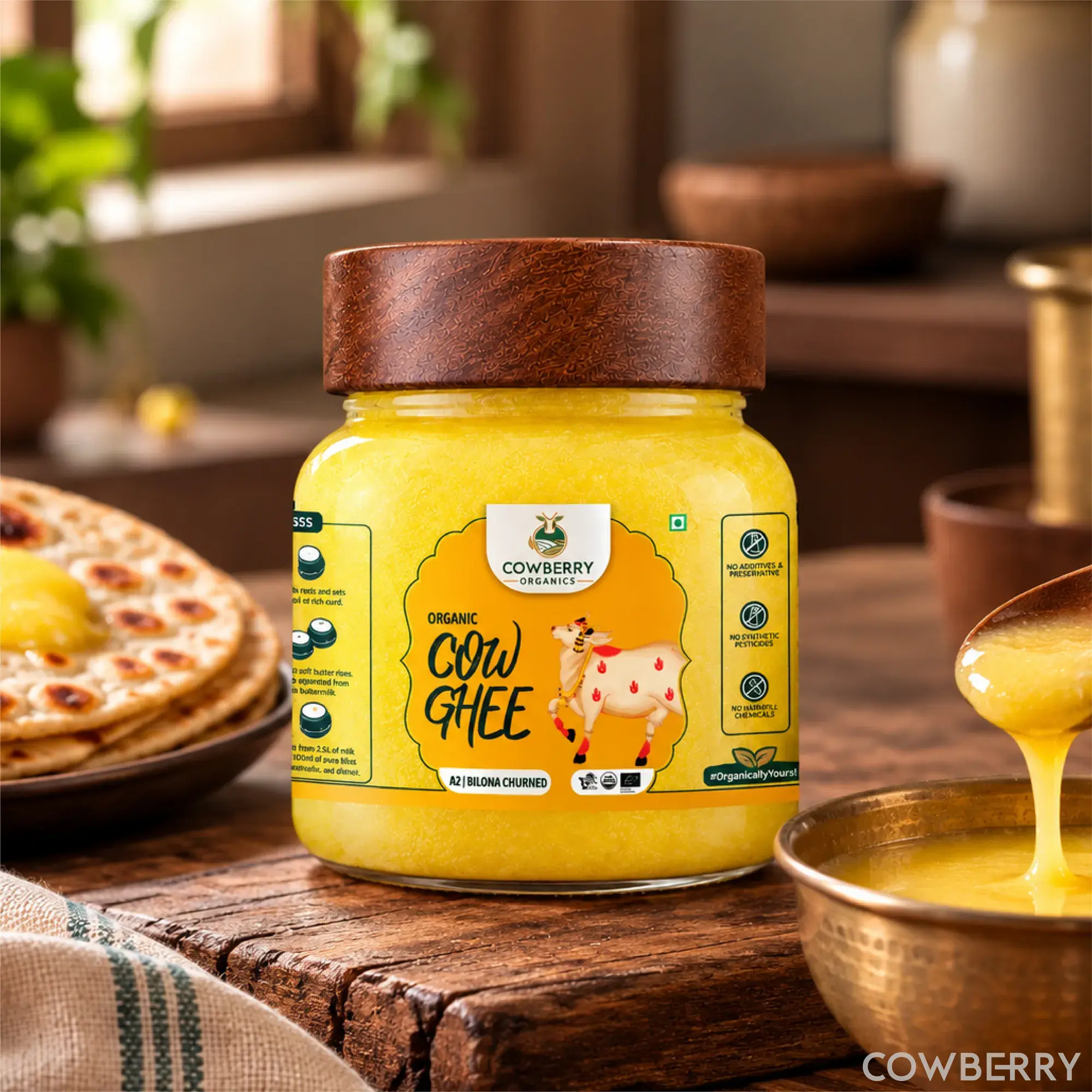
So the real choice is method and source. COWBERRY's A2 ghee is a bilona, curd-churned ghee from the A2 milk of Gir cows; a normal ghee may be cream-made from mixed-herd milk. The differences you can check — method and milk source — are there, not in the fat numbers.
A2 ghee vs normal ghee nutrition: one entry, not two
The table shows the single entry the food tables print for cow ghee, because A2 and A1 ghee are not listed separately anywhere in them. Read it and the point of the comparison is visible: 900 kcal per 100 g, 100 g of fat, and 0 g of protein, carbohydrate and fibre. The protein that differs between A1 and A2 milk does not survive into the jar in any amount the tables record. IFCT 2017 carries ghee only in its fatty-acid tables, printing no protein figure at all, and USDA FoodData Central's full entry prints 0 g of protein per 100 g. So on nutrition, the honest answer to a2 ghee vs normal ghee is: no difference is recorded.
| Nutrient | Cow ghee (A2 or regular) |
|---|---|
| Energy (kcal) | 900 |
| Protein (g) | 0 |
| Fat (g) | 100 |
| Carbohydrates (g) | 0 |
| Dietary fibre (g) | 0 |
| Iron (mg) | 0 |
| Calcium (mg) | 0 |
| Sodium (mg) | 0 |
| Vitamin C (mg) | 0 |
Per 100 g raw, edible portion. Composition: USDA FoodData Central (SR Legacy), FDC ID 171314, NDB 1323. — means not reported. These are average values for the food; the label on a pack gives the values for that product.
What A1 and A2 actually are
The A1/A2 story is a milk-protein story, and it starts with one amino acid. Beta-casein is roughly a third of the protein in cow's milk (about 30 percent, per a 2017 review in Advances in Nutrition). Its two main forms differ only at position 67: A1 has histidine there, A2 has proline. The review traces A1 to a mutation in the ancestors of European-type cattle and says it is absent in purebred Asian and African cattle, which is why milk sold in many countries is a blend of both. An Indian letter from 2012 (Indian Journal of Endocrinology and Metabolism) counts twelve variants of the gene and describes early studies that found only A2 in Indian native dairy cows and buffalo, with A1 commoner in exotic cattle.
What the A1/A2 studies say, and why ghee is not milk
The studies are about milk, not ghee, and their scope stops there. The 2017 systematic review that compared A1 with A2 beta-casein excluded cheese and fermented milk products, and it says plainly that the human evidence is limited: one clinical study linked A1 to delayed intestinal transit, and two linked it to looser stool, which the review classes as emerging evidence. The same review records that a 2008 European Food Safety Authority assessment found no convincing evidence for physiological effects in humans from BCM-7, the peptide released from A1 but not from A2, and its author disclosures name the a2 Milk Company and the A2 Corporation as having had dealings with three of the authors (consulting or support), which is worth knowing alongside the review's own caution about limited evidence.
None of this transfers to ghee. Ghee is 100 g of fat per 100 g with 0 g of protein: the tables print no protein for ghee, which is the protein the A1/A2 question is about. For someone choosing between A2 ghee and normal ghee, the milk findings are context, not a verdict on the fat.
Taste, colour and cooking
No study quoted here measures a taste difference between A2 ghee and normal ghee, so the honest answer is that none is recorded; what is recorded is the method. COWBERRY describes its A2 bilona ghee as golden and aromatic, made by culturing the milk, hand-churning it and heating the butter gently. For cooking, COWBERRY says its A2 ghee has a high smoke point and suits frying and sauteing. Whether a normal ghee matches in aroma depends on its own making, not on its A1 or A2 label.
Cost and where each fits
A2 bilona ghee is a slower product to make than cream-route ghee — curd to churn to gentle heating, in small batches, from cows grazed on chemical-free grassland and fed chemical-free fodder, which is how COWBERRY describes its own herd — and any price gap may reflect that extra labour. In the kitchen the two are interchangeable: anything that calls for ghee — tadka, roti, dal, sweets — takes either. Choose A2 ghee when the milk source and the method matter to you, and any good ghee when they do not. Both come under the same daily limit, so the choice changes flavour and origin, not the amount you can use.
Which for whom
- Both are the same fat. A2 ghee and normal ghee share one entry: 900 kcal and 100 g of fat per 100 g. The ICMR-NIN limit — a teaspoon or two of ghee or butter daily, or none if possible — applies to both, and ICMR counts visible saturated fat use as high once ghee or butter crosses 10 g over the day, on a 2000 kcal diet. The WHO guideline adds that adults and children should keep saturated fatty acids within 10 percent of total energy, with a further cut below that suggested as conditional.
- Lactose. Both are generally lactose-free, because the milk solids are removed during clarification; the A2 label adds nothing here.
- Milk protein sensitivity. Ghee keeps 0 g of protein per 100 g, but anyone who reacts to milk protein should still clear ghee with their doctor, since the A2 label does not make the fat itself different.
- Cholesterol and heart risk. Both are saturated-fat foods, and the WHO 10 percent line covers saturated fat from any source. A 2022 crossover study published in the British Journal of Nutrition found that ghee, against olive oil, raised fasting apoB and non-HDL cholesterol in healthy adults. Anyone managing high cholesterol or heart disease should ask their doctor or dietitian how much ghee fits the plan.
- Choosing by label. If the A2 claim matters to you, check what the label says about the milk source and the method; types of ghee walks through bilona, cow and buffalo ghee. For the numbers behind each jar, see ghee nutrition per 100 g; the bilona ghee guide carries the rest of the A2 story.
Cook with it: try Motichoor ladoo, Ghee rusk, Desi ghee roti.
FAQs
Is A2 ghee better?
Not by any number on record. A2 and normal ghee share one composition entry — 900 kcal and 100 g of fat per 100 g, 0 g of protein — so no table shows A2 ghee ahead. What can differ is the making: A2 ghee is often the slow bilona kind. If better means the method and the milk source, that is A2 ghee's case; if it means the nutrition, the tables record no difference.
Is A2 ghee better than A1?
For the fat itself, no table records a difference: the composition tables carry one entry for cow ghee, and ghee holds 0 g of protein per 100 g, so the A1/A2 protein question does not reach the jar. The milk studies that compare A1 and A2 are about milk, and their human evidence is limited. Choose by milk source and method if they matter to you; do not expect a different fat.
Difference between A2 ghee and bilona ghee?
A2 names the milk — it comes from cows carrying only A2 beta-casein — and bilona names the method: curd churned by hand before the butter is heated. A ghee can be both, as COWBERRY's A2 ghee is, or one without the other: a bilona ghee from a mixed herd is bilona but not A2, and a cream-route ghee from A2 milk is A2 but not bilona.
Difference between desi ghee and A2 ghee?
Desi ghee is the everyday word for milk-fat ghee, as against vanaspati, the vegetable substitute. A2 ghee is a subset of it: desi ghee whose milk came from A2-only cows. Any A2 ghee is desi ghee, while desi ghee from a mixed herd is not A2. Both are the same fat in the jar.
What is A2 ghee?
A2 ghee is clarified butter whose milk came from cows carrying only the A2 beta-casein. The protein's A1 and A2 versions differ at position 67, and early studies found Indian native cows carried only the A2 version. Because ghee's table entry shows 0 g of that protein per 100 g, A2 ghee is the same fat as any cow ghee, with a milk story behind it.
References
- USDA FoodData Central (SR Legacy): Butter, Clarified butter (ghee), FDC ID 171314
- Indian Food Composition Tables (IFCT) 2017, ICMR-National Institute of Nutrition
- Sodhi M, Mukesh M, Kataria RS, Mishra BP, Joshii BK. Milk proteins and human health: A1/A2 milk hypothesis. Indian J Endocrinol Metab, 2012
- Brooke-Taylor S, Dwyer K, Woodford K, Kost N. Systematic review of the gastrointestinal effects of A1 compared with A2 beta-casein. Advances in Nutrition, 2017
- Dietary Guidelines for Indians, ICMR-National Institute of Nutrition
- WHO guideline: saturated fatty acid and trans-fatty acid intake for adults and children (2023)
- Mohammadi Hosseinabadi S, Nasrollahzadeh J. Effects of diets rich in ghee or olive oil on cardiometabolic risk factors in healthy adults: a two-period, crossover, randomised trial. Br J Nutr, 2022
Shop this article
Keep reading
Cold pressed oil benefits: why they survive processing better
Mustard oil vs refined oil: nutrition, cooking and which to choose
Mustard oil omega 3: nutrition, calories and fat per 100g