by COWBERRY

10 minute read
Cow ghee vs buffalo ghee: colour, fat, taste and which to choose

Buffalo ghee is white and usually firmer and milder than cow ghee, which is yellow, softer and more aromatic. Both are clarified milk fat, so a spoon of either is a spoon of fat, and neither is a health food. The real differences are colour, texture, taste and cost. This comparison sets them side by side, with bilona ghee from A2 cow milk as the cow-ghee reference.
Cow ghee vs buffalo ghee: the verdict in three lines
- Look and feel: cow ghee is golden yellow and usually softer; buffalo ghee is white or faintly cream and usually sets harder.
- Nutrition: both are clarified milk fat. The reference figures for ghee are 900 kcal and 100 g of fat per 100 g; no food table we cite lists buffalo ghee separately, and no source we cite shows that one is healthier than the other.
- Use: choose by dish and budget. Cow ghee is the aromatic one for roti, dal and khichdi; buffalo ghee is the firm, mild one for frying and large batches of sweets.
Whichever you buy, the amount matters more than the animal: ICMR-NIN's guidelines say to limit ghee or butter to 1 to 2 teaspoons a day, or to go without where you can.
Buffalo ghee vs cow ghee, side by side
| Point | Cow ghee | Buffalo ghee |
|---|---|---|
| Colour | Golden yellow; the shade varies from batch to batch | White to pale cream |
| Texture when set | Usually softer, with finer grains | Usually firmer, with larger grains |
| Aroma and taste | Nutty and pronounced; a light tang when made from curd | Milder aroma and taste |
| Fat and calories | Clarified milk fat; the reference entry is for ghee in general | Clarified milk fat; not listed separately in any food table we cite |
| Common uses | Roti, dal, khichdi, tadka, laddu | Deep-frying, halwa and mithai in bulk, tadka |
| Relative cost | Higher | Lower |
Why the colour differs. Cow milk fat carries carotene, a yellow plant pigment that cows take in with green fodder, and the pigment stays in the ghee. Buffalo milk fat carries very little, so buffalo ghee sets white. The shade of cow ghee also varies with feed and from batch to batch, so a paler jar is not by itself a fault, and colour judged by eye does not prove which animal a ghee came from.
Texture. Buffalo ghee usually sets harder and in larger grains, while cow ghee stays softer at the same room temperature. Grain also varies with how the ghee was made and cooled, so two jars of one ghee can look different. How the breed, the milk and the method change a jar is explained under types of ghee.
Nutrition: fat and calories per 100 g
The table shows the one ghee entry our sources print: 900 kcal, 100 g of fat, 0 g protein, 0 g carbohydrate and 0 g fibre per 100 g (USDA FoodData Central, clarified butter). That entry does not state the animal, and IFCT 2017 lists ghee only in its fatty-acid tables, also without the milk source. So buffalo ghee is not printed separately anywhere we can cite, and this page gives no separate numbers for it.
What can be said is simple. Both are what remains of butter once its water and milk solids are gone, so a spoon of either counts as a spoon of fat in the day's total. One level teaspoon of ghee, if you take it as 5 g, works out to 45 kcal and 5 g of fat.
For health the amount decides, not the animal. WHO's 2023 guideline names 10% of a day's energy as the level to bring saturated fat down to, and the Indian dietary guidelines (ICMR-NIN) list ghee and butter as fats rich in saturated fat. The fat question is taken up under is ghee good for cholesterol, and spoon sizes under 1 spoon ghee calories.
| Nutrient | Ghee (clarified butter) |
|---|---|
| Energy (kcal) | 900 |
| Protein (g) | 0 |
| Fat (g) | 100 |
| Carbohydrates (g) | 0 |
| Dietary fibre (g) | 0 |
| Iron (mg) | 0 |
| Calcium (mg) | 0 |
| Sodium (mg) | 0 |
| Vitamin C (mg) | 0 |
Per 100 g raw, edible portion. Composition: USDA FoodData Central (SR Legacy), FDC ID 171314, NDB 1323. — means not reported. These are average values for the food; the label on a pack gives the values for that product.
What the 2022 study measured: telling cow ghee from buffalo ghee
The one study we cite that compares the two comes from the National Dairy Research Institute, Karnal (Mor and colleagues, Journal of Food Science and Technology, 2022). It is a dairy chemistry paper about telling the two apart, not a health study.
The team made pure cow ghee and pure buffalo ghee by the creamery butter method, and also mixed buffalo ghee into cow ghee at 5%, 10%, 15% and 20%. On these samples they measured four physico-chemical values (BR reading, RM value, Polenske value and Kirschner value) and five colour values: lightness, redness, yellowness, a yellowness index and a whiteness index.
What they found
- Colour separates the two clearly. Yellowness (b) ran from 59.68 to 79.31 in pure cow ghee and from 1.39 to 9.61 in buffalo ghee. The whiteness index ran from 16.07 to 28.85 in cow ghee and from 68.74 to 84.61 in buffalo ghee. Lightness overlapped.
- The chemistry overlaps more. The ranges for BR reading and Polenske value overlapped, while RM and Kirschner values ran higher in buffalo ghee.
- A blend is hard to spot. Cow ghee with up to 20% buffalo ghee still fell inside the range of pure cow ghee on most measures. Only the whiteness index and the Kirschner value were significantly higher in the mixed samples, so the authors propose those two to distinguish cow ghee from buffalo ghee.
The practical point: a blend of the two cannot be judged by eye. A 2024 review of adulteration adds that ghee is also mixed with vanaspati, animal fats and synthetic materials. The one home test, FSSAI's check for added starch, is explained in how to check ghee purity; finding vanaspati or other fats takes a laboratory.
Taste and cooking: where each ghee works
On the plate the two behave like cousins. Either one can make a tadka, fry a puri or finish a khichdi; what changes is aroma, body and how the finished dish sets.
Cow ghee in the kitchen
Cow ghee usually has the stronger aroma, so it earns its place where ghee is tasted directly: a smear on a hot roti or bhakri, a spoon over dal and rice, the tempering of dal tadka. Bilona ghee, churned from curd, adds a faint cultured tang. In sweets it gives a golden colour and a softer set, as in besan ke laddu and moong dal halwa.
Buffalo ghee benefits in the kitchen
The benefits of buffalo ghee are practical ones. It usually sets firm, so barfi, peda and mysore pak hold their shape. It is white, so pale sweets stay pale. Its flavour is mild, so it lets cardamom and saffron lead. And it usually costs less, which counts when a recipe takes ghee by the cup.
Both keep well in a clean, dry, airtight jar away from the stove, and neither should be heated until it smokes.
Cost and where each fits
Cow ghee usually costs more than buffalo ghee. The 2022 dairy study says the same from the trade side: cow ghee has become more popular and fetches a premium over buffalo ghee, which is why the authors set out to tell the two apart. For bilona cow ghee the gap is usually wider still, because setting the milk into curd and churning it for butter is slow work.
Where each fits:
- Daily table ghee: cow ghee, used by the teaspoon on roti, dal and rice, where its aroma is the point and a jar lasts long.
- Festival batches and frying: buffalo ghee, where the recipe needs cups of ghee and a firm set.
- One jar for everything: either. Pick by taste and budget, and use less of it.
Read the label for the milk source and buy from a maker who names it; a jar that says only ghee may be a blend. Storage is the same for both: a dry spoon, a tight lid and a cool shelf.
Which for whom: which ghee is good for health?
No source we cite ranks cow ghee above buffalo ghee for health, or the other way round. The 2024 review of ghee in Ayurveda and modern science notes that the Ayurvedic texts group ghee by milk source, among other things, and also that modern studies on the benefits of ghee are limited. So choose on what you can taste and see.
- You want ghee for roti, dal and khichdi: cow ghee. The A2 cow ghee guide explains what bilona and A2 mean on the label.
- You make sweets or fry in bulk: buffalo ghee gives a firm set and a mild taste for less money.
- You are watching cholesterol or weight: the animal does not change the advice. Keep any ghee to a teaspoon or two; the everyday cooking fat should be an oil such as groundnut or mustard.
- You want ghee for dry skin or lips: cow ghee, usually the softer of the two, spreads thinner; see ghee benefits for skin.
- You avoid milk: both are made from milk, so ask your doctor first.
FAQs
Is buffalo ghee good for health?
In small amounts it can fit a balanced diet, in the same way as cow ghee: it is a cooking fat, not a health food. None of the sources we cite compares the health effects of the two. The reference figures for ghee are 900 kcal and 100 g of fat per 100 g, and India's dietary guidelines say to limit ghee or butter to 1 to 2 teaspoons a day, or do without it where possible.
Which ghee is good for health?
Any pure ghee, cow or buffalo, can fit a balanced diet in small amounts. None of the sources we cite puts either ghee ahead of the other, and ghee of either kind is mostly saturated fat, which the WHO wants held to 10% of total energy intake. Choose cow ghee for aroma and buffalo ghee for sweets and frying, and measure it with a teaspoon.
Why is buffalo ghee white and cow ghee yellow?
Cow milk fat carries carotene, the yellow pigment that cows take in from green fodder, and it passes into the ghee. Buffalo milk fat has almost none, so buffalo ghee comes out white or pale cream. In a 2022 study the yellowness of pure cow ghee measured far higher than that of buffalo ghee, and the whiteness index far lower.
Does buffalo ghee have more fat than cow ghee?
Not in any table we can cite. Ghee is clarified milk fat, and the one printed entry gives 100 g of fat and 900 kcal per 100 g without naming the animal. Buffalo milk is usually the richer milk, but once either milk is made into ghee, a spoon of ghee is a spoon of fat.
Which ghee is better for sweets, cow or buffalo?
Buffalo ghee for sweets that must set firm and stay pale, such as barfi and peda, and for large batches where cost counts. Cow ghee for sweets where the aroma of ghee is the point, such as laddu and halwa made at home. Either works; the difference is in set, colour and aroma, not in sweetness.
Can cow ghee and buffalo ghee be mixed?
In the kitchen, yes: both are ghee and they blend without trouble. When buying, check that the label names the milk source. A 2022 study found that cow ghee with up to 20% buffalo ghee stayed within the range of pure cow ghee on most laboratory measures, so a blend cannot be judged by eye.
References
- Mor S, Sharma V, Arora S et al. Physico-chemical and color parameters to distinguish cow ghee from buffalo ghee. J Food Sci Technol, 2022
- USDA FoodData Central (SR Legacy): Butter, Clarified butter (ghee), FDC ID 171314
- Indian Food Composition Tables (IFCT) 2017, ICMR-National Institute of Nutrition
- WHO guideline: saturated fatty acid and trans-fatty acid intake for adults and children (2023)
- Dietary Guidelines for Indians, ICMR-National Institute of Nutrition
- Kataria D, Singh G. Health benefits of ghee: review of Ayurveda and modern science perspectives. J Ayurveda Integr Med, 2024
- Begum A, Jain BP. Adulteration in edible oil (mustard oil) and ghee; detection and their effects on human health. Int J Biochem Mol Biol, 2024
Shop this article
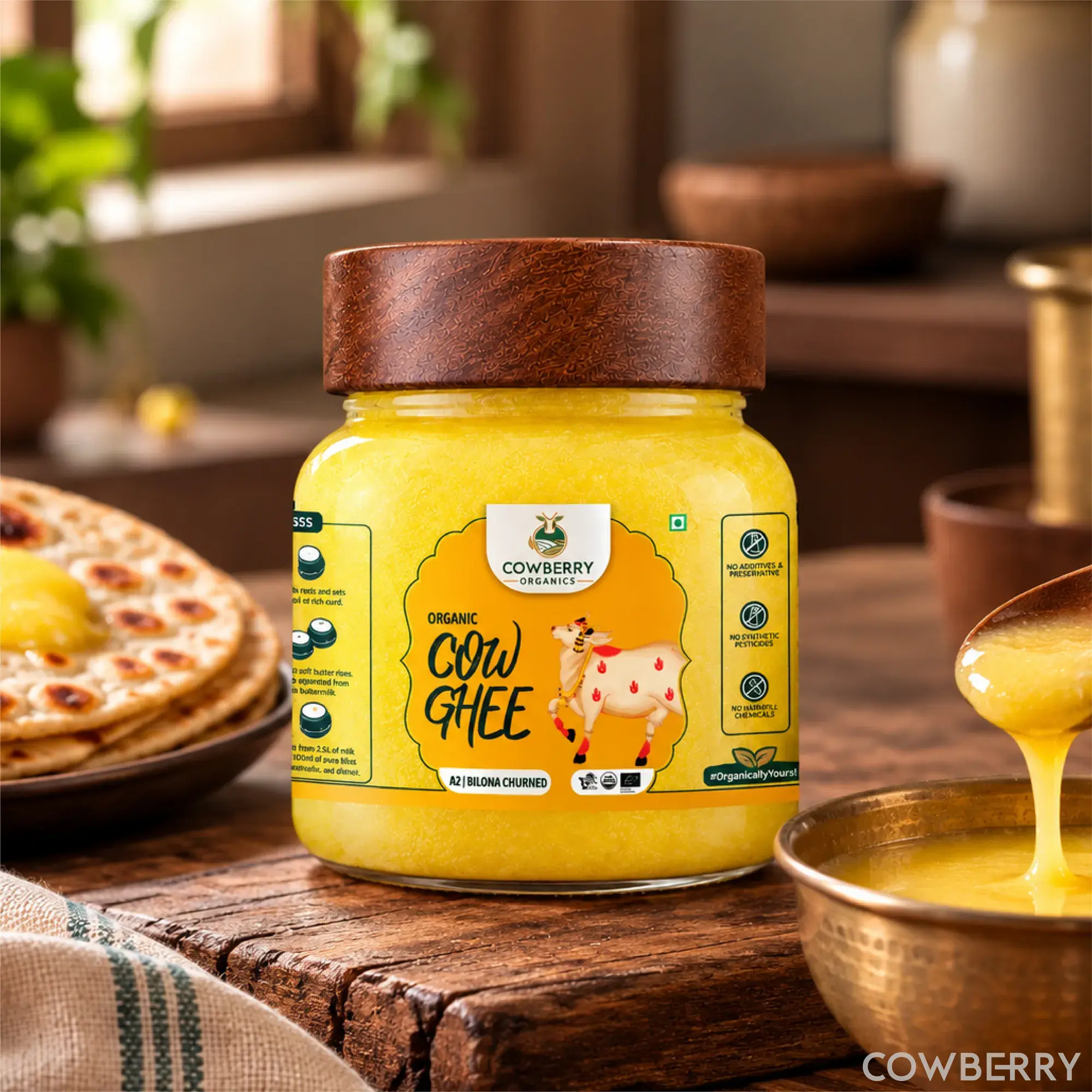
Keep reading
Cold pressed oil benefits: why they survive processing better
Mustard oil vs refined oil: nutrition, cooking and which to choose
Mustard oil omega 3: nutrition, calories and fat per 100g