by COWBERRY

13 minute read
10 benefits of ghee (and when to limit it)

Ghee benefits start in the kitchen: ghee takes tadka heat, carries vitamins A, D, E and K, helps the body absorb them from vegetables, and has almost no lactose. It is also saturated fat, at 45 kcal a teaspoon, so each benefit holds only within a limit. Here are ten benefits with their sources, the side effects, and the daily amount. For how it is made, see bilona ghee.
Ghee benefits in the kitchen: heat, flavour and keeping
Ghee is a cooking fat before it is anything else, so the first three benefits are ones you can check at your own stove.
1. It takes tadka and frying heat
Ghee is clarified butter: the butter is heated and its milk solids are removed. What remains has a high smoke point and is suitable for cooking, frying and sauteing. That suits Indian cooking, where cumin, mustard seeds and curry leaves go into fat that is already hot. We quote no smoke-point temperature, because the reference tables behind this page print none.
2. It adds flavour and makes a meal filling
ICMR-NIN's Dietary Guidelines for Indians list what fats do in a meal besides supplying energy: they add texture, flavour and taste, make the diet more palatable, and leave you feeling full and satisfied, so that hunger returns later. COWBERRY describes its bilona ghee as having a rich aroma and texture. Flavour comes with calories, though, so measure ghee with a spoon rather than pouring it.
3. It is easy to store
COWBERRY's storage advice for its ghee is short: an airtight container, a cool and dry spot, and no direct sunlight. The advice makes no mention of a fridge.
Benefits of eating ghee: what a spoonful carries
4. It carries vitamins A, D, E and K
Vitamins A, D, E and K, all four of them fat-soluble, are listed in COWBERRY's product facts for its ghee. The USDA entry used across this site prints no amounts for these vitamins, so no figure is quoted here, and there is no basis for counting ghee as a main source of them. The ICMR-NIN limit of 1 to 2 teaspoons a day still applies.
5. It helps you absorb vitamins from vegetables
This is the benefit with the firmest backing. The ICMR-NIN guidelines describe fats as a vehicle for vitamins A, D, E and K and for carotenes, and say that fats promote their absorption. Their chapter on cooking methods makes the same point about stir-frying: the added fat helps the body absorb fat-soluble vitamins, antioxidants and other plant compounds. The guidelines speak of fat in general, not of ghee alone, so oil does this too. In practice, cook carrots, tomatoes, capsicum or leafy greens, which the guidelines name as rich in carotenoids, with a teaspoon of fat rather than none.
6. It contains butyric acid
COWBERRY's product facts name butyric acid, a short-chain fatty acid, among what its ghee contains. The evidence on what it does is thin: a 2024 review by Kataria and Singh found that modern scientific literature has only limited studies on the functional benefits of ghee. We list butyric acid as something ghee contains, not as something it has been shown to do.
7. It packs energy into a small spoon
A teaspoon of ghee (5 g) gives 45 kcal and a tablespoon (15 g) gives 135 kcal, going by the 900 kcal per 100 g in USDA FoodData Central; IFCT 2017, the Indian tables, list ghee only for its fatty acids. For an adult watching weight, that density is a caution. For a small eater it is useful: the ICMR-NIN guidelines say children under five should get less bulky foods that are rich in energy, and name pulses, nuts, edible oil or ghee, milk and eggs. Their sample meals for infants past six months include 5 g of oil or ghee; add ghee to a baby's food only after your paediatrician's advice. The full arithmetic is on the 1 spoon ghee calories page.
Three more ghee benefits: lactose, vanaspati and tradition
8. It has almost no lactose or milk protein
USDA's entry for ghee shows 0 g carbohydrate and 0 g protein per 100 g, because lactose and the milk proteins leave with the milk solids when butter is clarified. COWBERRY's product facts call ghee generally lactose-free for the same reason, which is useful to know if lactose is why you cut down on milk. Generally is not always, so with a diagnosed milk allergy, talk to your doctor or dietitian about ghee too.
9. It is milk fat, not a hydrogenated fat
The ICMR-NIN guidelines note that vanaspati stands in for ghee and butter in cooking, sweets, snacks and bakery products. It is made by partially hydrogenating vegetable oil, which produces trans fatty acids, and the guidelines call trans fats more harmful than saturated fat and advise against vanaspati as a cooking medium. Ghee is made by churning and heating, with no hydrogenation. It is still a saturated fat, and the WHO guideline notes that dairy products from ruminant animals carry some trans fat naturally. Where the choice for a laddu or a halwa lies between the two, the guidelines' advice is to avoid vanaspati.
10. It has a long record of use
The same 2024 review went through eleven Ayurvedic texts spanning over 3000 years. Of the 2913 mentions of milk products in the context of their benefits, 774 were of ghee, the highest for any milk product. The benefits those texts put first are cognitive, digestive and nourishing. A long record is not a trial, and the review itself calls the modern studies limited, but it does show how long ghee has been part of Ayurvedic writing.
Is ghee healthy? What the studies found
Is ghee healthy? In moderate amounts, the studies on our reference list give no reason to fear it, and no reason to eat more of it either. Three of them measured blood lipids.
Tirupati, 2022. Researchers at Sri Padmavathi Medical College measured fasting serum lipids in healthy volunteers before and after a period of eating cow ghee. Taking all the volunteers together, total cholesterol and LDL cholesterol were significantly lower afterwards and the other values did not change significantly; among those who began with normal lipids, nothing changed significantly. The authors concluded that cow ghee consumption is not harmful to health.
Tehran, 2022. In a randomised crossover trial, thirty healthy men and women ate diets that included ghee for four weeks and olive oil for four weeks. Compared with olive oil, ghee raised apo B and non-HDL cholesterol. LDL cholesterol, triglycerides, glucose and insulin did not differ significantly, and body weight did not differ between the two diets.
Ohio, 2010. A paper in the journal AYU fed rats a diet with 10% ghee for four weeks: serum total cholesterol did not change significantly and triglycerides rose. Summing up the earlier literature, its authors wrote that the data do not support a conclusion of harm from moderate ghee consumption in the general population.
Put together, moderate amounts have not been shown to harm healthy people, but in the one direct comparison, apo B and non-HDL cholesterol were higher on ghee than on olive oil. The general rule in the ICMR-NIN guidelines still applies: saturated fats are known to raise serum total and LDL cholesterol. The detail is on the page that asks is ghee good for cholesterol.
Side effects of ghee and who should limit it
Ghee's side effects are those of any saturated fat eaten in quantity, so the question is always how much.
- Saturated fat. The ICMR-NIN guidelines state that a high intake of saturated fats adds to calorie intake and increases the risk of heart disease and stroke, and they name ghee and butter among the fats to limit.
- Calories. Ghee gives 9 kcal per gram. Two tablespoons in a day, easy to reach with parathas and a sweet, add 270 kcal.
- Cholesterol. Ghee is an animal food and so contains cholesterol, which plant oils do not.
Some people should keep ghee to the lower end of the range, or ask before using it:
- anyone who has been told to lower their cholesterol, or who has heart disease;
- anyone managing weight, since ghee is dense in calories, or diabetes, since the ICMR-NIN guidelines note that saturated fat lowers insulin sensitivity;
- pregnant and breastfeeding women: the guidelines ask that visible fat be restricted in these months and that nuts, oilseeds, beans and fish be encouraged instead;
- anyone with a diagnosed milk allergy;
- babies under six months, for whom the guidelines advise breast milk alone.
If you are in one of these groups, talk to your doctor or dietitian and settle on a daily amount before ghee goes into every meal.
How much ghee per day?
The ICMR-NIN guidelines start from need: a balanced diet with enough nuts and oilseeds already meets the requirement for essential fatty acids, and oil or ghee may be added on top for taste and flavour. On ghee they are direct: ghee or butter should be limited to just 1 to 2 teaspoons a day, or avoided if possible. In weight that is 5 to 10 g, and in energy 45 to 90 kcal. It sits inside a wider limit for all visible fat, cooking oil included, of 20 to 50 g a day according to how active you are.
The WHO guideline on saturated fat works from the other end. Its advice for adults and children is to cut saturated fat to 10% of total energy intake and to fill the gap with polyunsaturated fat, plant monounsaturated fat, or carbohydrate from foods with natural fibre, such as whole grains, vegetables, fruit and pulses. Ghee is not the only source of saturated fat in an Indian diet: ICMR-NIN names butter, milk and other milk products too, so ghee's share has to stay small.
Three habits keep a household inside the limit: measure ghee with a teaspoon and not from the jar; count the ghee inside sweets and parathas, not only the ghee on top; and cook the everyday sabzi in a plant oil, keeping ghee for the tadka and the roti. Which oil, and when, is covered under ghee vs oil.
How to eat ghee: on rotis, in dal and in sweets
The benefits above belong to ghee eaten with food, in small, measured amounts.
- On rotis: spread a thin layer on a hot khapli atta roti or bajra roti, and count it in the day's teaspoons.
- In dal and khichdi: put the ghee in the tempering of a dal tadka, or stir a spoonful into moong dal khichdi just before serving, so that the aroma reaches the table.
- With vegetables: cook palak, methi or carrots in a little ghee or oil; this is benefit 5 at work.
- In sweets: ragi laddu, besan ke laddu and moong dal halwa get their texture from ghee. They are occasional foods, and their ghee counts towards the day's limit: one besan laddu made to our recipe holds more than two teaspoons on its own.
How ghee is made, stored and bought is on the main bilona ghee page. Ghee on the skin instead of the plate is a separate subject, covered under ghee benefits for skin, and this page has a Hindi companion, ghee khane ke fayde.
Which ghee is best for health?
Which ghee is best for health, or which ghee is good for health, is usually asked as if one jar held an answer the others lack. On the evidence, the amount matters more than the type.
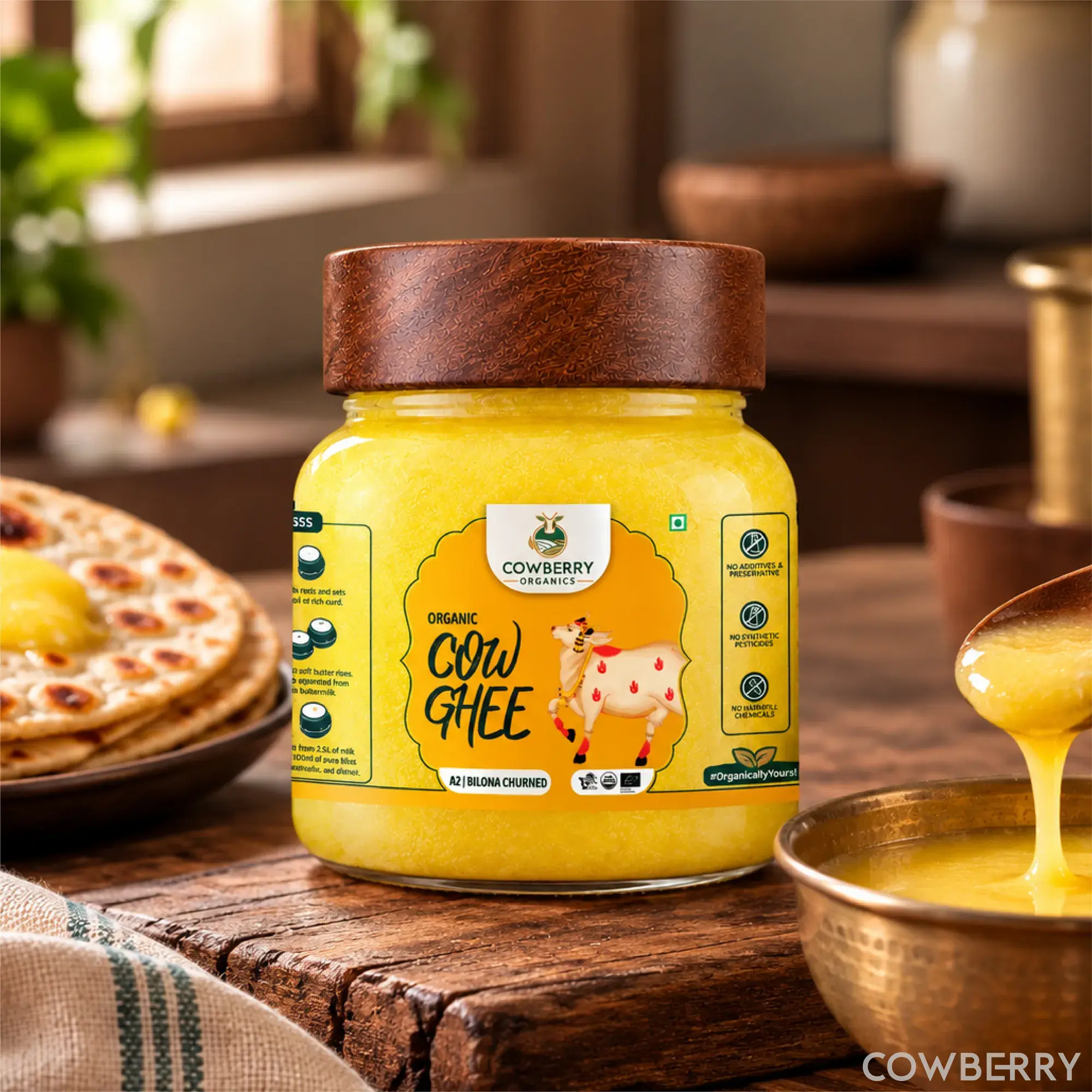
- A2 or regular: the A2 label is about the milk the ghee was made from. COWBERRY's ghee, for instance, starts as A2 milk from indigenous Gir cows in Gujarat. None of the studies we cite compares A2 ghee with other ghee for health, so read A2 as information about the source, not as a health claim.
- Cow or buffalo: a 2022 study from the National Dairy Research Institute, Karnal, could tell the two apart by measured values, colour among them: cow ghee is the yellower, buffalo ghee the whiter. That is a difference of identity, not a health ranking. More under buffalo ghee.
- Bilona or cream: COWBERRY links its bilona method to a rich aroma and texture; the USDA entry used here gives no separate figures for either method.
- Pure or adulterated: this is the difference that matters. Begum and Jain (2024) describe ghee stretched with vanaspati, animal fat or synthetic material, and ICMR-NIN tells buyers to get butter, ghee and khoa from reliable sources only. What a home test can and cannot catch is under how to check ghee purity.
So choose a ghee that names its milk source and its method, comes from a seller you trust, and smells fresh; then keep to the teaspoon. The types are compared one by one in the guide that starts with A2 Gir cow ghee.
FAQs
Is desi ghee good for health?
In small amounts, desi ghee can be part of a balanced diet. It contains vitamins A, D, E and K, suits high-heat cooking, and like any fat helps the body take up fat-soluble vitamins from the meal. It is also saturated fat with 45 kcal in a teaspoon, which is why the ICMR-NIN guidelines limit ghee or butter to 1 to 2 teaspoons a day, or none if it can be avoided.
Does ghee cause constipation?
No study on our reference list links ghee to constipation. Ghee has no fibre, and fibre is what the ICMR-NIN guidelines connect with proper bowel function; they also ask for enough fluids. So look first at the vegetables, whole grains and water in the day's meals. Ayurveda's use of ghee for digestion is traditional and has not been tested in the trials cited on this page. If constipation lasts, talk to your doctor or dietitian.
Is buffalo ghee good for health?
Buffalo ghee is as much ghee as cow ghee: milk fat, used in the same way and under the same limit of 1 to 2 teaspoons a day. A 2022 study from Karnal told them apart by colour and other measurements, cow ghee being the yellower and buffalo ghee the whiter. No study on our list shows that one is better for health than the other. The two are compared under buffalo ghee.
Is A2 ghee good for diabetes?
No study on our list tests A2 ghee in diabetes, so there is no evidence that it helps. Ghee has 0 g carbohydrate and adds no sugar, and in the 2022 Tehran trial in healthy adults, fasting glucose and insulin did not differ between ghee and olive oil. But the ICMR-NIN guidelines note that saturated fats reduce insulin sensitivity, so keep ghee small and talk to your doctor or dietitian to agree on your amount.
Can I eat ghee every day?
Yes, if the amount is small. The ICMR-NIN advice is 1 to 2 teaspoons of ghee or butter a day (5 to 10 g), or none if possible, counted within 20 to 50 g of visible fat depending on activity. A teaspoon on rotis or in dal fits that easily. Daily ghee becomes a problem when it is poured freely, or when sweets and fried snacks come on top of it.
Is ghee good for weight loss?
Not by itself. No study on our list shows that ghee reduces weight; in the 2022 Tehran trial body weight was no different on ghee and on olive oil when one replaced the other calorie for calorie. Ghee gives 9 kcal per gram like every fat, so a tablespoon adds 135 kcal. A measured teaspoon can fit a weight-loss diet; free pouring does not. If you are following a weight-loss plan, talk to your doctor or dietitian as well.
References
- USDA FoodData Central
- Indian Food Composition Tables (IFCT) 2017, ICMR-National Institute of Nutrition
- Dietary Guidelines for Indians, ICMR-National Institute of Nutrition
- WHO guideline: saturated fatty acid and trans-fatty acid intake for adults and children (2023)
- Kataria D, Singh G. Health benefits of ghee: review of Ayurveda and modern science perspectives. J Ayurveda Integr Med, 2024
- Munisekhar K, Singh MSB, Rao PS et al. Lipid profile in healthy human volunteers before and after consuming ghee. Bioinformation, 2022
- Mohammadi Hosseinabadi S, Nasrollahzadeh J. Effects of diets rich in ghee or olive oil on cardiometabolic risk factors in healthy adults: a two-period, crossover, randomised trial. Br J Nutr, 2022
- Sharma H, Zhang X, Dwivedi C. The effect of ghee (clarified butter) on serum lipid levels and microsomal lipid peroxidation. AYU, 2010
- Mor S, Sharma V, Arora S et al. Physico-chemical and color parameters to distinguish cow ghee from buffalo ghee. J Food Sci Technol, 2022
- Begum A, Jain BP. Adulteration in edible oil (mustard oil) and ghee; detection and their effects on human health. Int J Biochem Mol Biol, 2024
Shop this article
Keep reading
Cold pressed oil benefits: why they survive processing better
Mustard oil vs refined oil: nutrition, cooking and which to choose
Mustard oil omega 3: nutrition, calories and fat per 100g