by COWBERRY

12 minute read
Types of ghee: A2 Gir cow, bilona, buffalo, cultured and which is best

A2 Gir cow ghee is ghee made from the A2 milk of Gir cows, an indigenous Indian breed. The name describes the herd and its milk: ghee itself is almost pure fat, and USDA FoodData Central lists it at 0 g protein per 100 g. It is one of several types of ghee, sorted by animal, by method (such as bilona ghee) and by name.
What is A2 ghee, and what does A2 Gir cow ghee mean?
What is A2 ghee? It is ghee made from A2 milk, and to see what that means you have to start with the milk. About 30% of the protein in cow's milk is beta-casein, which comes in two main types, A1 and A2. They differ at a single point in a chain of 209 amino acids, position 67, where A2 carries proline and A1 carries histidine. The A1 type arose from a mutation in the ancestors of modern European-type cattle, so the milk sold in many countries is a mix of the two, while purebred Asian and African cattle do not carry the mutation (Brooke-Taylor and colleagues, Advances in Nutrition, 2017).
In India, early studies by scientists at the National Bureau of Animal Genetic Resources in Karnal found only the A2 type in the milk of native dairy cows and of buffalo, and the A1 type more often in exotic cattle (Sodhi and colleagues, 2012). So "A2 Gir cow ghee" on a jar tells you two things: the breed, Gir, an indigenous Indian cow, and the type of milk the ghee started from. COWBERRY's A2 cow ghee, for example, is made from the A2 milk of indigenous Gir cows raised on the grasslands of Gujarat.
The name describes the milk, not the ghee. A1 and A2 are types of protein, and ghee keeps almost none: it is butter heated until it clarifies, with the milk solids removed along the way, and USDA FoodData Central lists clarified butter (ghee) at 100 g fat and 0 g protein per 100 g. The debate over A1 and A2 milk turns on a peptide released when A1 beta-casein is digested, and a review by the European Food Safety Authority found no convincing evidence that it has physiological effects in humans. So A2 on a jar is not a health claim, and in ghee the protein it refers to is all but gone.
What the A2 label does tell you is where the milk came from: which herd, and which breed. Those are fair reasons to choose a jar when the label states them plainly. The method itself is explained step by step in our guide to bilona ghee.
Types of ghee by animal: cow ghee and buffalo ghee
Ghee is sold as cow ghee, buffalo ghee or a blend of the two.
Cow ghee
It is the yellow one of the two. At home it is commonly spooned over dal and rice, spread on rotis and stirred into khichdi.
Buffalo ghee
White to pale cream in colour, it goes into sweets, frying and everyday cooking much as cow ghee does.
Blends
A pack that says only "ghee" without naming the animal may be a blend of cow and buffalo milk fat.
The difference is measurable, not only visual. Measurements made in 2022 at NDRI, the National Dairy Research Institute, put cow ghee and buffalo ghee in separate ranges for yellowness and for whiteness, and the authors concluded that the Kirschner value and a whiteness index can tell the two apart. Taste, texture and use are compared side by side in cow ghee vs buffalo ghee.
Ghee types by method: bilona, cream and industrial
Labels also name the method, and this guide groups the methods into three routes from milk to ghee.
Bilona or curd-churned ghee
This route starts from curd, not cream. The milk is cultured into curd, the curd is churned until butter separates, and the butter is heated gently until it clarifies and the milk solids can be taken out. COWBERRY's A2 cow ghee is made this way: A2 milk from Gir cows, cultured into curd, hand-churned in small quantities and slowly heated.
Cream ghee
Here the starting point is cream taken off the milk, cooked straight into ghee or churned into butter first. The cow and buffalo ghee samples in the 2022 NDRI study were made from butter, by what the authors call the creamery butter method. Malai ghee made at home from cream collected over several days is the household version.
Industrial ghee
Large dairies make ghee from butter or cream at scale, and their labels may name no method at all.
Cultured ghee meaning
Cultured ghee is ghee whose cream or curd was fermented, or cultured, before churning. Bilona ghee counts as cultured, since it starts from curd, while ghee made from fresh, unfermented cream does not.
Ghee by breed and feed: Gir, desi cow and grass fed ghee
Some jars also name the breed of the herd:
- Gir: an indigenous Indian breed and the one behind A2 Gir cow ghee; the Gir cows behind COWBERRY's ghee are raised in Gujarat.
- Desi cow: any indigenous Indian breed, named or not. It is a category, not a breed.
These labels describe the herd. They are not a grade of ghee, and the USDA figures used on this page apply to every breed alike. If a jar says its breed's ghee is richer in some nutrient, that is the maker's claim, and no table we cite can check it.
Grass fed ghee
Grass fed ghee is ghee from cows that graze on pasture or eat mainly green fodder instead of grain-based feed. On a pack it is a description of how the herd is kept, so it is as reliable as the dairy that prints it.
Desi ghee, vanaspati and flavoured ghee: names that confuse
Desi ghee means local or traditional ghee. In shops it is used for any real ghee, cow or buffalo, to set it apart from vanaspati. It says nothing about breed or method unless the label adds "desi cow" or "bilona".
Pure ghee and shuddh ghee are selling words. They name no animal, breed or method, and FSSAI's advertising and claims regulations set conditions for adjectives such as pure, natural and traditional on a label.
Vanaspati is not ghee. It is a vegetable oil hardened by partial hydrogenation, and the ICMR-NIN guidelines note that it is used in place of ghee or butter, in cooking and in sweets. It contains no milk fat. Partial hydrogenation is also how industrial trans fat is produced, and the WHO's 2023 guideline on fat intake recommends that adults and children cut trans fat to a very small share of the day's energy. If the ingredient list names vegetable oil or hydrogenated fat, the tin is not ghee, whatever the front says.
Clarified butter is the English name that sources use for ghee: USDA FoodData Central files it under clarified butter, and a 2024 review describes ghee as the clarified butter obtained from milk. How ghee compares with butter and cooking oils is covered in ghee vs oil.
Flavoured and herbal ghee: plain ghee infused with garlic, herbs or spices is a seasoning. Ghee is ghrita in Sanskrit, and Ayurveda sorts its own types of ghee by milk source, method of making, maturation and physical phase, as Kataria and Singh's 2024 review describes; that is a separate subject from cooking ghee.
Ghee nutrition per 100 g: does the type change the numbers?
Not in any composition data we can cite. The USDA FoodData Central entry used here, for clarified butter (ghee), is not split by animal, breed or method, and per 100 g it lists 900 kcal and 100 g fat, with 0 g protein and 0 g carbohydrate. There is no fibre and no sugar, and because there is no carbohydrate, ghee has no glycemic index.
Nobody eats 100 g, so the useful figures are per spoon. One level teaspoon is roughly 5 g of ghee, or 45 kcal; a tablespoon is roughly 15 g, or 135 kcal. Ghee on a roti, in dal and in sweets is worked out on our page about 1 spoon ghee calories.
The Dietary Guidelines for Indians list ghee and butter among the high saturated-fat fats to limit, and the WHO guideline asks for saturated fat to be reduced to 10% of the day's total energy. That limit applies to bilona ghee and industrial ghee alike. What varies between types is what the table cannot show: aroma, colour, texture, the milk behind the jar and how carefully it was made.
| Nutrient | Ghee (clarified butter) |
|---|---|
| Energy (kcal) | 900 |
| Protein (g) | 0 |
| Fat (g) | 100 |
| Carbohydrates (g) | 0 |
| Dietary fibre (g) | 0 |
| Iron (mg) | 0 |
| Calcium (mg) | 0 |
| Sodium (mg) | 0 |
| Vitamin C (mg) | 0 |
Per 100 g raw, edible portion. Composition: USDA FoodData Central (SR Legacy), FDC ID 171314, NDB 1323. — means not reported. These are average values for the food; the label on a pack gives the values for that product.
Which ghee is best for health, and for which use?
For health, the honest answer is that the type matters less than the amount. The composition data we can cite gives ghee 900 kcal per 100 g with no split by type, so the label on the jar does not change the arithmetic of a spoonful. Kataria and Singh's 2024 review compared what the Ayurvedic texts say about ghee with modern research, and found the modern studies on its benefits limited in number; our summary is on the ghee benefits page. With raised cholesterol or a heart condition, the amount is a medical question: talk to your doctor or dietitian first.
In the kitchen, the question is which ghee fits the job:
- Over dal, rice, khichdi and rotis: cow ghee, bilona if you like a deeper aroma. It is eaten as it is, so flavour counts.
- Tadka and sauteing: any pure cow or buffalo ghee. The spices lead here, and ghee tolerates the heat of tempering.
- Deep-frying and large batches of sweets: buffalo or cream ghee, where the ghee's own aroma counts for less than in a spoonful over rice.
- Laddu, halwa and festival sweets at home: an aromatic cow ghee, because ghee is the main flavour. Try it in ragi laddu.
- Baking and in place of butter: a mild cream ghee, used in a slightly smaller quantity, since ghee is almost all fat.
Whatever the use, buy sealed ghee with a label you can check, from a reliable source, as the Dietary Guidelines for Indians advise.
How to choose ghee: colour, label and certification
Three things tell you more than the front of the pack.
- Colour: cow ghee is yellow and buffalo ghee white, a gap the 2022 NDRI study measured, so colour tells you the likely animal.
- Label: the word ghee, the animal, the breed if one is claimed, the method, the FSSAI licence number and the date of manufacture.
- Certification: look for a certification mark behind any organic claim; words such as natural or pure are adjectives, not certificates. What each mark means is set out in our guide to the India Organic logo and the other organic marks.
Once the jar is home, FSSAI's iodine test for added starch, and what it cannot detect, is explained in how to check ghee purity.
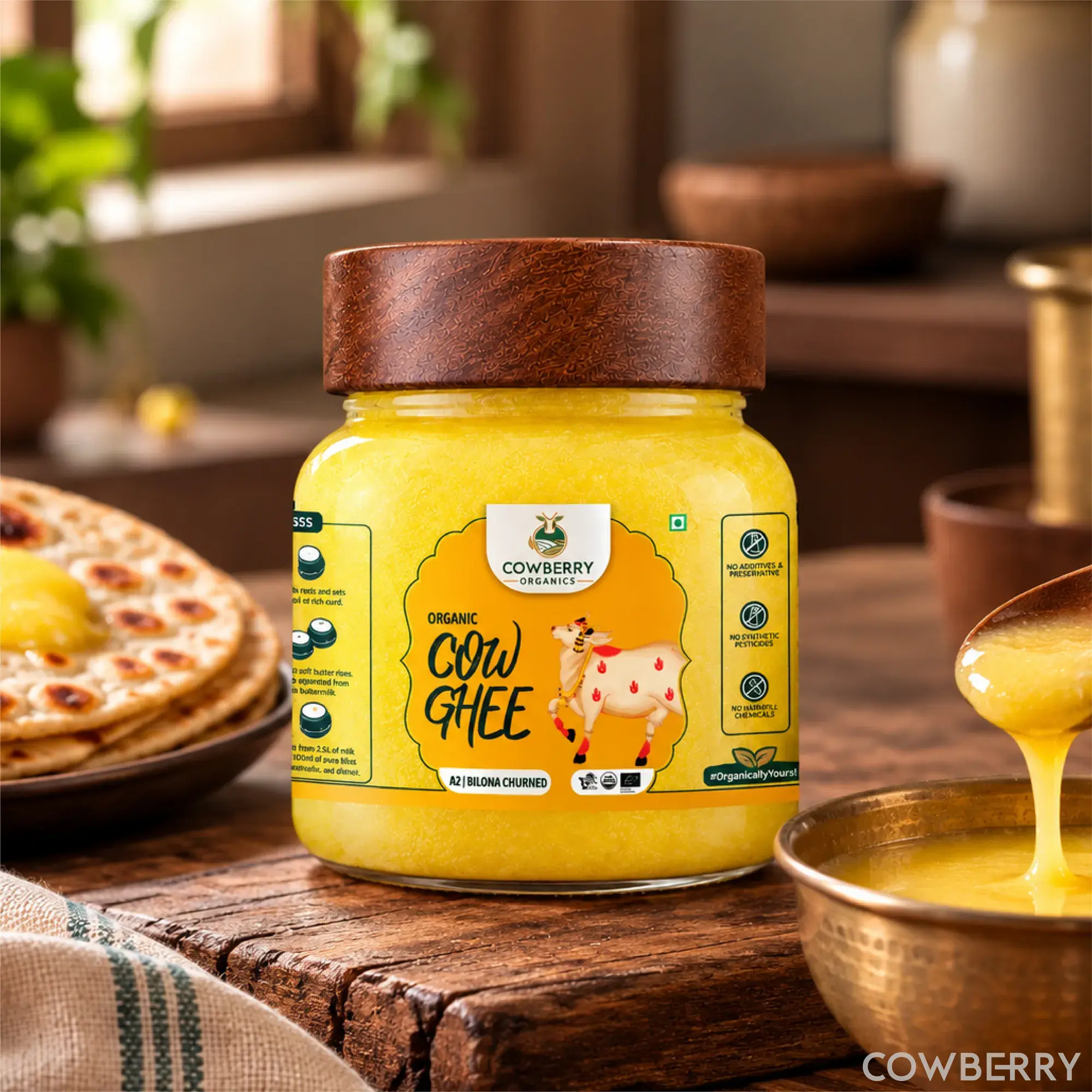
COWBERRY's Organic A2 Cow Ghee is a bilona ghee. Its A2 milk is from Gir cows of the Gujarat grasslands, kept under cow-based farming. It carries no additives or preservatives and is India Organic, USDA & EU certified.
Store any ghee in an airtight jar, away from heat and sunlight, and use a dry spoon.
FAQs
What is A2 ghee?
It is ghee made from A2 milk: milk whose beta-casein, about 30% of the protein in cow's milk, is only the A2 type, which differs from A1 at a single point in the protein chain. Early Indian studies found only A2 in the milk of native cows such as Gir. Ghee itself keeps almost no protein (USDA: 0 g per 100 g), so A2 tells you where the milk came from, not a health difference.
Which ghee is best for health?
None can be shown to be healthier on the numbers: USDA lists ghee at 900 kcal and 100 g fat per 100 g, with no separate figures for cow, buffalo, bilona or cream ghee. What you can choose is freshness, flavour, a label you can check and how much you eat. On a prescribed diet, the ghee allowance is worth a question: talk to your doctor or dietitian.
Is buffalo ghee good for health?
Buffalo ghee is a fat like cow ghee, so the same limit applies: the Dietary Guidelines for Indians suggest keeping ghee or butter to 1 to 2 teaspoons a day, or avoiding it if possible. It is whiter than cow ghee, but the USDA figures do not tell the two apart, so choose on taste and use. The comparison is in cow ghee vs buffalo ghee.
Can we use ghee instead of butter?
Yes. Ghee can stand in for butter in cooking, on rotis and in many baked goods. Because ghee is butter clarified down to its fat (USDA lists 100 g fat per 100 g of ghee), use a little less of it than the butter a recipe asks for. It also brings its own aroma, so a mild cream ghee suits baking better than a strongly scented one.
Is ghee good for cholesterol?
The guidelines we rely on do not class ghee as a cholesterol-lowering food; ICMR-NIN puts it with the high saturated-fat fats to limit, and the WHO guideline asks adults and children alike to reduce saturated fat to a tenth of their total energy intake. The studies and portions are covered in is ghee good for cholesterol; when your own numbers are raised, talk to your doctor or dietitian.
What does cultured ghee mean?
It means the ghee was made from cream or curd that had been cultured, that is fermented, before it was churned into butter. Bilona ghee, which starts from curd, is the example on this page. The USDA entry used here does not separate cultured from uncultured ghee; it puts ghee as a whole at 900 kcal per 100 g.
Is vanaspati the same as ghee?
No. Vanaspati is made from vegetable oil and contains no milk fat, while ghee is the clarified butter obtained from milk. The ingredient list settles it: vegetable oil or hydrogenated fat there means vanaspati or a blend, whatever the front of the tin says. Vanaspati mixed into ghee is one of the adulterations covered in how to check ghee purity.
References
- USDA FoodData Central
- Dietary Guidelines for Indians, ICMR-National Institute of Nutrition
- Kataria D, Singh G. Health benefits of ghee: review of Ayurveda and modern science perspectives. J Ayurveda Integr Med, 2024
- Mor S, Sharma V, Arora S et al. Physico-chemical and color parameters to distinguish cow ghee from buffalo ghee. J Food Sci Technol, 2022
- WHO guideline: saturated fatty acid and trans-fatty acid intake for adults and children (2023)
- FSSAI Food Safety and Standards (Advertising and Claims) Regulations 2018, compendium (PDF)
- Brooke-Taylor S, Dwyer K, Woodford K, Kost N. Systematic review of the gastrointestinal effects of A1 compared with A2 beta-casein. Advances in Nutrition, 2017
- Sodhi M, Mukesh M, Kataria RS, Mishra BP, Joshii BK. Milk proteins and human health: A1/A2 milk hypothesis. Indian J Endocrinol Metab, 2012
Shop this article
Keep reading
Cold pressed oil benefits: why they survive processing better
Mustard oil vs refined oil: nutrition, cooking and which to choose
Mustard oil omega 3: nutrition, calories and fat per 100g