by COWBERRY

9 minute read
How to check ghee purity: FSSAI's home test, lab tests and the label

How to check ghee purity at home: FSSAI's household test list has one test for ghee, in which a blue colour after two or three drops of tincture of iodine points to mashed potato, sweet potato or other starch. It cannot detect vanaspati, animal fat or other oils, so the label and a reliable seller matter for every jar, bilona ghee included.
Why ghee adulteration happens
Ghee is butter that has been heated and clarified, with the milk solids removed, so it is almost entirely fat: USDA FoodData Central lists 100 g fat per 100 g. A 2024 review by Begum and Jain links the steady reports of adulterated edible oils and ghee to rising demand in domestic and global markets, and records that ghee is repeatedly combined with animal fats, synthetic materials or vanaspati. FSSAI's household tests add a fourth kind of addition, starch.
- Vanaspati: vegetable oil turned solid by partial hydrogenation. The Dietary Guidelines for Indians record its use as a replacement for ghee and butter, both in cooking and in making sweets, snack foods and bakery goods.
- Animal fats: named in the 2024 review. No test on FSSAI's household list looks for them in ghee.
- Synthetic materials: the review's third group, also beyond any household test.
- Starch: mashed potatoes, sweet potatoes and other starches, the one addition FSSAI gives a household test for in ghee.
What goes into the jar also changes what you eat. The guidelines advise against using vanaspati as a cooking medium because it may contain trans fats and saturated fats, and they cite evidence that trans fats can increase the risk of heart disease and stroke. Their buying advice for milk products is brief: butter, ghee and khoa should be purchased from reliable sources only.
Pure ghee test at home: FSSAI's iodine test for starch
FSSAI's DART list (Detect Adulteration with Rapid Test) gathers quick tests for common food adulterants that can be done at home, and FSSAI describes its purpose as building consumer awareness about food safety. Of the four tests it lists under milk and milk products, one is for ghee and butter.
Iodine test for starch in ghee
- Take half a teaspoon of ghee in a transparent glass bowl.
- Add two or three drops of tincture of iodine.
What you see
- A blue colour: FSSAI reads it as a sign of mashed potatoes, sweet potatoes or other starches in the ghee.
- No blue colour: no added starch has shown up in that half teaspoon, and nothing else has been ruled out.
Use a separate spoonful for the test and throw it away afterwards; ghee that has had iodine dropped into it does not go back in the jar. If the colour turns blue, stop using that jar and take it up with the seller.
Know what the result cannot tell you. The iodine test looks for starch and nothing else: it does not detect vanaspati, animal fat or other oils, and a jar that shows no blue has not been shown to be pure. FSSAI's list has no melting, heating, chilling or smell test for ghee, and its one fridge test is written for coconut oil. Checking for anything beyond added starch needs a laboratory.
How to identify pure ghee beyond starch: lab tests and the FSSAI standard
Vanaspati, animal fat and other oils have to be found in a laboratory. The 2024 review by Begum and Jain names chromatography- and spectroscopy-based biochemical methods and high-precision analytical instruments as the ways adulteration is identified in edible oils. None of them has a kitchen version.
Dairy chemists also read a set of values from the fat itself. A 2022 study at the National Dairy Research Institute, Karnal, measured four laboratory values, the BR reading and the RM, Polenske and Kirschner values, and five colour values in pure cow ghee, pure buffalo ghee and cow ghee mixed with 5, 10, 15 or 20% buffalo ghee. The pure samples gave these ranges:
| Value | Pure cow ghee | Pure buffalo ghee |
|---|---|---|
| BR reading | 41.87 to 43.62 | 40.01 to 43.23 |
| RM value | 27.5 to 31.13 | 31.91 to 39.99 |
| Polenske value | 1.30 to 1.90 | 1.10 to 1.50 |
| Kirschner value | 20.74 to 24.14 | 26.84 to 33.96 |
| Whiteness index | 16.07 to 28.85 | 68.74 to 84.61 |
The mixed samples show why a single reading is not enough. Cow ghee carrying up to 20% buffalo ghee stayed inside the pure cow range for the BR reading, the RM and Polenske values and four of the five colour values. Only its Kirschner value and whiteness index were significantly higher, and the authors name those two as the values that tell cow ghee from buffalo ghee. How the two differ in the kitchen is covered in cow ghee vs buffalo ghee.
What “pure” means under FSSAI rules
FSSAI also sets what the word pure may mean on a pack. Under its Advertising and Claims Regulations, 2018, pure may describe only a single-ingredient food to which nothing has been added and which is free from avoidable contamination, with unavoidable contaminants below the prescribed limits. Compound foods should not generally be called pure, and the word may not be worked into a brand or fancy name to suggest a purity the food does not have.
What to look for on the label
A label cannot prove purity, but it names who is answerable for the jar and what they claim. ICMR-NIN's guidelines list what a food label shows, including the name of the food, its ingredients, net weight, brand, the maker's name and address, date of manufacture, use-by or expiry date and storage instructions. On a jar of ghee, look at these:
- Product name: it should say ghee. Vanaspati is a different product, a hydrogenated vegetable fat, however similar the tin looks.
- Ingredients: every ingredient is declared, in descending order of quantity. Vanaspati or a vegetable oil in that list means the jar is a blend.
- FSSAI logo with licence number, maker's name and address: the guidelines explain that the logo with a licence number shows the manufacturer is licensed by the regulator. Loose ghee ladled from an open tin carries none of this, and the same guidelines warn of the risk of adulteration when fats and oils are bought loose from unsealed containers.
- Milk source: cow, buffalo or a blend. Breed and A2 claims are the maker's statement about the herd; our guide to the types of ghee, from A2 Gir cow ghee to bilona, explains what each one means.
- Method: curd-churned (bilona) or cream-based. How bilona ghee is made is covered in the main guide.
- Dates and storage instructions: check the date of manufacture and the use-by date, and follow the storage instructions, which tell you where to keep the jar and for how long.
- Words and marks: natural, pure and traditional are claim words that FSSAI attaches conditions to, not certification marks. What the organic marks on a pack certify is set out in our guide to organic logos.
Some pre-packaged foods also carry certification marks for quality; the guidelines give AGMARK on agricultural products such as oils, spices, atta and honey as an example.
How to store ghee so it stays good
Start with the storage instructions on the jar: the Dietary Guidelines for Indians ask buyers to read them for where and how to keep a food and for how long. COWBERRY's advice for its A2 cow ghee is a sealed jar in a cool, dry spot that direct sunlight does not reach. Use a clean, dry spoon each time so that no water or crumbs go into the jar.
The guidelines also say food should be free from moulds, so a jar with mould at the rim goes in the bin, and so does ghee that smells or tastes off. A fresh jar shows in sweets where ghee carries the flavour, such as moong dal halwa and besan ke laddu.
FAQs
How to identify pure ghee at home?
At home you can rule out one thing: added starch. FSSAI's household method is to put half a teaspoon of ghee in a clear glass bowl and add two or three drops of tincture of iodine; a blue colour points to mashed potato, sweet potato or other starch. Beyond that, read the label and buy sealed ghee from a reliable seller, because finding vanaspati or animal fat needs a laboratory.
Can home tests prove that ghee is pure?
No. The one household test FSSAI lists for ghee detects added starch and nothing else. A jar with no blue colour may still hold vanaspati, animal fat or other oils, and finding those takes a laboratory: the 2024 review of oil and ghee adulteration cited here lists chromatography, spectroscopy and high-precision instruments among the detection methods.
Is white ghee adulterated?
Not because of its colour. The 2022 NDRI measurements gave pure buffalo ghee a whiteness index of 68.74 to 84.61 against 16.07 to 28.85 for pure cow ghee, so white ghee may simply be buffalo ghee. Colour cannot show whether anything was added, and FSSAI's household list has no colour test for ghee. See cow ghee vs buffalo ghee.
Is loose ghee more likely to be adulterated?
The Dietary Guidelines for Indians say it is riskier: they warn of adulteration when fats and oils are bought loose from unsealed containers, and call a reliable source always safer. Loose ghee also comes without a label, so there is no FSSAI licence number, maker's address or date of manufacture to check. A sealed, labelled jar gives you all three.
What is A2 ghee?
A2 ghee is made from A2 milk, milk whose beta-casein protein is only of the A2 type; COWBERRY's is a bilona ghee whose A2 milk comes from Gir cows raised in Gujarat. The A2 label describes the milk, not the fat: USDA FoodData Central lists ghee at 0 g protein per 100 g. No test on FSSAI's household list can check an A2 claim, so it rests on the maker's word. The labels are compared in types of ghee.
Is ghee healthy?
India's dietary guidelines class ghee as a fat to limit rather than a health food: ICMR-NIN groups it with the high saturated-fat fats, caps it at one or two teaspoons daily and says to skip it altogether if possible. USDA FoodData Central lists 900 kcal and 100 g fat per 100 g, so a level 5 g teaspoon gives about 45 kcal. Benefits and limits are weighed in ghee benefits.
References
- FSSAI DART: Detect Adulteration with Rapid Test, common quick tests for food adulterants at household (Eat Right India)
- Begum A, Jain BP. Adulteration in edible oil (mustard oil) and ghee; detection and their effects on human health. Int J Biochem Mol Biol, 2024
- Mor S, Sharma V, Arora S et al. Physico-chemical and color parameters to distinguish cow ghee from buffalo ghee. J Food Sci Technol, 2022
- Dietary Guidelines for Indians, ICMR-National Institute of Nutrition
- FSSAI Food Safety and Standards (Advertising and Claims) Regulations 2018, compendium (PDF)
- USDA FoodData Central
- Brooke-Taylor S, Dwyer K, Woodford K, Kost N. Systematic review of the gastrointestinal effects of A1 compared with A2 beta-casein. Advances in Nutrition, 2017
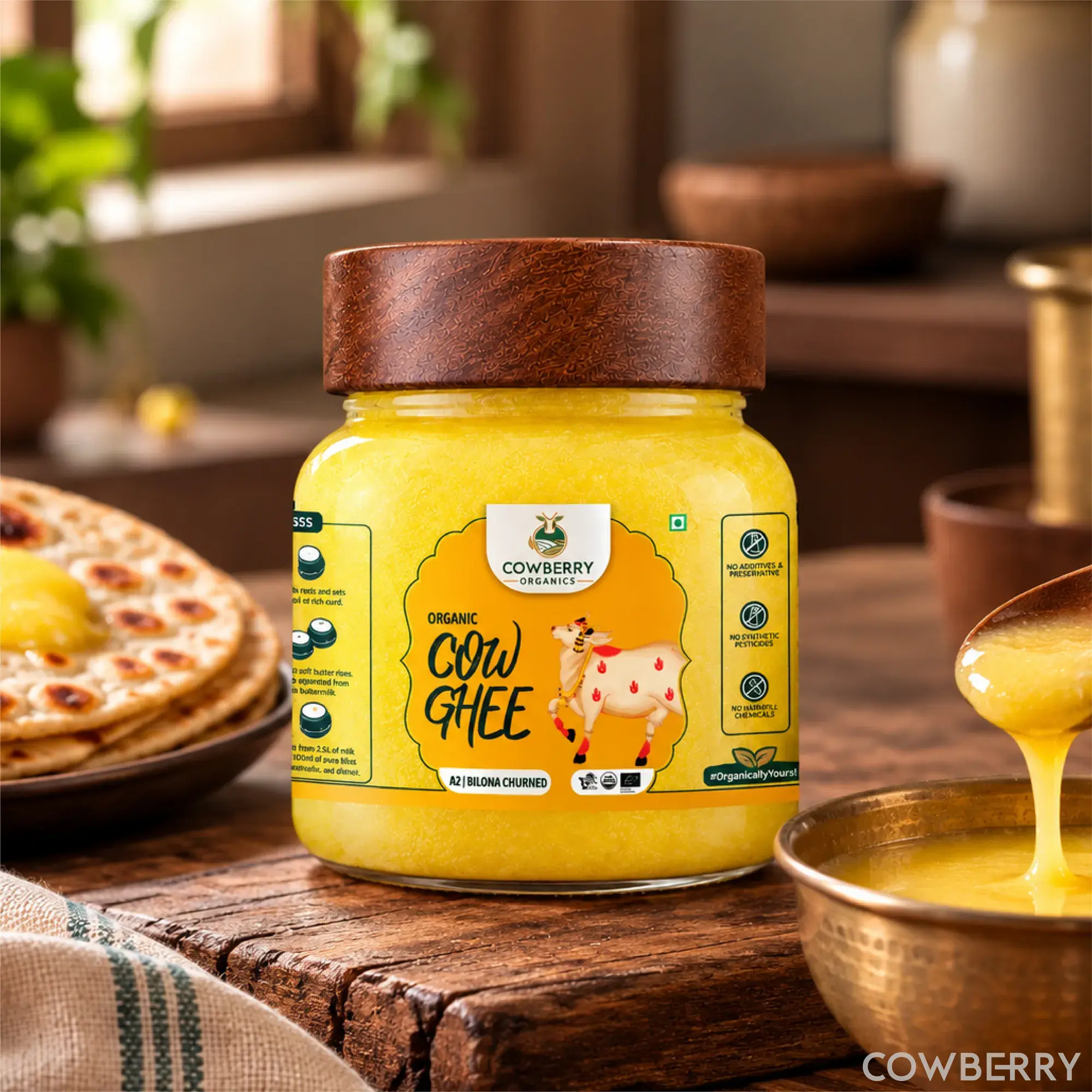
Shop this article
Keep reading
Cold pressed oil benefits: why they survive processing better
Mustard oil vs refined oil: nutrition, cooking and which to choose
Mustard oil omega 3: nutrition, calories and fat per 100g