by COWBERRY

15 minute read
Types of millets in India: names, nutrition and how to use each

The types of millets grown in India fall into three groups: the major millets jowar and bajra; the small or minor millets ragi, foxtail, kodo, little, barnyard and proso; and the pseudo-millets rajgira and kuttu, which come from broad-leaved plants rather than grasses. This guide gives each one its names in Indian languages, its nutrition per 100 g where a tested value exists, and the dishes it suits.
What is millet?
Millet is not one grain. The word covers a group of small-seeded grasses that farmers grow for food and fodder. ICAR-Indian Institute of Millets Research (IIMR) describes millets as a functional or agronomic group, not a taxonomic one: what they share is a small grain, a short growing season and the ability to yield in dry, hot conditions where other crops do poorly.
IIMR lists eight millets commonly cultivated in India under rain-fed conditions: sorghum, pearl millet, finger millet, foxtail millet, kodo millet, proso millet, barnyard millet and little millet. The United Nations declared 2023 the International Year of Millets, and FAO, which led the year, notes that millets can grow on arid land with minimal inputs.
Millets types at a glance
- Major millets: jowar (sorghum) and bajra (pearl millet), grown on a large scale and eaten as roti, bhakri, khichdi and porridge.
- Small or minor millets: ragi (finger millet), foxtail, kodo, little, barnyard and proso millet. Ragi is ground for mudde, roti and porridge; the other five are husked and cooked like rice.
- Pseudo-millets: rajgira (amaranth) and kuttu (buckwheat), which are seeds of broad-leaved plants, not grasses, but are cooked and sold alongside millets, mostly as fasting foods.
One note on the grouping: IIMR's bulletin names ragi among the small millets, and this guide follows it, although India grows far more ragi than the rest of the group: 1.8 million tonnes in 2015-16 against 0.39 million tonnes for the other small millets together, by IIMR's figures. IIMR notes that sorghum and the millets are gluten-free. Whichever you choose, the whole or unpolished grain is the one that still has its bran.
Major millets: jowar and bajra
Jowar and bajra are the major millets of India, each with a roti, a porridge and a regional cuisine of its own. Their IFCT 2017 values per 100 g of raw grain sit in the table that closes this section.
Jowar (sorghum)
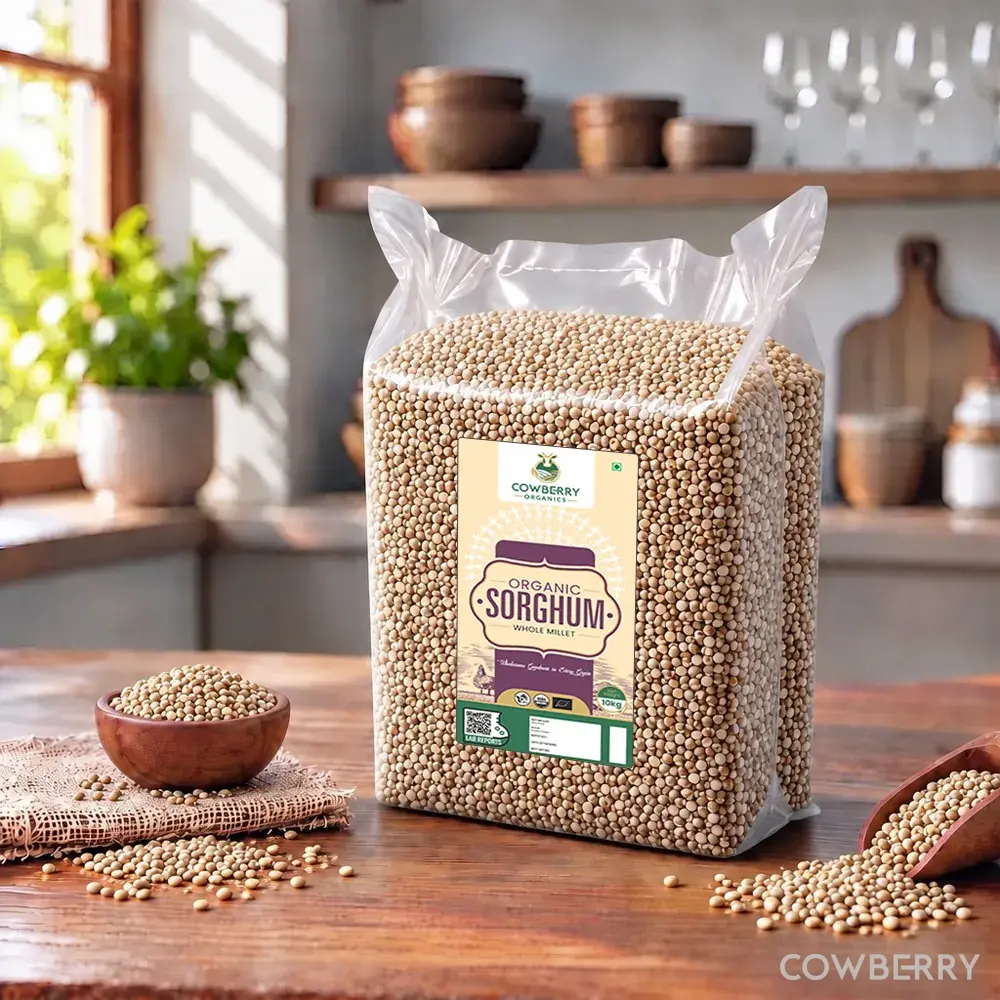
Jowar, Sorghum bicolor, is a round, cream-white grain, mild and faintly sweet. In IIMR's bulletin it is a major crop in Maharashtra, Telangana and Andhra Pradesh, and in parts of central India too. It has 334 kcal, 10 g protein and 10.2 g fibre per 100 g. The flour goes into bhakri and roti; the whole grain is soaked and cooked into upma and khichdi, or popped like corn. The University of Sydney's GI database gives boiled, de-husked jowar a GI of 66, from a single test. Names, nutrition and uses are in the jowar guide.
Bajra (pearl millet)
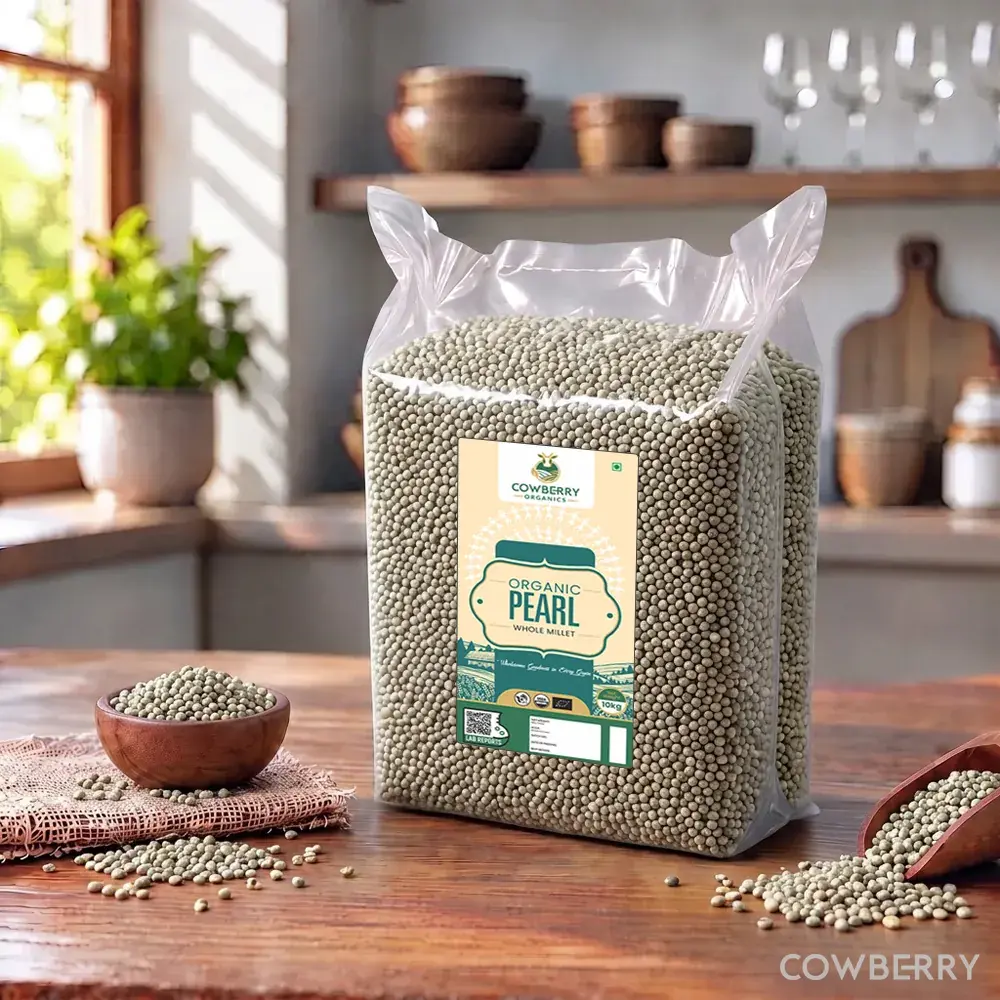
Bajra, Pennisetum glaucum, is a grey-green grain with a nutty, slightly bitter taste. IIMR calls pearl millet the most widely grown millet, adapted to drought, poor soil and heat, and the primary crop of desert Rajasthan. Per 100 g it has 348 kcal, 11 g protein, 11.5 g fibre, 6.4 mg iron and 5.4 g fat, more iron and fat than jowar or ragi. In the north and west it is a winter food: roti, rotlo, khichdi and raab. The database has no plain-grain entry for bajra; its GI of 57 is the mean of three tests on bajra roti. See the bajra guide.
| Nutrient | Jowar (sorghum) | Bajra (pearl millet) |
|---|---|---|
| Energy (kcal) | 334 | 348 |
| Protein (g) | 10 | 11 |
| Fat (g) | 1.7 | 5.4 |
| Carbohydrates (g) | 68 | 62 |
| Dietary fibre (g) | 10 | 11 |
| Iron (mg) | 4 | 6.4 |
| Calcium (mg) | 28 | 27 |
| Magnesium (mg) | 133 | 124 |
| Potassium (mg) | 328 | 365 |
| Sodium (mg) | 5.4 | 4.1 |
| Zinc (mg) | 2 | 2.8 |
| Folate (mcg) | 39 | 36 |
| Glycemic index (GI) | 66 | 57 |
Per 100 g raw, edible portion. Composition: IFCT 2017 (ICMR-NIN). GI: University of Sydney GI database. — means not reported. These are average values for the food; the label on a pack gives the values for that product.
Small or minor millets: ragi, foxtail, kodo, little, barnyard and proso
IIMR's bulletin names ragi (finger millet), foxtail, barnyard, little and proso millet as small millets, found in most of the southern and central states, especially where annual rainfall is below 350 mm. This section adds kodo millet. IFCT 2017 values for ragi, kodo and little millet are in the table that closes the section.
Ragi (finger millet)
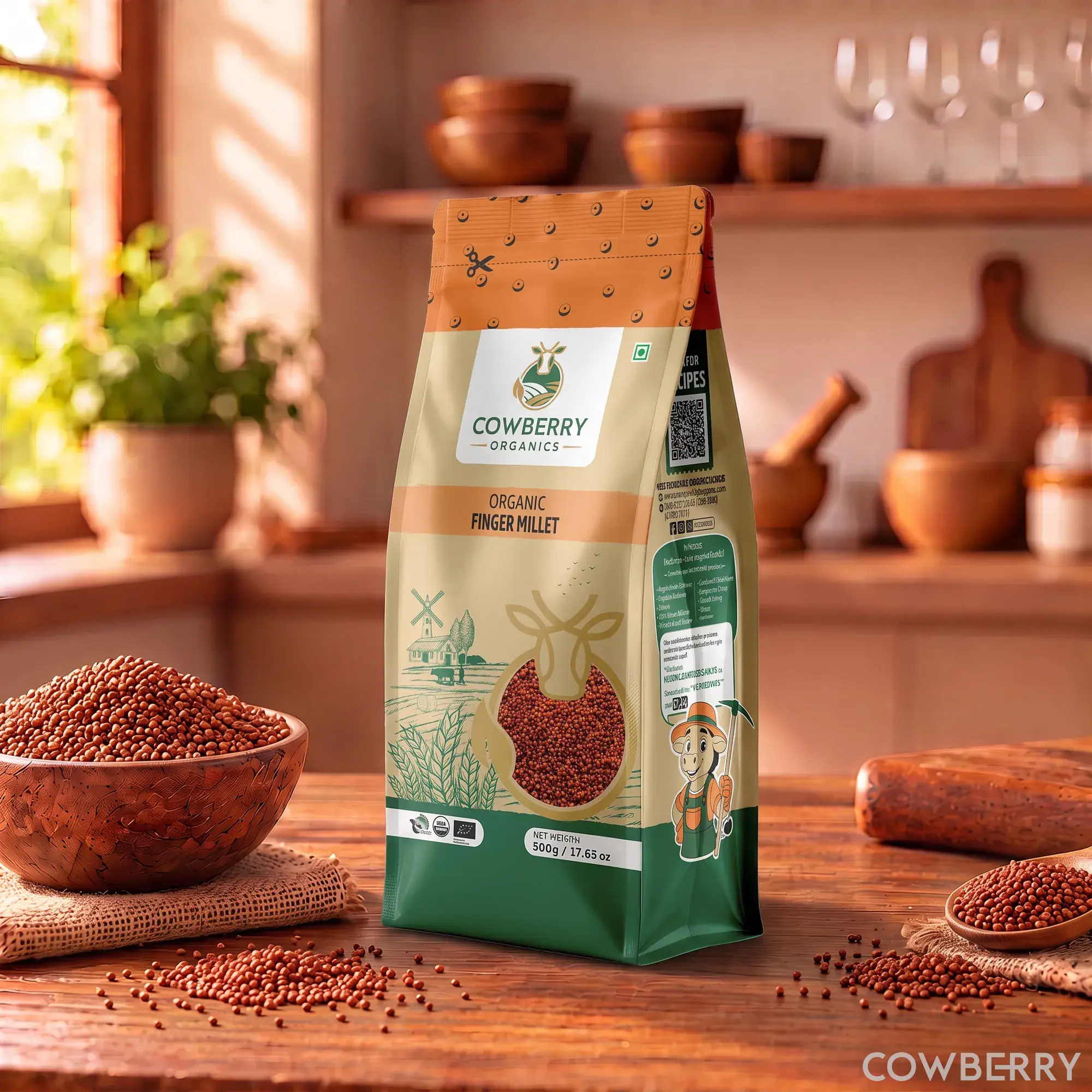
Ragi, Eleusine coracana, is a tiny, reddish-brown grain with an earthy taste, used mainly as flour. IIMR traces the English name to the finger-like spikes of its seed head. Per 100 g it has 321 kcal, 7.2 g protein, 11.2 g fibre and 364 mg calcium, and IIMR's bulletin calls finger millet the richest source of calcium among millets. Plain ragi has a GI of 68, from a single test. It is eaten as mudde, roti, dosa, ambli and malt: see the ragi guide.
Foxtail millet (kangni, navane, tenai)
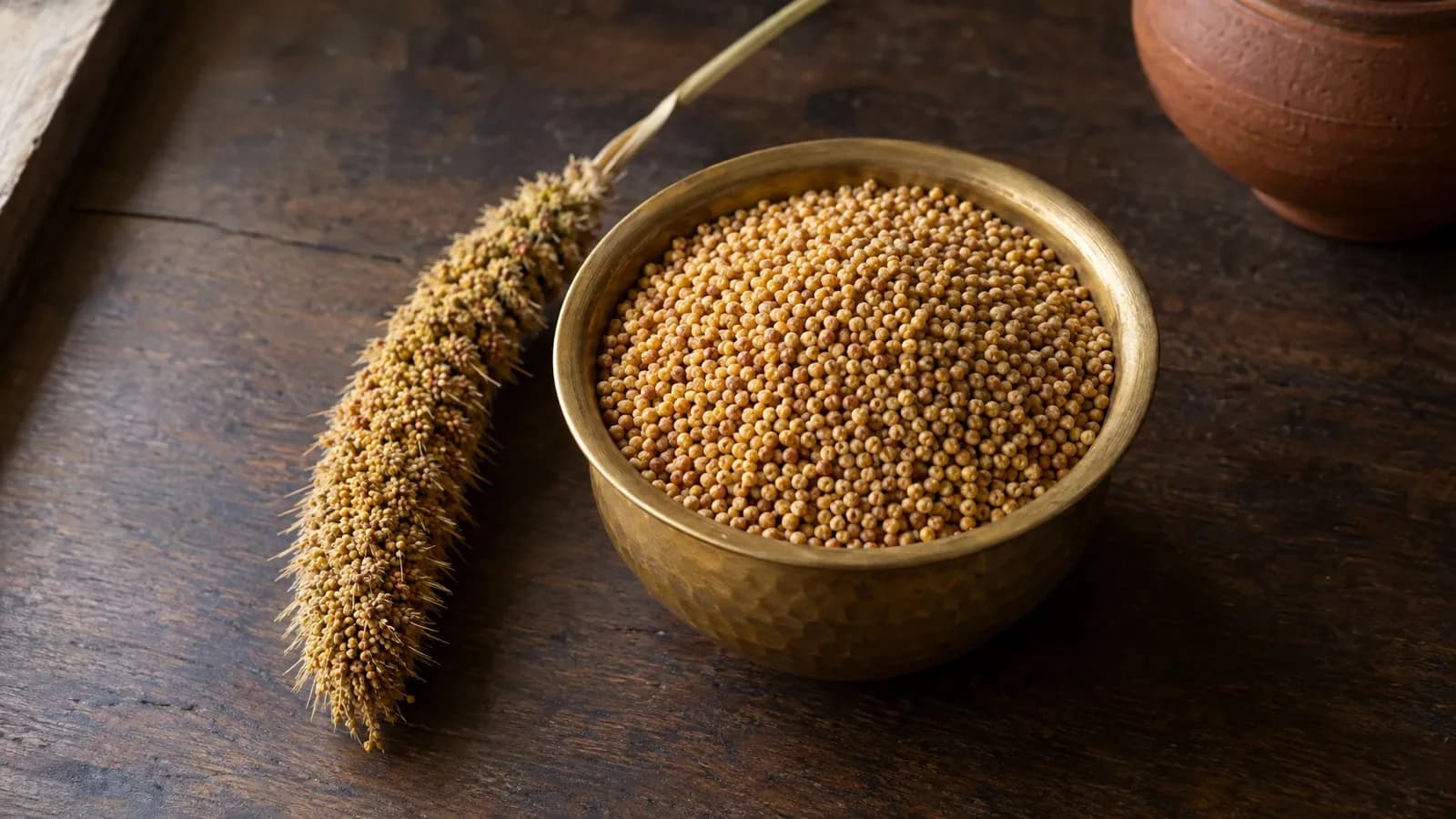
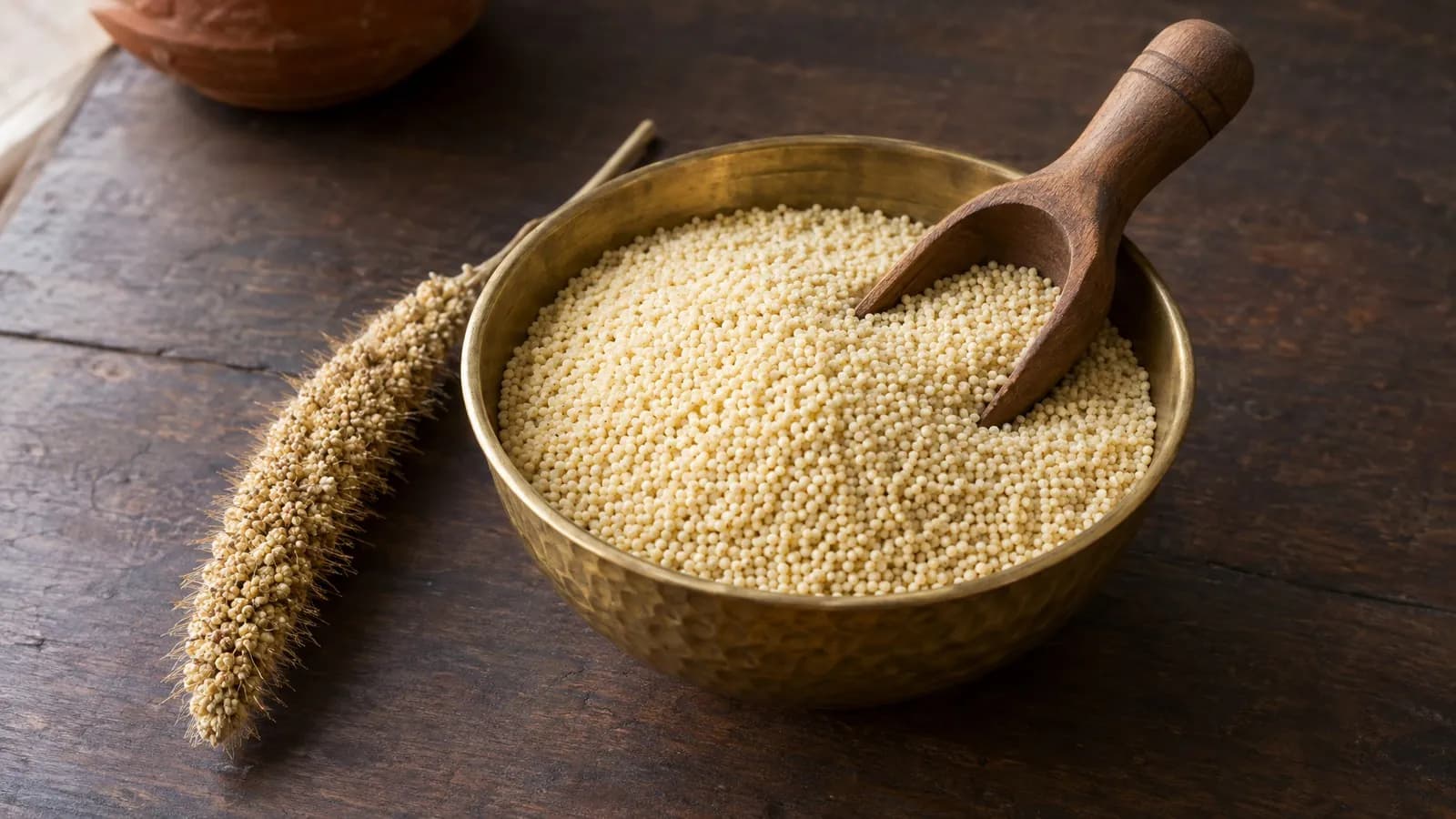
Foxtail millet, Setaria italica, is a small yellow grain with a mild taste. IIMR regards it as a native of China, second among millets in world production. IFCT 2017 has no entry for it; its one tested figure is a GI of 89 for plain cooked unpolished grain.
Kodo millet (kodon, varagu)
Kodo millet, Paspalum scrobiculatum, is described by IIMR as an indigenous cereal of India, grown in Uttar Pradesh, Kerala and Tamil Nadu. It has 332 kcal, 8.9 g protein, 6.4 g fibre and 2.3 mg iron per 100 g; no GI is reported for the plain grain.
Little millet (kutki, samai)
Little millet was domesticated in India. IIMR describes a round, smooth grain from a plant that stands both drought and waterlogging. IFCT lists it as samai: 347 kcal, 10.1 g protein, 7.7 g fibre and 3.9 g fat per 100 g, with a tested GI of 89 for plain cooked unpolished grain.
Barnyard millet (sanwa, oodalu)
Barnyard millet is a small white grain, cultivated for food and fodder, that IIMR lists as sanwa in Hindi and oodalu in Kannada. In north and west India it is a common fasting (vrat) grain. Neither IFCT 2017 nor USDA has an entry for it, and the GI database has no entry.
Proso millet (chena, barri)
Proso millet, Panicum miliaceum, is a pale, round grain from an annual grass suited to dry climates, northern India among them. IFCT 2017 has no entry for it.
A 2021 meta-analysis placed foxtail among the low-GI millets, though the single Indian test above gave 89, and found little millet's data inconsistent: read each tested value as one result.
| Nutrient | Ragi (finger millet) | Kodo millet (varagu) | Little millet (samai) |
|---|---|---|---|
| Energy (kcal) | 321 | 332 | 347 |
| Protein (g) | 7.2 | 8.9 | 10 |
| Fat (g) | 1.9 | 2.5 | 3.9 |
| Carbohydrates (g) | 67 | 66 | 66 |
| Dietary fibre (g) | 11 | 6.4 | 7.7 |
| Iron (mg) | 4.6 | 2.3 | 1.3 |
| Calcium (mg) | 364 | 15 | 16 |
| Magnesium (mg) | 146 | 122 | 91 |
| Potassium (mg) | 443 | 94 | 105 |
| Sodium (mg) | 4.8 | 3.4 | 4.8 |
| Zinc (mg) | 2.5 | 1.6 | 1.8 |
| Folate (mcg) | 35 | 39 | 36 |
| Glycemic index (GI) | 68 | — | 89 |
Per 100 g raw, edible portion. Composition: IFCT 2017 (ICMR-NIN). GI: University of Sydney GI database. — means not reported. These are average values for the food; the label on a pack gives the values for that product.
Pseudo-millets: rajgira (amaranth) and kuttu (buckwheat)
Rajgira and kuttu are not millets in the botanical sense. Both are seeds of broad-leaved plants. Neither is wheat, barley or rye, the three cereals that contain gluten, and both are cooked the way millets are, so shops and fasting menus group them together. The table under this section sets the two side by side.
Rajgira (amaranth)
Rajgira is the seed IFCT lists as amaranth seed, pale brown (Amaranthus cruentus), with the local names ramdana in Hindi and rajagaro in Gujarati. It is a tiny, pale seed that pops like popcorn. Per 100 g it has 356 kcal, 13.3 g protein, 7.5 g fibre, 8 mg iron, 162 mg calcium and 270 mg magnesium (IFCT 2017). No GI is reported for plain amaranth. Popped, it goes into laddu and chikki; as flour, into puri, thalipeeth and porridge.
Kuttu (buckwheat)
Kuttu is buckwheat, Fagopyrum esculentum, a three-cornered seed that is no relation of wheat. IFCT 2017 does not list it, so the values here come from USDA FoodData Central: 343 kcal, 13.2 g protein, 10 g fibre, 231 mg magnesium and 460 mg potassium per 100 g, with a GI of 53 for plain boiled groats. Kuttu ka atta is the flour of Navratri: puri, pakora, cheela and paratha bound with boiled potato.
Both carry more protein per 100 g than any millet in the two tables above, and rajgira has more iron than bajra. They are eaten in small amounts, though, so the millets still do the daily work.
| Nutrient | Rajgira (amaranth seed) | Kuttu (buckwheat) |
|---|---|---|
| Energy (kcal) | 356 | 343 |
| Protein (g) | 13 | 13 |
| Fat (g) | 5.6 | 3.4 |
| Carbohydrates (g) | 61 | 72 |
| Dietary fibre (g) | 7.5 | 10 |
| Iron (mg) | 8 | 2.2 |
| Calcium (mg) | 162 | 18 |
| Magnesium (mg) | 270 | 231 |
| Potassium (mg) | 413 | 460 |
| Sodium (mg) | 2.8 | 1 |
| Zinc (mg) | 2.5 | 2.4 |
| Folate (mcg) | 25 | 30 |
| Vitamin C (mg) | — | 0 |
| Glycemic index (GI) | — | 53 |
Per 100 g raw, edible portion. Composition: IFCT 2017 (ICMR-NIN); USDA FoodData Central (SR Legacy), FDC ID 170286, NDB 20008. GI: University of Sydney GI database. — means not reported. These are average values for the food; the label on a pack gives the values for that product.
Millet names in Indian languages
The same millet changes its name every few hundred kilometres. Both tables use the vernacular names printed by ICAR-IIMR on its millets page and in its nutrition bulletin, spelled as IIMR spells them; a dash means no name is listed.
| Language | Jowar (sorghum) | Bajra (pearl millet) | Ragi (finger millet) |
|---|---|---|---|
| Hindi | Jowar, Jowari, Juar | Bajra | Ragi, Mandua, Mandika, Marwah |
| Marathi | Jwari | Bajri | Nachni, Nagli |
| Gujarati | Jowari, Juar | Bajri | Nagli, Bavto |
| Punjabi | Jowar | Bajra | Mandhuka, Mandhal |
| Bengali | Jowar, Juar | Bajra | Marwa, Mandua |
| Odia | Juara | Bajra | Mandia |
| Kannada | Jola | Sajje | Ragi |
| Telugu | Jonna | Sajja, Sajjalu | Ragi Chodi, Ragulu |
| Tamil | Cholam | Kambu | Kelvaragu, Keppai, Ragi |
| Malayalam | Cholam | Kamboo | Moothari |
| Language | Foxtail | Kodo | Little | Barnyard | Proso |
|---|---|---|---|---|---|
| Hindi | Kangni, Kakum | Kodon | Kutki, Shavan | Sanwa, Jhangon | Chena, Barri |
| Marathi | Kang, Rala | Kodra | Sava, Halvi, Vari | Shamul | Vari |
| Gujarati | Kang | Kodra | Gajro, Kuri | Sama | Cheno |
| Punjabi | Kangni | Kodra | Swank | Swank | Cheena |
| Bengali | Kaon | Kodo | Sama | Shyama, Shamula | Cheena |
| Odia | Kanghu, Kangam, Kora | Kodua | Suan | Khira | China Bachari bagmu |
| Kannada | Navane | Harka | Same, Save | Oodalu | Baragu |
| Telugu | Korra, Korralu | Arikelu, Arika | Samalu | Udalu, Kodisama | Variga, Varigulu |
| Tamil | Tenai | Varagu | Samai | Kuthiravaali | Pani varagu |
| Malayalam | Thina | Varagu | Chama | — | Panivaragu |
Foxtail millet in Kannada, Tamil, Telugu and Hindi
Foxtail millet is navane in Kannada, tenai in Tamil, korra in Telugu, thina in Malayalam and kangni or kakum in Hindi.
Varagu in English
Varagu is the Tamil name of kodo millet, so kodo millet in English and varagu are one grain: kodon in Hindi, kodra in Gujarati, Marathi and Punjabi, harka in Kannada, arikelu in Telugu. Pani varagu is a different grain, proso millet.
Samai millet in English
Samai is the Tamil name of little millet. Kannada calls it same or save, Telugu samalu, Marathi sava, Malayalam chama and Hindi kutki.
Barnyard millet names, and the vari mix-up
Barnyard millet is sanwa or jhangon in Hindi, shamul in Marathi, sama in Gujarati, oodalu in Kannada, udalu or kodisama in Telugu and kuthiravaali in Tamil. Vari needs care: IIMR prints it as the Marathi name of both little millet and proso millet, so when a pack says vari, go by the English name beside it.
Which millet for which dish
Choose the millet by the dish you already cook. Jowar, bajra and ragi flour make breads, the husked small millets replace rice, and ragi covers breakfast and dessert as well.
- Roti and bhakri: jowar, bajra and ragi flour. Without gluten the dough will not roll thin, so it is mixed with hot water and shaped by patting. Try jowar bhakri, bajra roti or ragi roti.
- Dosa and idli: ragi or jowar flour in the batter, or kodo and little millet ground in place of rice. Start with ragi dosa or jowar dosa.
- Upma and khichdi: whole jowar and bajra after an overnight soak, or foxtail, little and barnyard millet after a short one, as in jowar upma and bajra khichdi.
- Porridge, malt and mudde: ragi flour cooked in water, with milk optional in porridge and malt, as in ragi porridge, ragi malt and ragi mudde.
- In place of rice: foxtail, little, kodo, barnyard and proso millet for curd rice, lemon rice, pulao and pongal, with two to two and a half cups of water for each cup of grain.
- Sweets: dry-roasted ragi flour bound with ghee and jaggery for ragi laddu, popped rajgira set with jaggery for laddu and chikki, and little millet for kheer.
- Fasting days: barnyard millet (sanwa), rajgira and kuttu, which are eaten when rice and wheat are not.
For the first meal of the day, our millet recipes collect the breakfast dishes in one place, and millets vs rice compares the two grains number by number.
How to start: one millet meal a day, soaking and storage
One millet meal a day
Change one meal, not the whole kitchen. Swap the dinner roti for jowar bhakri, or the breakfast for ragi porridge, and keep to that until your stomach is used to it before adding a second millet meal. Millets carry two to four times the fibre of polished rice, and a sudden jump can bring gas and bloating; a gradual start and enough water help. Rotate the millets through the week instead of eating one every day.
Soaking, sprouting and fermenting
Whole jowar and bajra need 8 hours in water before they will cook soft. Small millets need only a rinse, or 20 to 30 minutes in water if you have time. Soaking does more than shorten the cooking. IIMR notes that phytates and tannins, which millets carry along with their fibre, affect the bioavailability of minerals. In the eight laboratory studies covered by a 2021 systematic review, fermenting and germinating millets raised their bioavailable iron. Sprouted ragi flour, fermented dosa batter and ambli are old kitchen forms of the same idea.
What regular millet meals did in studies
That review also pooled 19 studies of people with anaemia and found haemoglobin rising with regular consumption of millets. A separate meta-analysis from the same year found that, in people with diabetes, blood glucose both fasting and after meals came down with long-term millet eating. Both findings concern millets eaten regularly over time, not a single meal.
Who should take advice first
Nine papers went into a 2024 systematic review of the concern that bajra causes goitre. The reviewers did not find the literature compelling or strong enough to assert that pearl millet, as part of a balanced diet, causes goitre in the general population, and they want more research before anyone states it conclusively. With a thyroid condition, or with diabetes managed on medicines, how much millet suits you is a question for your own clinic: talk to your doctor or dietitian.
Storage
Whole millets store well: a dry, tightly closed steel tin or glass jar, kept away from the stove and the sink, is all they need. Flour is a different matter. A 2025 review describes the shelf life of pearl millet flour as limited, with rancidity and off-flavour as the reason. Cooks know the result as the sharp, bitter taste of old bajra atta. Buy millet flours in small packs and keep them in the fridge in humid months. The monsoon routine is set out in our guide on how to store atta and whole grains.
How to buy millets: what to look for
A few checks at the shelf save a bad batch at home.
- Read the English name. Regional names overlap: sama, vari and swank each point to more than one millet in the tables above. The English name on the pack settles it.
- Choose unpolished small millets. Polishing takes off the bran, and IIMR describes the bran of millets as a rich source of dietary fibre. Unpolished grain is duller and a shade darker than the pearly polished kind.
- Look and smell. Whole grain should be even in colour and size, free of stones, dust and webbing, with a faintly sweet smell. Flour should smell nutty, never bitter or musty.
- Buy grain in large packs and flour in small ones. Whole grain keeps; flour does not.
- Check the certification. An organic claim should be backed by the certification marks printed on the pack, not by the word natural.
COWBERRY sells jowar, bajra and ragi as whole grain and as flour, all India Organic, USDA & EU certified: finger millet from Karnataka and the Western Ghats, sorghum from Maharashtra and pearl millet from Rajasthan and Gujarat, with ragi flour, jowar flour and bajra flour from the same regions.
FAQs
What is millet?
Millet is not a single crop but a shared name for several small-seeded grasses whose grain is eaten as food. In India it takes in the major millets, jowar and bajra, and the small millets: ragi, foxtail, kodo, little, barnyard and proso. They can grow on dry land with few inputs, contain no gluten, and are eaten as roti, as porridge or in place of rice.
Is quinoa a millet?
No. Quinoa is the seed of Chenopodium quinoa, a broad-leaved plant, while millets are grasses. It is cooked like a small millet and has no gluten, which is why the two are often shelved together. In the terms of this guide quinoa is a pseudo-millet, in the same group as rajgira and kuttu.
Is oats a millet?
No. Oats are a separate cereal and are not on the list of millets that ICAR-IIMR gives for India: sorghum, pearl, finger, foxtail, kodo, proso, barnyard and little millet. The two are often shelved together because both are eaten as whole grains and both suit porridge, but oats are sold rolled or cut, and millets as whole grain or flour.
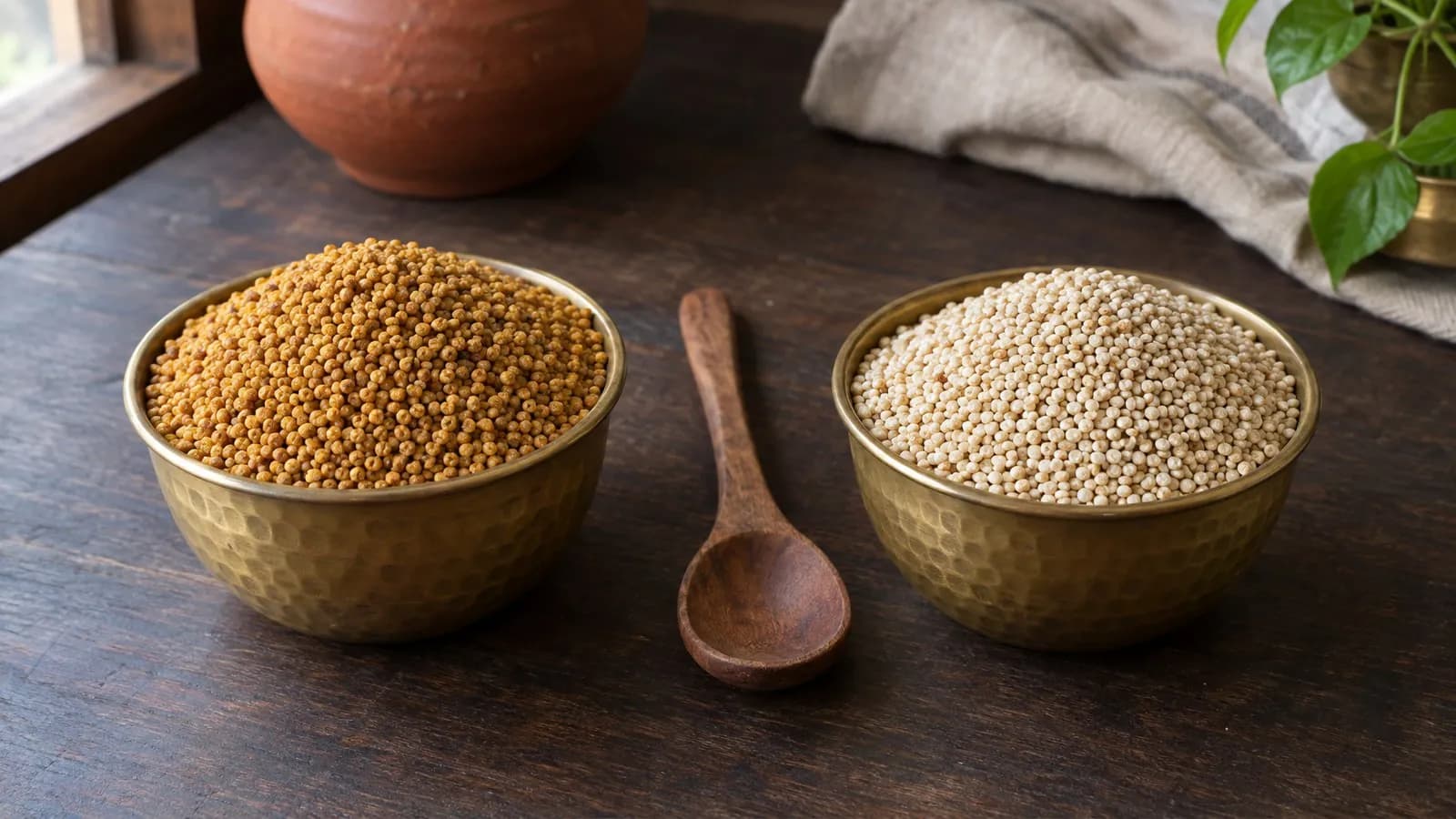
Is foxtail millet and quinoa same?
No. Foxtail millet is a true millet, a grass with small yellow grains, called kangni in Hindi, navane in Kannada, tenai in Tamil and korra in Telugu. Quinoa is the seed of a broad-leaved plant and is not a grass at all. They look alike once cooked and can replace each other in upma, pulao and salads.
Which millet flour is best?
It depends on what you want from it. Ragi flour leads on calcium, with 364 mg per 100 g; bajra flour has 6.4 mg iron and 11 g protein; jowar flour is mild in taste and makes a good first millet roti. Buy the one you will cook every week, in a small pack, and finish it while it is fresh.
Is millet flour gluten free?
Yes. Gluten is a protein of three cereals, wheat, barley and rye (NHS); no millet is one of them, so every millet in this guide is gluten-free. That is also why millet rotis are patted by hand and break more easily than wheat chapatis. If you have coeliac disease, choose flour that is milled and packed away from wheat, and talk to your doctor or dietitian.
References
- Indian Food Composition Tables (IFCT) 2017, ICMR-National Institute of Nutrition
- ICAR-Indian Institute of Millets Research: millets information and vernacular names
- Nutritional and health benefits of millets, ICAR-Indian Institute of Millets Research (PDF)
- University of Sydney glycemic index database (GI search)
- USDA FoodData Central
- FAO: International Year of Millets 2023
- Anitha S et al. A systematic review and meta-analysis of the potential of millets for managing and reducing the risk of developing diabetes mellitus. Front Nutr, 2021
- Anitha S et al. Millets can have a major impact on improving iron status, hemoglobin level and reducing iron deficiency anaemia: a systematic review and meta-analysis. Front Nutr, 2021
- Anitha S, Upadhyay S, Grando S et al. Does consumption of pearl millet cause goiter? A systematic review of existing evidence. Front Nutr, 2024
- Naraharasetti B, Chakraborty S. Thermal and nonthermal processing of pearl millet flour: impact on microbial safety, enzymatic stability, nutrients, functional properties, and shelf-life extension. Compr Rev Food Sci Food Saf, 2025
- NHS: coeliac disease
Shop this article
Keep reading
Foxtail millet vs quinoa: nutrition, taste and which to choose
Foxtail millet in Kannada, Hindi, Tamil and other Indian names
10 benefits of kangni (foxtail millet) and its side effects