
Jowar bhakri
Preparation Time
15 minutes
Cooking Time
25 minutes
Difficulty Level
moderate
Meal Type
Lunch
Serves 3
Key Ingredients
- Jowar (sorghum) flour
About This Recipe
Bhakri is the flatbread of rural Maharashtra, and jwarichi bhakri, the jowar version, is the common one in Marathwada, Solapur and Vidarbha, and across the border in north Karnataka, where the same bread is called jolada rotti. It is not rolled. A ball of dough is patted out on a board with the flat of the fingers, lifted onto a hot tawa, and its top is smeared with water; that film turns to steam and the bhakri puffs into two layers when it meets the flame. This recipe follows the village method with one change many home cooks make: the dough is mixed with boiling water rather than cold, which makes it far easier to pat without cracks.
Jowar has no gluten, so the dough has nothing elastic to hold it together; hot water gelatinises some of the starch and does that job instead. The finished bhakri is soft and slightly chewy while warm, with a thin dry skin and a faintly sweet, nutty taste that goes well with a hot green thecha or a soft pithla. It firms up as it cools, so serve it warm or keep it wrapped in a cloth until the meal.
The same method makes bajra bhakri in winter, or a half-jowar, half-bajra one. If your bhakris keep breaking, mix a tablespoon of rice flour into the dough for the first few tries. More ways to use the flour and the whole grain are in the full set of jowar recipes.
Ingredient List
Serving Size:
1x
2x
3x
Dough
- Jowar (sorghum) flour — 2 cups
- Boiling water — 1 1/2 cups

- Salt — 1/2 tsp
For patting
- Jowar flour, for dusting — 2 tbsp
For cooking
- Water, for brushing the top — 1/4 cup
To serve
- Ghee, 1 tsp per bhakri (optional) — 6 tsp
Skip The Store !
Get all you need for the recipe in just a few clicks
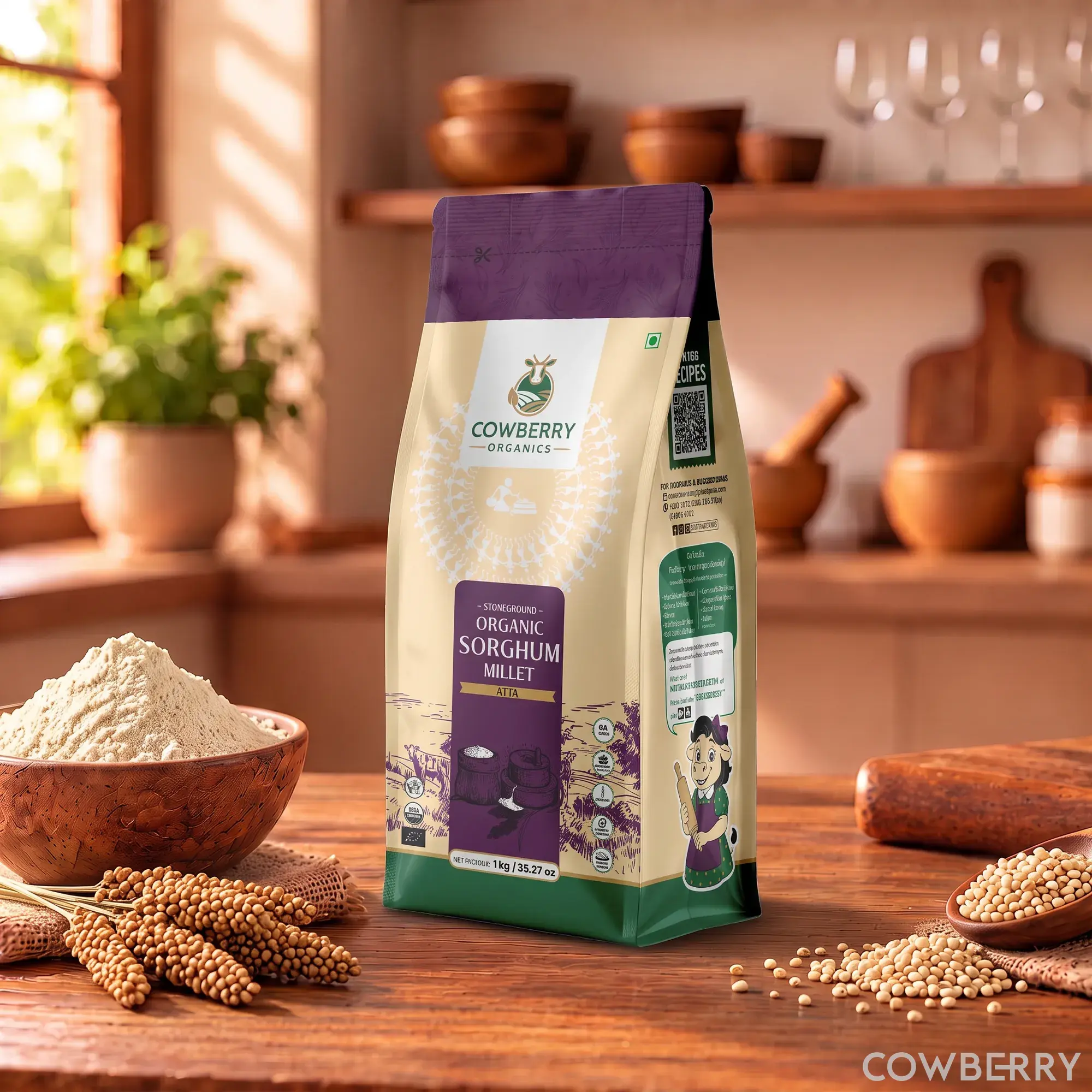
Serving Suggestions
Serve bhakri hot with a teaspoon of ghee on top and the classic Maharashtrian sides: pithla (a soft besan curry), zunka, green thecha or dry garlic chutney, a raw onion and a bowl of curd. It also goes with bharli vangi, matki usal, any dal or a dry vegetable sabzi. In villages, leftover bhakri is broken into a bowl of hot milk or dal for breakfast; keep it in the fridge overnight if you plan to do the same.
Tips for Cooking Jowar bhakri
Four things decide a bhakri. The water must be boiling when it hits the flour, or the dough cracks at the edges. Knead while the dough is warm and keep your palm wet; a cold dough will not pat out. Keep the bhakri 3 to 4 mm thick with an even edge, and use a properly hot tawa: too cool and it dries out before it can puff, too hot and the water film burns off before the inside cooks.

Chef’s Note
Smell the flour before you start: good jowar flour smells sweet and makes a pliable dough, while old flour turns bitter and crumbly and no amount of kneading will fix it. Stone-ground flour that still has its bran gives a speckled colour and a fuller flavour. One 40 g bhakri comes to about 134 kcal, 4 g protein and 4.1 g fibre before the ghee, so a serving of two is about 267 kcal.
Per serving (approx.): 267 kcal, protein 8 g, carbs 54 g, fat 1.4 g, fibre 8.2 g. Computed from IFCT 2017 / USDA values for the listed quantities. Measures: 1 cup = 240 ml, 1 tbsp = 15 ml, 1 tsp = 5 ml.
Happy Cooking !!
!!
ByCOWBERRY
Jul 10, 2026
Recipes You’ll Love
More everyday cooking with COWBERRY organics, from the same kitchen.

Preparation Time
15 Min
Cooking Time
25 Min
Difficulty Level
easy

Preparation Time
10 Min
Cooking Time
30 Min
Difficulty Level
easy

Preparation Time
20 Min
Cooking Time
30 Min
Difficulty Level
easy