by COWBERRY

12 minute read
Ragi (finger millet): names, nutrition, benefits and how to use it

Ragi is the Indian name for finger millet (Eleusine coracana), a small red-brown, naturally gluten-free grain that gives 364 mg of calcium and 11.2 g of fibre per 100 g, over nine times the calcium of whole wheat (IFCT 2017). Whole ragi is cooked or sprouted, and the flour goes into mudde, roti, dosa, porridge and laddu.
What is ragi?
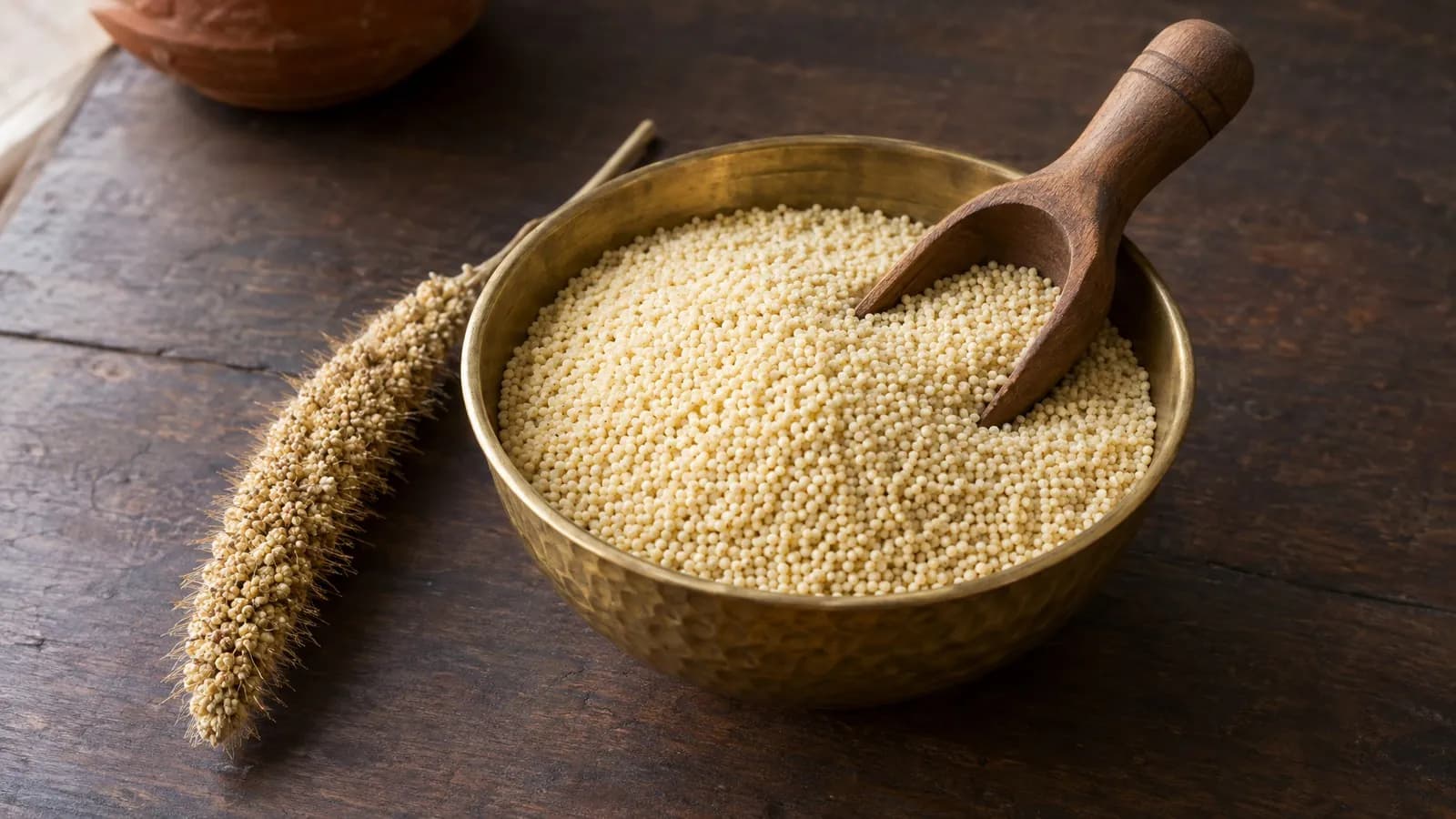
Ragi is finger millet, an annual grass grown for its small grain. Its seed head is a cluster of finger-like spikes, which is where the English name comes from. The seeds have a brick-red coat (a paler white ragi is also grown) and a mildly earthy, nutty taste.
Ragi is still a main part of the everyday diet in Karnataka, and ICAR-IIMR describes it as a primary crop in Tamil Nadu and Gujarat, usually grown under rain-fed conditions.
You will find it sold two ways: as whole ragi grain, which is soaked, cooked or sprouted, and as ragi flour (ragi atta, nachni atta), the everyday form for rotis, dosa, mudde and porridge. In Hindi the grain is called ragi or mandua, in Marathi nachni; the full list of ragi names in Hindi, English and other Indian languages is on its own page. It is one of the eight types of millets commonly grown in India.
Ragi names in Indian languages
Since ragi is also the word IFCT 2017 prints for Hindi, Bengali, Assamese, Kannada and Telugu, a common search is "ragi in English": the answer is finger millet, Eleusine coracana to botanists. Marathi speakers say nachni (IFCT 2017 prints a different word, noted below the table) and Tamil speakers kelvaragu, while IFCT gives bavato for Gujarati, mandal for Punjabi, mandia for Odia and mandwa for Urdu. The table below is the IFCT 2017 list, with the Marathi name corrected from ICAR-IIMR.
| Language | Name (romanised) |
|---|---|
| English | Ragi |
| Hindi | Ragi |
| Marathi | Nachni |
| Gujarati | Bavato |
| Punjabi | Mandal |
| Bengali | Ragi |
| Odia | Mandia |
| Assamese | Ragi |
| Kannada | Ragi |
| Telugu | Ragi |
| Tamil | Kelvaragu |
| Malayalam | Panjapulle |
| Urdu | Mandwa |
| Sanskrit | Madhulika |
| Botanical name | Eleusine coracana |
Source: IFCT 2017 (ICMR-NIN) local-names list. — means no name recorded in the source.
Marathi: IFCT 2017 prints ‘Bakri’; ‘Nachni’ per ICAR-Indian Institute of Millets Research, millets information page (vernacular names).
Ragi nutrition per 100 g
Per 100 g of raw grain, IFCT 2017 reports 321 kcal, 7.2 g protein, 1.9 g fat, 66.8 g carbohydrate and 11.2 g total fibre. What sets ragi apart is the mineral column: 364 mg calcium, 4.6 mg iron, 146 mg magnesium and 443 mg potassium. Whole wheat, by comparison, has 39.4 mg calcium, and raw milled rice has 7.5 mg calcium and 2.8 g fibre.
Protein is where wheat wins: 10.6 g against ragi's 7.2 g, and ragi's protein is low in lysine, so pairing it with dal, curd or milk rounds it out. In the University of Sydney GI database, soaked and steamed ragi grain tested in India scores 68, in the medium band; finger-millet rotis tested in India and Sri Lanka have come out both above and below that figure.
In kitchen terms, one medium roti takes about 30 g of flour, and that flour gives roughly 96 kcal, 109 mg calcium and 3.4 g fibre before any ghee. Figures for mudde, porridge and malt servings, and the full micronutrient list, are in the ragi nutritional value per 100 g breakdown.
| Nutrient | Ragi (finger millet) | Whole wheat | Rice (raw, milled) |
|---|---|---|---|
| Energy (kcal) | 321 | 322 | 357 |
| Protein (g) | 7.2 | 11 | 7.9 |
| Fat (g) | 1.9 | 1.5 | 0.5 |
| Carbohydrates (g) | 67 | 65 | 78 |
| Dietary fibre (g) | 11 | 11 | 2.8 |
| Iron (mg) | 4.6 | 4 | 0.7 |
| Calcium (mg) | 364 | 39 | 7.5 |
| Magnesium (mg) | 146 | 125 | 19 |
| Potassium (mg) | 443 | 366 | 108 |
| Sodium (mg) | 4.8 | 2.5 | 2.3 |
| Zinc (mg) | 2.5 | 2.9 | 1.2 |
| Folate (mcg) | 35 | 30 | 9.3 |
| Glycemic index (GI) | 68 | 47 | 50 |
Per 100 g raw, edible portion. Composition: IFCT 2017 (ICMR-NIN). GI: University of Sydney GI database. — means not reported. These are average values for the food; the label on a pack gives the values for that product.
Benefits of ragi
Each point below goes back to a figure in the table; the sources and the detail are in the full list of ragi benefits.
Calcium without dairy
ICAR-IIMR describes finger millet as the richest source of calcium among millets, and IFCT 2017 measures 364 mg in 100 g. A pair of ragi rotis, 60 g of flour between them, holds about 218 mg, which counts for anyone who eats little or no dairy.
Fibre that keeps you full
A 100 g portion has 11.2 g of fibre, and the ICMR-NIN guidelines note that fibre-rich foods, whole grains and millets among them, improve satiety. Whether that helps you lose weight is the subject of is ragi good for weight loss.
Naturally gluten-free
There is no gluten in ragi, and ICAR-IIMR calls it a good grain alternative for gluten-sensitive people. It works for rotis, dosa and baking; is ragi gluten free covers what people with coeliac disease should check.
Iron and other minerals
Ragi also supplies 4.6 mg iron per 100 g, with magnesium, potassium and zinc. To get more of that plant iron into the body, ICMR-NIN suggests vitamin C foods such as lemon or a coriander-and-chilli chutney in the same meal, tea kept at least an hour away from meals, and sprouted or fermented grains.
Blood sugar
With a GI of 68, ragi is a medium-GI grain rather than a low one. In Anitha and colleagues' 2021 meta-analysis, people with diabetes who made millets a long-term habit had lower fasting and post-meal glucose. Portion size and the rest of the plate still decide the effect; see is ragi good for diabetes.
Polyphenols
Devi and colleagues, reviewing finger millet in 2014, credit part of its health benefits to polyphenols and fibre and note their antioxidant properties; that is a reason to choose whole ragi flour over a sieved one.
Side effects: who should limit ragi
Ragi suits most people as an everyday grain. A few groups need care, and one common worry needs context.
- Kidney stones: ICAR-IIMR advises against ragi for anyone with kidney stones, because eating a lot of it could raise oxalic acid in the body; if you have had stones, check with your doctor or dietitian before ragi goes on your plate.
- Thyroid: concerns have been raised that millets affect the thyroid. A 2024 systematic review turned up nine papers, none of them on ragi: eight dealt with pearl millet and one with fonio. Its authors did not find the evidence strong enough to link pearl millet in a balanced diet with goitre in the general population. With a thyroid condition, ask your doctor.
- Constipation or bloating: going from a low-fibre diet straight to 11.2 g fibre per 100 g can unsettle the stomach, so bring ragi in slowly and drink more water.
- Babies: only once six months are past, and after your paediatrician's advice; ragi for babies explains how.
With diabetes, eat ragi as a measured portion that replaces rice or wheat instead of adding to it. If your meals follow a medical plan, talk to your doctor or dietitian before ragi becomes your main grain.
How to cook and use ragi
Whole ragi grain: rinse it and soak it for 8 hours or overnight, then either pressure cook it like brown rice, 3 to 4 whistles, or drain it, tie it in a cloth and leave it for a day to sprout. Sprouted ragi, dried and ground, is the "ragi malt" flour used for babies, elders and summer drinks.
Ragi flour is the everyday form and it behaves differently from wheat because it has no gluten. Ragi mudde, the Karnataka staple, is made by cooking the flour in salted boiling water until it turns into a stiff dough, then shaping it into balls with wet hands. Roti dough needs hot water and should be kneaded while it is still warm, since a cold-water dough cracks; press each roti flat with your palm on a damp cloth or a sheet of plastic. For an instant ragi dosa, whisk ragi flour with a little rice flour and water to a thin batter, no fermenting needed.
Porridge and drinks: whisk a few spoons of flour into water and simmer, stirring, until it thickens; finish it sweet with milk and jaggery, or thin it with buttermilk and salt for savoury ragi ambli. Sweets: roasted ragi flour with ghee and jaggery makes laddu, and ragi flour can stand in for part of the flour in cookies, cakes and idli batter.
New to ragi? Swap about a third of your chapati atta for ragi flour, and move to all-ragi rotis once the family is used to the taste.
How to store ragi
Whole ragi keeps well: store it in a closed steel or glass jar somewhere cool and dry. ICAR-IIMR notes that finger millet counts as a famine crop because it is easily stored for lean years. Sun-dry the grain for a few hours before long storage and drop in a few dried neem leaves.
Ragi flour is the fragile one. In whole-meal flour the germ is crushed, and ICAR-IIMR explains that oil from broken germ cells oxidises to a rancid smell and flavour, which limits how long such flour keeps. Flour is best bought in 1 kg packs and kept airtight, and through the humid monsoon months, June to September, it belongs in the fridge. Flour that smells musty or bitter has gone off and should be thrown away. Everything in our monsoon guide, how to store atta, grains and dals, applies to ragi as well.
Ragi recipes to start with
These six are the easiest place to start, and the ragi recipes roundup collects the rest.
- Ragi dosa: an instant batter with no fermenting, cooked thin and crisp.
- Ragi mudde: the Karnataka ball, eaten with bassaru or another thin saaru.
- Ragi roti: hand-patted, with onion and coriander or plain.
- Ragi porridge: a quick breakfast, made sweet or savoury.
- Ragi malt: a thin ragi drink, sweetened with jaggery or made savoury with buttermilk.
- Ragi laddu: a tiffin-box sweet of roasted ragi flour, jaggery, ghee, groundnuts and sesame.
How to buy ragi: what to look for
Grain or flour? Buy whole grain if you sprout, cook it like rice or want a flour that is fresh (a small mixer grinds it). Buy flour for rotis, dosa and porridge; it saves the soaking and milling.
Colour and smell: good ragi grain is a uniform deep red-brown with no dust or black specks; white ragi is a separate variety, not a sign of quality. Fresh flour smells nutty and faintly sweet. A sour, musty or bitter smell means old or rancid flour.
Milling: choose whole-meal flour, stone-ground or slow-milled, that keeps the seed coat and germ; ICAR-IIMR notes that the fibre, minerals and phenolics of millets are concentrated in the outer layer of the grain. Check the milling or packing date and prefer the pack that was milled last month over the one milled last year.
Certification: for organic ragi, check that the pack carries the India Organic, USDA & EU certified line; a pack that only says "natural" makes no certified claim.
Pack size: buy flour in a size you will use up quickly; whole grain keeps far longer and can be bought in bigger packs.
More on ragi
Ragi turns up as a drink, a ball, a flour and a roti, and each of those has a page of its own.
- Ragi java benefits: what one glass of this fermented ragi drink gives, who it suits and its side effects. To make it at home, follow the ragi java recipe.
- Ragi malt benefits: the glass plain or sweetened with jaggery, its side effects and a daily amount.
- Ragi mudde benefits: what one ball gives before the ghee goes on, and how many to eat.
- Ragi huri hittu: roasted ragi flour made at home, with a sprouted version for malt flour.
- Ragi vs wheat: the two grains nutrient by nutrient, their GI, and who should pick which roti.
- How much ragi per day: what a roti, a mudde and a glass of malt each give, and who should limit ragi.
- Ragi khane ke fayde aur nuksan: the benefits and side effects in Hinglish.
FAQs
What is ragi?
Ragi is finger millet (Eleusine coracana), a small red-brown millet that is still a staple grain in Karnataka. It has no gluten and gives 364 mg calcium per 100 g (IFCT 2017). It is sold both as flour, for rotis, mudde, dosa and porridge, and as whole grain that is cooked like rice or sprouted.
Is ragi gluten free?
Yes. Ragi has no gluten, so it fits a gluten-free diet for coeliac disease or gluten sensitivity. Because it lacks gluten, ragi roti dough is mixed with hot water and pressed out by hand rather than rolled, and ragi dosa batter borrows some rice flour for crispness. With coeliac disease, read the pack for a may-contain warning as well. More on is ragi gluten free.
How much protein in ragi?
Ragi has 7.2 g protein per 100 g (IFCT 2017), about a third less than whole wheat's 10.6 g. ICAR-IIMR notes that millet proteins are low in lysine but combine well with lysine-rich pulses and animal proteins, so dal, curd or milk on the side balances the meal. Each roti, at about 30 g of flour, carries roughly 2.1 g protein.
Can ragi cause constipation?
It is more likely to help than to cause it, provided you drink enough. Ragi has 11.2 g fibre per 100 g, and ICMR-NIN notes that dietary fibre, taken with enough fluid, is important for proper bowel function. Problems tend to start when a lot of ragi is added at once with little extra water, so increase it slowly; for a baby, go by your paediatrician's advice.
How much ragi per day?
ICMR-NIN's guidelines suggest that 20 to 30% of an adult's cereals, by raw weight, come from millets; on their 2000 kcal plate of 250 g cereals and millets, that is 50 to 75 g of millet a day. Ragi can fill that share or split it with jowar and bajra: two ragi rotis use 60 g of flour. Let it replace part of the usual grain rather than add to it, and rotate it with wheat and rice.
Is ragi hot in nature?
No. Traditional food beliefs usually call ragi cooling rather than heating, and ragi malt and savoury ragi ambli are often drunk in summer. Hot and cold are traditional labels, not something a nutrition table measures. You can eat ragi all year; in cold months serve it hot, as porridge or mudde.
Is ragi good for babies?
It can be one of a baby's first foods once solids begin. ICMR-NIN advises starting homemade semi-solid complementary foods soon after six months while breastfeeding continues, and ICAR-IIMR notes that sprouted grains are recommended for infants. Offer a smooth sprouted-ragi porridge after your paediatrician's advice and watch for any reaction; ragi for babies covers timing and side effects.
References
- Indian Food Composition Tables (IFCT) 2017, ICMR-National Institute of Nutrition
- University of Sydney glycemic index database (GI search)
- Nutritional and health benefits of millets, ICAR-Indian Institute of Millets Research (PDF)
- Devi PB, Vijayabharathi R, Sathyabama S et al. Health benefits of finger millet (Eleusine coracana L.) polyphenols and dietary fiber: a review. J Food Sci Technol, 2014
- Anitha S et al. A systematic review and meta-analysis of the potential of millets for managing and reducing the risk of developing diabetes mellitus. Front Nutr, 2021
- Dietary Guidelines for Indians, ICMR-National Institute of Nutrition
- Anitha S, Upadhyay S, Grando S et al. Does consumption of pearl millet cause goiter? A systematic review of existing evidence. Front Nutr, 2024
Shop this article
Keep reading
Foxtail millet vs quinoa: nutrition, taste and which to choose
Foxtail millet in Kannada, Hindi, Tamil and other Indian names
10 benefits of kangni (foxtail millet) and its side effects