by COWBERRY

17 minute read
Bajra (pearl millet): names, nutrition, benefits and how to use it

Bajra is the Hindi name for pearl millet (Pennisetum typhoideum), the small grey-gold grain behind the winter rotis, rotla and khichdi of Rajasthan and Gujarat. IFCT 2017 puts its iron at 6.42 mg per 100 g, ahead of wheat, jowar, ragi and rice, beside 10.96 g protein and 11.49 g fibre. The sections below run from its regional names to cooking, storage and buying.
What is bajra (pearl millet)?
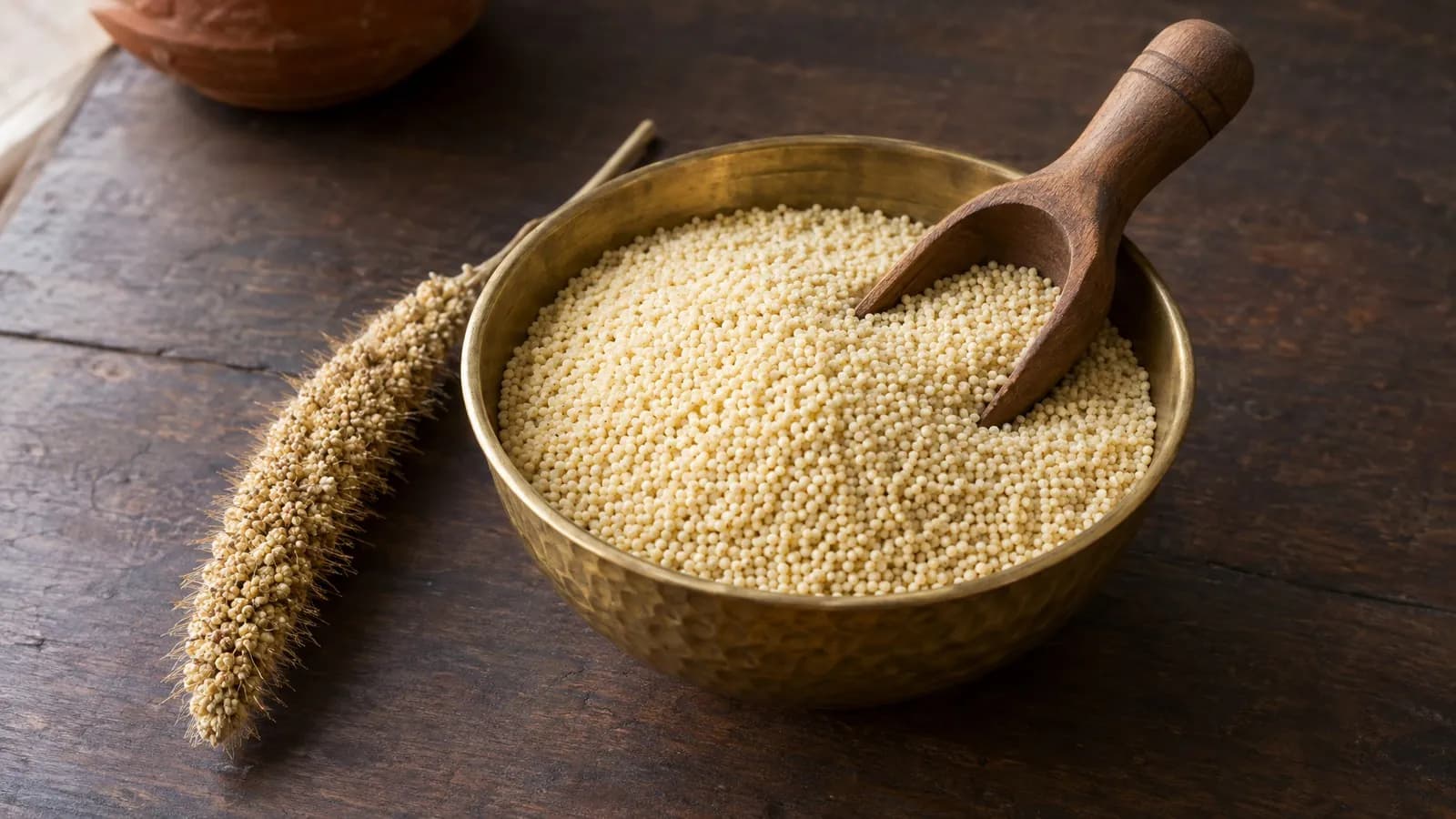
Bajra is pearl millet, a tall grass whose seeds grow packed on a stiff cylindrical spike that looks like a cattail or a candle. Each grain is round, a little larger than a mustard seed, and coloured grey, yellow-grey or olive with a soft sheen. The taste is nutty and faintly sweet, and the flour gives a grey, dense roti that smells of the earth after rain.
According to ICAR-IIMR, pearl millet originated in central tropical Africa and was probably domesticated 4,000 to 5,000 years ago along the southern edge of the Sahara's central highlands; it has been grown in Africa and the Indian subcontinent since prehistoric times. It is a crop for hard land. IIMR describes it as well adapted to drought, low soil fertility and high temperature, able to grow where maize or wheat would not survive, and a 2021 review in Frontiers in Plant Science (Satyavathi et al.) notes its deep root system and its ability to survive when water is scarce. In the desert regions of Rajasthan it is the main crop, and like the other millets IIMR lists for India it is commonly grown rain-fed.
You will find it sold two ways. Whole bajra grain is soaked and cooked for khichdi or sprouted, or ground at home. Bajra atta (bajra flour) is the everyday form for rotla, roti, thepla, raab and laddu. The grain is called bajri in Gujarat and Maharashtra, sajje in Karnataka, sajjalu in Telangana and Andhra Pradesh and kambu in Tamil Nadu; the full list is on the page that explains sajjalu in English and every other name of bajra. Of the eight types of millets that ICAR-IIMR lists as commonly cultivated in India, bajra is the one it calls the most widely grown.
Bajra names in Indian languages: sajje, sajjalu, kambu and bajri
"Sajjalu in English" and "sajje in English" have one answer: pearl millet, the grain the North calls bajra. IFCT 2017, the source of the table below, prints the English name as bajra itself; the ICAR-Indian Institute of Millets Research page gives pearl millet, the name research papers use. Gujarati and Marathi speakers say bajri, Kannada sajje, Telugu sajja or sajjalu, Tamil kambu and Malayalam kambam; Punjabi, Bengali, Odia and Urdu keep the word bajra. Neither source records a Sanskrit name. Each row is IFCT 2017's; the footnotes mark the ICAR-IIMR spellings added beside the printed ones, and the English entry is swapped for IIMR's pearl millet.
| Language | Name (romanised) |
|---|---|
| English | Pearl millet |
| Hindi | Bajra |
| Marathi | Bajra, Bajri |
| Gujarati | Bajri |
| Punjabi | Bajra |
| Bengali | Bajra |
| Odia | Bajra |
| Assamese | Baajra |
| Kannada | Sajje, Sajjai |
| Telugu | Sajjalu, Sajja |
| Tamil | Kambu |
| Malayalam | Kambam, Kamboo |
| Urdu | Bajra |
| Sanskrit | — |
| Botanical name | Pennisetum typhoideum |
Source: IFCT 2017 (ICMR-NIN) local-names list. — means no name recorded in the source.
English: IFCT 2017 prints ‘Bajra’; ‘Pearl millet’ per ICAR-Indian Institute of Millets Research, millets information page (vernacular names). Marathi ‘Bajri’: ICAR-Indian Institute of Millets Research, millets information page (vernacular names). Kannada ‘Sajjai’: Nutritional and health benefits of millets, ICAR-Indian Institute of Millets Research (PDF). Telugu ‘Sajja’: ICAR-Indian Institute of Millets Research, millets information page (vernacular names). Malayalam ‘Kamboo’: Nutritional and health benefits of millets, ICAR-Indian Institute of Millets Research (PDF).
Bajra nutrition per 100 g
Per 100 g of raw grain, IFCT 2017 reports 348 kcal, 10.96 g protein, 5.43 g fat, 61.78 g carbohydrate and 11.49 g total fibre. The mineral column is where bajra earns its place: 6.42 mg iron, 124 mg magnesium, 365 mg potassium, 2.76 mg zinc and 36.11 mcg folate. Calcium is modest at 27.35 mg; ragi is the calcium millet, bajra is the iron one.
Against the two grains it usually replaces, bajra has about the same protein as whole wheat (10.59 g) and more than milled rice (7.94 g), far more fibre than rice (11.49 g against 2.81 g) and more iron than both (whole wheat 3.97 mg, milled rice 0.65 mg). Its fat, 5.43 g, is higher than that of wheat (1.47 g) or rice (0.52 g), and above maize, jowar and ragi too. ICAR-IIMR puts about 70% of the free fat in pearl millet as unsaturated, and the same fat is held responsible for the way the flour spoils in storage.
The University of Sydney database gives bajra roti a GI of 57, averaging three India-tested entries for plain bajra roti and chapatti (flour and water only) that run from 49 to 68. That is a medium GI, below jowar and ragi and above the mean of the two wheat entries tested in India (47) and white basmati (50) in the same database. No plain-grain entry exists for bajra.
In household terms, one medium bajra roti made from 40 g of flour gives about 139 kcal, 4.4 g protein, 4.6 g fibre, 2.6 mg iron and 50 mg magnesium. Two rotis at dinner come to roughly 278 kcal and 5.1 mg iron.
| Nutrient | Bajra (pearl millet) | Whole wheat | Rice (raw, milled) |
|---|---|---|---|
| Energy (kcal) | 348 | 322 | 357 |
| Protein (g) | 11 | 11 | 7.9 |
| Fat (g) | 5.4 | 1.5 | 0.5 |
| Carbohydrates (g) | 62 | 65 | 78 |
| Dietary fibre (g) | 11 | 11 | 2.8 |
| Iron (mg) | 6.4 | 4 | 0.7 |
| Calcium (mg) | 27 | 39 | 7.5 |
| Magnesium (mg) | 124 | 125 | 19 |
| Potassium (mg) | 365 | 366 | 108 |
| Sodium (mg) | 4.1 | 2.5 | 2.3 |
| Zinc (mg) | 2.8 | 2.9 | 1.2 |
| Folate (mcg) | 36 | 30 | 9.3 |
| Glycemic index (GI) | 57 | 47 | 50 |
Per 100 g raw, edible portion. Composition: IFCT 2017 (ICMR-NIN). GI: University of Sydney GI database. — means not reported. These are average values for the food; the label on a pack gives the values for that product.
Benefits of bajra
Here are the short versions, each tied to the IFCT figures above or to a named study; bajra benefits and side effects goes through them in full.
Iron for haemoglobin
Bajra's 6.42 mg iron per 100 g is more than wheat, jowar, ragi or rice carry in IFCT 2017. In Anitha and colleagues' 2021 Frontiers in Nutrition meta-analysis, anaemic people who ate millets regularly saw their haemoglobin rise, serum ferritin went up in the human studies that measured it, and lab work showed that fermenting or sprouting millets made more of their iron available. ICMR-NIN advises eating vitamin C foods such as citrus, guava or amla with plant iron, and leaving an hour between tea and the meal.
Fibre that keeps you full
Bajra has 11.49 g fibre per 100 g, about four times the 2.81 g in milled rice. ICAR-IIMR notes that this fibre makes the grain slower to leave the stomach, so a bajra meal may hold off hunger for longer; the rice comparison is laid out in millets vs rice.
Protein close to wheat
At 10.96 g per 100 g, bajra matches whole wheat for protein and beats jowar and ragi. Its essential amino acids also score better than wheat's in a 2025 review in Chemistry and Biodiversity (Tanwar et al.). It is short of lysine, which ICAR-IIMR says pulses and animal protein make up, as in bajra khichdi with moong dal or a roti with dal or curd.
Magnesium and potassium
Bajra gives 124 mg magnesium and 365 mg potassium per 100 g, against 19.3 mg and 108 mg in milled rice; whole wheat is level on both.
Medium GI and steadier blood sugar
Bajra roti's GI of 57 puts it in the medium band, not the low one. The same team's second 2021 meta-analysis, on diabetes, found that eating millets long term brought down fasting and after-meal blood glucose in diabetic people, and HbA1c in people with prediabetes. Portion and what sits beside the roti still decide the result.
Naturally gluten-free
Gluten comes from wheat, barley and rye, the NHS explains, and bajra belongs to none of them; the 2025 Tanwar review describes pearl millet as naturally gluten-free. Bajra roti and khichdi therefore suit people with coeliac disease or wheat sensitivity, as long as the atta was not milled alongside wheat.
Energy
Bajra gives 348 kcal per 100 g, more than whole wheat (322 kcal) and a little less than milled rice (357 kcal).
Side effects: who should limit bajra
Eaten in normal portions, bajra suits most people. Four situations call for watching the quantity.
- Thyroid: the worry that bajra causes goitre comes up often. Anitha and colleagues' 2024 systematic review (Frontiers in Nutrition) found nine relevant papers, eight on pearl millet, and concluded they were too weak to show that bajra eaten within a balanced diet raises goitre rates in the general population; the authors want more research. If you have a thyroid condition, check with your doctor or dietitian before bajra becomes a daily staple.
- Heat: traditional Indian food lore calls bajra warming (garam), and many northern homes eat it in winter and rest it in summer. That is a belief, not a measured effect. If daily bajra feels heavy in hot weather, the Tamil answer is kambu koozh, fermented bajra porridge drunk cold with buttermilk; the northern one is to switch to jowar.
- Digestion: 11.49 g fibre per 100 g is a lot if you jump from maida and polished rice. Add bajra gradually, drink more water, and do not eat it dry; bajra rotla wants ghee, curd or a wet sabzi beside it.
- Kidney disease: bajra has 365 mg potassium per 100 g, level with whole wheat and more than three times the 108 mg in milled rice. Anyone on a potassium-restricted diet should ask their doctor before adding it.
With diabetes, count bajra as the grain of the meal rather than an addition to it. If a doctor has set your diet for a medical condition, ask them or your dietitian before bajra becomes a regular grain.
How to cook and use bajra: whole grain and bajra atta
Whole bajra grain: it needs a long soak, so wash it and leave it in water for 8 hours or overnight. In a pressure cooker it needs 4 to 5 whistles with water at three times the grain's volume, or about 40 minutes of simmering in an open pan, until the grains split and soften. Cooked this way it can stand in for rice under dal or be stirred into upma; the classic use is bajra khichdi, where the soaked grain is pounded or pulsed until cracked and cooked soft with moong dal, cumin and ghee, a winter one-pot dinner in Rajasthan. Soaked grain tied in a cloth for a day or two sprouts, and sprouted bajra goes into salads, chaat or a savoury porridge.
Bajra atta behaves nothing like wheat flour because it has no gluten. Knead it with hot water, a little at a time, pressing and folding until the dough is smooth and holds together; work with it while warm, because cold bajra dough cracks. Shape each roti by patting it on a floured cloth or plastic sheet, or between the palms the Gujarati way for a thick rotla, then cook it on a medium-hot tawa and finish it over the open flame until it puffs. The step-by-step method is in the bajra roti recipe. In Rajasthan the roti is eaten with ghee and gud, ker sangri or kadhi; in Gujarat the rotla with lasun chutney, curd and ringan no olo; in Maharashtra as bhakri with pithla or thecha; in north Karnataka as sajje rotti with yengai.
Drinks and porridge: bajra raab is a Rajasthani winter drink of bajra flour simmered in water or buttermilk with ajwain, ghee and jaggery. Kambu koozh, its Tamil opposite, is bajra cooked into a porridge, left to ferment overnight and drunk cold with buttermilk, onion and green chilli in summer. For a quick breakfast, stir a spoon of bajra flour into hot milk, cook it for five minutes and sweeten it with jaggery; the millet recipes for breakfast roundup has more morning ideas.
Everything else: bajra thepla and khakhra (often bajra atta mixed half and half with wheat atta), bajra vada, bajra dhokla, bajra laddu with ghee and gud, and puffed bajra for chivda. If you are new to it, start by replacing a third of the wheat atta in your chapati dough with bajra atta, and move to full bajra rotis once you are used to the taste.
How to store bajra and bajra atta
Whole bajra grain stays good for months when it is sealed and dry, in a steel or glass jar away from the stove. Give a big pack a few hours in the sun before storing it, tuck a few dried neem leaves into the jar, and look it over once a month through the monsoon. The grain outlasts the flour for a reason ICAR-IIMR explains: milling crushes the germ, and the oil it releases oxidises to a rancid smell and taste.
Bajra atta has a very short shelf life because rancidity sets in fast, as Goyal and Chugh (Journal of Food Science and Technology, 2017) put it. They stored flour from 21 pearl millet lines for 30 days and found that the rise in fat acidity went with fat content, pointing to the grain's own fat-splitting enzymes; bajra carries 5.43 g fat per 100 g. A 2025 review in Comprehensive Reviews in Food Science and Food Safety puts the keeping time of plain milled flour at no more than about a week, and found that processing steps such as dry heat, blanching or microwaving can stretch it to about 30 days. The home rules follow from that: buy 1 kg packs, check the milling date, keep the flour airtight, move it to the fridge from the day you open it in summer and the monsoon, and mill fresh at a chakki if you have one nearby. Throw out atta that smells bitter or soapy. The general rules for grains and flours are on how to store atta.
Bajra recipes to start with
Three of these dishes have full recipes on this site; the rest have a two-line method here. For the wider millet table, see the millet recipes roundup and the hubs for jowar and ragi, two millets that rotate well with bajra.
- Bajra roti: patted by hand from a hot-water dough, baked on the tawa and puffed over the flame, served with ghee and gud or lasun chutney.
- Bajra khichdi: soaked, cracked bajra with moong dal, ghee and cumin, the one-pot winter dinner.
- Bajra raab: mix 2 tablespoons of bajra flour smoothly with 2 cups of water or buttermilk, add a pinch each of ajwain and salt, and simmer, stirring, until it thickens; finish with a spoon of ghee and jaggery to taste and drink it hot.
- Kambu koozh: cook 1 cup of bajra flour or broken bajra in 4 cups of water to a thick porridge, cool, cover and leave overnight; next day loosen with buttermilk and salt and serve cold with raw onion and green chilli.
- Bajra laddu: roast 1 cup of bajra flour in 4 tablespoons of ghee on low heat for 10 to 12 minutes until it smells nutty; boil 100 g of jaggery powder with 1/2 cup of water to a one-string syrup, pour it into the flour off the heat with a pinch of cardamom, rest 5 minutes and press into 12 laddus while warm. The full method is in the bajra laddu recipe.
- Bajra thepla: knead equal parts bajra and wheat atta with curd, turmeric, chilli, ajwain and chopped methi, roll thin and cook with a little oil on both sides (an all-bajra dough also works, rolled between two plastic sheets).
How to buy bajra: what to look for
Grain or atta? Buy whole bajra if you make khichdi or sprouts, or if you grind small batches at home for the freshest flour. Buy bajra atta for rotla, roti, raab and thepla; it saves you the milling, but it must be fresh.
Colour and feel: good bajra grain is uniform, plump and grey-yellow with a pearl sheen; reject lots with black or shrivelled grains, dust, stones or bored holes. Fresh atta is pale grey, smells nutty and faintly sweet, and feels slightly oily between the fingers. A bitter, soapy or musty smell means old or rancid flour, and no chutney will hide it.
Milling date over everything: because the flour goes rancid quickly, the packing or milling date is the first thing to read on a pack of bajra atta. Pick the most recently milled pack, buy 1 kg at a time, and choose slow chakki or stone-ground atta made from the whole grain, bran and germ included.
Which bajra atta is best? The one milled most recently from whole, cleaned grain, with nothing added: an ingredient line that reads only bajra.
Certification: for organic bajra, the pack should print India Organic, USDA & EU certified; a label that only says "natural" does not mean organic. Whole grain can be bought in larger packs because it keeps; flour is best bought small and used quickly.
More on bajra
Bajra's questions on weight, blood sugar and gluten each have a full page, and the roundup puts the bajra dishes together by meal.
- Bajra recipes: upma, porridge and dosa for breakfast, roti, methi roti and khichdi for dinner, and thepla, raab and laddu besides.
- Pearl millet nutrition per 100 g, with calories per roti and per katori and bajra set against wheat and jowar.
- Bajra vs jowar: two millets compared on nutrition, taste and cost.
- Bajra vs wheat: iron, calcium, fat and fibre side by side, the GI of each roti, and which grain suits whom.
- Is bajra good for weight loss? Calories per roti and per katori, and how much to eat.
- Bajra for diabetes: the tested GI of bajra flatbreads, carbohydrate per roti and how to plan portions.
- Does bajra have gluten? Why bajra flour is gluten-free, and what that means with coeliac disease.
- Bajre ki roti ke fayde aur nuksan: the benefits and side effects in Hinglish.
FAQs
What is bajra?
Bajra is pearl millet, a small round grey-gold grain that is the staple crop of Rajasthan's desert districts and is eaten across western India as roti, rotla and khichdi. It has no gluten, and per 100 g it gives 10.96 g protein, 11.49 g fibre and 6.42 mg iron (IFCT 2017). It comes as whole grain and as bajra atta.
Is bajra gluten free?
Yes. Bajra has no gluten, so its dough never turns stretchy: it is made with hot water and shaped by patting, not rolling. People with coeliac disease or wheat sensitivity can eat it, but atta milled on the same stones as wheat may pick up some of it, so a coeliac buyer needs a pack that says the flour was milled separately.
Which bajra atta is best?
The freshest one. Bajra atta goes rancid quickly once milled, so the milling date matters more than the brand: pick the pack milled most recently, in 1 kg size, slow chakki or stone-ground from whole cleaned grain, with an ingredient line that reads only bajra. Keep it airtight and finish it fast.
Can pearl millet be cooked like rice?
Yes, with a soak first. Leave whole bajra in water for 8 hours or overnight, drain it, then cook it under pressure for 4 to 5 whistles in three times its volume of water until the grains split and soften; they stay chewier than rice, closer to broken wheat. Serve it under dal or turn it into bajra khichdi with moong dal.
Can bajra roti cause constipation?
Not usually, if you drink enough water with it. ICMR-NIN notes that dietary fibre matters for proper bowel function, and bajra has 11.49 g per 100 g. Trouble tends to start when someone jumps from maida or polished rice to two or three bajra rotis overnight without drinking more water, or eats the roti dry. Add bajra gradually and eat it with ghee, curd or a wet sabzi.
Is pearl millet good for diabetes?
It can be, when bajra takes the place of rice or wheat on the plate instead of adding to it. Bajra roti has a medium GI of 57 and bajra carries 11.49 g fibre per 100 g; in a 2021 meta-analysis, diabetic people who ate millets long term saw their fasting and after-meal glucose fall. One or two rotis with dal and sabzi is the usual pattern; for your own number, talk to your doctor or dietitian.
Is bajra hot in nature?
Only in food lore. Traditional Indian food classification calls bajra warming (garam), which is why many homes keep it for winter and switch to jowar in summer. That is a belief, not a measured effect, and at 348 kcal per 100 g bajra sits in the same range as other cereals. In Tamil Nadu it is eaten in summer as kambu koozh, fermented and served cold with buttermilk.
How much bajra per day?
The ICMR-NIN guidelines ask adults to take 20 to 30% of their cereals (raw weight) from millets, which on a 2000 kcal plate with 250 g of cereals and millets comes to 50 to 75 g a day. Bajra can fill that share or split it with jowar and ragi; a bowl of bajra khichdi holds 50 g of bajra, a roti about 40 g of atta. Eat it in place of other grain, not on top of it.
References
- Indian Food Composition Tables (IFCT) 2017, ICMR-National Institute of Nutrition
- University of Sydney glycemic index database (GI search)
- ICAR-Indian Institute of Millets Research: millets information and vernacular names
- Nutritional and health benefits of millets, ICAR-Indian Institute of Millets Research (PDF)
- Anitha S et al. A systematic review and meta-analysis of the potential of millets for managing and reducing the risk of developing diabetes mellitus. Front Nutr, 2021
- Anitha S et al. Millets can have a major impact on improving iron status, hemoglobin level and reducing iron deficiency anaemia: a systematic review and meta-analysis. Front Nutr, 2021
- Tanwar R, Panghal A, Kumari A et al. Nutritional, phytochemical and functional potential of pearl millet: a review. Chem Biodivers, 2025
- Anitha S, Upadhyay S, Grando S et al. Does consumption of pearl millet cause goiter? A systematic review of existing evidence. Front Nutr, 2024
- Satyavathi CT, Ambawat S, Khandelwal V et al. Pearl millet: a climate-resilient nutricereal for mitigating hidden hunger and provide nutritional security. Front Plant Sci, 2021
- NHS: coeliac disease
- Goyal P, Chugh LK. Shelf life determinants and enzyme activities of pearl millet: a comparison of changes in stored flour of hybrids, CMS lines, inbreds and composites. J Food Sci Technol, 2017
- Naraharasetti B, Chakraborty S. Thermal and nonthermal processing of pearl millet flour: impact on microbial safety, enzymatic stability, nutrients, functional properties, and shelf-life extension. Compr Rev Food Sci Food Saf, 2025
- Dietary Guidelines for Indians, ICMR-National Institute of Nutrition
Shop this article
Keep reading
Foxtail millet vs quinoa: nutrition, taste and which to choose
Foxtail millet in Kannada, Hindi, Tamil and other Indian names
10 benefits of kangni (foxtail millet) and its side effects