
Bajra roti
Preparation Time
20 minutes
Cooking Time
25 minutes
Difficulty Level
moderate
Meal Type
Dinner
Serves 3
Key Ingredients
- Bajra (pearl millet) flour
About This Recipe
Bajra roti belongs to the dry belt where the grain grows, Rajasthan and Gujarat among them. Many families eat it in winter, hot, with lehsun chutney, white butter, gud or kadhi. It is patted by hand because bajra has no gluten: a rolled dough tears, a patted one holds.
Two things make this version work for a first-timer. The dough is made with hot water, which softens the starch in the flour so that the dough binds and holds together without gluten; a cold-water bajra dough cracks at the edges however well you knead it. And each ball is kneaded again for half a minute just before patting, so it is warm and pliable when it reaches the board. The roti is thick, nutty and faintly sweet, crisp at the edges and soft inside, and it is a filling bread: bajra brings 11 g protein and 11.5 g fibre per 100 g (IFCT 2017).
Substitutions: mix jowar flour half and half for a milder, paler roti; add a pinch of ajwain or a handful of chopped methi leaves to the dough; a quarter of wheat atta makes the patting easier for beginners, though the roti is then no longer gluten-free. Use recently milled flour; bajra flour turns rancid and off in flavour as it ages.
Ingredient List
Serving Size:
1x
2x
3x
Dough
- Bajra (pearl millet) flour — 2 cups
- Water, boiling hot — 1 cup

- Salt — 1/2 tsp
- Ajwain seeds (optional) — 1 pinch
For patting
- Bajra flour, for dusting — 2 tbsp
- Water, in a small bowl — 1/2 cup
To finish

- Ghee — 6 tsp
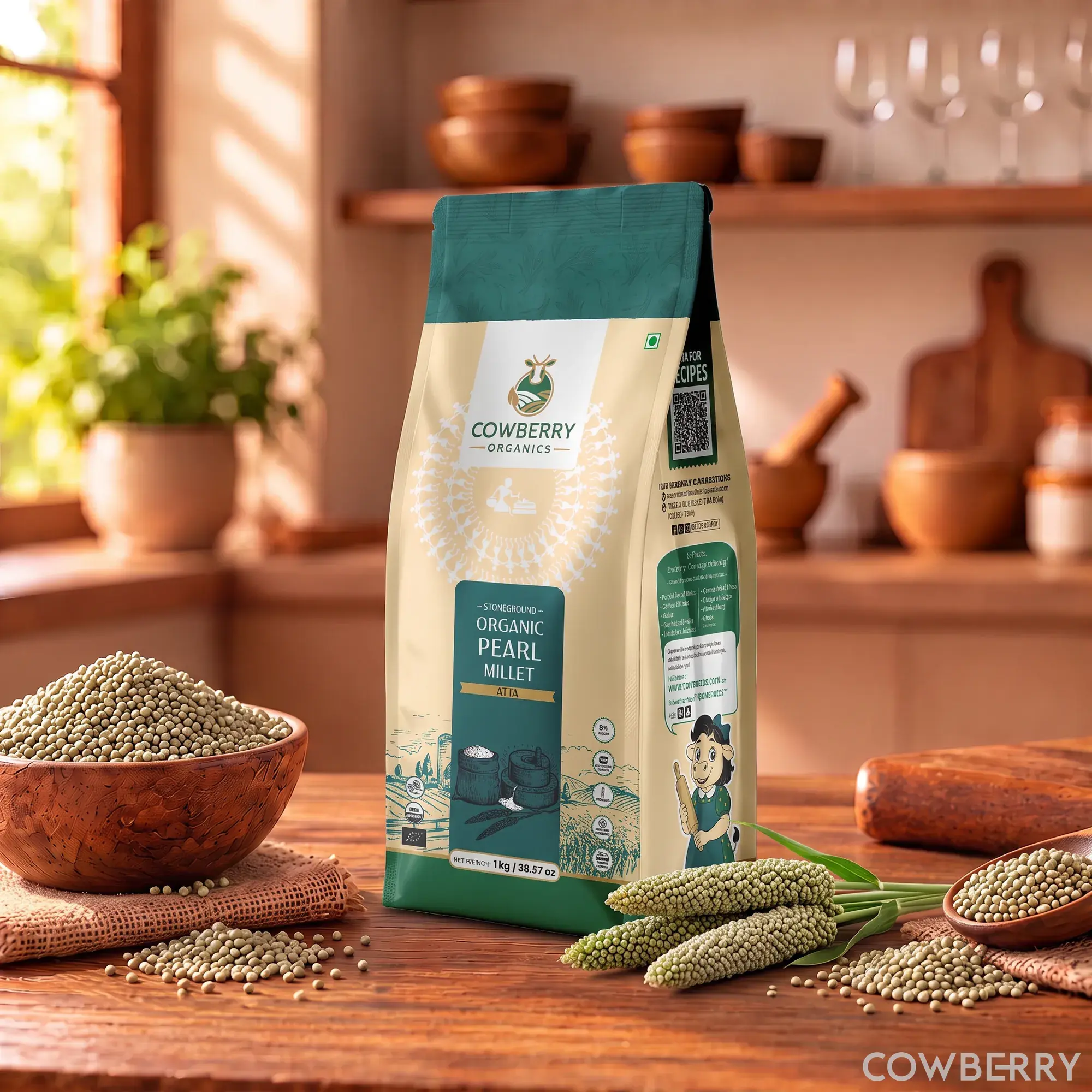
Skip The Store !
Get all you need for the recipe in just a few clicks
Serving Suggestions
The classic plate is bajra roti with lehsun chutney, a spoon of white butter or ghee and a lump of gud, with kadhi or a dry sabzi such as gatte or sev tamatar alongside. In Gujarat it goes with ringan no olo (roasted brinjal) and a glass of chhaas. Crumble a leftover roti into warm milk with jaggery for a quick sweet, or into salted buttermilk with roasted cumin for a summer snack.
Tips for Cooking Bajra roti
Cracks at the edge mean the dough is too dry or too cold: knead in a spoon of hot water and work the ball again before patting. Keep the dough and the shaped rotis under a damp cloth; bajra dough dries in minutes. A medium-hot tawa is right: too hot and the surface sets before the inside cooks, too cool and the roti turns hard. Wetting the top before the first flip keeps it from cracking.

Chef’s Note
Freshness of the flour decides the taste: bajra carries 5.4 g fat per 100 g, and once the grain is milled that fat turns rancid quickly, which is where the stale, off taste of an old bajra roti comes from. Buy small packs and finish them quickly. Two rotis, each from 40 g flour with a teaspoon of ghee, come to about 368 kcal, 8.8 g protein and 9.2 g fibre. The whole grain, soaked and cooked, makes bajra khichdi.
Per serving (approx.): 368 kcal, protein 8.8 g, carbs 49 g, fat 14 g, fibre 9.2 g. Computed from IFCT 2017 / USDA values for the listed quantities. Measures: 1 cup = 240 ml, 1 tbsp = 15 ml, 1 tsp = 5 ml.
Happy Cooking !!
!!
ByCOWBERRY
Jul 02, 2026
Recipes You’ll Love
More everyday cooking with COWBERRY organics, from the same kitchen.

Preparation Time
10 Min
Cooking Time
25 Min
Difficulty Level
easy

Preparation Time
10 Min
Cooking Time
35 Min
Difficulty Level
easy

Preparation Time
10 Min
Cooking Time
15 Min
Difficulty Level
easy