by COWBERRY

10 minute read
Turmeric (haldi): names, nutrition, benefits and how to use it

Haldi is turmeric, the bright yellow spice ground from the dried underground stem of Curcuma longa, a ginger-family plant; IFCT 2017 records the powder at 281 kcal, 7.66 g of protein and 21.38 g of fibre per 100 g. Names, nutrition, benefits, side effects, cooking, storage, five recipes and buying follow.
What is turmeric (haldi)?
Turmeric comes from the dried underground stem, the rhizome, of Curcuma longa, a member of the ginger family; NCCIH describes the plant as grown commercially in Southeast Asia and India, with the rhizome put to culinary and cosmetic uses. Indian kitchens know the spice as haldi and keep it in two forms. Turmeric powder, or haldi powder, is the dried root milled fine, the exact food name in IFCT 2017's table, and it carries every measured amount on this page. Raw haldi, or kachi haldi, is the fresh root, grated into chutneys and sliced into pickles rather than measured in spoons; IFCT 2017's composition values cover the powder alone. Inside the root sits curcumin, a major component, and NCCIH credits it with the spice's yellow colour; the health activities of turmeric are commonly attributed to curcuminoids, which include curcumin. The whole spice and the single compound are separated on turmeric vs curcumin, and every language name sits on haldi in English.
Haldi names in Indian languages
The Hindi word is haldi, and Punjabi and Urdu share it. IFCT 2017's local-names list runs wider, and the table below carries all of it: halad in Marathi and haddar in Gujarati, holud in Bengali and haladi in Odia, anashina in Kannada and pasupu in Telugu, manjal in Tamil and Malayalam, and haladi again in Sanskrit, 13 Indian languages in all. The same list prints turmeric powder as the English food name and Curcuma domestica as the botanical one; NCCIH's entry gives the Latin name as Curcuma longa, with Curcuma domestica listed as a synonym. Two everyday spellings appear under the table as variants of the printed names: arishina for the Kannada name and haldar for the Gujarati one. One page walks through each language in turn: haldi in English.
| Language | Name (romanised) |
|---|---|
| English | Turmeric powder |
| Hindi | Haldi |
| Marathi | Halad |
| Gujarati | Haddar, Haldar |
| Punjabi | Haldi |
| Bengali | Holud |
| Odia | Haladi |
| Assamese | Halodhi |
| Kannada | Anashina, Arishina |
| Telugu | Pasupu |
| Tamil | Manjal |
| Malayalam | Manjal |
| Urdu | Haldi |
| Sanskrit | Haladi |
| Botanical name | Curcuma domestica |
Source: IFCT 2017 (ICMR-NIN) local-names list. — means no name recorded in the source.
Gujarati ‘Haldar’: spelling variant of the IFCT 2017 name ‘Haddar’. Kannada ‘Arishina’: spelling variant of the IFCT 2017 name ‘Anashina’.
Turmeric powder nutrition per 100 g
IFCT 2017's turmeric entry reads 281 kcal of energy per 100 g, with 7.66 g of protein, 5.03 g of fat, 49.22 g of carbohydrate and 21.38 g of fibre inside that 100 g. Iron stands out among spices at 46.08 mg, followed by 2374 mg of potassium, 260 mg of magnesium and 122 mg of calcium. No vitamin C value is reported for the powder, and the spice has no glycemic index on record, so this page quotes none.
Nobody eats a spice by the 100 g, so the spoon scale matters more. One level teaspoon of the powder, weighed as 3 g, holds about 8 kcal, 1.5 g of carbohydrate, 0.6 g of fibre and 1.4 mg of iron, and half a teaspoon contributes close to 0.7 g of carbohydrate. That is the scale at which haldi enters a dal or a cup of milk. The complete per-100 g table, with the spoon-scale sums beside it, is on turmeric nutrition facts per 100g.
| Nutrient | Turmeric powder, raw |
|---|---|
| Energy (kcal) | 281 |
| Protein (g) | 7.7 |
| Fat (g) | 5 |
| Carbohydrates (g) | 49 |
| Dietary fibre (g) | 21 |
| Iron (mg) | 46 |
| Calcium (mg) | 122 |
| Magnesium (mg) | 260 |
| Potassium (mg) | 2374 |
| Sodium (mg) | 24 |
| Zinc (mg) | 2.6 |
| Folate (mcg) | 14 |
Per 100 g raw, edible portion. Composition: IFCT 2017 (ICMR-NIN). — means not reported. These are average values for the food; the label on a pack gives the values for that product.
Benefits of turmeric
ICMR-NIN's Dietary Guidelines group turmeric with the spices that bring plenty of antioxidants and can fit a balanced diet. The research story sits on curcumin: a 2017 Foods review describes turmeric as the compound's major source and reports that curcumin aids in managing oxidative and inflammatory states, plus metabolic syndrome, arthritis, anxiety and hyperlipidemia, with antioxidant and anti-inflammatory activity behind most reported benefits. A 2019 Nutrients review catalogues the properties studied for curcumin, among them antioxidant, anti-inflammatory, antidiabetic and hepatoprotective.
Two cautions travel with those lists. The 2017 review notes that curcumin on its own is poorly bioavailable, apparently mainly because of poor absorption, rapid metabolism and rapid elimination. And NCCIH, which surveys this research, finds the studies still short of a firm conclusion: it cannot say definitively that turmeric or curcumin helps with any health purpose. Historically, NCCIH records use in Chinese, Indian (Ayurvedic), Islamic and Thai traditional medicine for complaints such as indigestion and the common cold.
Two condition questions have their own pages, and both land on the same reading: neither review reports a blood glucose reading from people with diabetes, and weight loss appears in neither paper's findings. The sourced detail is on turmeric benefits and side effects, in Hinglish on haldi ke fayde, and question by question on is haldi good for diabetes and turmeric for weight loss.
Side effects: who should limit turmeric
For turmeric eaten as a spice in food, neither ICMR-NIN nor NCCIH sets a limit or prints a warning. The cautions belong to the supplement aisle, and NCCIH states them plainly: ordinary oral turmeric and curcumin are, in the recommended amounts, likely safe for up to 2 or 3 months, and liver damage has been reported in some people who took highly bioavailable formulations. Taken by mouth, turmeric can bring nausea and vomiting, acid reflux, an upset stomach, diarrhea or constipation.
- People on medicines: NCCIH's advice is to speak with a health care provider before using any herbal product, since some herbs and medicines can clash harmfully.
- Pregnancy and nursing: supplements may be unsafe in pregnancy, and for breastfeeding little is known about doses beyond what food commonly carries.
- Long-term capsule use: the two-to-three-month safety window covers conventionally formulated products, so indefinite daily capsules sit outside what the source supports.
Cooking with haldi is a kitchen matter; the cautions above are for capsules and extracts. The fuller list of who should hold back is on turmeric benefits and side effects, and the supplement side of the line is on turmeric vs curcumin.
How to cook and use turmeric
The powder earns its keep in the tadka and the simmer. For a dal or sabzi that serves four, a quarter to half a teaspoon is the kitchen habit: stirred into hot oil or ghee for a few seconds, or into the simmering pot with the salt, so it cooks into the dish instead of sitting raw. The drinks all follow one measure: for two cups, half a teaspoon of haldi and a quarter teaspoon of pepper, the pepper stirred in off the heat, the haldi whisked into cold milk for haldi doodh, stirred into warm water for turmeric water, or simmered in water for turmeric tea. For dough, a teaspoon (3 g) kneaded into 240 g of atta turns out golden rotis, and a tablespoon (9 g) stirred through warm roasted besan makes a batch of haldi laddus. Raw haldi is a flavour ingredient: grate it into chutneys and pickle it thin.
Black pepper also turns up in curcumin research. The 2017 review reports a 2000 percent rise in curcumin's bioavailability when piperine, black pepper's major active component, was combined in a complex with the compound; whether a kitchen pinch in a dal does anything similar is not measured in these sources. Portion steps live on how to eat turmeric; the pairing science sits on turmeric and black pepper; every dish is collected on turmeric recipes.
How to store turmeric powder
Turmeric powder keeps its freshness and aroma in an airtight jar kept cool and dry, with a dry spoon and the lid closed tight after use; the same jar rule holds whether the powder seasons the dal or the glass of milk. Keep the jar away from the stove, where steam can cake the powder, and a musty or off smell is the sign to replace it. Ground turmeric needs no fridge; a sealed jar on a cupboard shelf does the job.
Turmeric recipes to start with
Five recipes begin with the same jar, and the turmeric recipes roundup collects them with more.
- Turmeric milk (haldi doodh): turmeric whisked into cold milk, simmered and strained smooth, then finished with pepper and a spoon of jaggery, two cups in about eleven minutes.
- Turmeric tea (haldi chai): turmeric simmered in water and finished with pepper, lemon and honey; no tea leaves, no milk, two cups in about eleven minutes.
- Turmeric water (haldi water): turmeric whisked into water warmed only until it steams, with lemon, pepper and honey, two glasses in about nine minutes.
- Haldi laddu: soft besan and jaggery laddus with the turmeric stirred through the warm roast at the end, sixteen laddus in about 28 minutes, plus cooling.
- Turmeric roti: turmeric kneaded into whole wheat dough and roasted on the tawa with a smear of ghee, eight rotis in about 40 minutes.
How to buy turmeric: what to look for
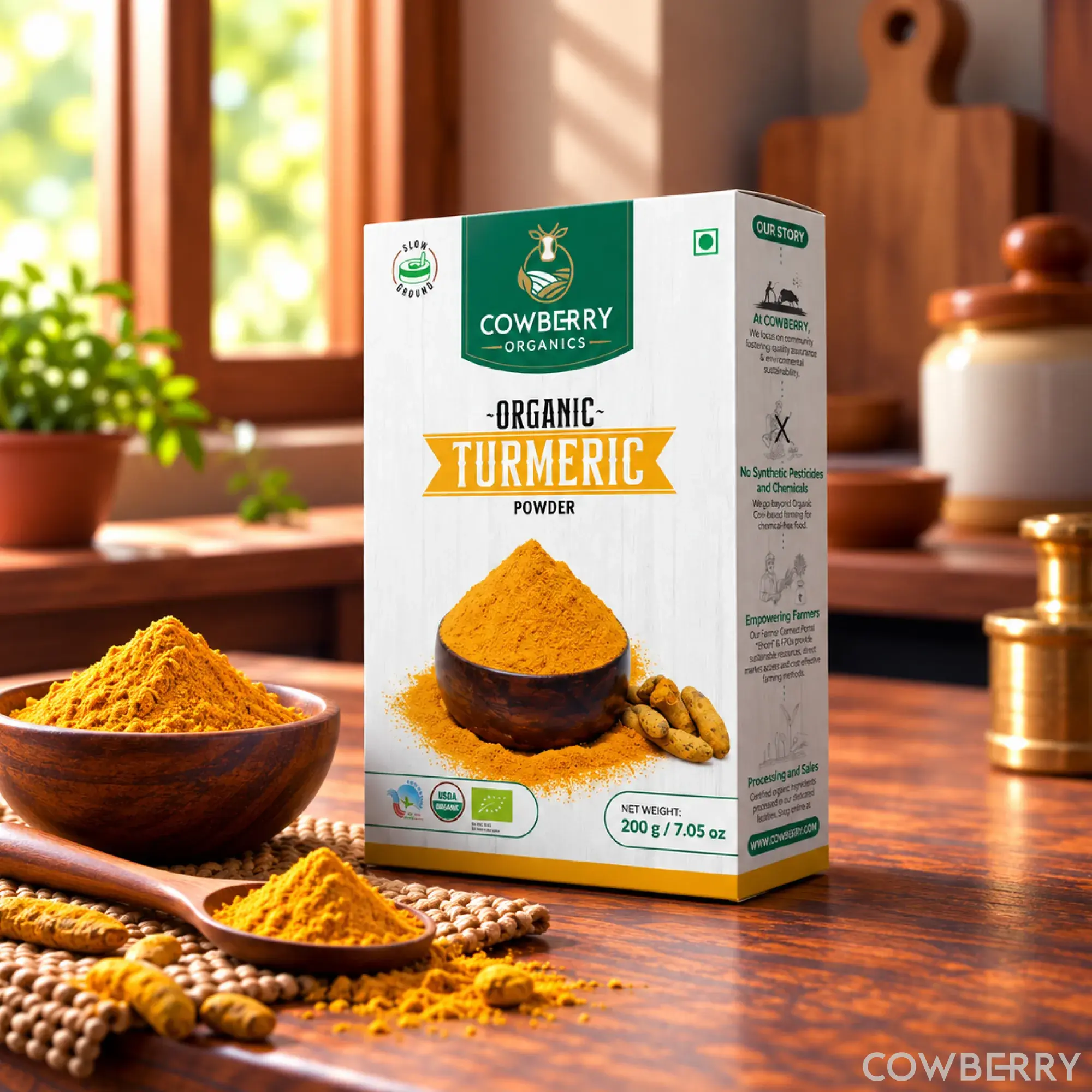
For spices, ICMR-NIN's advice is direct: prefer the whole fingers, uniform in colour, size and shape, and pick only certified packs, since powders are the likelier form to be adulterated. The caution has a measured backdrop. A 2024 study bought 356 turmeric samples, 180 dried roots and 176 powders, from shops in 23 cities of India, Pakistan, Sri Lanka and Nepal, and found detectable lead in 14 percent. Where lead ran high, the molar ratio of lead to chromium sat near one to one, which the authors read as suggestive of lead chromate; the four countries studied together produce more than 80 percent of the world's turmeric. The at-home tests that separate a good powder from a bright, suspicious one live on how to check turmeric purity, and whether the organic premium is worth it for spices is weighed on do spices need to be organic. COWBERRY's turmeric powder is grown organically in Maharashtra (Sangli) and Andhra Pradesh and carries the India Organic, USDA & EU certified line.
FAQs
What is haldi?
Haldi is turmeric, the spice that colours dal and curries, ground from the underground stem of Curcuma longa, a ginger-family plant; NCCIH places its commercial growing in Southeast Asia and India. Indian kitchens use it in the tadka, in the dal and in warm milk, and IFCT 2017 measures the powder at 281 kcal and 49.22 g of carbohydrate per 100 g.
What is haldi powder?
Haldi powder is turmeric powder: the dried rhizome ground fine, the form IFCT 2017 measures at 281 kcal of energy, 7.66 g of protein and 49.22 g of carbohydrate per 100 g. By the spoon it stays small: one level teaspoon (3 g) comes to roughly 8 kcal and 1.5 g of carbohydrate.
Is haldi milk good for cough?
No: NCCIH records the historical use of turmeric for the common cold in traditional medicine, and nothing it reports supports haldi milk as a cough remedy. The drink itself is milk with turmeric, so the milk carries the nutrition while the haldi, a quarter teaspoon a cup in the recipe, adds only a few kcal; make it unsweetened if sugar is a concern, and for the cough follow your doctor's advice.
Which turmeric is best for health?
ICMR-NIN and the curcumin reviews rank no turmeric variety, so the honest answer concerns the pack, not the variety. The guidelines' buying rule settles it: the whole root over the powder, and a certified pack, since powders are the form more likely to be adulterated. A certified powder is fine for the kitchen; capsules and extracts are a question for a doctor.
How to identify pure haldi powder?
Start from the pack, as ICMR-NIN advises: buy certified products and prefer whole turmeric fingers over powder, because ground spices are more likely to be adulterated than whole ones. The risk is measured: in 356 samples bought across 23 South Asian cities, a 2024 study detected lead in 14 percent. The step-by-step home tests are on how to check turmeric purity.
Can haldi be eaten in fast?
Neither ICMR-NIN's guidelines nor NCCIH nor the curcumin reviews gives a rule for haldi in vrat food. The spice itself adds almost nothing to a fast-day plate, so the practice your family keeps decides.
Why turmeric is known as golden spice?
The name points to the colour: NCCIH credits curcumin, a major component of turmeric, with the spice's yellow colour, and the powder turns rice, dal and curries golden as it cooks in.
References
- Indian Food Composition Tables (IFCT) 2017, ICMR-National Institute of Nutrition
- Dietary Guidelines for Indians, ICMR-National Institute of Nutrition
- Hewlings SJ, Kalman DS. Curcumin: a review of its effects on human health. Foods, 2017
- Dei Cas M, Ghidoni R. Dietary Curcumin: Correlation between Bioavailability and Health Potential. Nutrients, 2019
- Forsyth JE, Mistree D, Nash E et al. Evidence of turmeric adulteration with lead chromate across South Asia. Sci Total Environ, 2024
- NCCIH: Turmeric (health information page)
Shop this article
Keep reading
Coriander water benefits: what dhania water actually does
Peanuts in Hindi (moongfali): groundnut names in Indian languages
Coriander vs cilantro: are they the same herb?