by COWBERRY

7 minute read
Turmeric for weight loss: what it can and cannot do, and how to use it

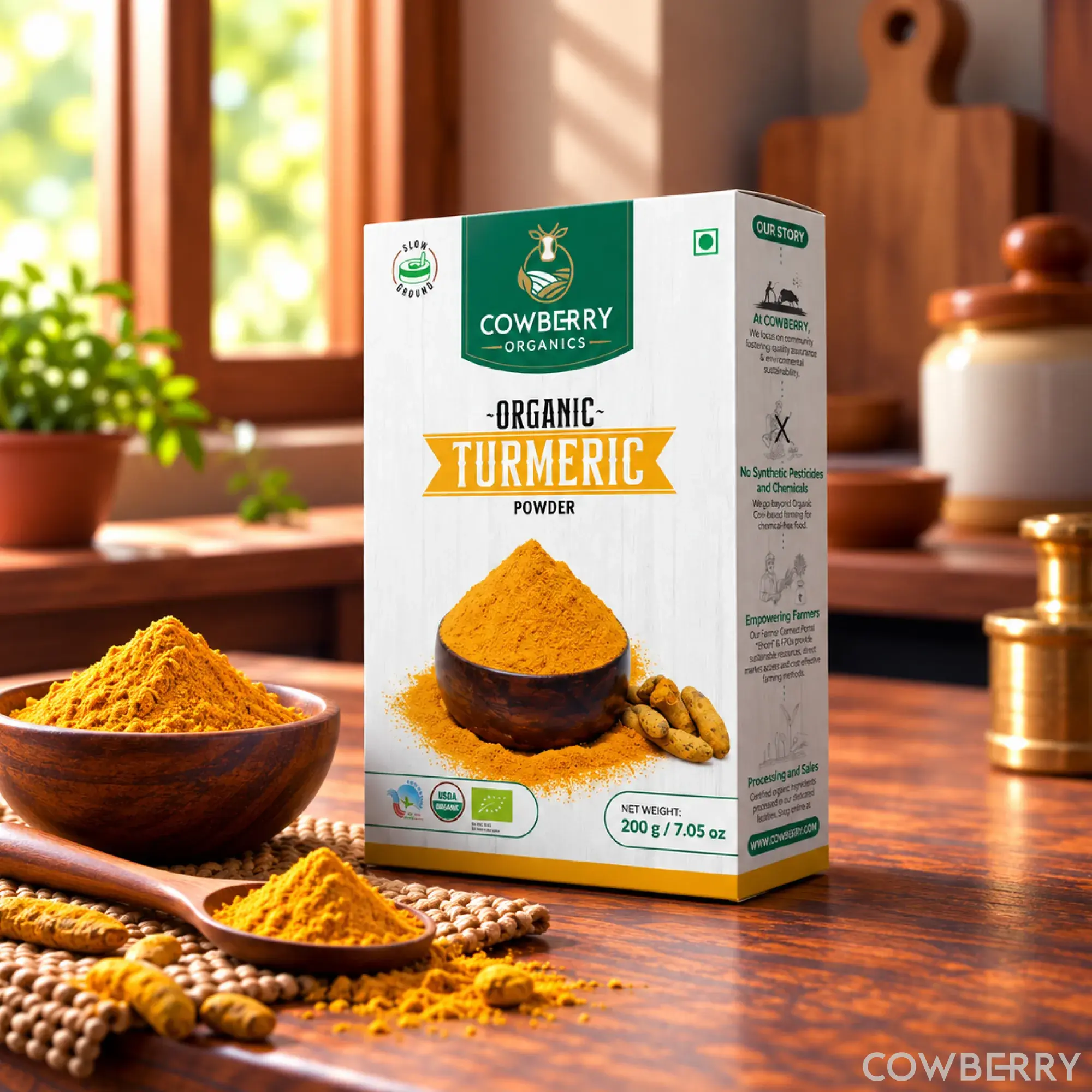
Turmeric for weight loss begins with a small fact: one level teaspoon (3 g) holds about 8 kcal and 1.5 g of carbohydrate, so the spice is not where weight is gained or lost. Neither curcumin review in the references names weight loss among its findings; what the evidence says, and how haldi earns its keep in a weight-loss kitchen, is below. The haldi guide covers the spice.
Short answer: does turmeric cause weight loss?
None of the reviews in the references shows turmeric or curcumin making people lose weight. The 2017 Foods review reports that curcumin aids in managing conditions from oxidative and inflammatory to metabolic syndrome, arthritis, anxiety and hyperlipidemia, and body weight is not on that list. The 2019 Nutrients review lists the properties studied for curcumin, and weight loss is not among them either. NCCIH goes further in the other direction: its turmeric page finds the evidence too short for any definite conclusion about a health benefit. What the spice does offer a weight-loss kitchen is real and smaller: colour and flavour for about 8 kcal a teaspoon, which seasons dal and sabzi with almost nothing added to the day's count.
Calories in a teaspoon of turmeric
The table is IFCT 2017's printed composition of turmeric powder per 100 g: 281 kcal of energy, 7.66 g of protein, 5.03 g of fat, 49.22 g of carbohydrate and 21.38 g of fibre. None of that matters per 100 g, because the spice is eaten by the spoon. One level teaspoon, at 3 g, comes to about 8 kcal, 0.2 g of protein, 1.5 g of carbohydrate, 0.6 g of fibre and 1.4 mg of iron, and half a teaspoon carries about 0.7 g of carbohydrate. The fibre column looks big at 21.38 g per 100 g, but at 0.6 g a teaspoon it is a garnish, not a weight-loss lever.
| Nutrient | Turmeric powder, raw |
|---|---|
| Energy (kcal) | 281 |
| Protein (g) | 7.7 |
| Fat (g) | 5 |
| Carbohydrates (g) | 49 |
| Dietary fibre (g) | 21 |
| Iron (mg) | 46 |
| Calcium (mg) | 122 |
| Magnesium (mg) | 260 |
| Potassium (mg) | 2374 |
| Sodium (mg) | 24 |
| Zinc (mg) | 2.6 |
| Folate (mcg) | 14 |
Per 100 g raw, edible portion. Composition: IFCT 2017 (ICMR-NIN). — means not reported. These are average values for the food; the label on a pack gives the values for that product.
What the evidence says, and what it does not say
The first paper to look at is a 2017 review published in Foods, by Hewlings and Kalman. Its reading of curcumin starts from turmeric as the polyphenol's major source, and the review's headline is a list: curcumin aids in managing oxidative and inflammatory conditions, arthritis, anxiety, hyperlipidemia and metabolic syndrome, with antioxidant and anti-inflammatory effects credited for most of those reported benefits. Body weight, body fat and appetite do not appear in its abstract.
The second paper, a 2019 review in Nutrients, calls curcumin the yellow pigment extracted from turmeric and lists its studied properties: antioxidant, anti-inflammatory, antidiabetic, hepatoprotective, anti-allergic, anti-dermatophyte and neuroprotective. There is no weight property on that list, and the abstract gives no trial numbers for any of them. NCCIH, part of the US National Institutes of Health, states plainly that the evidence it has reviewed does not settle whether turmeric or curcumin benefits health.
So the verdict on turmeric for weight loss: curcumin is widely studied, but these reviews do not show it moving body weight. Anyone selling the opposite is reading past the papers.
How to use turmeric in a weight-loss kitchen
Where haldi does earn its keep is as a flavour that costs almost nothing. A dal, sabzi or tadka gets its colour and flavour from a quarter to half a teaspoon, and the drinks passed around as turmeric for weight loss recipes deserve a closer look.
The drinks: where the calories live
Turmeric water is hot water with the powder stirred in, and turmeric tea is the powder simmered in water. Both recipes finish with honey; leave it out and the glass carries little beyond the turmeric's own energy, about 8 kcal a teaspoon. Haldi doodh is different: the milk carries the energy, so the drink is as heavy as the milk and sweetener you put into it, and the haldi inside adds only a few kcal. The turmeric for weight loss recipe worth keeping is therefore the unsweetened one, in any of the three forms.
Portions
Use the cooking amounts from how to eat turmeric: a quarter to half a teaspoon in a pot for four. ICMR-NIN and NCCIH give no daily figure for turmeric. The pairing with black pepper, and what the research does and does not show about it, is on turmeric and black pepper. More turmeric is not more progress: neither curcumin review links a larger amount of turmeric to any weight result, so spooning in extra changes the colour, not the outcome.
What to avoid
- Sweetened haldi doodh labelled a slimming drink. The sugar and the milk are the energy; the haldi is not. A sweetened turmeric latte bought daily is a dessert habit, not a turmeric habit.
- Curcumin capsules bought on weight-loss claims. The two curcumin reviews show no such effect, and NCCIH adds two cautions for supplements: standard curcumin, not modified to raise absorption, counts as likely safe at recommended doses over a span of two to three months, and some users of highly bioavailable formulations have had liver damage reported. A capsule that promises what the evidence does not show deserves a doctor's opinion, not a shopping cart.
- Loose, suspiciously bright powder. A 2024 study that tested 356 turmeric samples bought in 23 cities detected lead in 14 percent of them, and in the samples with more lead the ratio of lead to chromium was close to equal, which the authors say suggests lead chromate. Prefer whole turmeric fingers that are even in colour, size and shape, and buy only certified products, as ICMR-NIN advises. The home tests are on how to check turmeric purity.
- Building the diet around haldi. A spice that adds 8 kcal a teaspoon cannot carry a weight-loss plan; the plan is the food around it. The spice supports the diet, not the other way round.
Talk to your doctor or dietitian
Weight loss is a medical-nutrition project, and the useful conversation starts with a professional. A doctor or dietitian can say whether a supplement is safe beside your medicines, since NCCIH cautions that certain herbs and medicines can clash harmfully, and can build the food plan in which haldi, for weight loss purposes, is a flavour rather than a promise. Take this page's reading along: the spice is light, the curcumin reviews show no weight result, and the plan that works will be about portions and food; for the spice itself, the haldi guide is the fuller read. Whatever you add or change, talk to your doctor or dietitian first.
FAQs
What is turmeric?
Turmeric comes from the rhizome, or underground stem, of Curcuma longa, a plant in the ginger family, as the NCCIH turmeric page describes it. IFCT 2017 prints its composition for the powder: 281 kcal, 7.66 g of protein and 49.22 g of carbohydrate per 100 g. By the spoon, a 3 g teaspoon is about 8 kcal, a small amount in any day's food.
Is turmeric milk good for health?
Haldi doodh is milk with turmeric, so its health profile is mostly the milk's, with the haldi adding about 8 kcal and a little colour per teaspoon. Made with plain milk and no sugar it is a simple home drink; NCCIH's line on turmeric itself stays cautious, with no health benefit firmly established in the evidence it surveys. The milk, not the haldi, is where the energy sits.
What is the difference between turmeric and curcumin?
Turmeric is the whole spice; curcumin is one compound inside it, the pigment that gives it its yellow colour. Cooking uses the whole powder, while NCCIH's safety cautions, such as the liver damage reported with some highly bioavailable curcumin products, concern supplements, so the capsule side belongs to a doctor. The comparison is worked through on turmeric vs curcumin.
How to identify pure turmeric powder?
Start with the pack: certified products only, as ICMR-NIN advises, because powdered spices are more likely to be adulterated; whole turmeric fingers are the safer buy. A 2024 study that tested 356 South Asian samples detected lead in 14 percent of them. The full set of home checks is on how to check turmeric purity.
Is haldi farali?
No rule on haldi in vrat or farali food appears in ICMR-NIN's guidelines or the other references, so this page sets none. What is certain is the size of it: a level teaspoon is 3 g and about 8 kcal, a rounding error in any fasting plan. Follow the vrat rules your family keeps for spices, and keep the haldi to cooking amounts.
References
- Indian Food Composition Tables (IFCT) 2017, ICMR-National Institute of Nutrition
- Dietary Guidelines for Indians, ICMR-National Institute of Nutrition
- Hewlings SJ, Kalman DS. Curcumin: a review of its effects on human health. Foods, 2017
- Dei Cas M, Ghidoni R. Dietary Curcumin: Correlation between Bioavailability and Health Potential. Nutrients, 2019
- Forsyth JE, Mistree D, Nash E et al. Evidence of turmeric adulteration with lead chromate across South Asia. Sci Total Environ, 2024
- NCCIH: Turmeric (health information page)
Shop this article
Keep reading
Coriander water benefits: what dhania water actually does
Peanuts in Hindi (moongfali): groundnut names in Indian languages
Coriander vs cilantro: are they the same herb?